Avoiding Hidden Costs in Removals: What to Watch For
By Housey · Last reviewed 11th of May 2026

Avoiding Hidden Costs in Removals: What to Watch For
Getting a low headline quote from a removal firm only to face a string of surcharges on moving day is one of the most frustrating experiences in an already stressful house move. UK removal quotes vary significantly in how comprehensive they are — and the gap between what a quote states and what a homeowner actually pays is often explained by charges buried in terms and conditions rather than disclosed upfront. Knowing where the extra costs typically hide helps you compare quotes fairly and choose a firm whose pricing matches the full scope of your move.
Key points
- The British Association of Removers (BAR) requires member firms to provide written, itemised quotations and adherence to a code of practice backed by an Alternative Dispute Resolution (ADR) scheme — giving consumers a formal complaints route if something goes wrong.
- Long carry surcharges apply when the removal vehicle cannot park within the firm's included distance (typically 20–30 m) of the property entrance — common in terraced streets, city-centre flats, and buildings without kerb access.
- Packing materials — boxes, wrapping paper, bubble wrap, wardrobe boxes — are almost always quoted separately and can add £150–£500 to the total cost depending on volume.
- Items requiring specialist handling (pianos, pool tables, antiques, large safes, marble surfaces) attract surcharges or may require a specialist firm — always declare these when requesting quotes.
- If completion is delayed and the removal vehicle has loaded, waiting time charges typically begin one to two hours after the agreed start time, running to £50–£150 per hour depending on the firm.
How removal quotes are typically structured
A standard removal quote covers the cost of a crew and vehicle or vehicles for a defined number of hours or days, including the loading and unloading of furniture and boxed items. What the headline figure frequently excludes includes:
- Packing service: If the removal firm packs your belongings, this is a separately charged service — typically £300–£800 for a 3-bedroom house, depending on volume and fragility.
- Packing materials: Even if you self-pack, the firm may supply boxes and materials charged per item or per pack.
- Dismantling and reassembly: Flat-pack furniture, beds, and large wardrobes are often excluded unless explicitly agreed.
- Appliance disconnection and reconnection: Washing machines, dishwashers, and gas cookers require a plumber or engineer and are outside standard removal scope.
- Storage: If there is a gap between move-out and move-in dates, short-term storage costs apply — either in the removal firm's depository or a self-storage facility.
- Insurance excess: Most removal firms include basic goods-in-transit cover, but the policy may carry a per-item or per-incident excess that significantly limits useful cover.
Quote comparison template
When collecting quotes from multiple removal firms, use a consistent checklist to ensure you are comparing equivalent scopes rather than guessing at what each includes:
Line item | Firm A | Firm B | Firm C |
|---|---|---|---|
Crew and vehicle cost |
|
|
|
Packing service (if required) |
|
|
|
Packing materials |
|
|
|
Dismantling and reassembly |
|
|
|
Long carry or parking surcharge |
|
|
|
Piano or specialist item handling |
|
|
|
Storage (if needed) |
|
|
|
Insurance excess |
|
|
|
VAT at 20% included? |
|
|
|
Total all-in estimated cost |
|
|
|
Use this template when collecting quotes to ensure you are comparing equivalent scopes.
Common hidden charges to watch for
Access and parking surcharges
Removal firms assess access either on a site visit or via postcode and property type. If parking restrictions mean their vehicle cannot stop close to your front door, a long carry charge applies — often calculated per 10 m beyond an included distance. In London and other city centres, residents' parking permits or temporary road closures may need to be arranged in advance by the homeowner — and paid for separately.
For properties above ground floor in a block without a lift — or with a small lift — a stair or floor surcharge usually applies. Some firms charge per flight of stairs per load item; others apply a flat surcharge for upper-floor properties.
Items requiring specialist handling
Pianos, pool tables, large safes, marble table tops, and fine art pieces require specialist equipment and trained personnel. If these items are not declared when requesting a quote, the firm is entitled to charge the additional cost on moving day — or may decline to move them at all. Declare every unusual or oversized item before quotes are finalised.
Waiting time and abortive charges
If completion is delayed by solicitors or a chain issue, you may not be able to access your new property at the agreed time. Most removal firms include a grace period — often one hour — after which hourly waiting charges apply. Some firms also charge an abortive fee if the move is cancelled or postponed with less than 48–72 hours' notice. Check both conditions before signing.
Insurance gaps for self-packed items
Standard goods-in-transit policies often exclude or limit cover for damage to items packed by the owner. If you packed the box yourself, the firm may not be liable for breakage inside it even if the box was handled roughly. Check explicitly whether owner-packed items are covered under the policy, and what the excess is per item and per claim.
Storage and re-delivery fees
If you move into temporary accommodation or need to store belongings between exchange and completion, container storage in a removal firm's depository typically costs £25–£60 per week for the contents of a 3-bedroom house. Re-delivery from storage to your new address is usually a separate charge and should be clarified in writing before you agree to the storage arrangement.
Red flags when choosing a removal firm
Be cautious if a firm:
- Provides a quote without a site visit or video survey for moves involving two or more bedrooms, or any specialist items
- Offers a quote significantly lower than all others without explaining the difference in scope
- Cannot provide written confirmation of goods-in-transit insurance cover, policy details, and excess amounts
- Does not show VAT separately in their quote — all VAT-registered firms must charge 20% on removal services
- Is not a BAR member or equivalent (National Guild of Removers and Storers — NGRS is also recognised)
- Requests an unusually large cash deposit or payment in full before the move date
- Has no traceable business address or verifiable online reviews
What to ask before booking a removal firm
- What does this quote explicitly include and exclude?
- Is VAT at 20% included in all figures shown?
- What is your waiting time policy, and at what point does the charge begin?
- How is goods-in-transit insurance structured — what is covered, what is excluded, and what is the excess per item?
- Are items packed by the homeowner covered under your policy?
- What happens if completion is delayed — do you offer rebooking or on-site storage at a confirmed rate?
- Are you a BAR or NGRS member, and do you have access to an Alternative Dispute Resolution (ADR) scheme?
- Do you conduct a site visit or video survey before issuing a final, fixed quote?
When to get professional help
For most domestic moves, using a BAR-registered firm, obtaining at least three itemised quotes, and reading the terms carefully is sufficient protection. Consider specialist input if:
- You are moving high-value items such as fine art, antiques, or a significant wine collection — a specialist fine art removal firm or a separate all-risks insurance policy may be appropriate
- You are moving internationally — customs documentation, prohibited goods restrictions, and marine transit insurance add significant complexity
- You are in a chain with uncertain timing — a conveyancer or legal adviser can help coordinate exchange and completion to minimise the risk of waiting time charges and abortive fees
How Housey can help
Housey helps UK homeowners find and compare vetted house removals firms, including those handling international removals. Describe your move to receive itemised quotes from firms with verified credentials in your area — so you can compare on a consistent basis and see clearly what each quote includes.
Frequently asked questions
Are removal costs VAT-inclusive in the UK?
VAT-registered removal firms must charge VAT at 20% on their services. Not all small removal firms are VAT-registered — the threshold is £90,000 annual turnover — so a cheaper quote from an unregistered firm may appear lower but carries a different risk profile around insurance, recourse, and trade body membership. Always ask explicitly whether a quote is VAT-inclusive before comparing figures across firms.
What is BAR membership and why does it matter?
The British Association of Removers (BAR) is the main UK trade body for removal firms. BAR membership requires adherence to a code of practice, written pre-move surveys, itemised quotations, and access to an Alternative Dispute Resolution (ADR) scheme if something goes wrong. It is not a guarantee of quality but provides significantly more consumer protection than using an unregistered firm, particularly if goods are lost or damaged.
How much should I budget for packing materials?
Budget £100–£300 for self-packing a 2–3 bedroom house, depending on how many fragile or awkwardly shaped items you have. If the removal firm supplies materials and packs your belongings, materials and labour combined typically add £400–£900 to the quote. Collecting free boxes from supermarkets and decluttering before the move can meaningfully reduce this cost.
What should I do if something is damaged during a move?
Document damage with photographs immediately on delivery, before the removal crew leaves if possible. Report the damage to the firm in writing within the timeframe specified in their terms and conditions — typically 24–72 hours. If you cannot resolve the dispute directly, and the firm is a BAR member, refer to BAR's Alternative Dispute Resolution scheme. The Financial Ombudsman Service may be relevant if the dispute involves an insurance claim.
Sources and further reading
- Find a BAR member remover — British Association of Removers
- Moving home — Citizens Advice
- VAT rates — GOV.UK
- National Guild of Removers and Storers — NGRS
Useful next reads
 Buying & Moving
Managing Delays with Removal Companies: Rights and Resolution
If a removal company is late, your rights depend on your contract and whether the company is BAR-registered.
 Buying & Moving
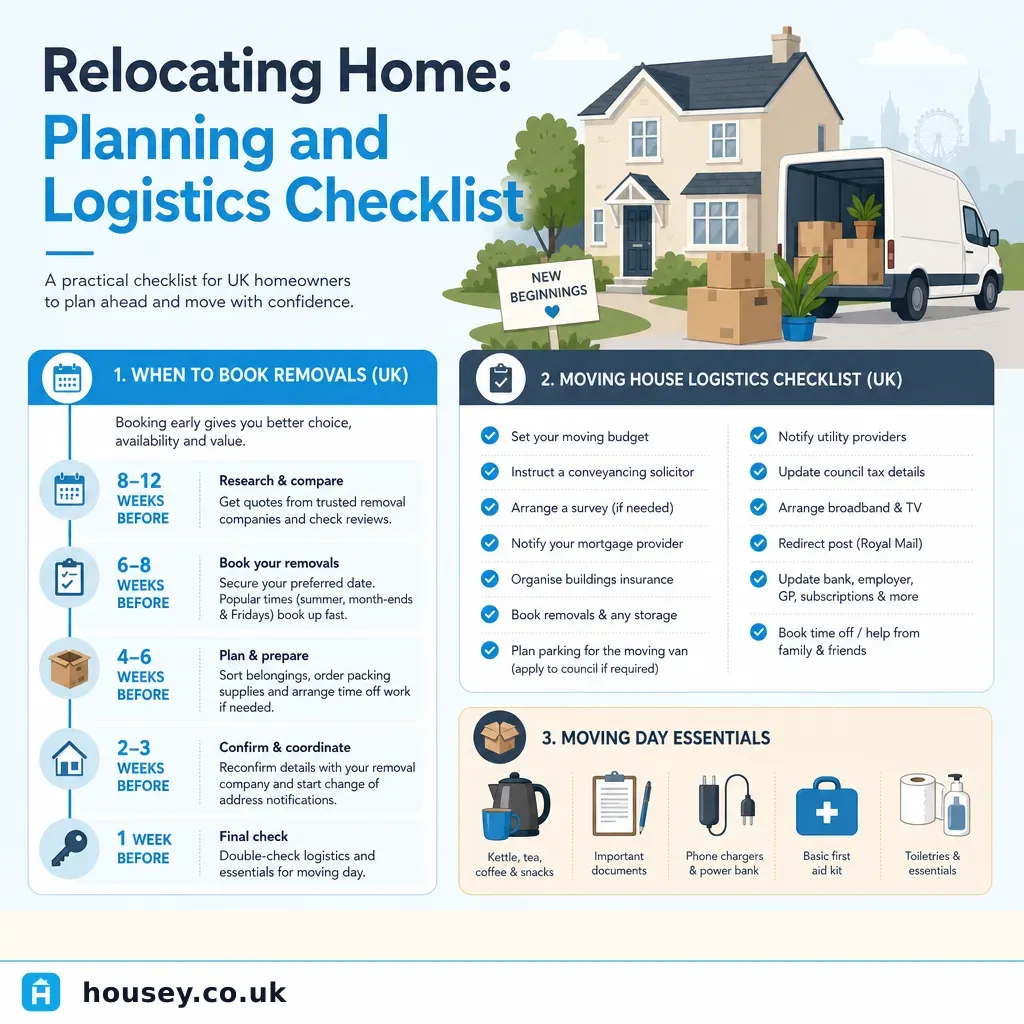
Relocating Home: Planning and Logistics Checklist
Successful home relocation in the UK typically requires 8–12 weeks of advance planning.
 Buying & Moving
Professional House Removal Services: Costs and Logistics
Professional house removal services in the UK typically cost £800–£2,000 for a 3-bedroom local move, rising to £1,500–£4,000 for long-distance relocations.
 Buying & Moving
Understanding the Costs Involved in Your Property Transaction
Buying a property in the UK typically costs 2–5% above the headline price once stamp duty, conveyancing fees, survey costs, mortgage arrangement fees, and removal costs are added.
 Buying & Moving
Planning Your Home Removal: What to Expect from Professional Services
A professional removal company loads, transports, and unloads your household belongings between properties.