Relocating Home: Planning and Logistics Checklist
By Housey · Last reviewed 30th of May 2026
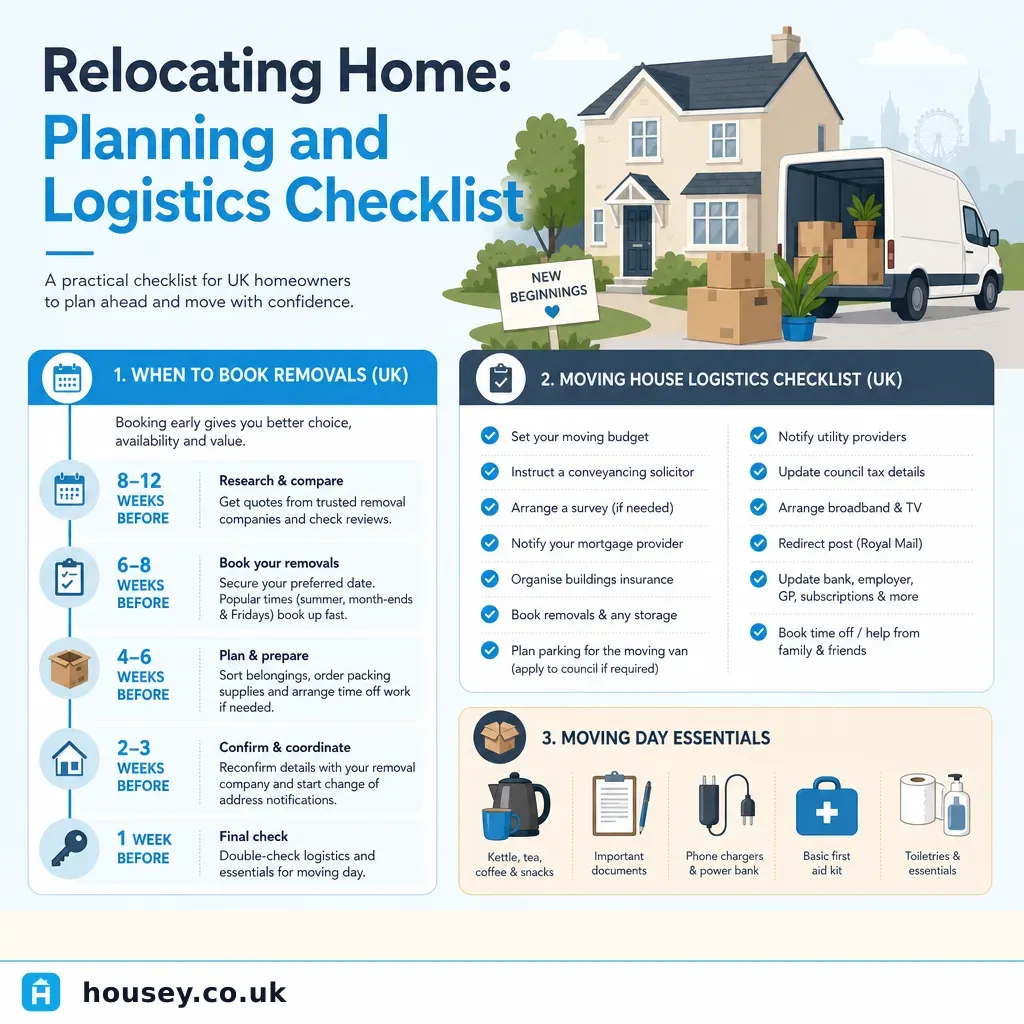
Relocating Home: Planning and Logistics Checklist
Relocation touches almost every aspect of daily life — from bank accounts and school places to utilities, council tax, and the physical movement of everything you own. Whether you are moving across town or to the other end of the country, the logistics are routinely underestimated, and the most stressful moments typically stem from tasks left until the final week. A structured plan started 8–12 weeks out makes the difference between a manageable moving day and a chaotic one.
Key points
- Book a removals firm at least 6–8 weeks before your target completion date; peak periods (July–August school holidays, month-end, and quarter-days) fill quickly.
- Royal Mail's Redirection service starts from approximately £33.99 for three months — set it up to begin on completion day, not after, to catch immediate correspondence.
- DVLA requires you to update both your driving licence address and your vehicle's V5C logbook; both can be done via GOV.UK at no charge.
- Many utility providers need up to 30 days' notice to close or transfer accounts — check your contract terms well before moving week.
- Some local councils require 5–14 days' notice to suspend a parking bay or loading area outside your property; arrange this early to protect access on moving day.
Building your relocation timeline
A backwards-planned timeline from your expected completion date reduces last-minute pressure.
8–12 weeks before moving
Get at least three written quotes from removals firms. Ask specifically about insurance cover, packing services, and what happens if completion is delayed at short notice. Begin decluttering — charity collections, council bulky-waste bookings, and online selling all take longer to organise than expected. Research self-storage options if a chain gap might leave you between properties.
4–6 weeks before moving
Confirm the removal firm and pay any deposit. Provide a detailed room-by-room inventory of large and fragile items. Notify schools, GP, dentist, and optician of your change of address. Begin updating financial and government records: bank accounts, pension providers, HMRC (self-assessment, child benefit, or tax credits), and the Electoral Register via gov.uk/register-to-vote. Set up Royal Mail Redirection to start from completion day.
2–4 weeks before moving
Contact gas, electricity, water, and broadband providers with your move date and planned final meter readings. Update your DVLA driving licence address and V5C logbook. Confirm that your home and contents insurance covers the new address from exchange, and check whether the policy includes goods in transit. Apply for any council parking suspensions needed, allowing adequate lead time for processing.
Moving week
Confirm key-release time with your solicitor before the removal van arrives — in a purchase chain, funds must clear through your conveyancer before keys are released, and the timing can shift on the day. Pack an essentials box to travel with you (documents, medications, chargers, kettle, change of clothes) rather than loading it into the removal van. Take timestamped photographs of meter readings at both properties.
After moving in
Register with a local GP if you have moved outside your previous practice's catchment area. Update the Electoral Register and open a council tax account at the new address. Note the location of the stopcock, consumer unit, and gas isolation valve at the new property.
Comparing removal service types
Not every move requires the same level of service. The table below helps match your situation to the right approach.
Service type | Best for | Not ideal for | Key cost driver | Main risk if poorly matched |
|---|---|---|---|---|
Full-service (pack and move) | Large households, time-poor movers, long-distance relocations | Tight budgets, single-room moves | Volume and packing time | Higher cost than necessary for smaller moves |
Part-pack (firm packs fragiles only) | Movers who want control but need fragile items professionally protected | Homes with extensive art, antiques, or pianos | Fragile item count | Breakages in owner-packed boxes |
Man-and-van | Small volumes, short local moves under 30 miles | Three-bedroom-plus homes, staircases, long distances | Hourly rate and distance | Limited insurance; time easily underestimated |
Self-drive van hire | Very small moves, solo movers with flexible time | Full-house moves, large or heavy furniture | Van size and hire duration | Personal injury risk; damage liability |
Indicative UK service types, last reviewed 2026-05-30. Obtain at least three written quotes; prices vary by volume, floor access, distance, and location.
Why a property inventory matters at handover
An inventory taken at the point of handover creates a contemporaneous record of the condition of fixtures, fittings, and any contents passing with the property. In a sale, this is particularly relevant if a dispute arises over what was meant to remain — carpets, light fittings, or integrated appliances listed on the TA10 (Fixtures and Fittings form) can occasionally be subject to later disagreement.
For buyers moving into a recently occupied home, a condition record establishes a baseline: if defects emerge shortly after completion, a dated inventory helps establish whether they pre-dated your ownership. An inventory clerk produces a professionally formatted, timestamped report that can be referenced by both parties.
Moving day checklist
When to get professional help
Most domestic relocation logistics are manageable without specialist involvement. Consider engaging professionals when:
- Moves involve pianos, large artwork, or high-value antiques — specialist handlers carry appropriate transit insurance and purpose-built packaging.
- You need secure storage between properties; check that the firm is a member of the British Association of Removers (BAR) or holds goods-in-storage insurance.
- A last-minute chain collapse forces a short-notice move — costs increase significantly, and not all firms can accommodate less than 48 hours' notice.
- You are relocating internationally; export documentation, customs compliance, and container shipping involve requirements well beyond a domestic move.
How Housey can help
Housey connects homeowners with vetted house removals firms and professional inventory clerks across the UK. Submit a single request and receive quotes from local providers to compare services, inclusions, and pricing before committing.
Frequently asked questions
When should I book a removals firm in the UK?
Book as early as possible — ideally 6–8 weeks before your expected completion date. End-of-month, quarter-day, and summer school holiday dates (July–August) fill fastest. If you are in a property chain, ask whether the firm offers a provisional booking that can be confirmed once exchange takes place, so you are not committed to a date before you have certainty.
Does my contents insurance cover goods in transit during a house move?
Many standard home contents policies do not automatically cover items during transit. Check your policy wording before moving week. Your removal firm's own insurance typically covers accidental damage caused by their staff during loading and unloading, but usually excludes owner-packed boxes. A specialist transit insurance policy can fill any gap in cover.
What is Royal Mail Redirection and how long should I take it out for?
Royal Mail Redirection diverts post from your old address to your new one from a date you choose. It is available for three, six, or twelve months, currently from approximately £33.99 for three months — check royalmail.com for current pricing. It is a safety net, not a substitute for updating your address directly with banks, HMRC, and the DVLA, as some correspondence such as tracked or special-delivery items is not covered.
Sources and further reading
- Change your address with DVLA — GOV.UK
- Royal Mail Redirection service — Royal Mail
- Moving house — Citizens Advice
- Register to vote — GOV.UK
- Find a BAR removal company — British Association of Removers
Useful next reads
 Buying & Moving
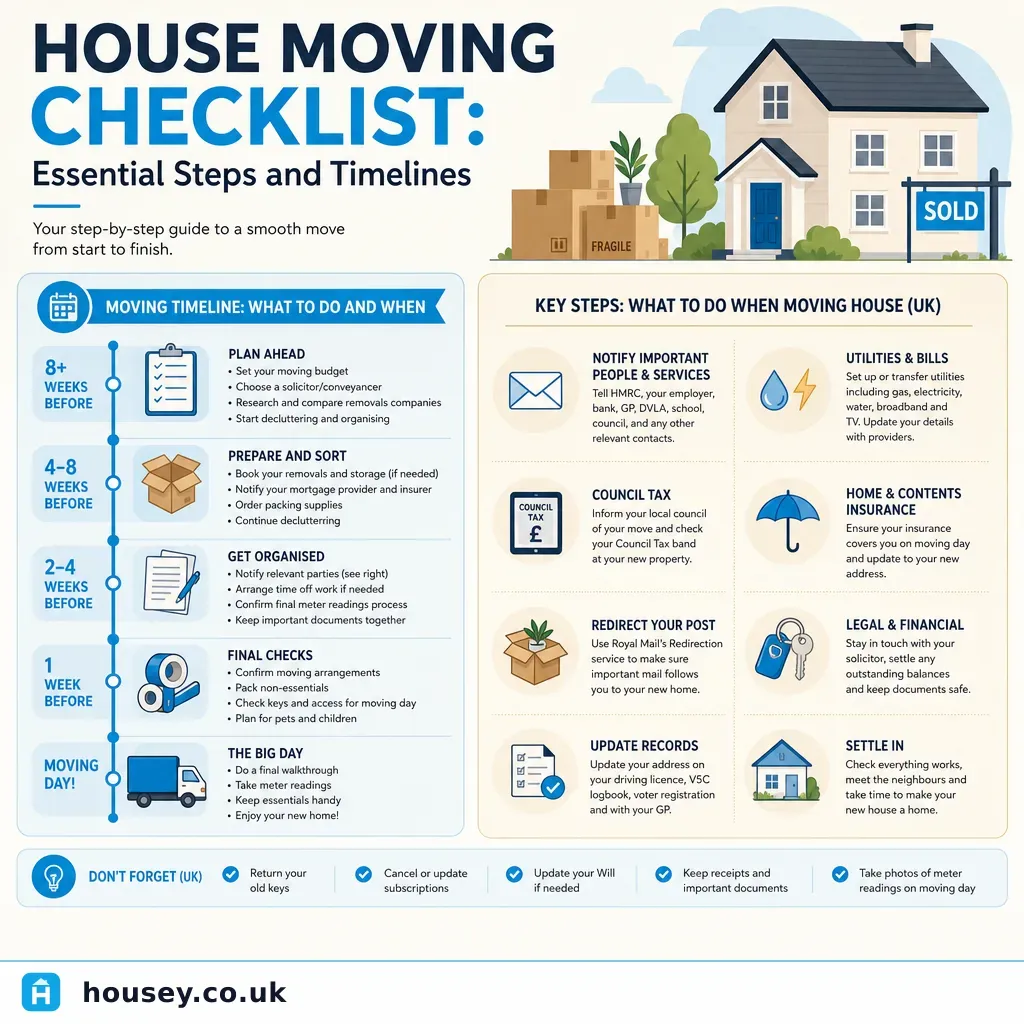
House Moving Checklist: Essential Steps and Timelines
A UK house move typically spans 8–12 weeks of preparation: book removals 4–6 weeks out, notify the DVLA, HMRC, and utilities as exchange approaches, take meter readings on moving day, and update Council Tax and the electoral register on arrival.
 Buying & Moving
Planning Your Home Removal: What to Expect from Professional Services
A professional removal company loads, transports, and unloads your household belongings between properties.
 Buying & Moving
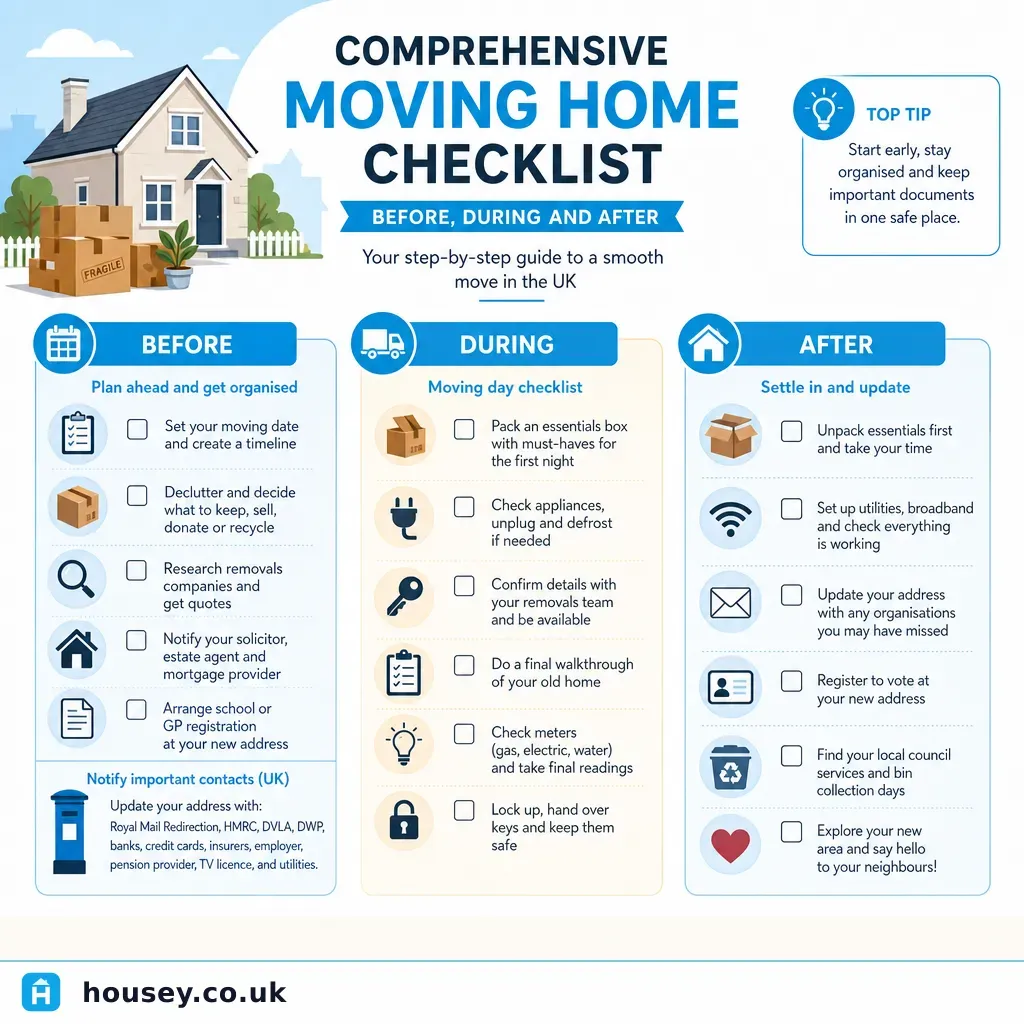
Comprehensive Moving Home Checklist: Before, During and After
Moving house in the UK involves tasks across roughly eight weeks: instructing a conveyancer and removal firm early, systematically notifying organisations of your new address, confirming buildings insurance from exchange, taking meter readings on completion day, and registering with the new council and utilities promptly.
 Buying & Moving
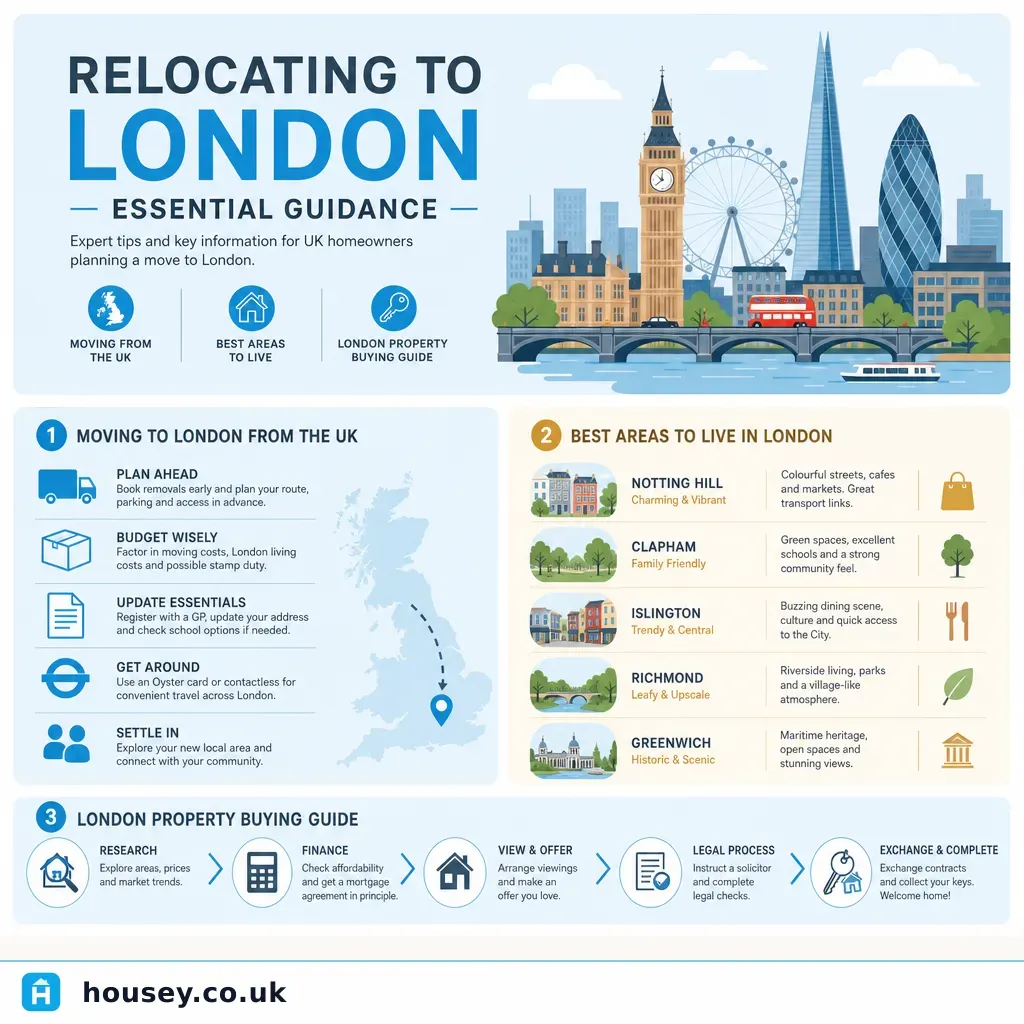
Relocating to London: Essential Guidance
Relocating to London involves choosing a borough and zone that match your commute, budget, and lifestyle, then navigating conveyancing, Stamp Duty Land Tax, and removals logistics.
 Buying & Moving
The Evolution and Development of the Removals Industry
The UK removals industry has transformed from Victorian horse-drawn furniture wagons into a specialist logistics sector with professional accreditation, containerised storage, international moves, and digital booking.