Home Staging: Presentation Strategies for Property Sale
By Housey · Last reviewed 30th of May 2026
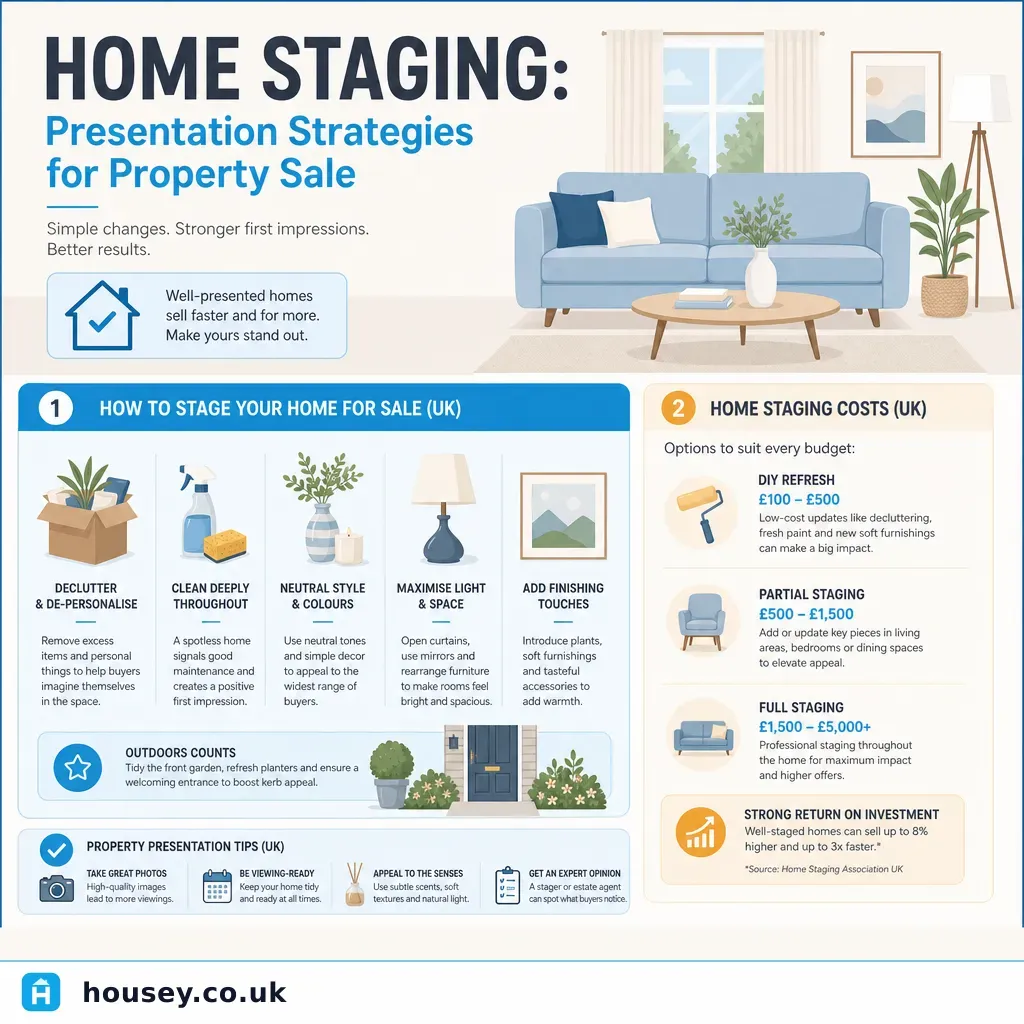
Home Staging: Presentation Strategies for Property Sale
When a property goes on the market, the first impression it makes — in listing photographs and at viewings — is one of the most influential factors in how quickly it sells and at what price. UK estate agents consistently report that well-presented properties receive more enquiries and spend fewer days on the market. Staging is not about expensive refurbishment; it is about helping potential buyers picture themselves in the space without the distraction of another family's clutter, colour choices, or furniture.
Key points
- The Home Staging Association UK & Ireland reported in 2022 that staged properties sold up to three times faster than unstaged equivalents and achieved up to 8% more in some cases.
- Professional property photography is typically charged at £100–£300 for a standard residential property; with over 90% of buyers beginning their search online, listing photographs are the primary filter (Indicative UK costs, last reviewed 2026-05-30).
- The Energy Performance Certificate (EPC) must be available before a property is marketed for sale under the Energy Performance of Buildings Regulations 2012 — a rating of C or above is increasingly a positive marketing asset.
- Concealing material defects during staging is a misrepresentation under the Consumer Protection from Unfair Trading Regulations 2008 — staging improves presentation, but must not obscure known problems.
- Hiring a storage unit (from approximately £50–£100 per month) during the marketing period is a practical way to remove excess furniture and personal belongings without full decluttering.
Staging levels: what is involved and when it pays
Not every property needs the same staging investment. The right approach depends on the property's condition, asking price, and target buyer.
Staging level | What it involves | Best for | Approximate cost |
|---|---|---|---|
DIY declutter and deep clean | Remove personal items, clean throughout, neutral styling | Well-maintained properties with good bones | Time only |
Light refresh | Touch-up paintwork in neutral tones, replace dated fixtures, professional carpet clean | Properties with a strong layout but tired finishes | £200–£1,500 |
Staging consultation | A professional advises on furniture arrangement, accessory edits, and presentation | Mid-market properties with sub-optimal layout or mixed styling | £300–£800 |
Full professional staging | Hired furniture and accessories; complete room styling | Vacant properties, high-value market, developer units | £1,000–£5,000+ |
Indicative UK costs, last reviewed 2026-05-30.
Room-by-room staging checklist
Kitchen
- Clear worktops entirely — allow only one or two styled items (a bowl of fruit, a clean cafetière).
- Degrease all surfaces including the extractor hood, oven, and splashback tiles.
- Remove fridge magnets, children's drawings, and personal notes.
- Replace any damaged cabinet door handles if budget allows.
Living room
- Arrange furniture to maximise the sense of space — sofas pulled slightly away from walls read better in photographs.
- Remove excess cushions and throws that create visual clutter.
- Ensure window dressings hang correctly and are clean.
- Use table or floor lamps for warm, layered lighting — overhead lighting alone often looks harsh in property photographs.
Bedrooms
- Make all beds with matching, freshly laundered linen; add two or three coordinated cushions.
- Clear bedside tables to one or two items.
- Remove personal photographs and memorabilia.
- Ensure wardrobes are no more than 70% full — buyers do open them.
Bathrooms
- Remove all personal toiletries and store them out of sight for photography and viewings.
- Display fresh, neatly folded white or neutral-toned towels.
- Descale taps, showerheads, and tiles.
- Replace or regrout any discoloured or cracked sealant.
Hallway
- Clear shoes, bags, coats, and children's equipment.
- Ensure the front door and entrance mat are clean and in good condition.
- Add one welcoming detail — a plant, a mirror, or a simple piece of artwork.
What not to assume about home staging
Buyers will automatically see past the clutter. Research consistently shows that buyers find it difficult to visualise a space's potential when it is heavily personalised or crowded. Decluttering ranks as the highest-impact low-cost staging action.
Staging only pays off on expensive properties. Lower-priced properties can benefit proportionately more: buyers at that price point — often first-time buyers — have less experience visualising potential and are more influenced by how a home feels on a first visit.
A full renovation before selling will pay for itself. Major pre-sale renovation rarely recoups its full cost. A light refresh — neutral paint, replaced sealant, updated cabinet handles — typically delivers far better return on effort than a new kitchen or bathroom.
Professional photography is an unnecessary expense. With the majority of buyers searching on Rightmove and Zoopla before any viewing, the listing photograph is the primary filter. Poor photographs can mean a property is scrolled past entirely before a viewing is ever booked.
Staging means hiding defects. Under the Consumer Protection from Unfair Trading Regulations 2008, sellers must not mislead buyers about material matters. Staging is about presentation, not concealment.
Which staging approach suits your situation?
- Stage at DIY level if the property is in a neutral, well-maintained condition and the main tasks are cleaning and decluttering.
- Invest in a light refresh if paintwork is scuffed, fixtures are dated, or carpets would benefit from professional cleaning.
- Book a staging consultation if you are uncertain how to present specific rooms or the property has an unusual layout that needs careful furniture placement.
- Commission full professional staging if the property is vacant, at a higher price point, or has previously been on the market without achieving a sale.
- Always commission professional photography — at any price point, the cost-to-benefit ratio is consistently favourable.
When to get professional help
Professional staging or photography input is worthwhile for any property going to market. It becomes particularly valuable when:
- The property has been listed before and failed to sell — viewing feedback about presentation is a strong signal.
- The property is vacant — empty rooms are notoriously difficult to photograph attractively and harder for buyers to assess spatially.
- The asking price is at or above the upper end of local comparables.
- The property has a complex or unusual layout that benefits from careful furniture placement to define the function of each space.
How Housey can help
Housey connects sellers with professional property photographers and floorplan specialists who can present your home to its best advantage in online listings. High-quality images and an accurate floorplan can make a meaningful difference to enquiry volumes from the first day of marketing.
Frequently asked questions
Does home staging actually work in the UK market?
Evidence from the Home Staging Association UK & Ireland suggests staged properties sell faster and often for more than unstaged equivalents. The most impactful steps — decluttering and cleaning — cost nothing but time. Professional staging carries a cost and is most likely to pay for itself on higher-value or previously unsold properties.
Should I redecorate throughout before selling?
Full redecorating is rarely necessary. Touching up scuffed paintwork, repainting one or two rooms in neutral tones such as off-white or warm grey, and replacing bathroom sealant and kitchen handles typically delivers a stronger return on effort than wholesale redecorating. Match any fresh paint colour to what is already there, or move to a warmer neutral.
What colours are best for staging a UK property for sale?
Warm neutrals — off-white, greige (grey-beige), and warm light grey — consistently perform well across UK buyer demographics. They read well in photographs under both natural and artificial light and allow buyers to project their own tastes onto the space. Strong feature colours can appeal to some buyers while alienating others.
Can I still live in my property while it is staged?
Yes — most UK sellers do. The key is to systematically declutter before photography and viewings and to reset the staging between appointments. Hiring a storage unit for surplus furniture and personal belongings is a practical short-term solution that makes day-to-day living with reduced clutter more manageable.
Sources and further reading
- Home Staging Association UK & Ireland — research and statistics — Home Staging Association UK & Ireland
- Consumer Protection from Unfair Trading Regulations 2008 — legislation.gov.uk
- Energy Performance Certificates for homes — GOV.UK
- Rightmove — property search data — Rightmove
Useful next reads
 Buying & Moving
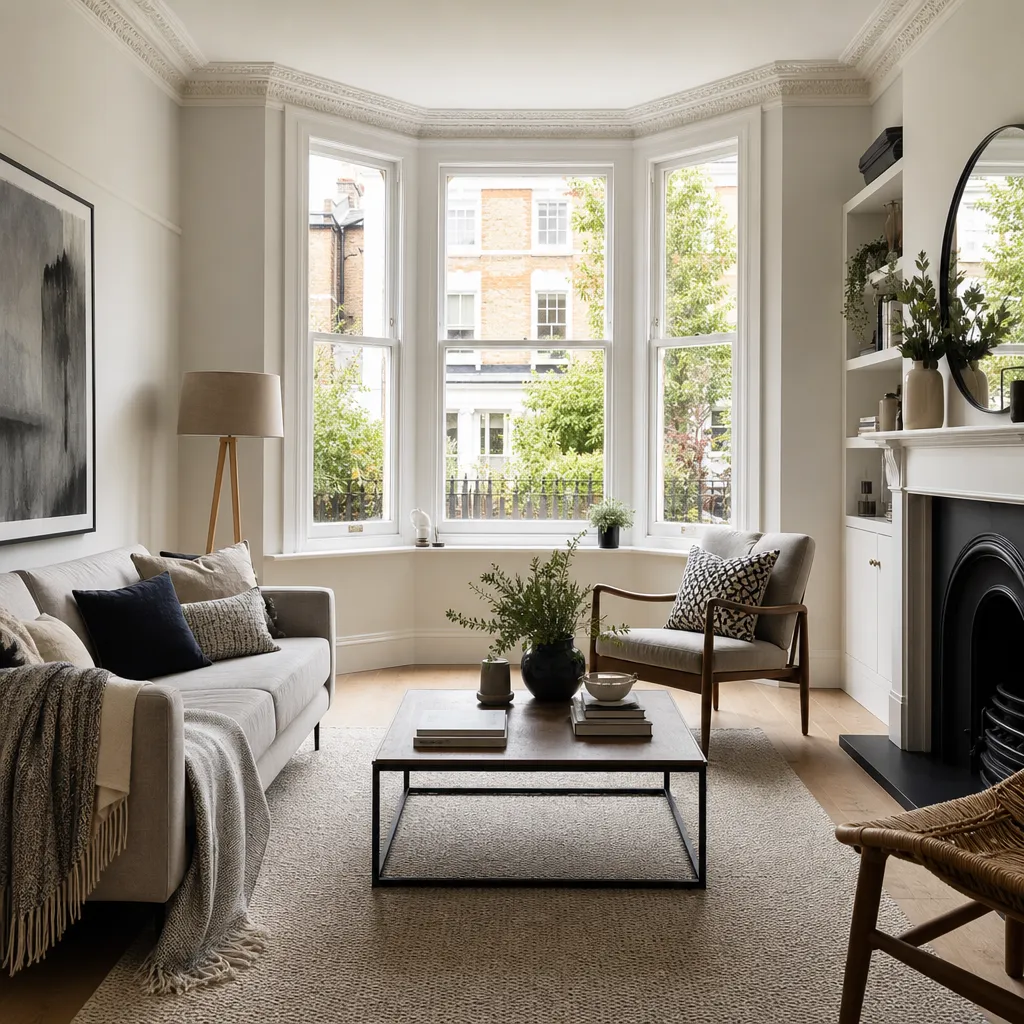
Achieving Show-Home Presentation and Professional Styling
Show-home presentation involves decluttering, deep cleaning, neutral redecoration, and optimising lighting before photography and viewings.
 Buying & Moving
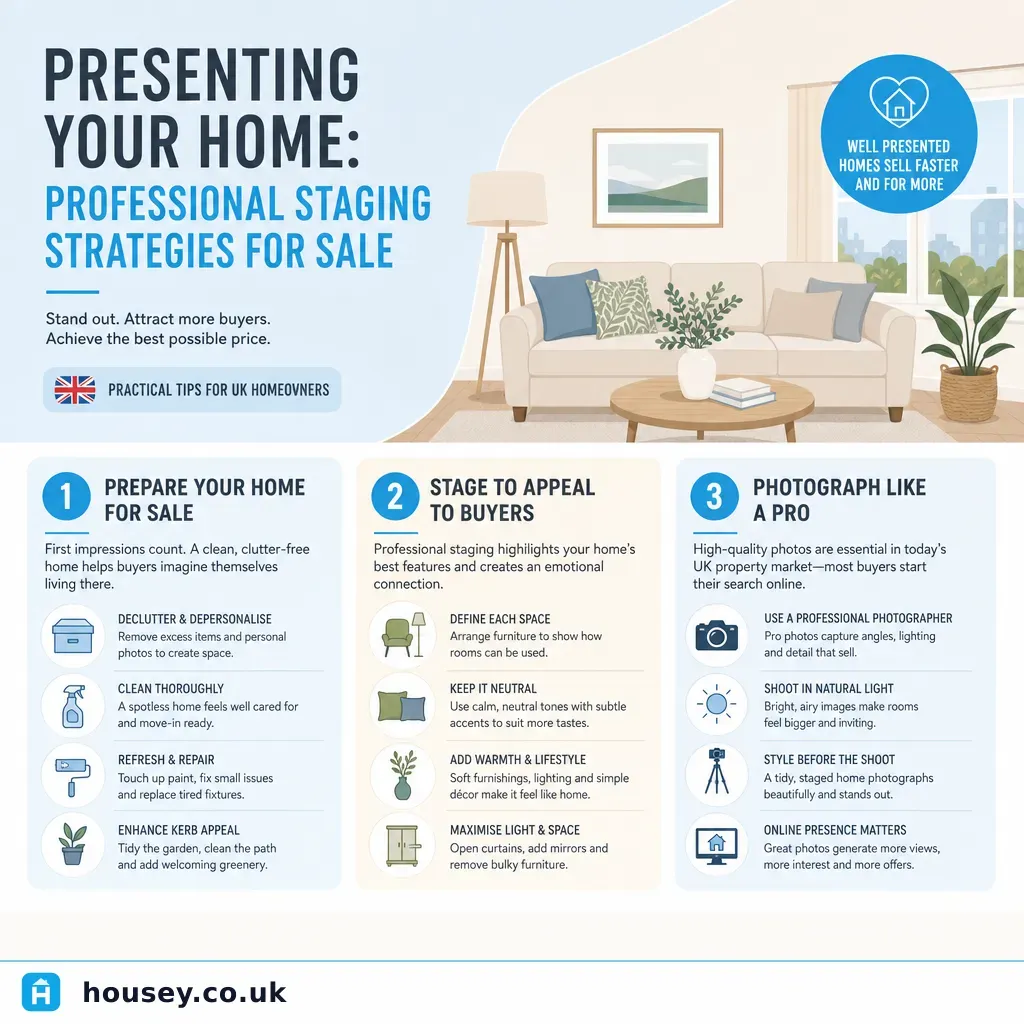
Presenting Your Home: Professional Staging Strategies for Sale
Home staging for a UK property sale means presenting each room to look spacious, neutral, and well-lit — primarily through decluttering, cleaning, and considered styling rather than expensive renovation.
 Buying & Moving
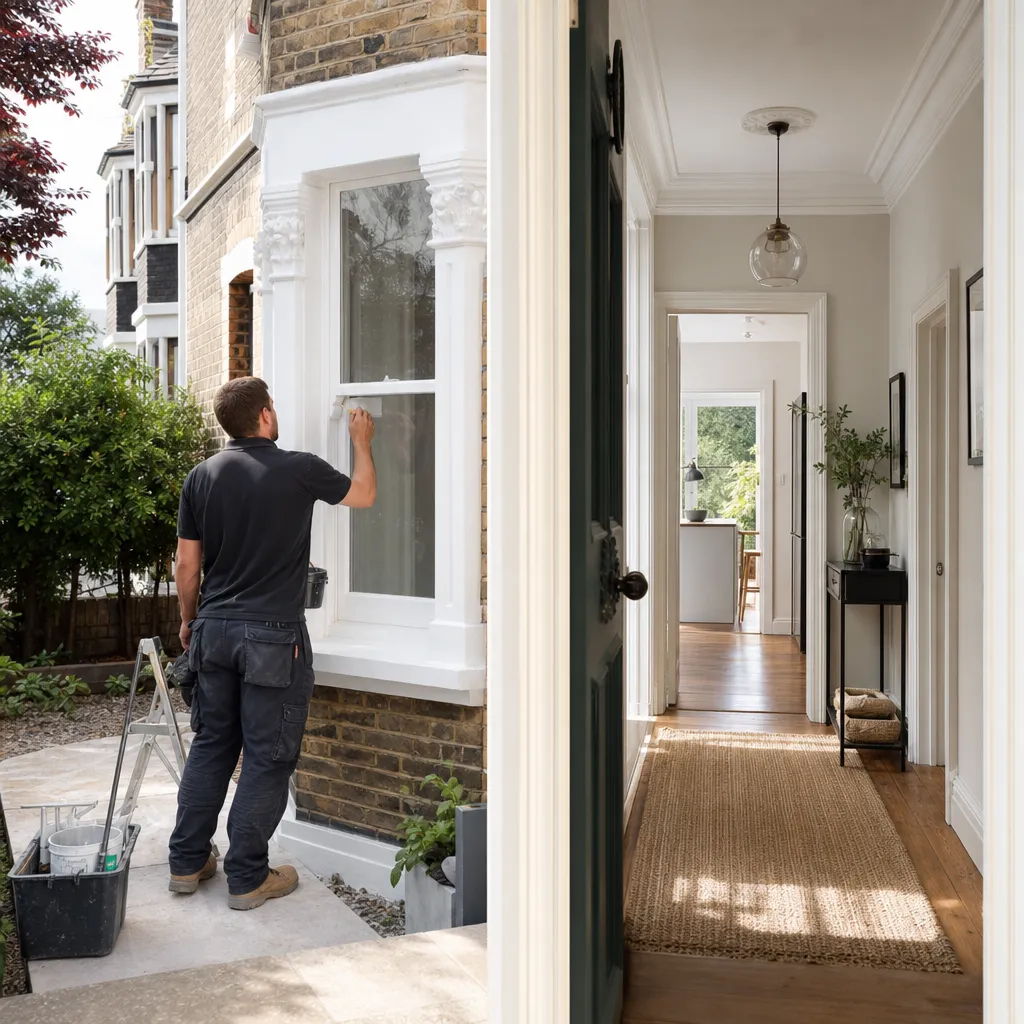
Preparing Your Home for Sale: Interior and Exterior Improvements
Preparing your home for sale means prioritising presentation over renovation.
 Buying & Moving
Property Enhancement Strategies for a Successful Sale
Enhancing a UK property before listing typically involves improving kerb appeal, decluttering and neutralising décor, addressing minor maintenance issues, and investing in professional photography.
 Buying & Moving
Which Home Improvements Add Real Value to Your Property?
In the UK, loft conversions, single and double-storey extensions, and energy-efficiency upgrades are most reliably linked to added property value.