How to Plan a Long-Distance Relocation in the UK
By Housey · Last reviewed 9th of May 2026
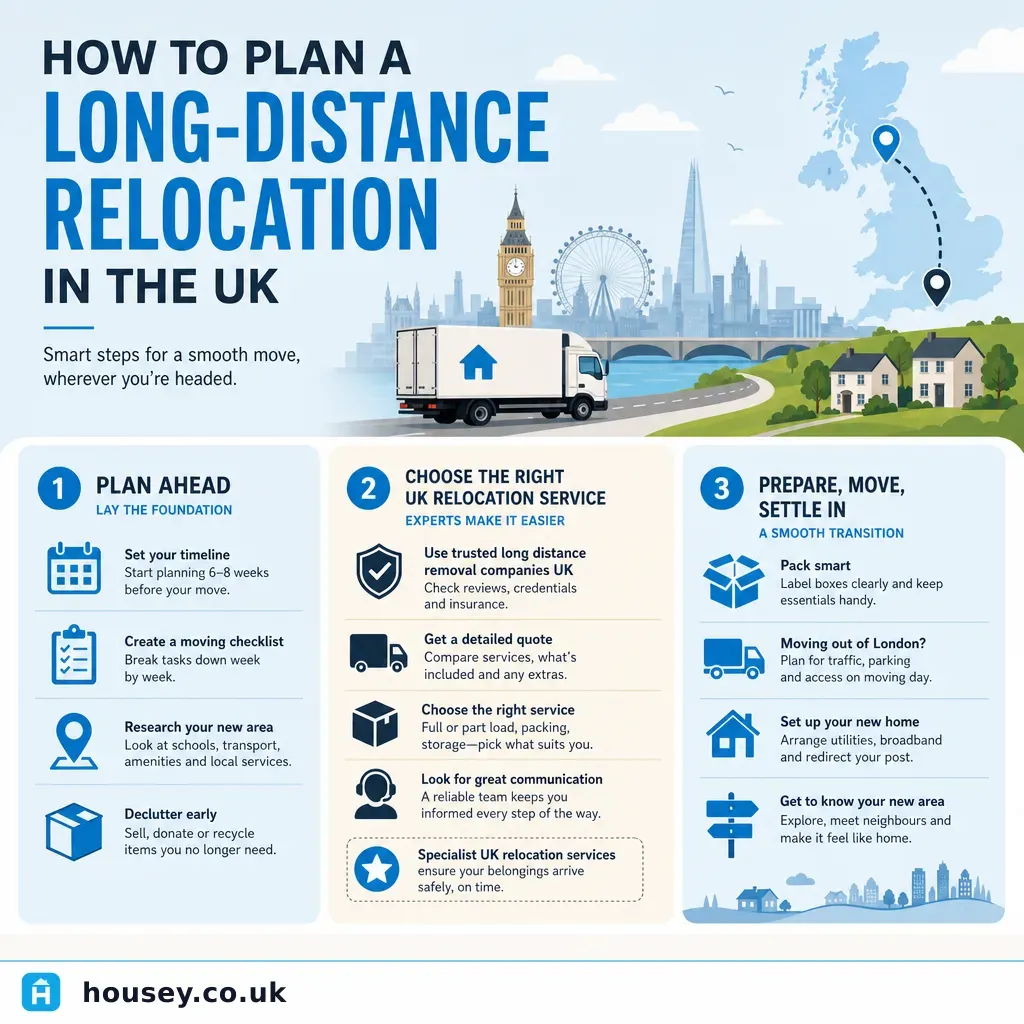
How to Plan a Long-Distance Relocation in the UK
Long-distance moves — whether from London to the countryside, between major cities, or from one region of England to another — involve far more coordination than a local house move. For most households, the gap between a smooth transition and a stressful one comes down to timing, sequencing, and choosing the right professionals for each stage.
Key points
- Instruct a conveyancer or solicitor 8–12 weeks before your target completion date; local authority searches alone can take 3–6 weeks in some areas.
- Most professional removal firms recommend booking 4–6 weeks ahead for a long-distance move — longer if you are moving between July and September.
- ONS internal migration data consistently records a significant net outflow of residents from London to other English regions, making inter-regional moves one of the most common long-distance move types in the UK.
- Moving to a different local authority means school places, GP registration, and council tax band all need updating separately — none are transferred automatically.
- Scotland operates a different legal system for property transactions; a Scottish-qualified solicitor is required for Scottish purchases, not an English or Welsh conveyancer.
What a long-distance relocation actually involves
A long-distance move differs from a local one in several practical ways: the removal lorry may be on the road for several hours, access and parking at both ends need prior arrangement, and the risk of delays from traffic, diversions, or ferry crossings (for moves to Scotland, Wales, or Northern Ireland) is higher. There are also more decisions about what to move, what to put in storage, and what to sell or donate before departure.
Most long-distance relocations require at least four separate service providers: a conveyancer, a removal firm, possibly a storage provider, and sometimes a relocation agent to help research the destination area before committing to a purchase.
How to sequence your relocation
Getting the order right is critical. Starting too late on conveyancing or leaving removals to the last minute are the two most common causes of a stressful move.
Stage | When to act | Key task |
|---|---|---|
Area research | As soon as possible | Visit the destination; check schools, transport links, and amenities |
Instruct a conveyancer | 8–12 weeks before target completion | Choose a solicitor or licensed conveyancer; complete ID verification |
Property surveys | After offer accepted | Book a RICS Level 2 or Level 3 Home Survey for the destination property |
Book removal firm | 4–6 weeks before move date | Compare at least 3 quotes; confirm insurance and packing options |
Storage (if needed) | 4–6 weeks before move date | Confirm unit size, access hours, and minimum contract length |
Change of address | 2–4 weeks before | DVLA, HMRC, banks, employer, GP, utilities, Royal Mail redirect |
Completion day | Move day | Confirm key handover time with estate agent; keep documents and medications in a separate bag |
Choosing a removal firm for a long-distance move
Not all removal firms are equipped for long-distance work. Look for firms that are members of the British Association of Removers (BAR) or hold BAR Approved Mover accreditation — these firms have agreed to a code of practice and offer an independent dispute resolution scheme if something goes wrong.
What to ask a removal firm before accepting a quote
- Is the quote fixed-price, or can it change on the day?
- Does your insurance cover the full replacement value of belongings, not just a per-kilogram limit?
- Who will carry out the move — your own staff, or a subcontractor?
- Do you offer a packing service, and what materials are included?
- What happens if completion is delayed on the day?
- Is VAT included in the quoted price?
- What is the estimated journey time, and what contingency arrangements do you have for delays?
Conveyancing when buying in a new area
Buying in an unfamiliar area adds complexity to conveyancing. Your solicitor must run local authority searches specific to the destination — including flood risk, planning history, and local land charges — which vary considerably between regions and local planning authorities.
Worked example: London to the East Midlands
A family selling a leasehold flat in Islington and buying a semi-detached house in Stamford, Lincolnshire, would typically face:
- Two separate conveyancing matters (sale and purchase), ideally handled by one firm to improve coordination
- Local authority searches for South Kesteven District Council
- A RICS Level 2 Home Survey on the 1980s semi-detached destination property
- A long-distance removal of around 100 miles, typically priced at £1,500–£3,000 depending on volume (indicative UK costs, last reviewed 2026-05-09 — quotes vary significantly)
- Possible short-term storage if sale and purchase completions do not align
Decision tree: Do you need a relocation agent?
- Manage the move yourself if you know the destination area well, have scheduling flexibility, and are comfortable coordinating removals, conveyancing, and area research independently.
- Consider a relocation agent if you are moving to an unfamiliar region, have a tight timeline (for example, an employer-led move), or need help researching schools, GPs, and neighbourhoods before committing to a purchase.
- Check your employer's relocation policy if your company is requiring the move — many packages include a removal allowance, temporary accommodation, and conveyancing support. Confirm what is covered before arranging anything separately.
- Ask a BAR-accredited removal firm for guidance if your main concern is the physical move and you are comfortable managing legal and research elements yourself.
Moving out of London: what to check before committing
Inter-regional moves from London to areas such as the Cotswolds, East Anglia, the South West, and parts of Yorkshire and the East Midlands have increased demand for long-distance removal services in recent years. Before committing to a destination, check:
- Broadband speeds at the specific property postcode via Ofcom's checker — not just the area average
- Rail journey times to your workplace, particularly if you plan to commute part-time after the move
- NHS dentist availability — many rural and semi-rural areas have very limited NHS dental capacity
- School catchment areas — these change annually, and proximity does not guarantee a place
- Flood risk — GOV.UK's long-term flood risk service covers England and should be checked before making an offer
When to get professional help
Most long-distance relocations benefit from professional removals support from the outset. Seek specialist advice promptly if:
- You are buying a listed building or a property in a conservation area and are uncertain about what works are permitted
- Your removal includes specialist items such as antiques, a piano, or a wine collection requiring specialist carriers and packaging
- You are moving to Scotland, where property law differs materially from England and Wales
- Your chain involves more than three properties, where a delay at any point can cascade across all parties
How Housey can help
Housey connects you with vetted house removals firms experienced in long-distance UK moves, as well as conveyancing solicitors who can manage both sale and purchase. Submit your move details and receive quotes from relevant local providers.
Frequently asked questions
How far in advance should I book a removal firm for a long-distance move?
Most BAR-accredited removal firms recommend booking at least 4–6 weeks ahead for a long-distance move. During peak season (July to September) and around school holidays, availability is limited and 8 weeks' notice is advisable. Many firms will provisionally hold a date while you await exchange of contracts, so it is worth approaching them early even before a completion date is confirmed.
Do I need a solicitor based in the area I am moving to?
No — UK conveyancers can act on purchases anywhere in England and Wales regardless of where they are based. If you are buying in Scotland, however, you must use a Scottish-qualified solicitor, as Scottish property law — including the offer and missives process — differs from the system in England and Wales. For complex rural transactions, a solicitor with relevant specialist experience may be advisable.
What does a relocation agent's service typically include?
Relocation agents usually offer area orientation tours, school and GP research, property shortlisting, negotiation support, and coordination with removal firms and solicitors. Services and fees vary considerably — some charge a flat fee, others a percentage of the purchase price. Employer-funded relocations may include a more comprehensive package. Always confirm in writing what is included before instructing an agent.
Can I move some belongings into storage and the rest directly to the new property?
Yes. A phased move — where some items go into storage while you temporarily rent or stay with family — is common when sale and purchase completions do not align. Confirm minimum contract lengths, access hours, and whether the facility is climate-controlled before booking, particularly if you are storing temperature-sensitive items such as artwork, instruments, or wine.
Sources and further reading
- Check your long-term flood risk — Environment Agency / GOV.UK
- Find a BAR Approved Mover — British Association of Removers
- Ofcom connected nations broadband checker — Ofcom
- Buying or selling your home — GOV.UK
- Internal migration, England and Wales — Office for National Statistics
Useful next reads
 Buying & Moving
Planning Your Home Removal: What to Expect from Professional Services
A professional removal company loads, transports, and unloads your household belongings between properties.
 Buying & Moving
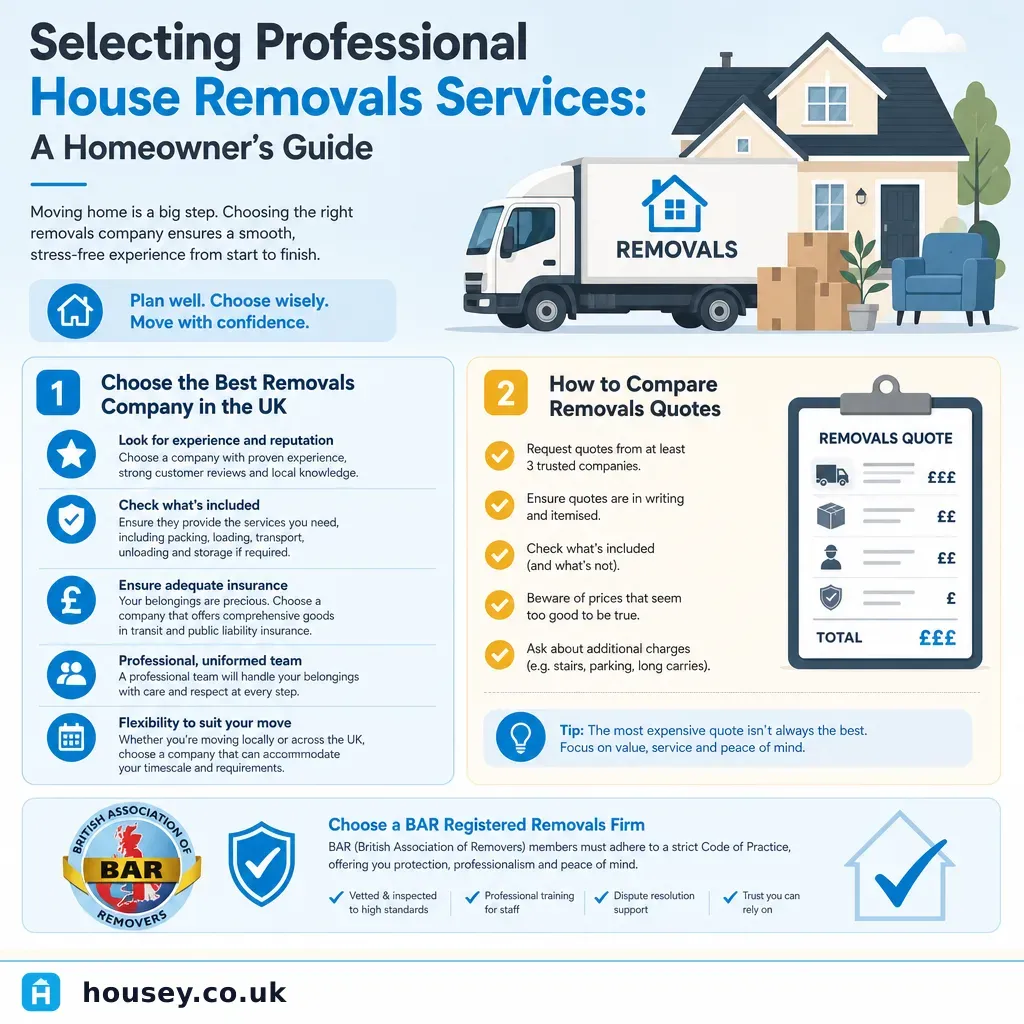
Selecting Professional House Removals Services: A Homeowner's Guide
Choose a removals firm registered with the British Association of Removers (BAR), which carries out a pre-move survey before quoting and provides a written binding quotation with goods-in-transit insurance.
 Buying & Moving
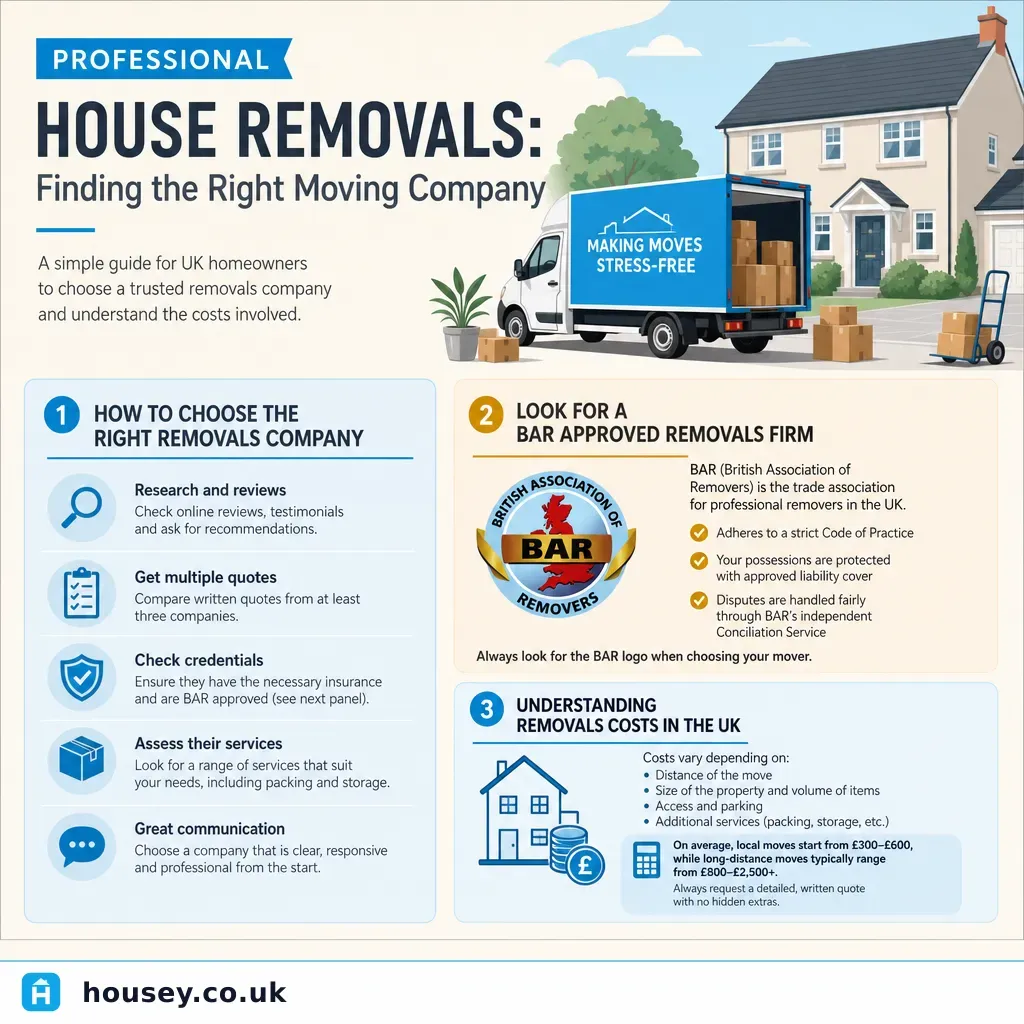
Professional House Removals: Finding the Right Moving Company
Finding the right house removals company involves checking membership of a recognised trade body such as the British Association of Removers (BAR), confirming goods-in-transit insurance cover, and comparing itemised written quotes.
 Buying & Moving
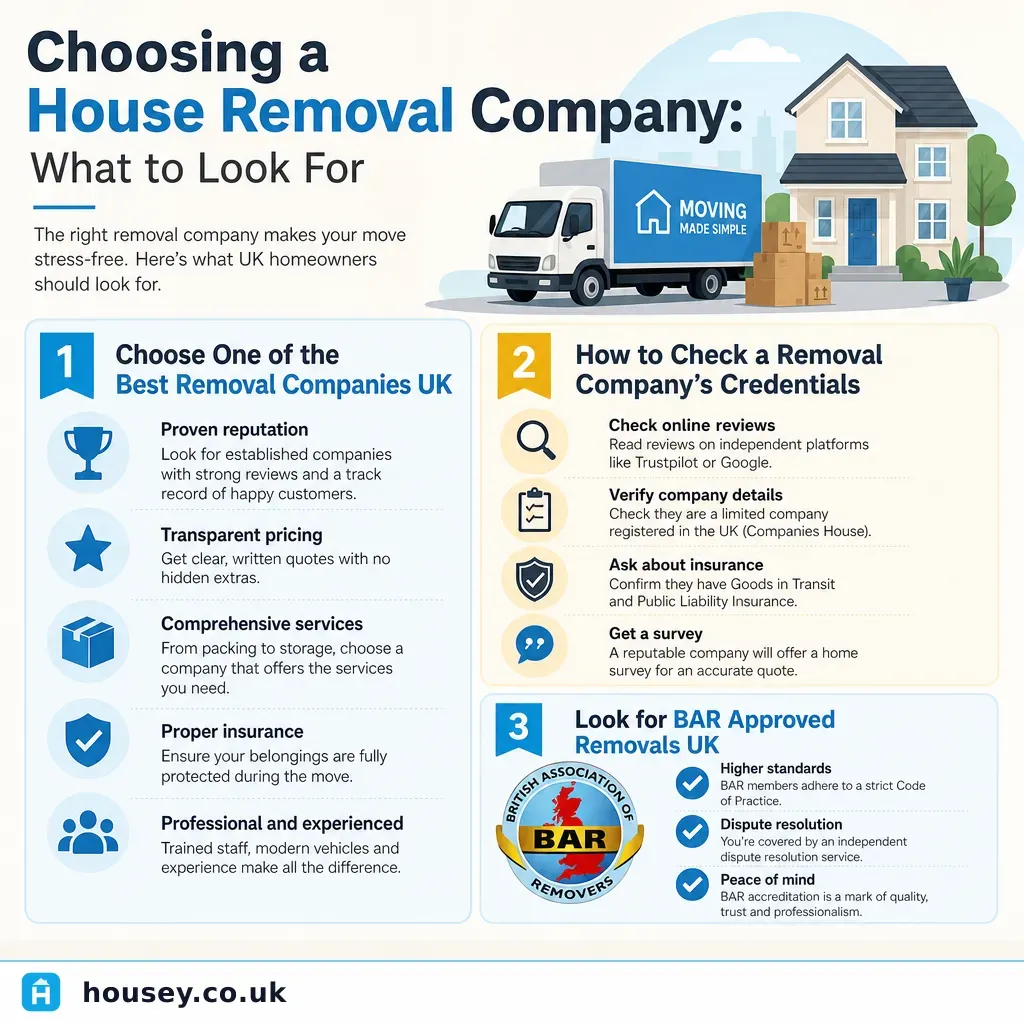
Choosing a House Removal Company: What to Look For
Choose a UK removal company that belongs to the British Association of Removers (BAR) or the Removals Industry Ombudsman Scheme (RIOS), carries goods-in-transit and public liability insurance, and provides a written quote after properly surveying your home.
 Buying & Moving
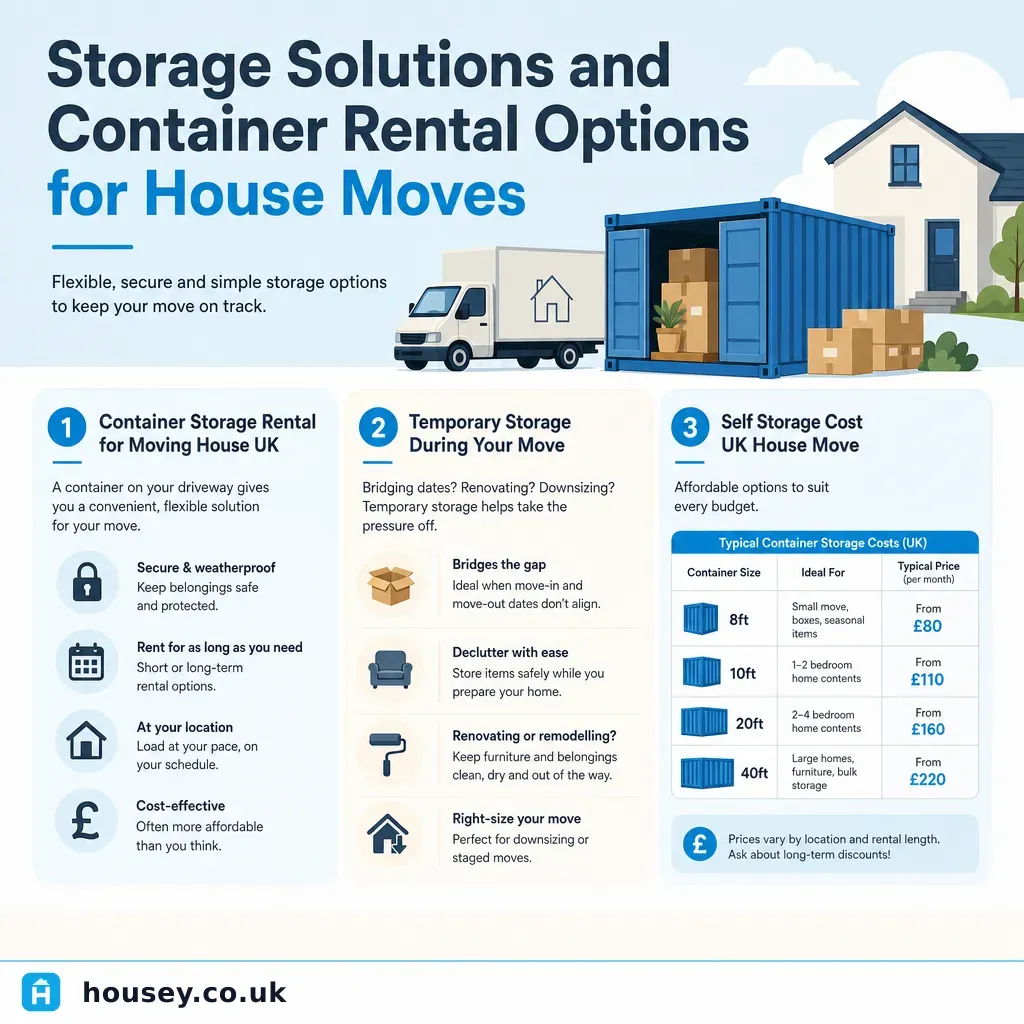
Storage Solutions and Container Rental Options for House Moves
When moving house in the UK, temporary storage options include self-storage units, portable storage containers delivered to your door, and removal company storage vans.