Professional House Removals: Finding the Right Moving Company
By Housey · Last reviewed 24th of May 2026

Professional House Removals: Finding the Right Moving Company
Choosing a removals company is one of the last things many homeowners think about during a property transaction, and one of the most consequential if it goes wrong. Moving day is one of the most logistically complex and time-sensitive events in a property chain — the difference between a well-organised professional firm and an unreliable one can mean damaged belongings, missed deadlines, or a move that stalls an entire chain. Understanding what to look for, what to ask, and what good service looks like helps you make a confident, informed choice.
Key points
- The British Association of Removers (BAR) is the UK's leading trade body for removal companies; BAR members must hold goods-in-transit insurance, protect client deposits in a separate account, and provide access to an independent dispute-resolution scheme.
- Removals firms are not legally required to hold a licence in the UK, meaning quality and standards vary considerably; BAR, the National Guild of Removers and Storers (NGRS), or the International Association of Movers (IAM) for overseas moves all provide meaningful benchmarks.
- Goods-in-transit insurance covers your belongings while they are being loaded, transported, and unloaded — but many policies impose per-item value limits of £500–£1,000, which may fall well short of replacement cost for high-value items.
- End-of-month Fridays are the busiest moving days in the UK; booking 6–8 weeks ahead for these dates is advisable to secure your preferred firm.
- A pre-move survey — conducted in person or via video call — is standard practice with reputable firms and is the only reliable basis for an accurate fixed or estimated quote.
How to compare removals companies
Not all removals companies offer the same type of service. This table sets out the main categories and what to expect from each.
Type | Best for | Typical service | Key check |
|---|---|---|---|
BAR full-service firm | Families, high-value contents, long-distance or complex moves | Packing, transport, unpacking, furniture disassembly and reassembly | BAR membership; fixed-price quote following in-person survey |
NGRS member firm | Standard domestic moves with some quality assurance | Loading, transport, and basic packing options | NGRS membership; written quote |
Man-and-van service | Small moves, single rooms, student relocations | Loading and transport only; customer usually packs | Goods-in-transit insurance; public liability insurance |
Self-drive van hire | Very budget-conscious movers with minimal furniture | Customer does all packing, loading, and driving | Correct CDW (collision damage waiver) cover; appropriate van size |
Specialist removals | Grand pianos, fine art, antiques, wine collections | White-glove handling; specialist crating and climate control | Specialist accreditation; dedicated fine art or high-value insurance |
International removals | Overseas moves within the EU or worldwide | Customs documentation, groupage, or full-container shipping | IAM or BAR International membership; customs clearance experience |
What to ask before accepting a removals quote
Use this list when evaluating written quotes from firms:
- Will you conduct a pre-move survey (in person or by video call) before confirming a fixed price?
- What does the quote include — packing materials, disassembly and reassembly of flat-pack furniture, specialist items such as televisions or mirrors?
- What goods-in-transit insurance is included? What is the per-item limit and the total cover ceiling?
- What happens if legal completion is delayed and the lorry needs to wait — is waiting time charged, and at what rate?
- What is your cancellation and postponement policy, and is the deposit protected in a client account?
- Are you a BAR or NGRS member? Can I see confirmation?
- Will the same crew that loads at our current address also unload at the destination?
- How do you handle fragile, high-value, or awkward items?
- Is VAT included in the quoted price?
What not to assume about removals insurance
Many homeowners assume their home contents insurance covers belongings during a house move. This is often not the case, or cover is more limited than expected:
- Many home contents policies exclude items while in transit, or provide only third-party fire-and-theft cover rather than all-risks cover.
- Goods-in-transit insurance provided by a removals firm typically carries per-item limits — often £500–£1,000 per item — that may be far below the replacement value of televisions, antiques, jewellery, or musical instruments.
- If you pack your own boxes, many removals firms will not accept liability for breakages to items inside — professional packing by the firm is commonly a condition of full transit cover.
Check your home contents policy wording and the removals firm's insurance schedule carefully before moving day. For genuinely high-value items, a standalone valuation and a specialist transit insurance policy may be the appropriate approach.
Red flags when hiring a removals company
Treat these as warning signs and seek alternative quotes if a firm:
- Provides a quote over the telephone or online without requesting an inventory or conducting a survey.
- Cannot or will not provide written confirmation of the agreed price and services.
- Requests full payment in advance, before moving day.
- Has no evidence of goods-in-transit insurance.
- Has no verifiable business address or Companies House registration.
- Quotes a price noticeably lower than others but cannot explain what has been excluded.
- Has no clear cancellation, postponement, or complaints-handling process.
Planning your move: homeowner checklist
A well-organised move reduces stress and minimises the risk of items being mislaid or damaged. Work through this checklist in the weeks before moving day.
6–8 weeks before:
2–4 weeks before:
1 week before:
Moving day:
When to get professional help
Most domestic moves are handled well by established, insured removals firms. Consider specialist guidance or additional services if:
- You are moving internationally and need customs documentation prepared correctly for your destination country.
- You have items requiring specialist handling: fine art, antiques, large musical instruments, medical equipment, or wine collections.
- Your move involves a significant gap between exchange and completion requiring secure short or long-term storage.
- You are a landlord clearing a property after a tenancy and need a formal inventory of contents.
- You are helping an elderly or vulnerable person move and need a firm experienced in providing additional care and support.
How Housey can help
Housey connects homeowners with vetted house removals companies across the UK who can survey your belongings and provide detailed written quotes. If you need short or long-term storage between completion dates, or are planning a move abroad and need international removals specialists, Housey can match you with firms experienced in those requirements.
Frequently asked questions
How much does a house removal cost in the UK?
Costs depend on the volume of belongings, distance, and services included. As a rough guide, a local move for a two-bedroom home with a basic load-and-transport service might start from £400–£800, while a full-service move including packing, transport, and unpacking for a larger home over a longer distance can reach £2,000–£5,000 or more. Indicative UK costs, last reviewed 2026-05-24. Always obtain at least three itemised written quotes.
What is the best day of the week to move house?
Tuesday, Wednesday, and Thursday tend to be quieter moving days and often attract lower quotes from removals firms compared with Fridays and Saturdays. End-of-month dates — when most conveyancing completions cluster — are the busiest of all. For these dates, booking 6–8 weeks in advance is advisable to secure your preferred firm and avoid premium last-minute pricing.
Can a removals company refuse to move certain items?
Yes. Most firms will not transport items classified as hazardous: gas cylinders, flammable liquids, fireworks, and certain chemicals. Some also decline large plants, perishable food, and high-value cash. Specialist items such as grand pianos or fine art may require a dedicated specialist rather than a standard removals crew. Ask for a prohibited and specialist items list when arranging your pre-move survey.
What should I do if items are damaged during a house move?
Report damage to the removals firm in writing as soon as possible — ideally on moving day before the crew departs — and photograph everything. BAR members are required to provide access to an independent dispute-resolution scheme. If the firm does not respond adequately, contact BAR directly. You may also have recourse under the Consumer Rights Act 2015, which requires services to be performed with reasonable care and skill.
Sources and further reading
- British Association of Removers (BAR) — British Association of Removers
- National Guild of Removers and Storers (NGRS) — NGRS
- Citizens Advice: moving home — Citizens Advice
- Royal Mail postal redirection service — Royal Mail
- Tell DVLA you have changed address — GOV.UK
Useful next reads
 Buying & Moving
Selecting Professional House Removals Services: A Homeowner's Guide
Choose a removals firm registered with the British Association of Removers (BAR), which carries out a pre-move survey before quoting and provides a written binding quotation with goods-in-transit insurance.
 Buying & Moving
Choosing a House Removal Company: What to Look For
Choose a UK removal company that belongs to the British Association of Removers (BAR) or the Removals Industry Ombudsman Scheme (RIOS), carries goods-in-transit and public liability insurance, and provides a written quote after properly surveying your home.
 Buying & Moving
Planning Your Home Removal: What to Expect from Professional Services
A professional removal company loads, transports, and unloads your household belongings between properties.
 Buying & Moving
Professional House Removals Services: Choosing the Right Moving Company
A professional house removals company handles loading, transport, and unloading; full-service firms with BAR membership also offer deposit protection and independent dispute resolution.
 Buying & Moving
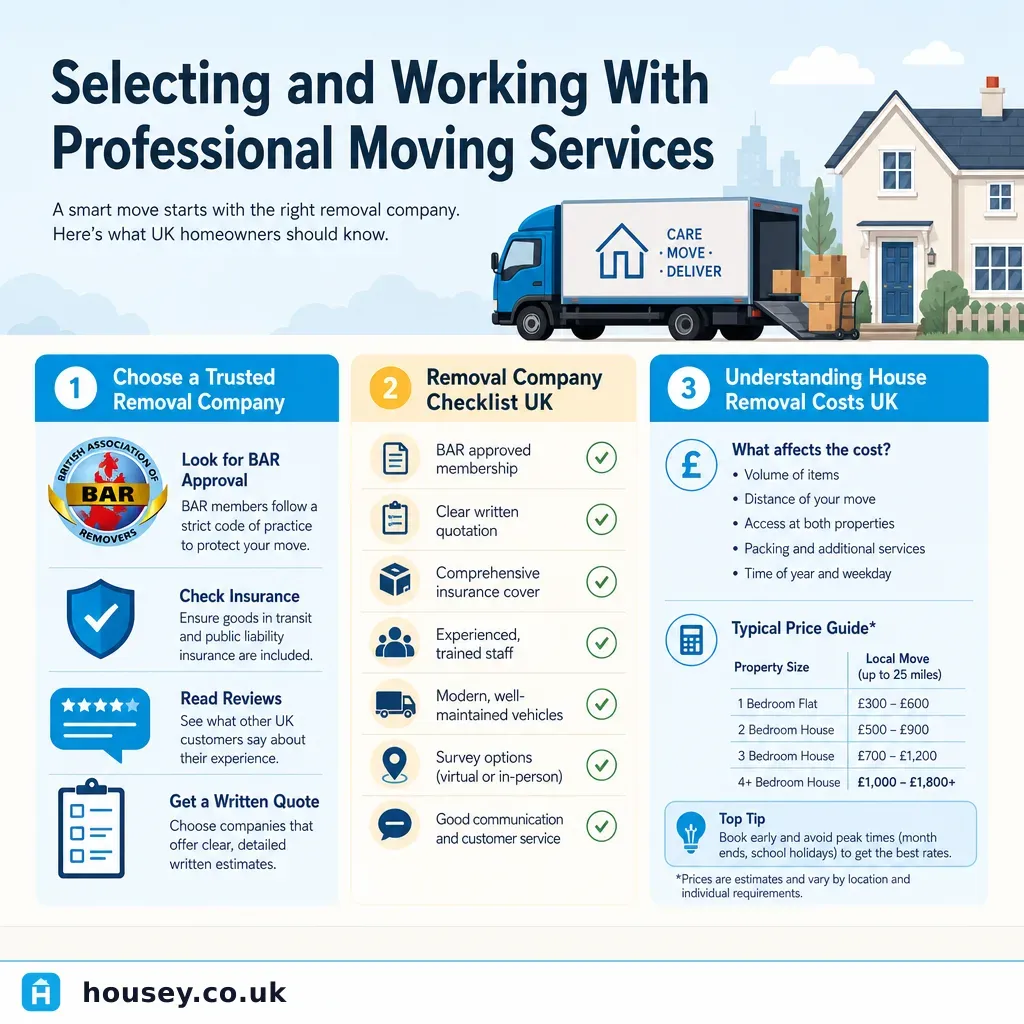
Selecting and Working With Professional Moving Services
Choose a removal company that is a British Association of Removers (BAR) member, has its own employed staff and vehicles, and provides a written quote after a survey.