Preparing Your Property for Sale: Pre-Sale Enhancement Guide
By Housey · Last reviewed 7th of May 2026
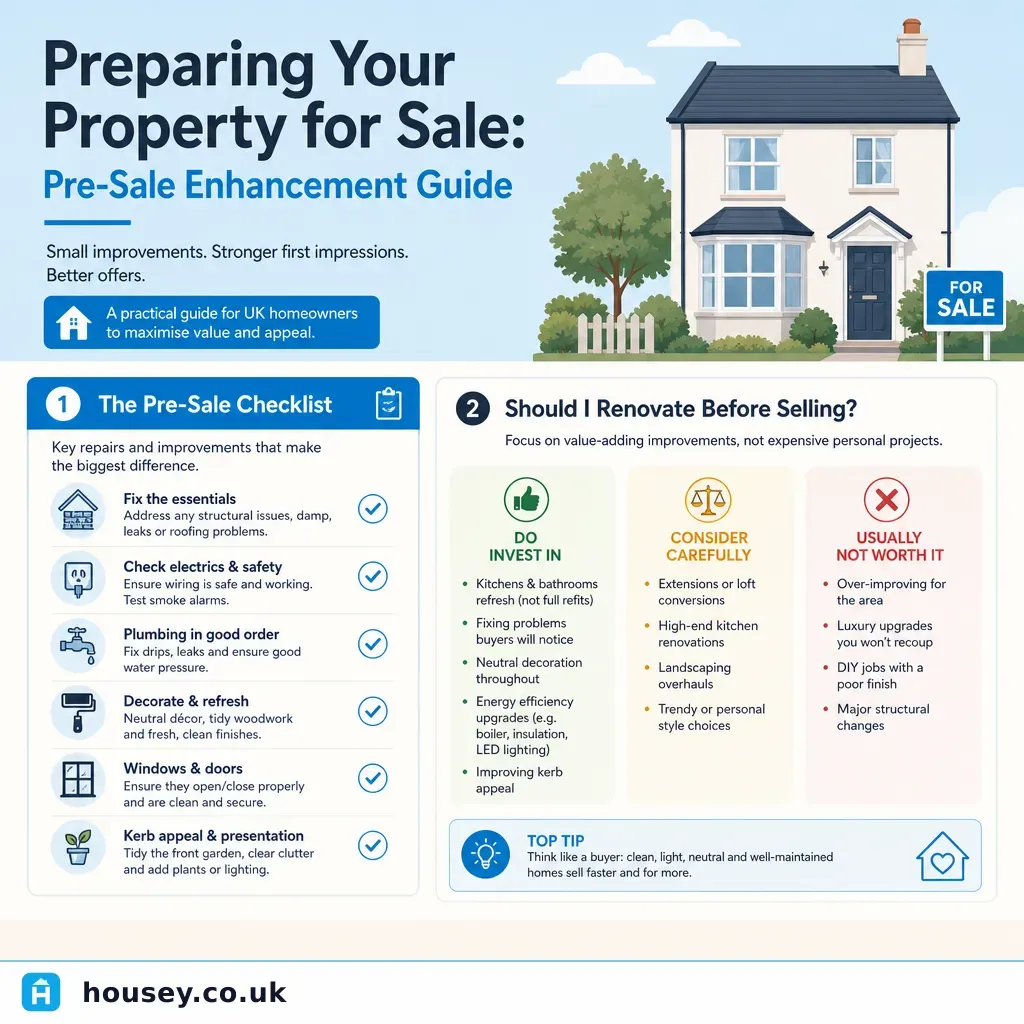
Preparing Your Property for Sale: Pre-Sale Enhancement Guide
Most sellers focus on finding the right estate agent and agreeing a fee, but what buyers see — online and in person — often determines whether you achieve asking price or accept a reduced offer. Pre-sale preparation matters whether you are selling a 1930s semi-detached in the Midlands, a Victorian terrace in Bristol, or a leasehold flat in a London conversion.
Key points
- An EPC is a legal requirement before marketing a property for sale in England, Wales, and Northern Ireland; check the national EPC register on GOV.UK to confirm whether yours is still valid (EPCs last ten years).
- Known damp, structural, or electrical issues discovered during a buyer's RICS survey commonly trigger price renegotiation or withdrawal; addressing them before listing puts you in a stronger negotiating position.
- Minor visible defects — dripping taps, cracked plaster, stiff doors — signal poor maintenance to buyers and can lead them to assume worse problems exist throughout the property.
- In Scotland, the Home Report (a single survey, property questionnaire, and EPC) is required by law before a property can be marketed for sale.
- Professional photography is standard in most UK price brackets; listings with professional images consistently outperform those photographed on smartphones for portal click-through rates.
What pre-sale preparation actually involves
Pre-sale preparation is not the same as full renovation. The goal is to present the property in its best honest condition — not to disguise problems or over-invest in improvements with poor return. The main areas are:
- Structural and maintenance checks: fixing known defects before listing reduces the risk of survey-triggered renegotiation after an offer has been accepted.
- Cosmetic presentation: neutral décor, clean surfaces, working fixtures, and decluttered rooms allow buyers to project themselves into the space.
- Kerb appeal: the exterior is what buyers see first — both in listing photographs and on arrival for a viewing.
- Documentation readiness: having gas safety certificates, boiler service records, planning permissions, FENSA window certificates, and building control completions ready speeds conveyancing.
- Professional marketing materials: photographs, floorplans, and a current EPC are standard expectations in most price brackets.
Room-by-room pre-sale checklist
Work through this before instructing your estate agent.
Exterior and kerb appeal
Entrance hall
Kitchen
Bathrooms
Bedrooms
Throughout
Which improvements are worth making before a sale?
Not all improvements offer good return. This table reflects widely reported estate agent and surveyor observations — weigh each against your specific property, its condition, and your local market.
Improvement | Likely return on effort | Notes |
|---|---|---|
Decluttering and deep clean | High | Very low cost; consistently cited as one of the most effective pre-sale actions |
Neutral redecoration | High | Particularly effective if current décor is heavily personal or dated |
Fixing minor visible defects | High | Signals good maintenance; reduces risk of survey renegotiation |
Kerb appeal improvements | High | First impression in listing photos and on arrival at viewings |
Professional photography | High | Standard in most price brackets; improves portal click-through rates |
Resolving known damp | Medium to high | Unresolved damp will typically be flagged on a buyer's survey and renegotiated |
New kitchen or bathroom | Low to medium | Rarely recoups full installation cost; cleanliness and condition matter more than newness |
Full extension or loft conversion | Low (for immediate sale) | A long-term investment that rarely adds its full cost back at point of sale |
Should you get a pre-sale survey?
A pre-sale survey is not standard practice in England and Wales, but is worth considering if the property is older (pre-1950), has visible defects, or you want to price with confidence and reduce renegotiation risk. Common pre-sale inspection types:
- Damp and timber report: if you suspect moisture ingress, rising damp, or timber decay, having a qualified specialist assess and treat the problem — with a written report and guarantee — gives you documentation to share with buyers.
- RICS Level 2 or Level 3 survey: a broad condition assessment before marketing, particularly useful for older or extended properties.
- EICR (Electrical Installation Condition Report): advisable if the property has not had a recent electrical inspection; buyers' solicitors sometimes request one for properties with older wiring.
In Scotland, the legally required Home Report carries out this function automatically before marketing begins.
Red flags that buyers and their surveyors will notice
These issues most frequently trigger price renegotiation or withdrawal during the buyer's due diligence period:
- Visible damp or ceiling staining: even if historic and resolved, unexplained marks raise questions without supporting documentation.
- Sticking doors or windows: can indicate structural movement, moisture-related swelling, or poorly fitted replacements.
- Cracks running through multiple planes: masonry cracks that step through brickwork or extend beyond mortar joints concern chartered surveyors.
- Outdated electrical consumer units: older rewirable fuse boards in pre-1970s properties often prompt buyers to request an EICR before proceeding.
- No documentation for works: extensions, loft conversions, and replacement windows require planning permissions, building control sign-offs, or FENSA certificates; absent paperwork slows conveyancing or requires indemnity insurance.
- Boiler over 15 years old with no service record: buyers or their solicitors may request a Gas Safe engineer's report before exchange.
Disclosing known issues — and providing evidence they have been addressed — puts you in a considerably stronger position than having them surface during a buyer's survey.
When to get professional help
Most pre-sale preparation involves decisions you can make yourself. Speak to a qualified professional if:
- You suspect active damp, rising damp, or timber decay — commission a damp and timber survey and treat any problems before listing.
- A visible crack in masonry concerns you — a chartered surveyor or structural engineer should assess it before you market the property.
- Works carried out during your ownership may have required building regulations approval — your local authority building control or a solicitor can advise on documentation.
How Housey can help
Housey connects you with vetted professionals to support your sale preparation. Whether you need professional property photography and floorplans before going to market, or want a damp and timber survey to address known issues before they appear on a buyer's survey report, you can request quotes from qualified local specialists through Housey.
Frequently asked questions
How far in advance of listing should I start preparing my property?
Allow at least four to six weeks for minor repairs, photography, and documentation. If you suspect damp, roof problems, or other defects needing investigation and treatment, allow eight to twelve weeks. Starting late often means rushing repairs or going to market before known issues are resolved, which weakens your negotiating position.
Do I legally need an EPC before selling my property?
In England, Wales, and Northern Ireland, an EPC is required before a property is marketed for sale. A valid EPC lasts ten years — check the national EPC register on GOV.UK before commissioning a new one. In Scotland, the EPC forms part of the legally required Home Report, which must be prepared before marketing begins.
Is neutral décor really important when selling?
Broadly yes. Buyers find it easier to imagine living in a property when decoration is relatively neutral. Strong colour choices or heavily themed rooms can distract from the property's features. Repainting is low cost relative to its potential impact on buyer perception and willingness to offer at or near asking price.
What documents should I prepare for my solicitor before selling?
Gather: EPC, gas safety certificates and boiler service history, EICR if available, planning permissions and building control completion certificates for any works, FENSA or Certass certificates for replacement windows, guarantees for damp proofing or structural works, and — if leasehold — the lease, service charge accounts, ground rent schedule, and managing agent contact details.
Should I be present during viewings?
Most estate agents advise leaving the property during viewings. Buyers typically look around and discuss more freely without the seller present. Ensure the property is tidy, well-lit, and at a comfortable temperature before you leave.
Sources and further reading
- Find your Energy Performance Certificate — GOV.UK
- Buying, owning and selling a home — GOV.UK
- Home Report in Scotland — Scottish Government
- RICS Home Survey Standards — RICS
Useful next reads
 Buying & Moving
Effective Property Marketing Strategies for Sellers
UK home sellers achieve more viewings and stronger offers by combining professional photography, an accurate floor plan, and a compelling portal listing.
 Buying & Moving
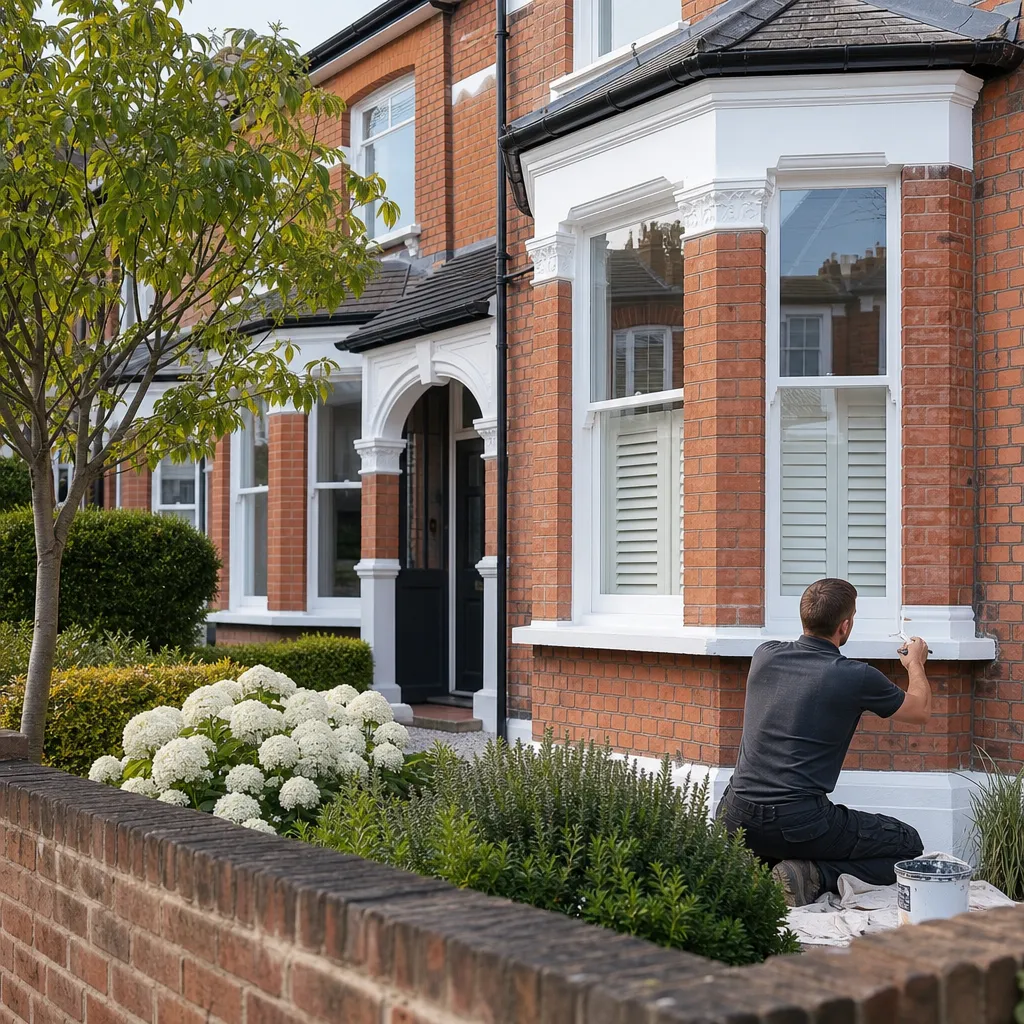
Property Enhancement Strategies for a Successful Sale
Enhancing a UK property before listing typically involves improving kerb appeal, decluttering and neutralising décor, addressing minor maintenance issues, and investing in professional photography.
 Buying & Moving
Effective Marketing Strategies for Selling Your Property
Effective property marketing in the UK combines professional photography, an accurate portal listing on Rightmove and Zoopla, a correctly priced asking price, and well-prepared viewings.
 Buying & Moving
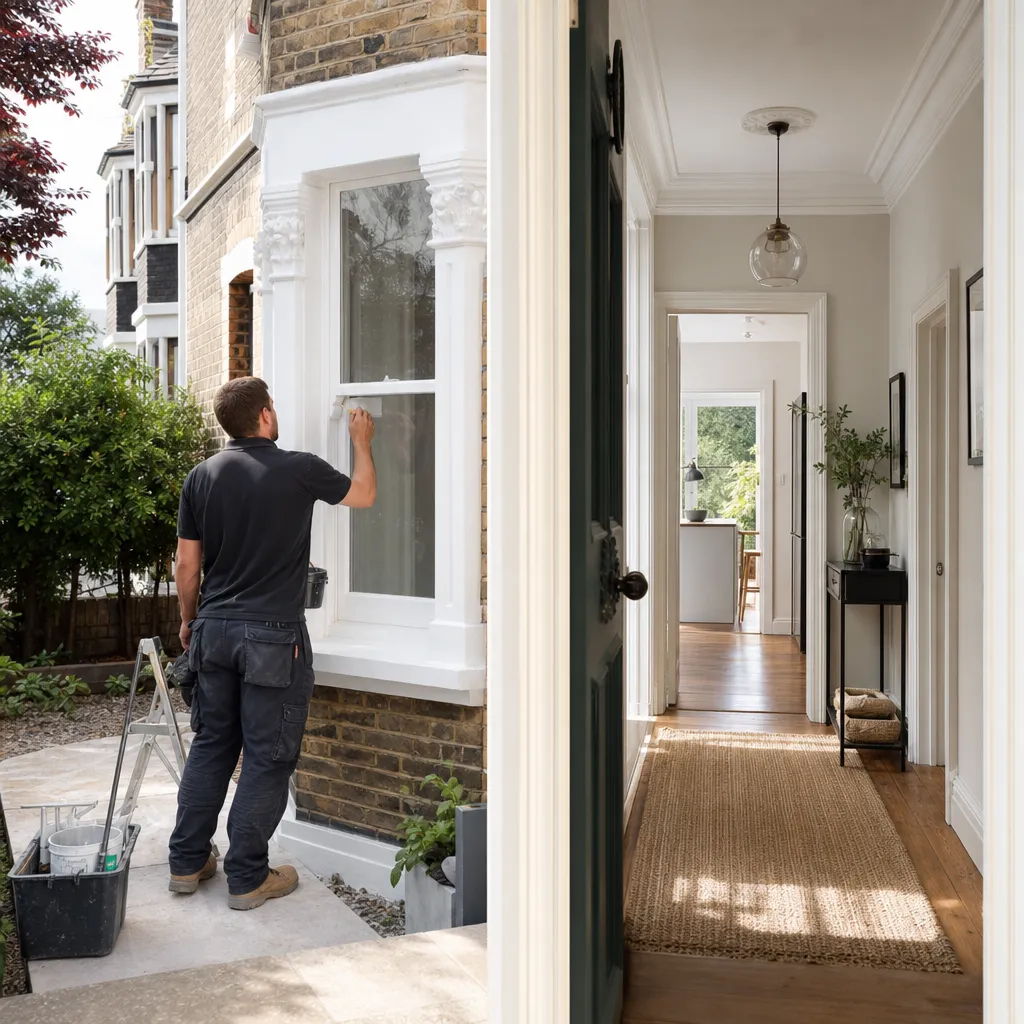
Preparing Your Home for Sale: Interior and Exterior Improvements
Preparing your home for sale means prioritising presentation over renovation.
 Buying & Moving
Professional approaches to photographing properties for sale
Professional property photography uses wide-angle lenses, HDR exposure blending, and careful staging to present rooms accurately and attractively.