Professional House Removals Services: Choosing the Right Moving Company
By Housey · Last reviewed 31st of May 2026
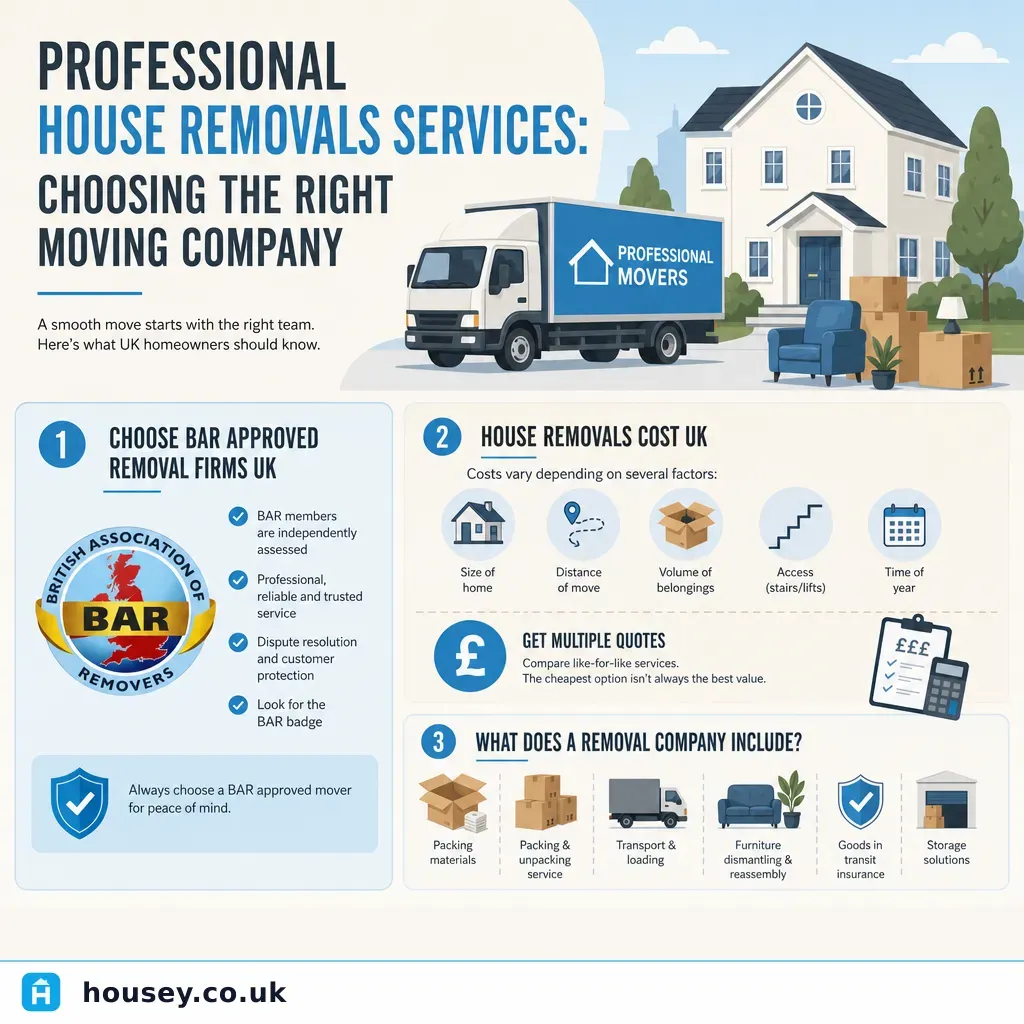
Professional House Removals Services: Choosing the Right Moving Company
Moving day is one of the most logistically pressured moments of a property transaction. In England and Wales, exchange and completion can happen as little as a week apart, leaving limited time to book a professional removal firm and organise packing. Choosing the right company — and understanding what the service actually includes — can make the difference between a smooth move and a costly, stressful day that spills into the evening.
Key points
- The British Association of Removers (BAR) operates an Advance Payment Guarantee protecting deposits paid to member firms, plus a Trading Standards-backed Code of Practice.
- Removal quotes in the UK are usually calculated on cubic volume (m³), distance, and access factors — not a flat per-item rate.
- Goods in transit insurance is standard but policies differ significantly; always check the maximum sum insured and per-item limits before signing.
- Full packing services typically add 20–40% to a base removal quote; part-packing of kitchen and fragile items only is a common middle option.
- In England and Wales, completion typically occurs on a business day and chain dependencies can mean your move is conditional on others — build flexibility into your booking.
What professional house removal services include
A professional removal firm typically provides:
- Survey and quote: Either an in-person home survey or a video survey to assess volume, access, and special items such as pianos, antiques, or large garden equipment.
- Loading and transport: Trained staff loading items into specialist vehicles with blankets, racking, and securing equipment to prevent damage in transit.
- Unloading and placement: Items delivered to the designated rooms in the new property.
- Goods in transit insurance: Cover for loss or damage during transit — policy terms vary and should always be read carefully before the move date.
Optional extras include full or part packing, unpacking, furniture dismantling and reassembly, storage (useful when exchange and completion dates differ), and specialist services for pianos, artwork, or wine collections.
BAR membership and why it matters
The British Association of Removers (BAR) is the UK's leading trade association for professional removal firms. BAR membership provides:
- Advance Payment Guarantee: If a BAR member firm ceases trading before your move date, your deposit is protected and can be reclaimed.
- Code of Practice: BAR members are audited against Trading Standards-approved standards covering surveys, quotes, contracts, and complaints handling.
- Alternative Dispute Resolution (ADR): Access to an independent ADR service if problems cannot be resolved directly with the firm.
BAR membership is not mandatory, and many reputable non-BAR firms operate across the UK. However, for large or high-value moves, the deposit protection and dispute resolution framework provides meaningful consumer security.
Comparing removal options
Option | Best for | Not ideal for | Indicative cost range | Key limitation |
|---|---|---|---|---|
DIY van hire | Small moves, few large items, flexible timescale | Families, large properties, fragile or high-value items | £100–£400 per day (van only) | Physical effort; no goods insurance; driving a large vehicle |
Man-and-van | Studios, one-bed flats, small local moves | Multi-bedroom houses, long distances, piano or specialist items | £50–£120 per hour (2 men) | Variable professionalism; often no BAR membership or formal insurance |
Full-service removal firm | Two or more bedroom houses, long-distance moves, high-value contents | Very small or purely local moves where cost is the main driver | £800–£3,000+ depending on volume and distance | Higher cost; requires advance booking, especially at peak periods |
Full-service with packing | Busy households, fragile or high-value collections, time-constrained moves | Those who prefer to control packing for personal or security reasons | £1,200–£4,500+ | Additional cost; you must be available on packing day |
Indicative UK costs, last reviewed 2026-05-31. Costs vary significantly by region, volume, distance, and time of year. Always request itemised, surveyed-volume quotes.
What to ask before accepting a quote
- What is included and excluded? Confirm whether the quote covers loading, transport, unloading and, if relevant, packing, unpacking, and dismantling.
- How is the price calculated? Ask whether it is based on a surveyed volume, an estimated volume, or time and materials — surveyed volume quotes carry less ambiguity on moving day.
- What insurance is provided? Request the maximum sum insured, per-item limit, excess, and claims process. Ask whether high-value items such as jewellery, art, or electronics need to be declared separately.
- Who will carry out the work? Confirm whether the firm uses its own staff or subcontracts; ask for confirmation of training standards.
- Is VAT included in the quote?
- What is the booking deposit, and how is it protected? For BAR members, the Advance Payment Guarantee covers deposits if the firm becomes insolvent.
- What happens if completion is delayed on the day? Late completions are common in England and Wales; ask whether there is a waiting fee and what the rescheduling process involves.
- Do you provide a written contract? Always request a written agreement confirming scope, price, cancellation terms, and liability.
Moving day checklist
Prepare in advance to reduce day-of pressure:
- Confirm completion time with your solicitor on the morning of moving day — do not assume funds will transfer at a specific hour.
- Notify the removal firm immediately if completion is likely to be delayed.
- Keep important documents — ID, passports, solicitor correspondence, and property keys — with you in the car, not in the removal van.
- Defrost the freezer at least 24 hours in advance and disconnect appliances that require disconnection before transport.
- Label boxes by destination room, not content — this speeds up unloading and placement at the new property.
- Photograph the condition of the property before leaving (particularly useful for deposit purposes if vacating a rented home).
- Have a 'first night' box accessible in the van or your car: kettle, mugs, phone chargers, essential toiletries, and bedding for children.
When to get professional help
For most house moves, a reputable professional removal firm handles the principal physical and logistical risks. Seek specialist help if:
- Your move involves a piano, large sculpture, or fine art — specialist handlers use different equipment and insurance.
- You are moving internationally — international removals involve customs documentation, container shipping or airfreight, and compliance with destination-country import rules.
- Exchange and completion will occur on different days — short-term storage requires a firm that can hold your goods securely in a suitable facility.
- You are moving a business alongside your home — commercial removals have different insurance and logistics requirements.
How Housey can help
Housey makes it straightforward to compare quotes from vetted house removal companies in your area. If your move includes a gap between exchange and completion, you can also find storage providers to bridge the period. For moves abroad, international removals specialists can advise on logistics, customs, and insurance. If you are moving into or out of a rented property, an inventory clerk can document the property condition at both ends of the tenancy.
Frequently asked questions
When should I book a removal firm?
Book as early as possible once you have a likely completion date — ideally as soon as contracts are exchanged. In England and Wales, the completion date is legally fixed at exchange, giving you a confirmed date to book against. Popular moving days — Fridays, end of month, school holiday periods — fill up quickly. Confirm and pay any deposit promptly after exchange.
What does goods in transit insurance cover?
Goods in transit insurance covers loss or damage to your belongings while being moved by the removal firm. Check the maximum sum insured, the per-item limit (commonly £500–£1,500 per item), the excess, and exclusions — for example, fragile items not packed by the firm. For high-value items, you may need a separate specialist policy or to declare them in advance for an increased limit.
What is a BAR-approved removal firm?
A BAR (British Association of Removers) approved firm operates under a Trading Standards-backed Code of Practice. Deposits paid to BAR members are protected by an Advance Payment Guarantee if the firm becomes insolvent before your move. BAR membership does not guarantee quality, but it adds meaningful consumer protection for advance payments and provides access to an independent dispute resolution scheme.
Can a removal firm refuse to move certain items?
Yes. Most firms will not transport hazardous materials — aerosols, flammable liquids, gas canisters — perishable food, live plants, or items of very high declared value without prior arrangement. Check the firm's exclusions list before the move and make alternative arrangements. Pets must always travel with you, not in the removal vehicle.
Sources and further reading
- British Association of Removers — Consumer Information — British Association of Removers
- Moving Home — Citizens Advice — Citizens Advice
- How to Choose a Removal Firm — Which?
- Owning and Renting a Home — GOV.UK
Useful next reads
 Buying & Moving
Selecting Professional House Removals Services: A Homeowner's Guide
Choose a removals firm registered with the British Association of Removers (BAR), which carries out a pre-move survey before quoting and provides a written binding quotation with goods-in-transit insurance.
 Buying & Moving
Professional House Removals: Finding the Right Moving Company
Finding the right house removals company involves checking membership of a recognised trade body such as the British Association of Removers (BAR), confirming goods-in-transit insurance cover, and comparing itemised written quotes.
 Buying & Moving
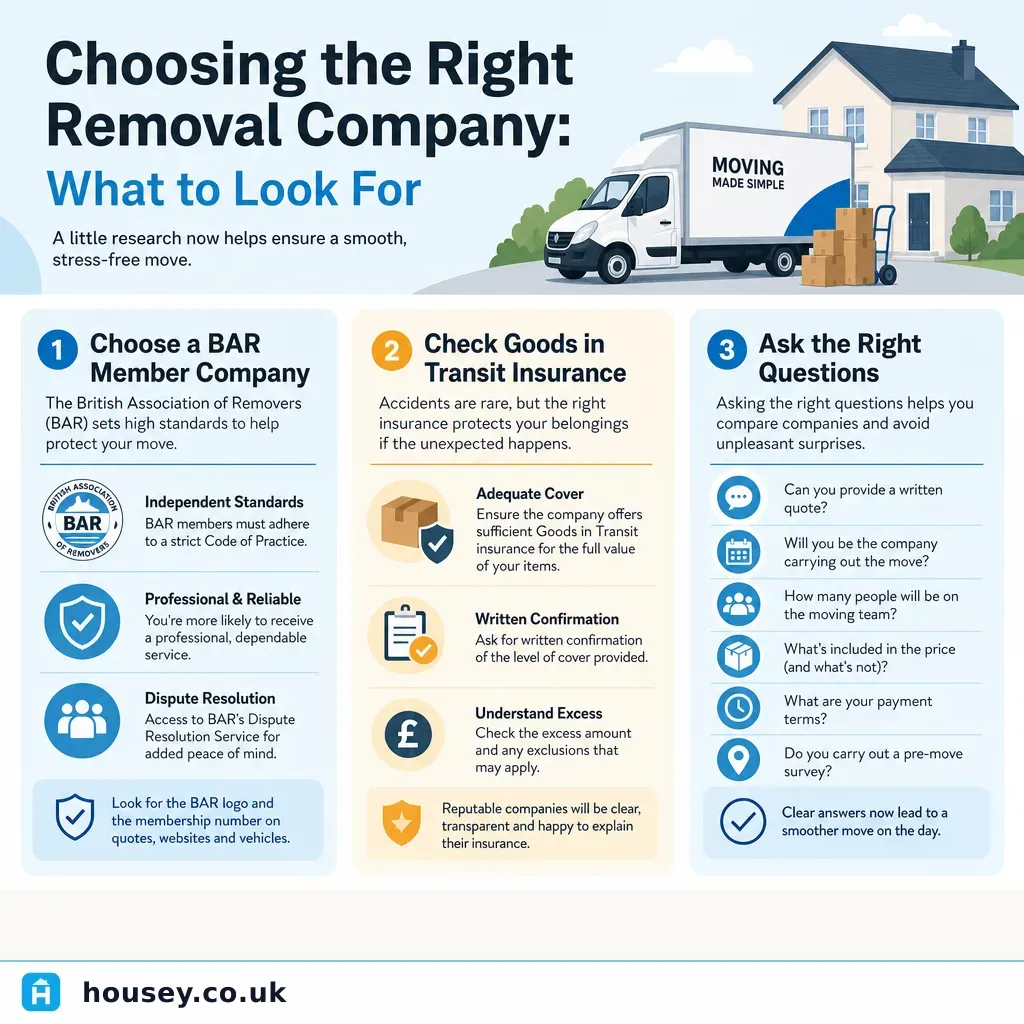
Choosing the Right Removal Company: What to Look For
Look for a removal company that belongs to the British Association of Removers (BAR), carries goods-in-transit insurance, and conducts a pre-move survey before issuing a quote.
 Buying & Moving
Choosing a House Removal Company: What to Look For
Choose a UK removal company that belongs to the British Association of Removers (BAR) or the Removals Industry Ombudsman Scheme (RIOS), carries goods-in-transit and public liability insurance, and provides a written quote after properly surveying your home.
 Buying & Moving
How to Plan a House Move: A Practical Guide to Residential Relocations
A UK house move goes more smoothly with planning that starts 6–8 weeks before moving day.