Selecting and Working With Professional Moving Services
By Housey · Last reviewed 30th of May 2026
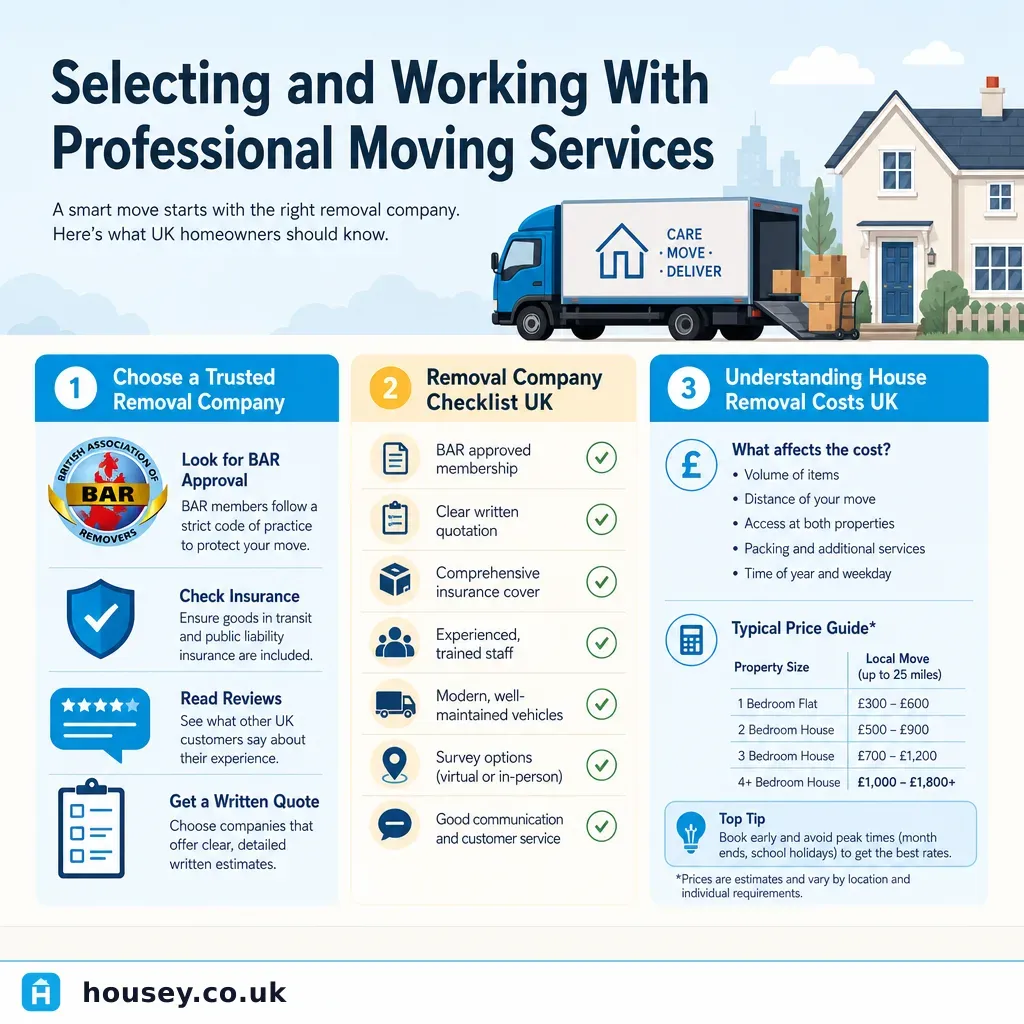
Selecting and Working With Professional Moving Services
Choosing a removal company tends to be one of the final decisions made before moving day and — too often — one of the least carefully considered. A poor choice can result in damaged belongings, a missed key-release window, or disputes over costs that were not made clear at the quoting stage. Taking a structured approach to selecting and working with your removal team makes the difference between a stressful experience and a well-managed one.
Key points
- The British Association of Removers (BAR) is the main trade body for professional removal companies in the UK; BAR members must follow a Code of Practice approved by the Chartered Trading Standards Institute and participate in a deposit-protection scheme.
- Removal costs vary significantly by volume, distance, access difficulty, and timing — Friday and end-of-month moves typically attract higher prices than mid-week, mid-month slots.
- A full packing service, where the removal team packs everything, reduces disputes over breakage liability because the company assumes responsibility for items it has packed.
- Transit insurance provided by removal companies often includes per-item limits and excludes categories such as electronics, antiques, jewellery, and cash — read the full policy schedule before signing.
- Completion-day key release is co-ordinated by solicitors and is not always predictable; brief your removal company in advance about potential timing uncertainty and confirm their policy on waiting time charges.
How to find a reputable removal company
Start with the BAR's online Find a Remover tool or ask for recommendations from your estate agent, solicitor, or neighbours who have moved recently. For international or long-distance moves, also check for membership of the International Association of Movers (IAM) or FIDI Global Alliance.
When shortlisting companies:
- Confirm BAR membership or an equivalent recognised trade body affiliation.
- Check that the company has a physical UK address and a landline telephone number.
- Read verified reviews on Google or Trustpilot and look for comments about punctuality, communication, and care in handling belongings.
- Confirm the company uses its own employed staff and owned vehicles on moving day, rather than subcontracting.
Comparing removal service types
Removal service comparison table
Service type | Best for | Not ideal for | Indicative cost range | Main risk |
|---|---|---|---|---|
Full packing and removal | Large family homes; very busy households; high-value contents | Tight budgets; those who prefer to oversee packing closely | Higher — varies widely by volume and distance | Less personal control over packing order and priority |
Self-pack, professional removal | Most standard moves; balances cost and control | Large homes with many fragile items | Mid-range | Breakage liability may fall to homeowner if self-packing was inadequate |
Man-and-van | Small flats; single loads; short local moves | Family homes; long distances; complex access | Lower | Often no comparable insurance; less accountability |
Shared or part-load container | International moves; flexible timing acceptable | Fixed completion date required | Variable | Longer delivery window; less direct schedule control |
Indicative UK costs; last reviewed 2026-05-30. Always obtain at least three written quotes — costs vary widely by location, volume, and date.
What to ask before accepting a quote
- What is included and excluded — does the quote cover dismantling and reassembling furniture?
- Will the company's own employees carry out the work, or will it be subcontracted?
- What qualifications, training, or accreditations do the removal operatives hold?
- What transit insurance is included, and what are the per-item and total claim limits?
- Is VAT included in the quoted price?
- What is the policy on delays to key release — is waiting time charged, and how is it calculated?
- What happens if the completion date changes at short notice?
- Will the price be confirmed in writing and is it fixed, or can it change on the day?
Moving preparation checklist
Good preparation before moving day reduces delays and makes the removal team's job significantly easier.
- 8–12 weeks before moving: Obtain at least three written quotes; book your preferred company; pay a deposit and receive written booking confirmation.
- 4–6 weeks before: Begin sorting and decluttering — removal companies typically charge by volume, so less to move means lower cost.
- 2–4 weeks before: Notify your home insurer of the move date; review the removal company's transit insurance schedule; note any exclusions for high-value items.
- 1–2 weeks before: Pack non-essential items; label all boxes clearly with contents and destination room; prepare a first-night box with essentials (kettle, bedding, toiletries, important documents).
- Day before moving: Defrost the fridge-freezer; confirm the likely key-release time with your solicitor; dismantle flat-pack furniture being left behind.
- Moving day: Be present or have a trusted representative available throughout; do a room-by-room walk-through before the team leaves your old address; photograph any pre-existing damage to furniture before loading begins.
Red flags when choosing a removal company
- No written quote — reputable companies always provide a written, itemised quote after a survey (in-person or video call).
- Cash payment only, no receipt — professional removal companies issue VAT receipts and accept bank transfer or card.
- Cannot name their insurer or state policy limits — transit insurance is a basic professional requirement, not an optional extra.
- Significantly undercuts all other quotes — can reflect fewer staff, older vehicles, or subcontracting, which affects reliability and claims handling.
- No fixed address or landline number — operating only through a mobile number and a generic email address offers limited recourse if problems arise.
- Requests a large deposit immediately with no written confirmation — BAR members offer deposit protection; non-members cannot guarantee your money if they cease trading before your move.
- No survey offered before quoting — without a survey, volume cannot be properly assessed and the price may be revised upward on the day.
Working with your removal team on the day
Brief the team clearly when they arrive:
- Walk through the property together and highlight fragile, heavy, or particularly valuable items.
- Confirm clearly which items are not being taken — items for disposal, or items the seller is still collecting.
- Show them where packing materials and protective covers are located if you are self-packing.
- Agree a locking-up procedure for your old property: who checks each room, who holds the keys at the end.
At your new property, direct the team room by room using your labelled boxes. A simple hand-drawn floor plan taped to each door saves time and reduces the number of boxes moved twice.
When to get professional help
For most domestic moves, the removal company itself is the specialist. However, use dedicated specialists in these situations:
- High-value art, antiques, or musical instruments: instruct a fine-art mover or piano specialist rather than a general removal company.
- Large safes or commercial equipment: requires specialist lifting equipment not typically carried by domestic removal firms.
- International moves: use an IAM- or FIDI-accredited international mover — customs documentation and shipping regulations are complex.
- Storage between properties: check whether storage is in the company's own insured facility or subcontracted to a third party, and confirm insurance coverage during the storage period.
How Housey can help
Housey connects you with vetted house removal companies across the UK, including BAR-member firms. Describe your move and compare quotes from professional removal companies in your area before you book.
Frequently asked questions
What is a BAR-approved removal company?
The British Association of Removers (BAR) is the UK's principal trade body for the removals industry. BAR members must adhere to a Code of Practice approved by the Chartered Trading Standards Institute, maintain adequate insurance, and participate in a deposit-protection scheme that safeguards your deposit if the company ceases trading before your move. BAR membership provides a meaningful baseline of accountability and access to a dispute resolution process.
How far in advance should I book a removal company?
For moves on or around a completion date — which often falls on a Friday — book 6–8 weeks ahead. Removal companies in popular areas, and particularly during spring and summer, fill quickly. If your completion date changes, contact your removal company as soon as possible; many will accommodate a date change with sufficient notice, though availability cannot be guaranteed.
What insurance does a removal company provide?
Most professional removal companies include goods-in-transit insurance, but policy limits vary considerably. Many policies cap claims per item and commonly exclude or limit cover for electronics, jewellery, cash, documents, and antiques. Read the full policy schedule before moving day, and consider extending your home contents policy for high-value items during transit and any storage period.
What is the difference between a full packing service and self-pack removal?
In a full packing service, the removal company's operatives pack all your belongings using professional materials, taking responsibility for damage to items they have packed. In a self-pack move, you pack your own boxes and the company loads, transports, and unloads. Self-packing is cheaper but if items are damaged due to inadequate packing, the removal company may not accept liability. Some firms offer partial packing for fragile or valuable items only.
Sources and further reading
- British Association of Removers: find a remover — British Association of Removers
- Citizens Advice: moving home — Citizens Advice
- Chartered Trading Standards Institute: approved codes of practice — Chartered Trading Standards Institute
- GOV.UK: tell HMRC about a change of address — GOV.UK
Useful next reads
 Buying & Moving
Professional House Removals: Finding the Right Moving Company
Finding the right house removals company involves checking membership of a recognised trade body such as the British Association of Removers (BAR), confirming goods-in-transit insurance cover, and comparing itemised written quotes.
 Buying & Moving
Planning Your Home Removal: What to Expect from Professional Services
A professional removal company loads, transports, and unloads your household belongings between properties.
 Buying & Moving
Professional House Removals Services: Choosing the Right Moving Company
A professional house removals company handles loading, transport, and unloading; full-service firms with BAR membership also offer deposit protection and independent dispute resolution.
 Buying & Moving
Selecting Professional House Removals Services: A Homeowner's Guide
Choose a removals firm registered with the British Association of Removers (BAR), which carries out a pre-move survey before quoting and provides a written binding quotation with goods-in-transit insurance.
 Buying & Moving
Choosing a House Removal Company: What to Look For
Choose a UK removal company that belongs to the British Association of Removers (BAR) or the Removals Industry Ombudsman Scheme (RIOS), carries goods-in-transit and public liability insurance, and provides a written quote after properly surveying your home.