Proven Strategies For A Smooth House Sale And Relocation
By Housey · Last reviewed 30th of May 2026
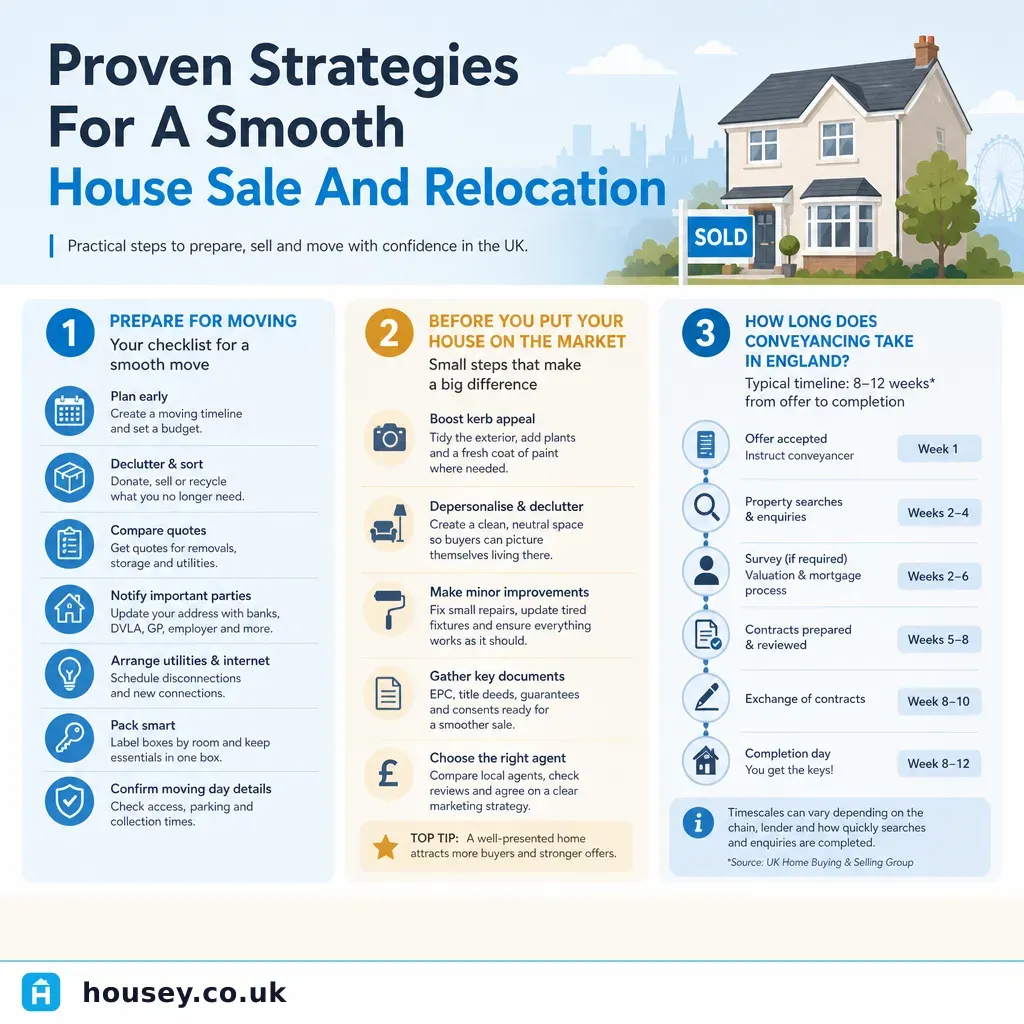
Proven Strategies For A Smooth House Sale And Relocation
Selling a property and relocating simultaneously involves managing conveyancing, estate agent marketing, removals logistics, and a chain of other parties — often on timescales that are not entirely within your control. Problems most commonly arise from late preparation: instructing a solicitor too late, underestimating packing time, or failing to book removals until after completion has been confirmed. A structured approach — starting well before your listing goes live — reduces delays, unexpected costs, and moving-day stress.
Key points
- The average time from accepting an offer to legal completion in England and Wales is approximately twelve to sixteen weeks, though chains and mortgage-related delays can extend this significantly (HM Land Registry data).
- An Energy Performance Certificate (EPC) is legally required before marketing a property for sale in England, Scotland, and Wales; a certificate valid for up to ten years must be in place before the listing goes live.
- Professional property photography and floor plans consistently help listings perform better; Rightmove research suggests listings with floor plans receive significantly more enquiries than those without.
- Removal companies typically require two to four weeks' notice for standard moves; specialist movers and peak-period dates (late spring and summer) may need longer lead times.
- Instructing a conveyancing solicitor before accepting an offer allows title documentation to be prepared in advance, reducing the most common cause of conveyancing delay.
A sale and relocation timeline
Stage | When to act | Key tasks |
|---|---|---|
Preparation | 8–12 weeks before listing | Declutter; instruct solicitor; gather title documents, EPC, and building work certificates; arrange professional photography and floor plans |
Marketing | Listing goes live | Monitor viewings; respond to offers; agree negotiation parameters with estate agent |
Offer accepted | Day 1 of conveyancing | Confirm solicitor is instructed; complete TA6 and TA10 forms; request management pack if leasehold |
Exchange | Typically 8–14 weeks after offer accepted | Agree completion date; confirm removal booking; arrange storage if needed; notify utilities |
Completion | Agreed date | Keys handed over; final meter readings taken; post redirect active |
Moving in | Completion day or days either side | Removals crew executes move; unpack essentials first |
Preparing your property for sale
Documentation
Solicitors and buyers' conveyancers will request a range of documents during the sale. Gathering these before accepting an offer reduces the most common cause of conveyancing delay: the seller not having paperwork to hand.
Documents to locate or obtain in advance:
- Title deeds or official copies from HM Land Registry (available online via the Land Registry portal)
- A valid Energy Performance Certificate (required before marketing; valid for ten years)
- Building Regulations completion certificates for any notifiable works — extensions, loft conversions, electrical work
- Planning permission documentation and any associated conditions
- FENSA or CERTASS certificates for replacement windows or doors installed since April 2002
- Party wall agreements, where applicable
- Boiler service records and Gas Safe certificates for recent gas work
- Lease, service charge statements, and ground rent schedule if the property is leasehold
Presentation and marketing
Professional photography and floor plans are among the lowest-cost marketing investments relative to property value. Most estate agents can arrange these, but the quality of in-house photography varies considerably. Specialist property photography and floor plans services typically produce higher-quality results that improve listing engagement on Rightmove and Zoopla.
Choosing and briefing a removal company
Getting removal quotes early — ideally four to six weeks before your planned completion date — means you can confirm a booking promptly once the date is set, rather than scrambling for availability at short notice.
What to ask before accepting a removal quote
- What is included and excluded — full packing, furniture dismantling, specialist items?
- What accreditations does the company hold, such as membership of the British Association of Removers (BAR)?
- What insurance covers your possessions in transit and during packing?
- What happens if the completion date changes at short notice — is there a cancellation or rescheduling fee?
- Is VAT included in the quoted price?
- How will fragile, high-value, or specialist items such as pianos, antiques, and artwork be handled?
- Is there an hourly rate if the move overruns?
House removals companies on Housey are vetted and can provide itemised quotes based on your property size and move date.
Using storage between sale and purchase
If your sale completes before your purchase, or if you are downsizing and need time to decide what to keep, short-term storage provides a practical buffer. Options include self-storage (you load and access), container storage (loaded by removals crew and stored off-site), and managed storage (full-service and easier for fragile items). Storage is often best arranged through your removal company as part of the same booking to simplify logistics.
Conveyancing: what slows most sales down
Conveyancing in England and Wales covers legal title investigation, searches, mortgage requirements, and the exchange and completion process. The most common causes of delay are:
- Missing documentation on the seller's side — the most preventable cause
- Local authority search delays (typically three to six weeks; sometimes longer in certain councils)
- Mortgage valuation or survey findings requiring renegotiation
- Leasehold issues: management pack delays, service charge disputes, or short leases (generally under eighty years)
- Chain collapses from another party in a linked transaction
Instructing a conveyancing solicitor as early as possible — ideally before your property goes to market — means initial forms can be completed and title issues identified before a buyer is found.
Which approach suits your situation?
- If you have already accepted an offer: instruct a solicitor immediately if not already done; return TA6 and TA10 forms promptly; book a removal company before the completion date is confirmed, choosing one with a flexible cancellation policy.
- If you are about to list: spend two to four weeks preparing documentation, arranging a new EPC if yours has expired, decluttering, and booking professional photography.
- If you are in a chain: maintain regular contact with your estate agent for chain updates; be prepared to negotiate completion dates across the chain; consider requesting an overlap between your sale and purchase completions to reduce moving-day pressure.
- If you are downsizing: arrange storage or a pre-move declutter service early; oversized or specialist items need appropriate removal expertise well in advance.
- If you are relocating to an unfamiliar area: commission a survey on your purchase property to understand its condition and value before committing to the agreed price.
Pre-move checklist
When to get professional help
Most of the selling and moving process is self-managed with good preparation, but professional advice is essential at certain points:
- A survey on your purchase property identifies significant defects — a RICS-registered surveyor or structural engineer can advise on repair costs and whether renegotiation is warranted.
- You are selling a leasehold property with a lease under eighty years — a specialist leasehold solicitor can advise on the implications for your sale and whether an extension is needed before marketing.
- Boundary disputes, restrictive covenants, or other title complexities arise — your conveyancer should flag these, but an independent legal opinion may be warranted.
How Housey can help
Housey connects you with professionals across the full sale and relocation process. Compare quotes from house removals companies, arrange storage for the transition period, book property photography and floor plans to maximise your listing's appeal, and instruct a conveyancing solicitor early to keep the legal process on track.
Frequently asked questions
How far in advance should I book a removal company?
Aim to get quotes four to six weeks before your planned completion date and confirm the booking as soon as a date is agreed. In peak periods — late spring, summer school holidays, and end-of-month dates — good removal companies can be fully booked two to three weeks in advance. Booking early also gives you time to compare quotes without pressure.
Do I need an EPC before I put my house on the market?
Yes. In England, Scotland, and Wales, you must have a valid Energy Performance Certificate before marketing a property for sale. If your current certificate is more than ten years old, you will need a new one commissioned. Failure to have an EPC in place when required can result in a Trading Standards penalty.
What is the TA6 form in a house sale?
The TA6 Property Information Form is a standard document completed by the seller and used by the buyer's conveyancer to understand the property, covering boundaries, disputes, alterations, services, and planning history. Completing it accurately and promptly is one of the most impactful things a seller can do to speed up the conveyancing process.
Can I use the same solicitor for both the sale and the purchase?
Yes. Many solicitors handle both simultaneously for the same client. Using one firm for both transactions can simplify communication and help coordinate exchange and completion dates across a chain, though it is worth comparing service levels and fees before instructing.
Sources and further reading
- GOV.UK: Selling a home — official guidance for property sellers in England and Wales
- HM Land Registry: Official copies and title documents — how to obtain title documentation
- Citizens Advice: Buying and selling your home — practical guidance for buyers and sellers
- British Association of Removers (BAR) — trade body for vetted removal companies
- Rightmove: Selling guide — guidance on property marketing and listing performance
Useful next reads
 Buying & Moving
Property Enhancement Strategies for a Successful Sale
Enhancing a UK property before listing typically involves improving kerb appeal, decluttering and neutralising décor, addressing minor maintenance issues, and investing in professional photography.
 Buying & Moving
Planning Your Home Removal: What to Expect from Professional Services
A professional removal company loads, transports, and unloads your household belongings between properties.
 Buying & Moving
Relocating your family home for better school access: planning your house move
Moving for a better school means timing your purchase against two hard constraints: the admissions deadline and the conveyancing timeline.
 Buying & Moving
Professional approaches to photographing properties for sale
Professional property photography uses wide-angle lenses, HDR exposure blending, and careful staging to present rooms accurately and attractively.
 Buying & Moving
Achieving Show-Home Presentation and Professional Styling
Show-home presentation involves decluttering, deep cleaning, neutral redecoration, and optimising lighting before photography and viewings.