Relocating your family home for better school access: planning your house move
By Housey · Last reviewed 7th of May 2026

Relocating your family home for better school access: planning your house move
School admission deadlines create hard calendar constraints that most other house moves do not have. Local authorities in England assess catchment eligibility based on your address at the time of application — not when school starts — which means the timing of your purchase matters enormously. For a family planning a move, conveyancing timelines, catchment boundary rules, and admission fraud policies all need to be understood well before you agree an offer.
Key points
- In England, secondary school applications close on 31 October and primary school applications close on 15 January the following year; Scotland, Wales, and Northern Ireland each use different deadlines.
- Local authorities assess catchment eligibility using your address at the time of application — completing your purchase before the deadline matters more than completing before school starts.
- Councils actively investigate address fraud; temporarily using a relative's address to gain admission can result in a place being withdrawn, even after a child has started at the school.
- Conveyancing in England and Wales takes an average of 12–16 weeks from offer acceptance; work backwards from the admissions deadline to find your latest safe offer date.
- Catchment boundaries change each year based on demand — always check the local authority's current published admission arrangements, not last year's school prospectus.
How school catchment areas work in England and Wales
Most oversubscribed state schools in England use proximity to the school as a primary criterion for allocating places. This is not a fixed zone: the effective catchment changes each year based on the number of applications and the distance of the last child admitted. A distance that secured a place in the previous round may not be sufficient the following year.
The legal framework is the School Admissions Code (England), which requires admission authorities to publish their arrangements annually, including the oversubscription criteria and the distance applied in the previous round. This information is available through GOV.UK and local authority admissions portals.
In Wales, the Welsh Government's School Admissions Code applies and local authorities administer their own arrangements. Contact the admissions team of the relevant council for current criteria.
Timing your move against the admissions deadline
Working backwards from the application deadline is the most reliable approach.
Decision tree: can you complete in time?
- Choose to proceed now if: you can realistically accept an offer at least 16 weeks before the admissions deadline and your chain is short.
- Ask your conveyancer for a timetable assessment if: you are in a chain of three or more properties — add 4–6 weeks to the base estimate.
- Consider renting in the catchment area if: you cannot complete the purchase before the deadline and need to apply in the current cycle.
- Seek specialist advice if: you are unsure whether exchange of contracts is sufficient for the local authority to accept the new address, or if your situation involves unusual tenure or title.
Conveyancing is not linear. Mortgage valuations, local authority searches, and title queries can each add weeks. Ask your conveyancer at instruction stage for a realistic assessment based on chain length and property type.
The address fraud risk and how to protect yourself
Using a temporary address — a relative's home, or a rental you do not genuinely occupy as your main residence — solely to secure a school place is treated as fraud by local authorities. Councils have the power to investigate and often do for oversubscribed schools, using Council Tax records, the electoral roll, and in some cases site visits. GOV.UK guidance confirms that school places can be withdrawn where an address was used fraudulently.
To avoid any risk:
- Be genuinely resident at the new address before submitting the application.
- Ensure the address on the application matches your Council Tax registration and other official correspondence.
- Do not apply using an address where you only have an accepted offer — an accepted offer is not legally binding in England and Wales, and your purchase could still fall through.
Property checks when buying in a target catchment area
Comparison table: additional checks for a school-driven move
Check | Why it matters | Suggested action |
|---|---|---|
Last year's furthest admitted distance | Indicates how close you need to be | Request the school's published admissions outcomes from the local authority |
Property title and boundaries | Disputes or shared drives can delay exchange | Instruct a conveyancer early; check the Land Registry title plan |
Property condition | Defects found late can delay exchange past your deadline | Commission a RICS Home Survey early in the buying process |
School transport and day-to-day logistics | Practical consideration beyond the admissions question | Visit at school run time; check walking routes and public transport links |
Future oversubscription risk | The school may become harder to access in subsequent years | Check published pupil number projections from the local authority |
Document and preparation checklist
Homeowner checklist: moving for school access
What to ask a conveyancer before instructing them
- What is your current average time from instruction to exchange for a property in a chain?
- Have you handled purchases where a school admissions deadline was a factor?
- How will you flag if the timeline looks at risk?
- At what legal milestone — offer, exchange, or completion — will a local authority typically accept a new address for an admissions application?
When to get professional help
For most families, the key professional is a solicitor or licensed conveyancer. Seek additional specialist input in these situations:
- If the property is leasehold, has an unusual title, or involves a shared ownership scheme, instruct a conveyancer with relevant experience.
- If a school place is refused and you wish to appeal, seek guidance from the Advisory Centre for Education (ACE) or a specialist education solicitor.
- If the property shows visible signs of damp, structural movement, or non-standard construction, a RICS Level 3 Building Survey reduces the risk of a late defect report causing the purchase to collapse close to your deadline.
How Housey can help
Housey can connect you with conveyancers, surveyors, and removal companies across the UK. Getting conveyancing quotes in as soon as an offer is accepted gives your timeline the best chance. A RICS Home Survey commissioned early reduces the risk of a defect finding derailing the move at the worst possible moment. If you are selling your current home, property photography and floorplans can help attract buyers quickly — and when completion day arrives, house removals booked well in advance will make the day itself far smoother.
Frequently asked questions
Can I apply for a school place before my purchase has completed?
In England, some local authorities accept applications based on an address where contracts have been exchanged, though policies vary. Contact your local authority admissions team directly and provide a solicitor's letter confirming exchange. Do not apply using an address based solely on an accepted offer, as this is not legally binding and your purchase could still fall through.
What happens if my purchase falls through after I applied using the new address?
If your purchase collapses, you must notify the admissions authority and revert to your actual address. Continuing to claim a place based on an address you no longer occupy may be treated as fraud. The local authority will reassess your application based on your genuine current address.
Is renting in a catchment area valid for school applications?
Renting is valid if you genuinely occupy the property as your main residence. Local authorities may request tenancy agreements and evidence of occupation. A short-term tenancy taken solely to secure a school place, while maintaining a family home elsewhere, is likely to be investigated and could result in the place being withdrawn.
How early should I instruct a conveyancer?
Instruct a conveyancer on the day your offer is accepted, or before if possible. Conveyancers carry out identity and anti-money laundering checks before substantive work can begin, and every day saved at the start matters when you are working to a hard admissions deadline.
Do catchment area rules apply to faith schools and grammar schools?
Faith schools and grammar schools use different oversubscription criteria — faith commitment and selective tests respectively — in addition to or instead of distance. Check each school's published admission arrangements carefully before relying on proximity alone as your primary selection criterion.
Sources and further reading
- Apply for a primary school place — GOV.UK — UK Government
- School Admissions Code — Department for Education — Department for Education
- School admissions in Wales — Welsh Government — Welsh Government
- RICS Home Surveys — RICS — Royal Institution of Chartered Surveyors
- Buying a home: conveyancing — Citizens Advice — Citizens Advice
Useful next reads
 Buying & Moving
Planning Your Home Removal: What to Expect from Professional Services
A professional removal company loads, transports, and unloads your household belongings between properties.
 Buying & Moving
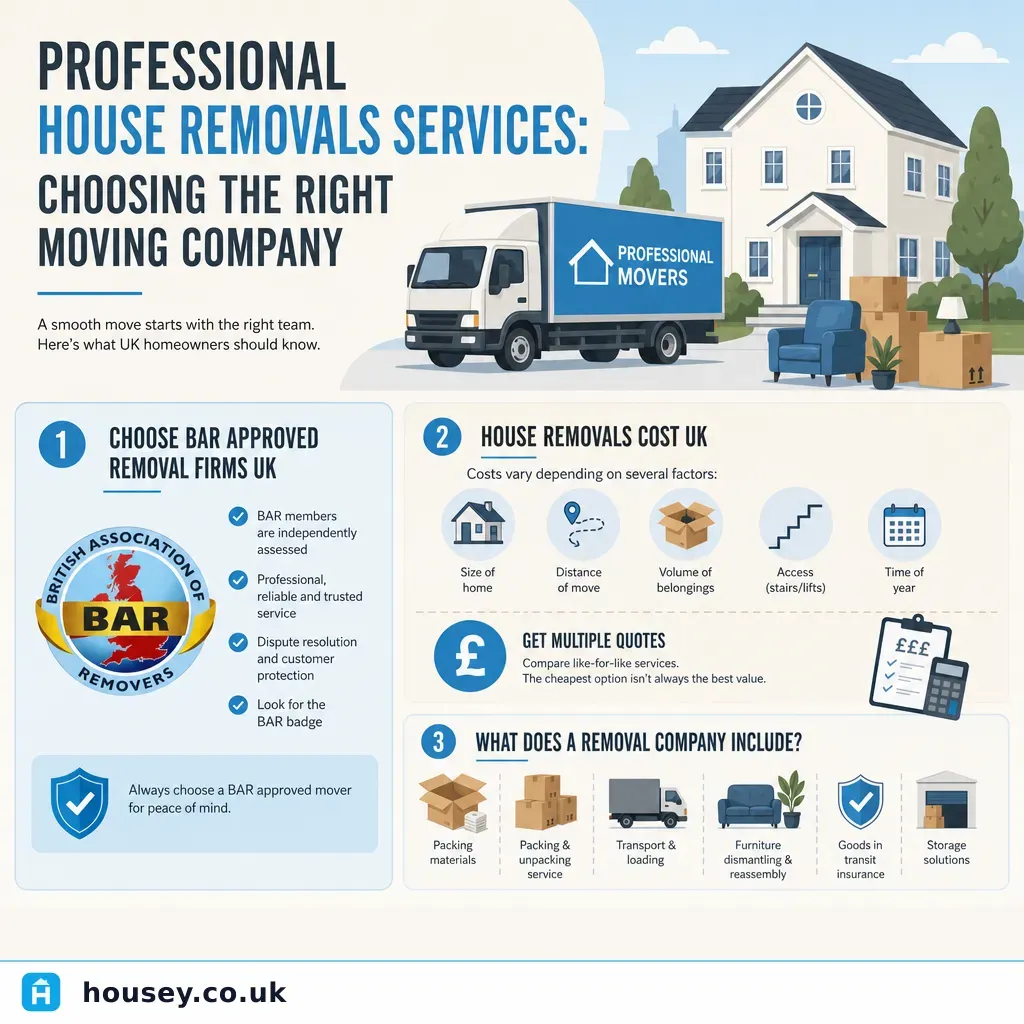
Professional House Removals Services: Choosing the Right Moving Company
A professional house removals company handles loading, transport, and unloading; full-service firms with BAR membership also offer deposit protection and independent dispute resolution.
 Buying & Moving
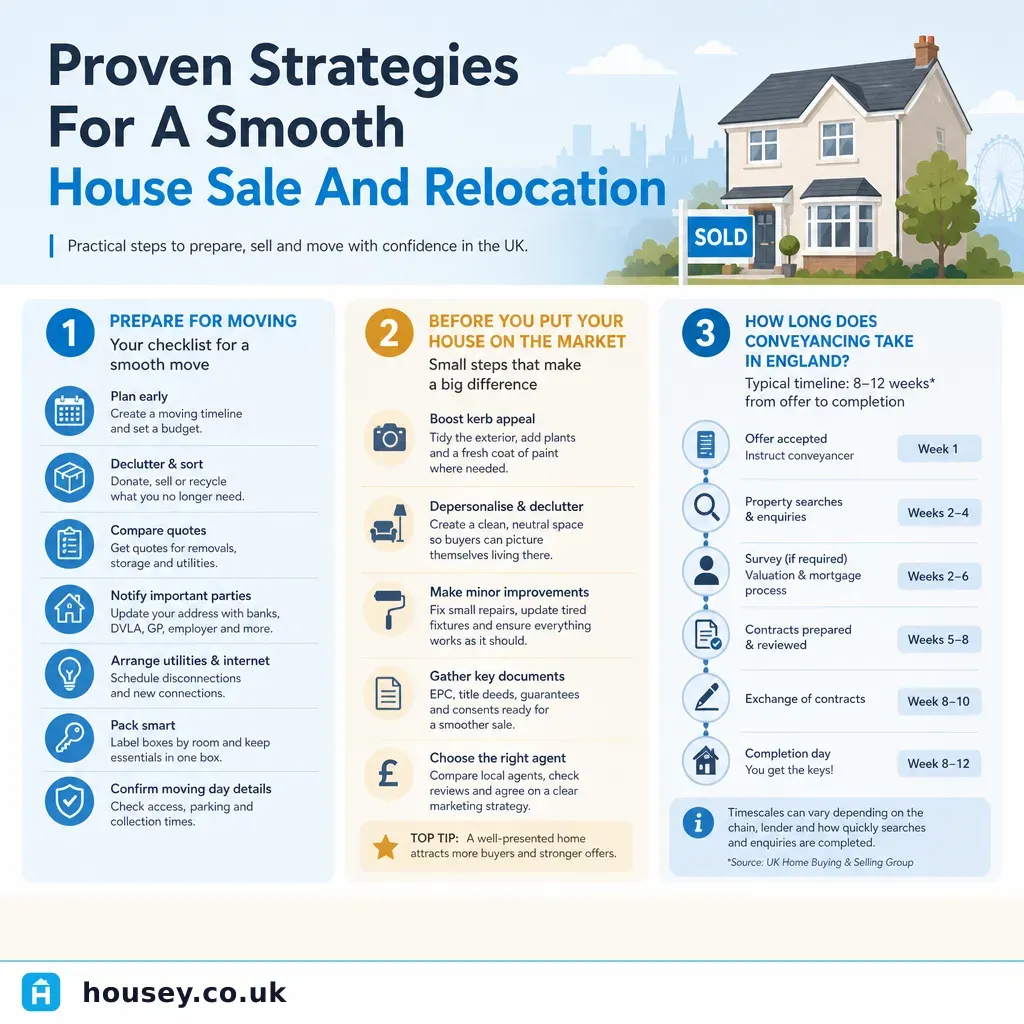
Proven Strategies For A Smooth House Sale And Relocation
Selling a house and relocating smoothly in the UK depends on preparation at every stage: instructing a solicitor early, presenting the property well for marketing, and booking removals before your completion date is confirmed.
 Buying & Moving
Moving Home During the Festive Season: Planning and Logistics Guide
Moving home during the festive season is achievable but requires extra planning.
 Buying & Moving
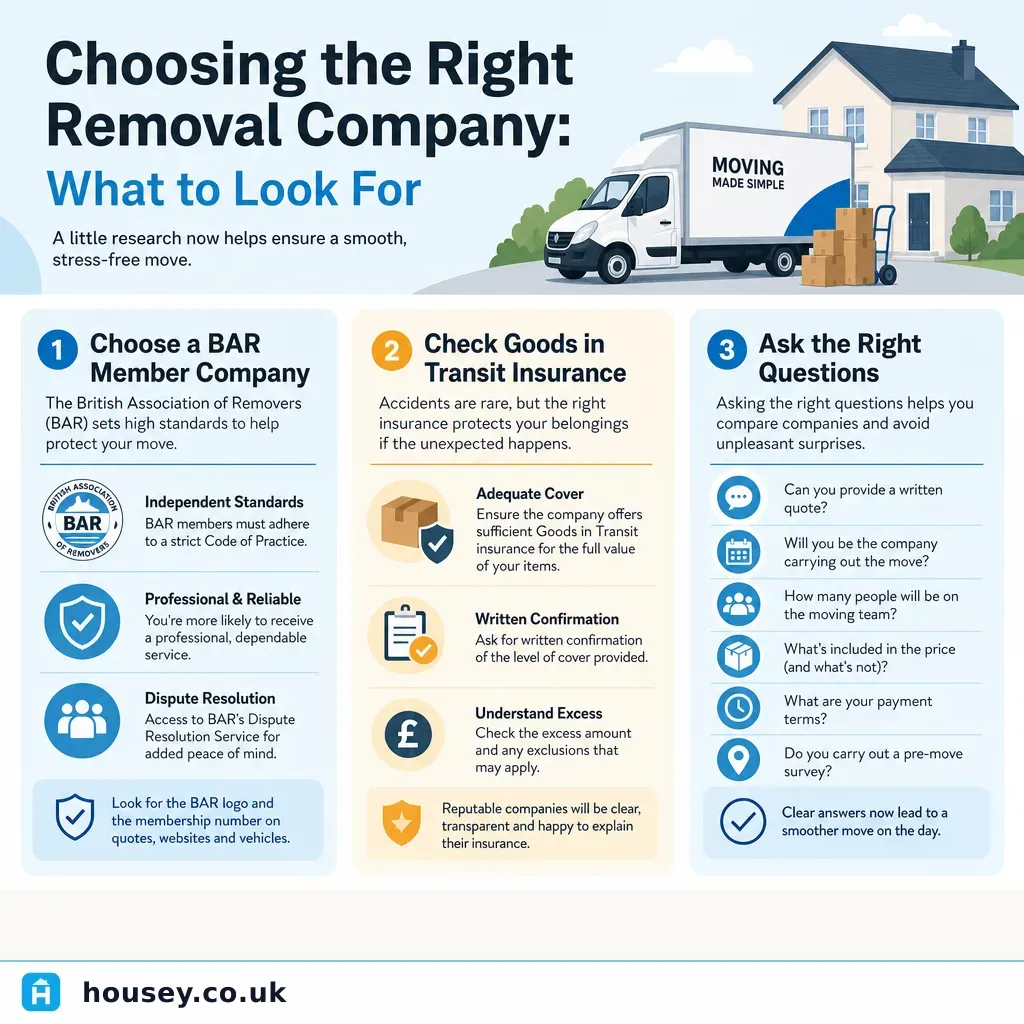
Choosing the Right Removal Company: What to Look For
Look for a removal company that belongs to the British Association of Removers (BAR), carries goods-in-transit insurance, and conducts a pre-move survey before issuing a quote.