Self-Storage Solutions and Service Pricing
By Housey · Last reviewed 11th of May 2026
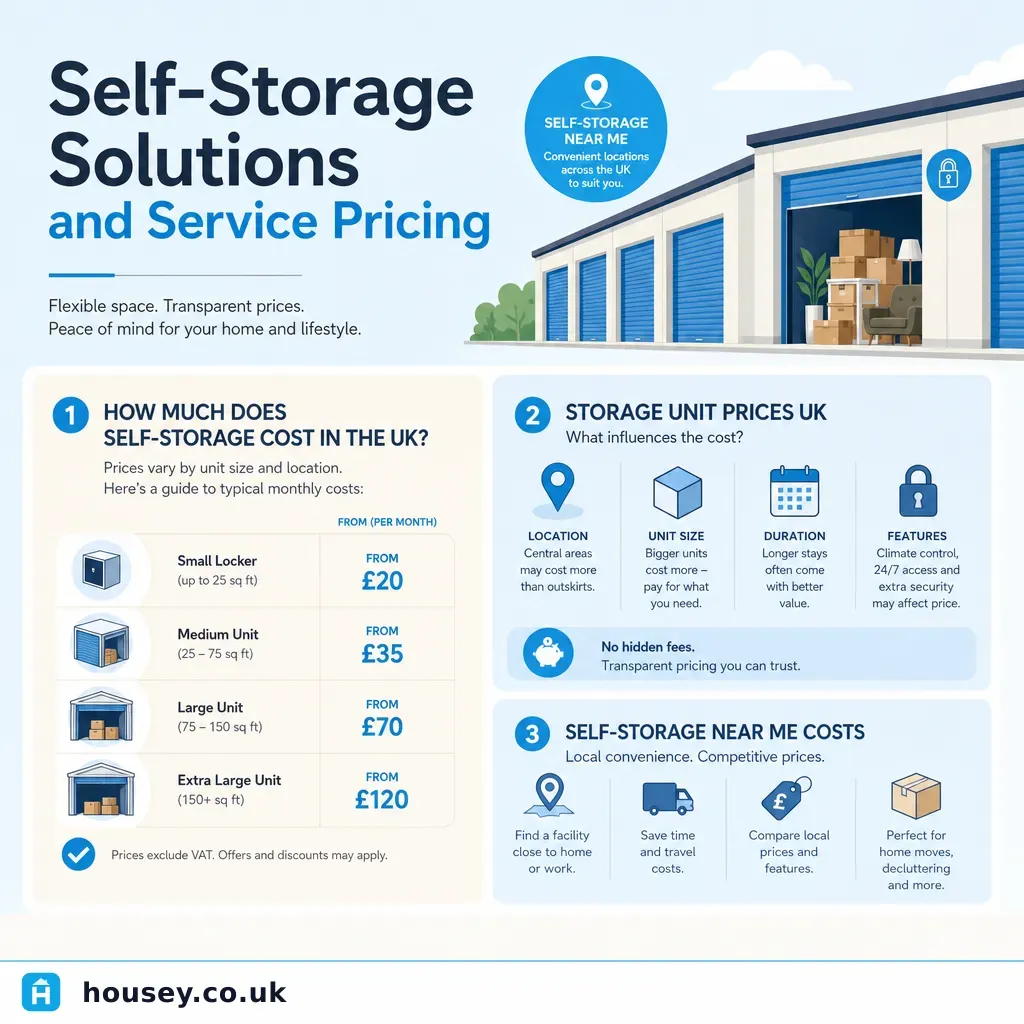
Self-Storage Solutions and Service Pricing
Self-storage is a practical option for UK homeowners at several stages of a property journey: bridging a gap in a chain, waiting for a property to become renovation-ready, or decluttering before marketing a home for sale. With more than 2,100 facilities across the UK according to the Self Storage Association UK (SSA UK), pricing, unit sizes, and quality vary considerably — and the cheapest headline rate is not always the best value once access restrictions and insurance obligations are factored in.
Key points
- UK self-storage prices are quoted per week and vary by unit size, location, and facility type — indicative weekly rates range from £8–£35 for a small locker to £80–£200+ for a 150 sq ft room in a major city (last reviewed 2026-05-11).
- The Self Storage Association UK (SSA UK) reports that London and the South East typically run 40–60% above UK regional averages for equivalent unit sizes.
- Most standard UK home contents insurance policies do not automatically cover items stored off-site — check your policy wording before assuming you are covered, or arrange separate cover through the facility or a specialist insurer.
- Access hours vary significantly between operators: purpose-built facilities often offer 24/7 PIN access, while container depots commonly restrict access to staffed business hours only.
- Many operators offer heavily discounted introductory rates for the first 4–8 weeks — always ask for the ongoing standard rate and any price review terms before signing a rental agreement.
How is self-storage priced in the UK?
Storage operators price by floor area (in square feet or square metres), per week. Most advertise an introductory rate for short initial periods, with the standard ongoing rate kicking in afterwards — sometimes substantially higher.
Key price drivers include:
- Location: Central London and major city centres carry a significant premium over suburban and rural facilities.
- Unit size: Smaller units have a higher cost per square foot; larger units offer economy of scale.
- Facility type: Purpose-built multi-storey facilities with climate control and individual unit alarms typically cost more than outdoor container storage.
- Rental duration: Many operators offer reduced rates for commitments of three months or more.
- Introductory offers: Headline rates often apply for the first four to eight weeks only — the ongoing rate is what matters for any move or renovation project lasting longer.
Storage unit sizes and what they hold
Unit size | Typical contents | Best for |
|---|---|---|
16–25 sq ft (locker) | Boxes, small items, documents | Students; short-term overflow; document archiving |
25–50 sq ft | Contents of a studio or small bedroom | Single-room clearances; moving home |
50–75 sq ft | Contents of a 1-bed flat | Moving between properties; renovation works |
75–100 sq ft | Contents of a 2-bed flat | Family moves; loft clearances |
100–150 sq ft | Contents of a 3-bed house | Full household during a renovation |
150–200 sq ft | Large family home contents | Long-term renovation; extended travel |
200 sq ft+ | Multiple households; business stock | Commercial use; major property projects |
Note: contents estimates assume reasonably efficient packing. If items are bulky — large sofas, wardrobes, or appliances — size up by one tier to avoid difficulty fitting items.
Which storage option is right for you?
- Choose purpose-built indoor self-storage if you need 24/7 access, climate-controlled conditions for furniture or electronics, or robust security features (CCTV, individual unit alarms, gate access control).
- Choose container or yard storage if you need drive-up access for large or heavy items, are storing tools or construction materials, or cost is the primary consideration.
- Choose portable storage (delivered and collected) if you want to pack at home before the unit is collected, or if travelling to a facility is inconvenient. Providers deliver a unit to your address, allow you to pack it, then collect and store it at their depot.
- Choose managed storage (room in a warehouse) if you want the operator to handle collection, storage, and redelivery without you needing to visit the facility — suitable for high-value items or long-distance relocations.
- Ask your removals company about storage-in-transit, which bundles the move and short-term storage into a single quote — often cost-effective for chain breaks of under four weeks.
Indicative UK self-storage costs by size and region
Unit size | London (per week) | Regional city (per week) | Rural or suburban (per week) |
|---|---|---|---|
25 sq ft | £20–£40 | £12–£22 | £8–£16 |
50 sq ft | £35–£70 | £22–£45 | £15–£30 |
75 sq ft | £50–£100 | £30–£60 | £22–£42 |
100 sq ft | £65–£130 | £40–£80 | £28–£55 |
150 sq ft | £90–£180 | £55–£110 | £38–£72 |
Indicative UK costs, last reviewed 2026-05-11. Figures exclude VAT (20%) and contents insurance. Introductory offers may be substantially lower; ongoing rates and availability vary by operator and postcode.
What to check before signing a storage contract
- What is the ongoing weekly or monthly rate after any introductory offer expires?
- How much notice is required to vacate — and is there a minimum rental period?
- What are the access hours, and are there any restrictions for evenings or weekends?
- Is contents insurance included, optional, or a mandatory extra? What is the cover limit and excess?
- What security does the facility operate — CCTV coverage, individual unit alarms, gate access control, manned reception?
- Is the unit accessible at ground level, or are goods lifts and trolleys available for upper floors?
- What items are prohibited? Most operators exclude flammable liquids, food, animals, and live plants.
- Is VAT included in the quoted price? Most UK self-storage quotes are shown excluding VAT at 20%.
Self-storage checklist before you move in
When to get professional help
Self-storage is straightforward for most homeowners, but some situations warrant specialist advice:
- If you are storing high-value items — artwork, antiques, wine collections, musical instruments — seek a specialist climate-controlled or managed fine-art storage facility rather than a standard self-storage unit.
- If you are storing business records, check your obligations under the UK GDPR (Data Protection Act 2018) and applicable Records Management codes — a specialist document storage provider may be more appropriate than consumer self-storage.
- If you are in a broken chain and need to store an entire household, a removals company with storage-in-transit may offer a more seamless and fully insured solution than arranging storage independently.
How Housey can help
Whether you are between properties, mid-renovation, or preparing a home for sale, Housey can connect you with storage providers near you that offer the unit size, security level, and access hours you need. Compare quotes and find the right storage solution for your move or project.
Frequently asked questions
How much does self-storage cost per month in the UK?
Costs vary widely by location and unit size. A 50 sq ft unit typically costs £150–£300 per month in London and £90–£195 per month in regional cities (indicative costs, last reviewed 2026-05-11). Always compare the ongoing monthly rate rather than the introductory promotional price, which may be substantially lower for the first four to eight weeks only.
Is self-storage covered by insurance?
Not automatically. Most UK operators include basic contents cover in the rental or offer it as an optional add-on. Cover limits and excesses vary between providers. Your existing home contents insurance may not extend to goods stored externally without a specific endorsement — always check your policy wording before assuming your belongings are covered.
How long can I keep items in self-storage?
Most UK facilities have no maximum rental period. You can store for as little as one week or for several years. Long-term rentals may be subject to periodic price reviews — check the review clause in the rental agreement before committing to avoid unexpected rate increases after the introductory period ends.
Can I access my storage unit at any time?
Many purpose-built facilities offer 24/7 access via PIN code or key fob. Container yards and some smaller operators restrict access to staffed hours only. Always confirm specific access hours before renting, particularly if you may need access at weekends or evenings during a house move or renovation project.
Sources and further reading
- Self Storage Association UK: Industry data and guidance — Self Storage Association UK
- GOV.UK: Data protection and UK GDPR — GOV.UK
- Citizens Advice: Moving house — Citizens Advice
Useful next reads
 Buying & Moving
Planning Your Home Removal: What to Expect from Professional Services
A professional removal company loads, transports, and unloads your household belongings between properties.
 Buying & Moving
Storage Solutions and Container Rental Options for House Moves
When moving house in the UK, temporary storage options include self-storage units, portable storage containers delivered to your door, and removal company storage vans.
 Buying & Moving
Professional House Removal Services: Costs and Logistics
Professional house removal services in the UK typically cost £800–£2,000 for a 3-bedroom local move, rising to £1,500–£4,000 for long-distance relocations.
 Buying & Moving
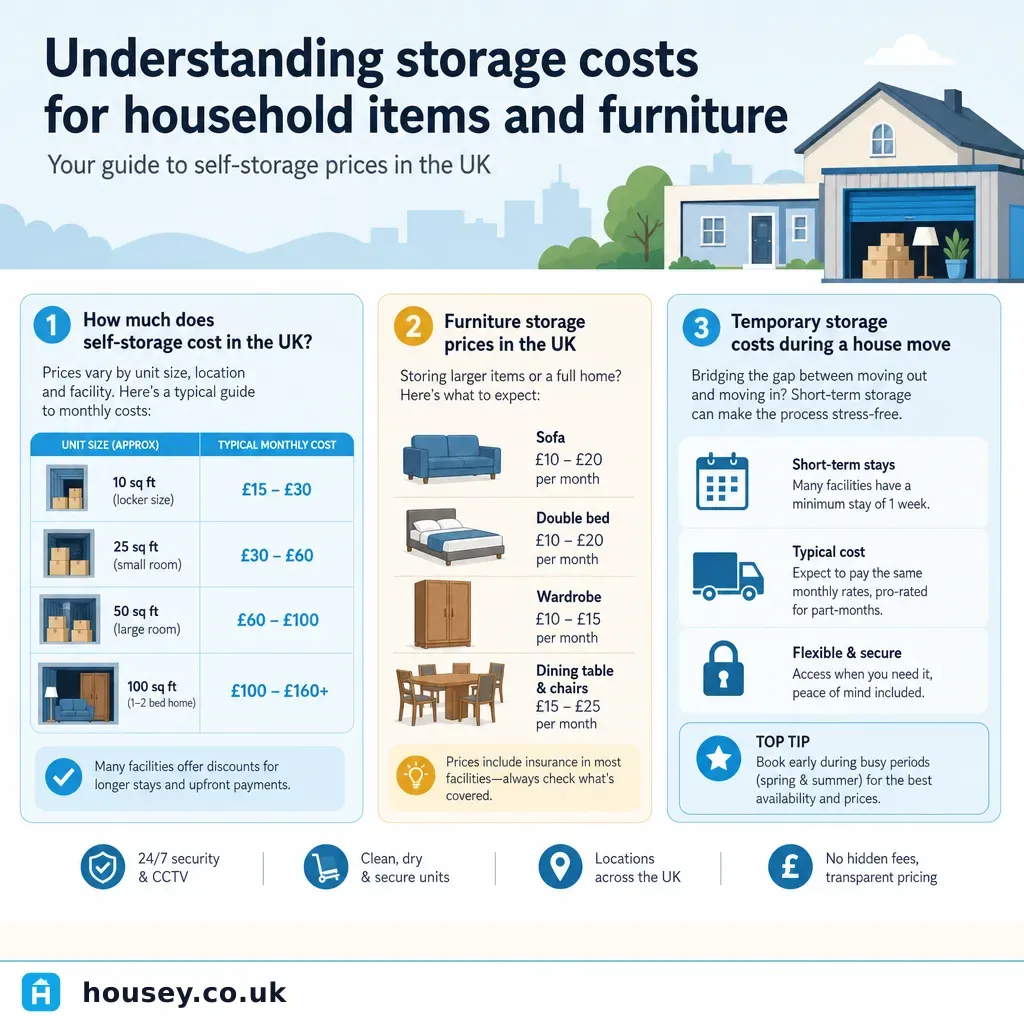
Understanding storage costs for household items and furniture
Self-storage in the UK typically costs £15–£80 per week depending on unit size and location, with London and the South East around 30–50% more expensive.
 Buying & Moving
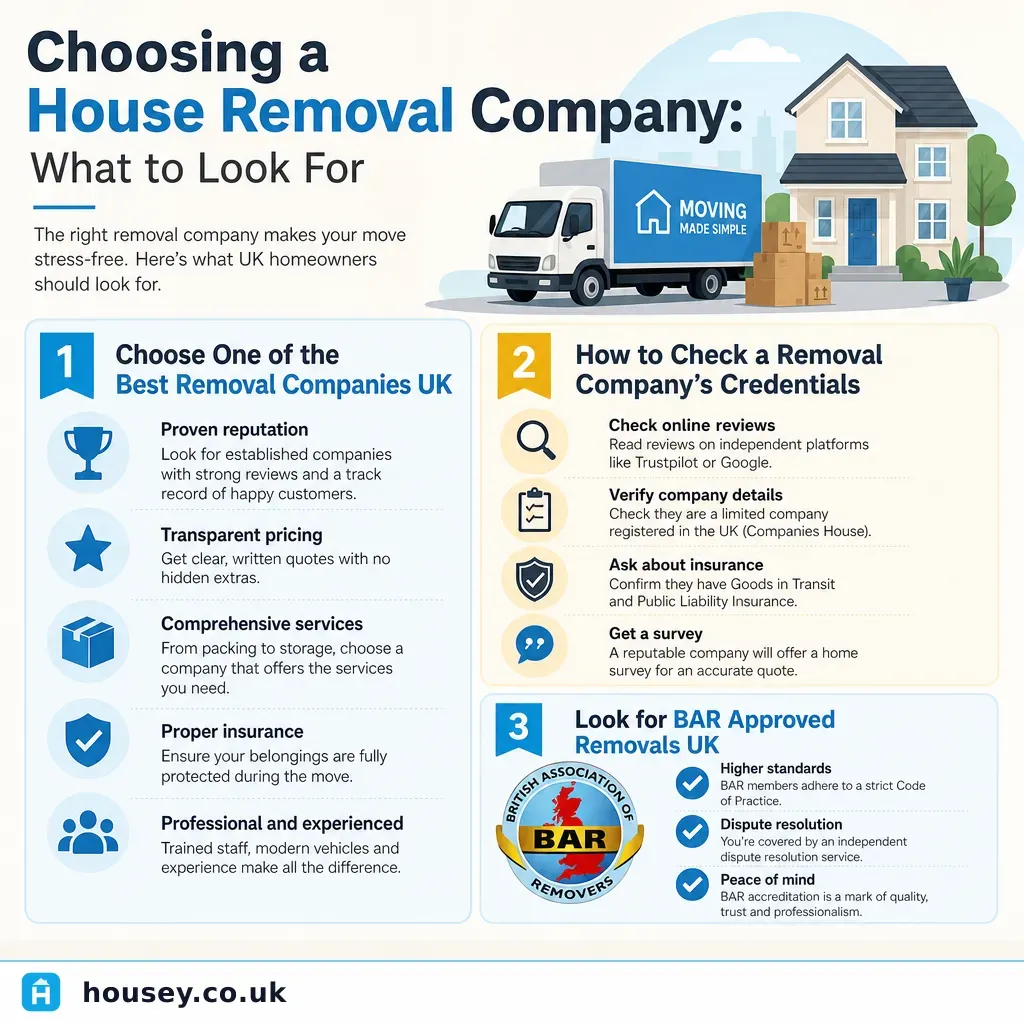
Choosing a House Removal Company: What to Look For
Choose a UK removal company that belongs to the British Association of Removers (BAR) or the Removals Industry Ombudsman Scheme (RIOS), carries goods-in-transit and public liability insurance, and provides a written quote after properly surveying your home.