Understanding storage costs for household items and furniture
By Housey · Last reviewed 6th of May 2026
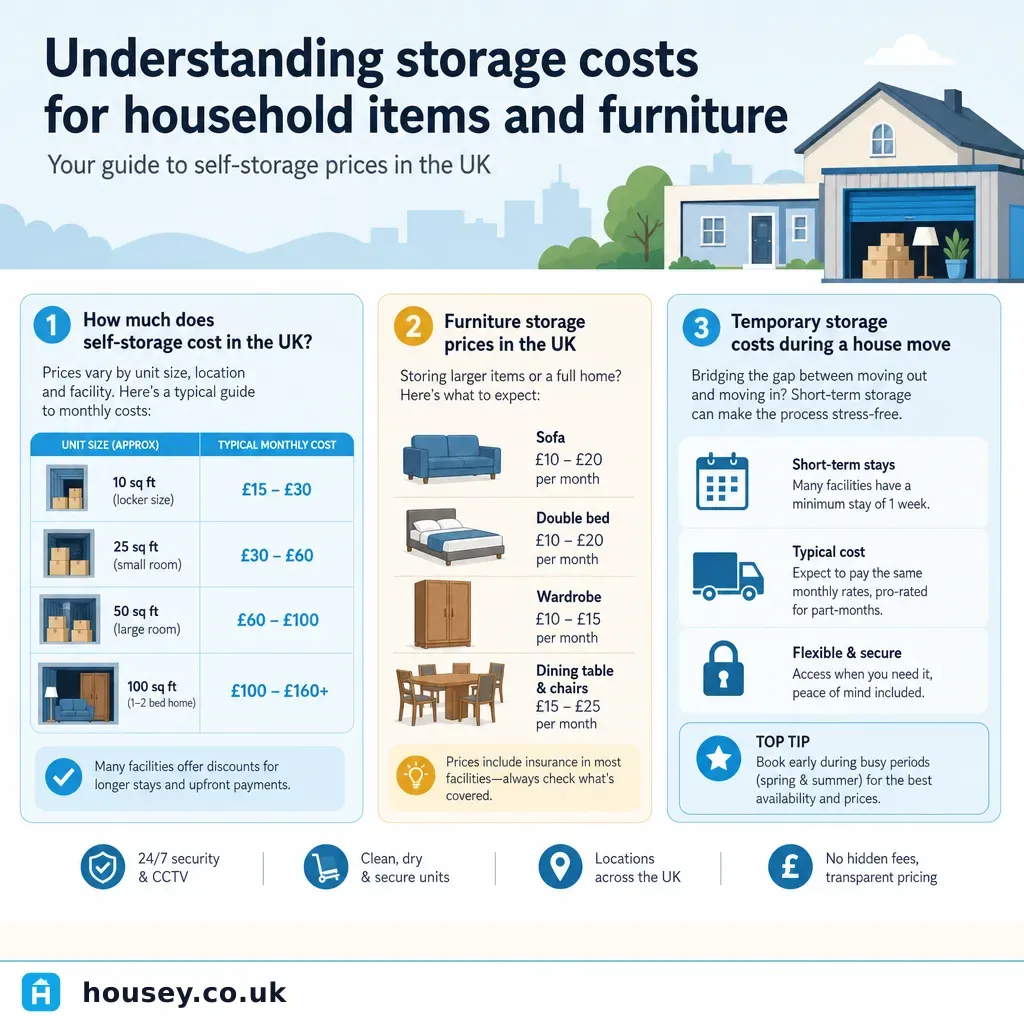
Understanding storage costs for household items and furniture
Moving home, carrying out a major renovation, downsizing, or dealing with a probate clearance are all situations where UK homeowners need somewhere safe to put their belongings — sometimes for a few weeks, sometimes for several months. The UK self-storage sector is well established and competitive, but prices vary considerably by unit size, location, access type, and contract length, which makes it worth understanding the structure before signing anything.
Key points
- The Self Storage Association UK (SSA UK) is the main trade body for UK operators; membership is a useful indicator of site security, professional standards, and complaints processes.
- A 50 sq ft self-storage unit — roughly the contents of a standard single bedroom — typically costs £25–£55 per week outside London, and £40–£80 per week in London and the South East.
- Most self-storage contracts are rolling monthly with a two-to-four-week notice period; introductory discounts of up to 50% are common for the first four to eight weeks and are often worth negotiating.
- Standard UK home contents insurance policies generally do not cover possessions held at a third-party storage facility — check your policy before storing valuables, and ask whether the operator offers on-site cover.
- Container storage (depot-based or mobile) is typically 20–40% cheaper than an equivalent self-storage unit, but access is usually by appointment rather than on demand.
What types of storage are available in the UK?
Homeowners have four main options, each with different trade-offs between cost, convenience, and flexibility.
Self-storage facilities Drive-up or interior-access units within a managed, alarmed facility. You hold the padlock key; the operator has no access to your unit. Sizes range from locker-sized (25 sq ft) to large (400 sq ft or more). Most sites offer extended or 24-hour access and on-site CCTV.
Container storage A steel shipping container delivered to your door (mobile container) or held at a secure depot. You load it yourself; the operator collects and stores it off-site. Access requires booking a slot at the depot. Generally cheaper than self-storage for equivalent volume, but less flexible.
Removal company storage Many UK removal firms offer short- or medium-term warehousing, often as part of a combined move-and-store package. Belongings are palletised or containerised within a warehouse. Access may be restricted to set days or available only by prior arrangement.
Furniture and antiques specialists Facilities focused on valuable, delicate, or irreplaceable items: padded individual vaults, climate control, and item-level logging. Costs are substantially higher but appropriate for antiques, fine art, or sensitive documents.
How much does storage cost in the UK?
Indicative UK costs, last reviewed 2026-05-06. Prices vary by location, operator, and unit type. Always request itemised quotes including VAT.
Unit size | Approximate contents | Weekly cost (outside London) | Weekly cost (London/South East) |
|---|---|---|---|
25 sq ft (locker/small) | Boxes, small items | £15–£30 | £25–£50 |
50 sq ft (single bedroom) | Bedroom contents, boxes | £25–£55 | £40–£80 |
100 sq ft (one-bed flat) | Flat contents minus appliances | £45–£100 | £70–£150 |
200 sq ft (two–three-bed house) | Most of a house | £80–£180 | £130–£280 |
20ft container (depot) | Whole-house equivalent | £60–£130/week | £100–£200/week |
Most operators also charge a one-off administration fee (typically £15–£30) and require purchase or deposit of a padlock. VAT at 20% applies to all rental costs.
Comparing storage types: which suits your situation?
Type | Best for | Not ideal for | Access | Approximate cost vs self-storage |
|---|---|---|---|---|
Self-storage (drive-up or interior) | Frequent access; short-term between moves | Large volumes on a tight budget | Usually daily or 24/7 | Baseline |
Container storage (mobile or depot) | Cost-sensitive; single load and unload | Regular or spontaneous access needs | By appointment | 20–40% less |
Removal company storage | Combined with a house move; medium-term | Frequent or flexible access requirements | Varies by operator | Broadly comparable |
Furniture and antiques specialist | Valuable, fragile, or irreplaceable items | Standard household goods on a budget | By appointment | 30–100% more |
Worked example: the Patel family between completions in Leicester
The Patel family sell their three-bedroom 1970s semi in Leicester before their onward purchase completes. They need around ten weeks of storage for the contents of two bedrooms, a living room, and a garage — roughly 160 sq ft of furniture, boxes, and appliances.
- Self-storage unit (150 sq ft) in Leicester: approximately £60–£75 per week = £600–£750 for ten weeks, plus administration fee and VAT.
- Container storage (20ft, depot-based): approximately £55–£65 per week = £550–£650 for ten weeks.
- Removal company combined package: the removal firm quotes £2,100 for the full move including ten weeks' storage, compared to roughly £1,400 for the move alone. The additional £700 covers storage and removes the need to organise van hire to transport items to a separate self-storage site.
The family opted for the combined removal and storage package, which simplified logistics and eliminated the cost and effort of a separate storage run.
What to check before booking storage
What not to assume
"My home insurance covers items in storage." Standard home contents policies typically cover possessions at your home address. Off-site storage usually requires a specific policy extension or separate specialist cover. Check with your insurer before storing anything of value, and ask whether the storage operator offers on-site insurance — many do, at a modest weekly premium.
"All facilities charge similar prices." Prices can differ by 50% or more between two facilities in the same town. Ground-floor or drive-up units are often priced higher than interior or upper-floor spaces at the same site. Always get at least three quotes.
"The advertised price is the all-in price." Introductory offers frequently revert to the standard rate after four to eight weeks. Ask what the full weekly rate is after any promotional period, and calculate your total cost at that rate before committing.
"Container storage means slow or difficult access." Many depot operators offer next-working-day access windows, and some allow same-day access with sufficient notice. For homeowners who load and unload once, depot access can be more convenient than travelling to a distant self-storage park.
When to get professional help
Storage is a straightforward commercial service, but a few situations warrant extra care:
- If you are storing antiques, fine art, wine, or sensitive documents, choose a specialist facility with padded vaults, climate control, and item-level logging rather than a standard self-storage unit.
- If items belong to a probate estate, consult a solicitor before removing and storing anything — establishing what is in the estate and who has legal authority to act is important before items are moved.
- If belongings include electrical equipment with lithium batteries (e-bikes, power tools, mobility scooters), check the operator's terms carefully; many facilities restrict these due to fire risk.
How Housey can help
If you are planning a move and need both removal and storage services, Housey can help you request and compare quotes from trusted UK providers. Explore storage services or house removals to compare options in your area side by side.
Frequently asked questions
How far in advance should I book storage when moving house?
For self-storage, two to four weeks' notice is usually sufficient outside peak periods. Demand rises in summer (June–August) and at month-ends when many tenancies change over. Container storage deliveries may need a week or more of lead time. Book early if your moving date falls near school holidays or the end of a calendar month.
Can I store a sofa in self-storage?
Yes. A 50–75 sq ft unit is typically large enough for a standard three-seater sofa and additional smaller items. Disassemble legs where possible, and wrap upholstered items in breathable dust sheets rather than plastic, which can trap moisture and lead to mildew during longer storage periods.
Is there a minimum rental period for self-storage in the UK?
Most UK self-storage operators set a minimum of one to four weeks. Some offer daily rates for very short-term needs, though these are proportionally more expensive. Container storage typically has a minimum of one calendar month. Always confirm the notice period required to end the contract before you sign.
Are storage costs tax-deductible?
For private homeowners, storage costs are not generally tax-deductible. Landlords storing items temporarily between tenancies may be able to claim storage as an allowable letting expense if it relates directly to a rental property. Speak to a qualified tax adviser for guidance specific to your circumstances.
What items cannot be stored in UK self-storage?
Standard exclusions include flammable or explosive materials, perishable food, live plants or animals, and illegal goods. Many facilities also restrict lithium batteries and certain chemicals. Some operators exclude legally held firearms. Exclusions vary between facilities, so always read the operator's terms and conditions before booking.
Sources and further reading
- Self Storage Association UK: find a member facility — Self Storage Association UK (SSA UK)
- Citizens Advice: moving home — Citizens Advice
- Association of British Insurers: home insurance guidance — Association of British Insurers (ABI)
- GOV.UK: income tax when you rent out a property — allowable expenses — GOV.UK
Useful next reads
 Buying & Moving
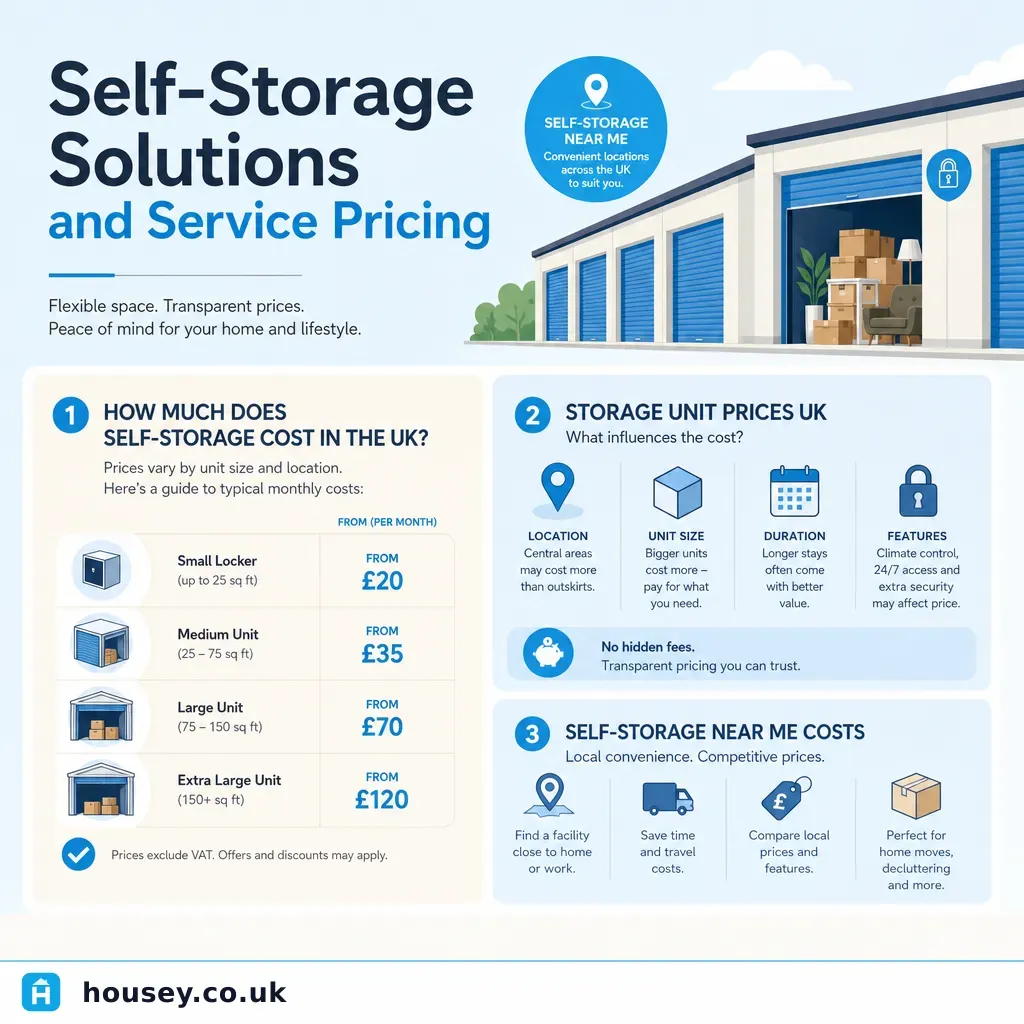
Self-Storage Solutions and Service Pricing
UK self-storage prices typically range from £8–£35 per week for small lockers to £80–£200 or more per week for large rooms in major cities.
 Buying & Moving
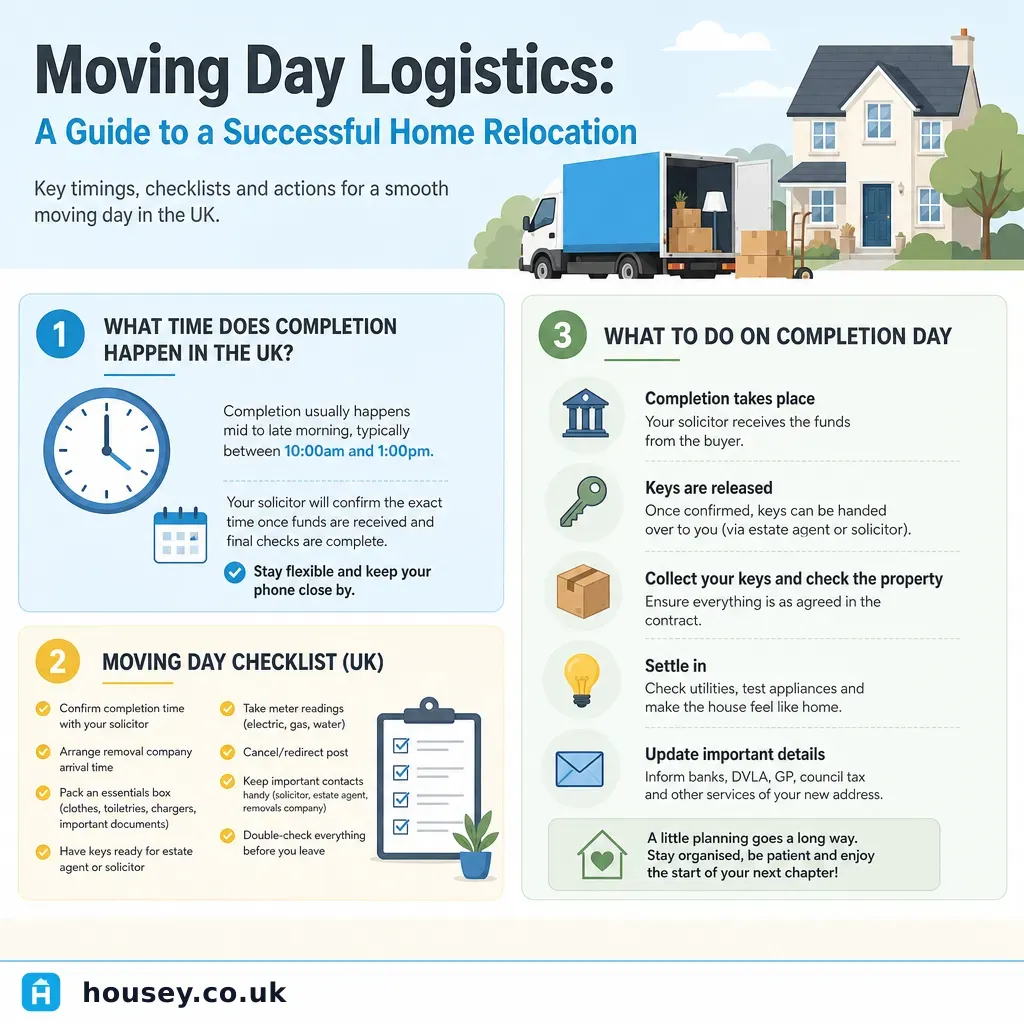
Moving Day Logistics: A Guide to a Successful Home Relocation
On moving day, wait for your solicitor to confirm completion before collecting keys — there is no fixed handover time and most UK completions happen between 11am and 2pm.
 Buying & Moving
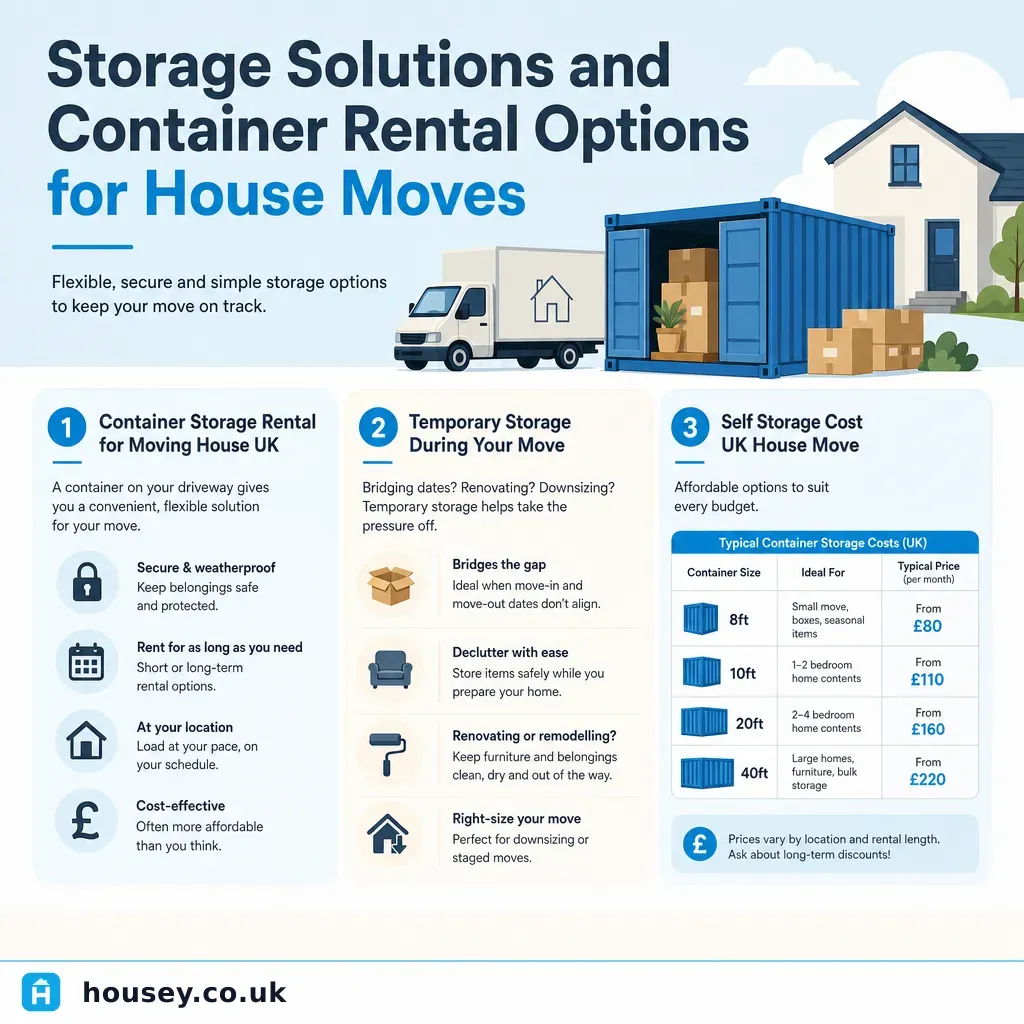
Storage Solutions and Container Rental Options for House Moves
When moving house in the UK, temporary storage options include self-storage units, portable storage containers delivered to your door, and removal company storage vans.
 Buying & Moving
Professional House Removal Services: Costs and Logistics
Professional house removal services in the UK typically cost £800–£2,000 for a 3-bedroom local move, rising to £1,500–£4,000 for long-distance relocations.
 Buying & Moving
Understanding the Costs Involved in Your Property Transaction
Buying a property in the UK typically costs 2–5% above the headline price once stamp duty, conveyancing fees, survey costs, mortgage arrangement fees, and removal costs are added.