Choosing the Right Removal Company: What to Look For
By Housey · Last reviewed 18th of May 2026
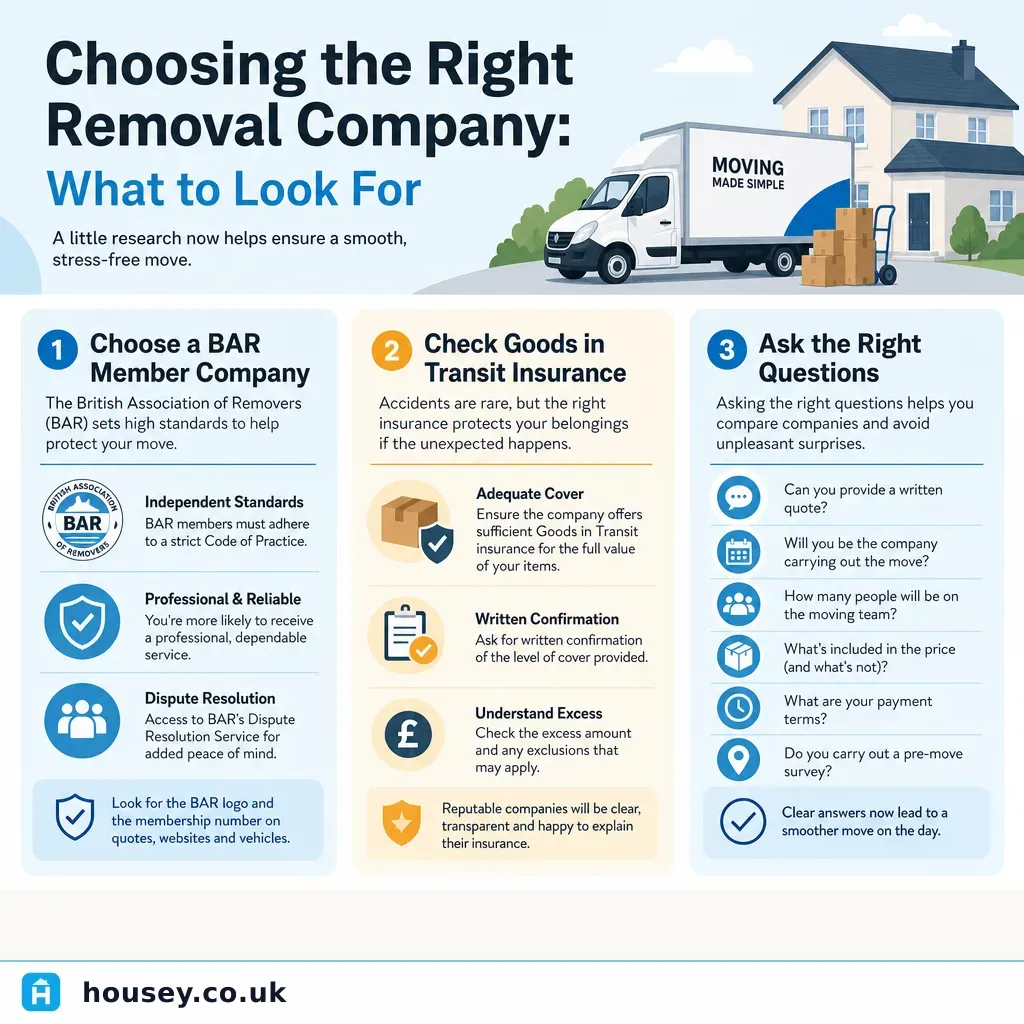
Choosing the Right Removal Company: What to Look For
Moving house is one of the most logistically complex days in a homeowner's life, and the removal company you choose will largely determine whether it goes smoothly or expensively wrong. Whether you are moving across town or across the country, the difference between a well-organised professional firm and an unvetted operator can mean the difference between everything arriving safely and a drawn-out damage dispute. During spring and summer peak seasons — and particularly on Fridays and month-end completion dates — demand is high and service quality varies widely.
Key points
- The British Association of Removers (BAR) is the UK's main trade body for removal firms; BAR members must follow a code of practice approved by the Chartered Trading Standards Institute (CTSI) and carry a consumer deposit protection scheme.
- Goods-in-transit insurance is not automatically included in every quote — confirm coverage limits, exclusions, and the excess per claim in writing before booking.
- A reputable removal firm will conduct a pre-move survey (in person or by video call) before issuing a quote; avoid firms that price solely over the phone without viewing your belongings.
- Under the Consumer Rights Act 2015, services must be carried out with reasonable care and skill, but this does not replace the need for specialist goods-in-transit insurance covering your belongings.
- Storage-in-transit is frequently needed when completion dates slip; confirm in advance whether your chosen firm can provide this and at what daily or weekly rate.
What does a professional removal company do?
A full professional removal service typically covers packing, loading, transporting, and unloading your belongings at the destination. Some firms also offer unpacking, furniture reassembly, and specialist handling for pianos, antiques, fine art, or wine collections. At the other end of the scale, a man-and-van service handles transport only — you supply all the packing and loading.
Understanding what you need before requesting quotes helps you compare like for like. A common mistake is comparing a full-packing quote from one firm against a transport-only quote from another and assuming the difference is purely profit margin.
Confirm these service elements before requesting quotes:
- Packing (full, partial, or transport only)
- Specialist item handling (piano, antiques, fragile artwork, wine)
- Disassembly and reassembly of furniture
- Storage-in-transit if there may be a gap between your completion dates
- International shipping, if you are moving abroad
- House clearance for items you do not plan to take
How to compare removal companies fairly
Factor | What to check | Why it matters |
|---|---|---|
Trade body membership | BAR, NGRS, or equivalent | Code of practice, consumer protection, and formal dispute resolution access |
Goods-in-transit insurance | Cover amount, exclusions, and excess per claim | Your belongings may have no protection without this |
Survey method | In-person or video survey before quoting | Ensures accurate pricing; reduces risk of extras on moving day |
Quote type | Binding or estimated | Binding quotes protect against unexpected charges |
Crew and vehicle | Number of crew, vehicle size, number of trips needed | Affects completion time and risk of overloading |
Subcontracting | Will the firm carry out the work itself or pass it on? | Affects quality control and accountability |
Verified reviews | Google, Trustpilot, BAR member directory — check recency | Real customer experience beyond marketing claims |
Payment terms | When is final payment due? | Avoid firms requiring full payment before moving day |
Which accreditations and memberships matter?
British Association of Removers (BAR): The most widely recognised trade body for UK removal companies. BAR members must adhere to the BAR Code of Practice, approved by the Chartered Trading Standards Institute (CTSI). Members also participate in the BAR Advance Payment Guarantee, which protects your deposit if the firm becomes insolvent before moving day.
National Guild of Removers and Storers (NGRS): A second reputable trade association with its own code of conduct. Some smaller regional firms belong to NGRS rather than BAR.
Checkatrade and Trustpilot: These platforms carry customer reviews but do not verify trading standards compliance in the same way as BAR or NGRS. Use them to supplement — not replace — trade body membership checks.
Firms without any trade body membership are not automatically poor performers, but the formal consumer protections available to you if something goes wrong are weaker and less structured.
Understanding removal insurance
Three types of insurance are relevant when moving house:
- Goods-in-transit insurance — covers your belongings while they are being moved. This should be provided by the removal firm, but limits and exclusions vary. Check the per-item limit and whether items you pack yourself, fragile items, or high-value items are covered.
- Storage insurance — if your belongings enter short or long-term storage, check whether the facility carries its own cover or whether the removal firm's policy extends to stored goods.
- Home contents insurance — some policies include limited removal cover; check with your insurer before moving day, as conditions apply.
If the removal firm's goods-in-transit cover seems insufficient for the total value of your belongings, standalone specialist removal insurance is available from specialist providers. Ask your removal company or insurance broker for options.
Homeowner checklist: preparing for removal quotes
Before contacting removal companies, prepare the following:
What to ask before accepting a quote
- Is this a binding quote or an estimate, and what could change the final price?
- What goods-in-transit insurance do you carry, and what is the per-item limit and excess?
- Will the crew who conduct the survey be the same people carrying out the move?
- Do you subcontract any part of this work to another firm?
- What happens if completion is delayed and the van cannot wait at the destination?
- Can you provide storage-in-transit, and what is the daily or weekly rate?
- What is your process if an item is damaged during the move?
- Is VAT included in this quote?
- When is final payment due, and what are your cancellation terms?
Red flags to watch for
Be cautious if you encounter these warning signs when evaluating removal firms:
- Quote given without a survey — a firm pricing solely over the phone without viewing your belongings is guessing, and may add charges on moving day.
- Very low quote with vague terms — significant underpricing can signal hidden extras later or minimal insurance cover.
- Full payment demanded upfront — reputable firms typically take a deposit; full advance payment increases your risk if the firm cancels or underperforms.
- No written contract — any professional firm should provide a written agreement covering scope, price, insurance, and cancellation terms before the move.
- No trade body membership and no verifiable reviews — not disqualifying on its own, but reduces the formal consumer protections available to you.
- Social media as the sole contact channel — makes it harder to verify the firm's identity, insurance status, and accountability.
When to get professional help
For most domestic moves, choosing a removal company carefully is the primary professional decision you need to make. However, seek specialist support in these situations:
- High-value or irreplaceable items such as fine art, antiques, pianos, or wine collections may require a specialist fine art removal firm rather than a general remover.
- International moves involve customs paperwork, export controls, and potentially quarantine rules — use a firm that is a FIDI member or belongs to the BAR International Group.
- Disputed damage claims — if a firm disputes your claim, BAR's Alternative Dispute Resolution (ADR) service can help resolve it without going to court.
- Uncertain completion dates — if your chain has multiple simultaneous completions, confirm storage-in-transit arrangements before moving day, not on it.
How Housey can help
Housey connects you with vetted house removals companies across the UK, so you can compare quotes from firms that have been checked for trade body membership and insurance coverage. If you need storage between moves, are planning international removals, or need house clearance before or after a move, Housey can connect you with the right specialist.
Frequently asked questions
Should I always choose a BAR member removal company?
BAR membership is a strong signal of professionalism and provides consumer protections, including a deposit guarantee if the firm becomes insolvent before moving day. It is not a legal requirement, and some reputable firms are not BAR members — but membership gives you access to a formal dispute resolution route that is harder to reach with an unaffiliated operator.
How far in advance should I book a removal company?
For moves during busy periods — spring and summer, Fridays, and month-end completion dates — booking 6–8 weeks ahead is sensible. In quieter periods, 2–4 weeks is often sufficient. Avoid booking too far ahead if your completion date is uncertain, as cancellation fees may apply depending on the firm's terms.
What is storage-in-transit and do I need it?
Storage-in-transit is short-term storage arranged when your move-out and move-in dates do not align — typically when completion on your purchase is delayed after you have already vacated. Some removal firms include this as standard; others charge a daily or weekly rate. Confirm the terms before committing if your chain involves multiple simultaneous completions.
Can I pack my own boxes to reduce the cost?
Yes, and most removal firms permit this. However, items you pack yourself are often excluded from goods-in-transit insurance — damage inside a self-packed box may not be covered. Confirm this specifically with your removal company before deciding how much packing to handle yourself.
What if my belongings are damaged on moving day?
Report any damage in writing on the day or as soon as possible afterwards, and photograph it before moving the item. Most professional firms have a claims process, and BAR members are required to offer access to Alternative Dispute Resolution (ADR). If the firm disputes a valid claim, the ADR process or the civil courts are your escalation routes.
Sources and further reading
- British Association of Removers (BAR) — Code of practice, member directory, and consumer deposit protection scheme
- National Guild of Removers and Storers (NGRS) — Trade body membership and standards
- Chartered Trading Standards Institute (CTSI) — Approval body for the BAR Code of Practice
- Problems with a service: your consumer rights — Citizens Advice
- FIDI Global Alliance — International removal standards and accredited member directory
Useful next reads
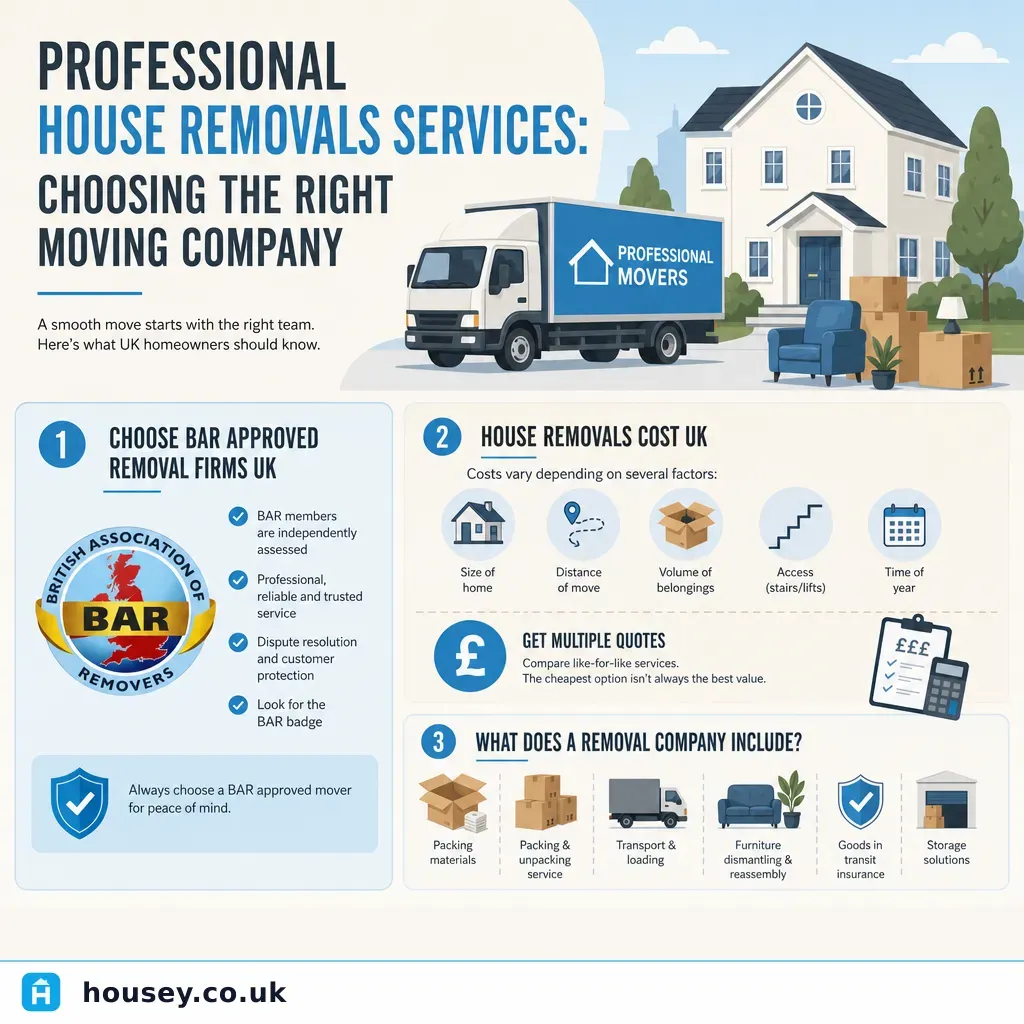 Buying & Moving
Professional House Removals Services: Choosing the Right Moving Company
A professional house removals company handles loading, transport, and unloading; full-service firms with BAR membership also offer deposit protection and independent dispute resolution.
 Buying & Moving
Professional House Removals: Finding the Right Moving Company
Finding the right house removals company involves checking membership of a recognised trade body such as the British Association of Removers (BAR), confirming goods-in-transit insurance cover, and comparing itemised written quotes.
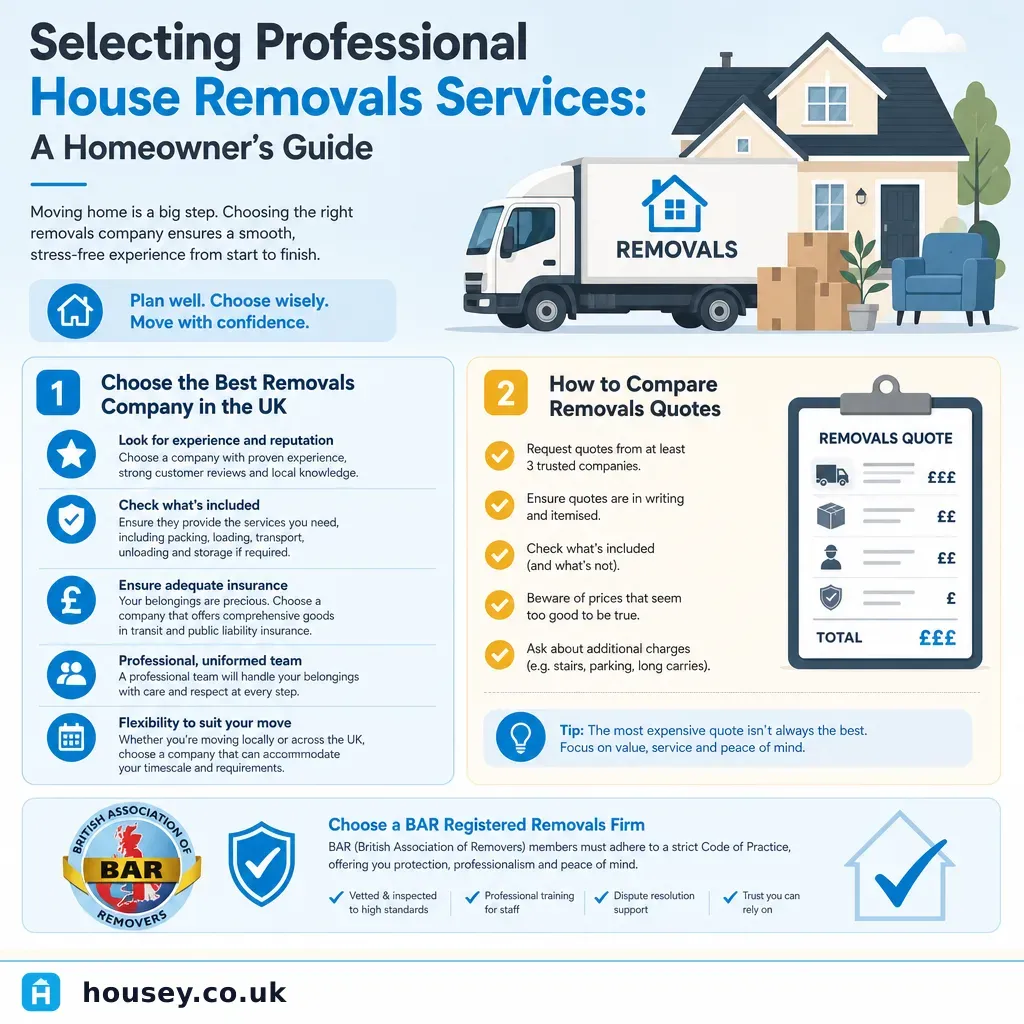 Buying & Moving
Selecting Professional House Removals Services: A Homeowner's Guide
Choose a removals firm registered with the British Association of Removers (BAR), which carries out a pre-move survey before quoting and provides a written binding quotation with goods-in-transit insurance.
 Buying & Moving
Relocating your family home for better school access: planning your house move
Moving for a better school means timing your purchase against two hard constraints: the admissions deadline and the conveyancing timeline.
 Buying & Moving
Choosing a House Removal Company: What to Look For
Choose a UK removal company that belongs to the British Association of Removers (BAR) or the Removals Industry Ombudsman Scheme (RIOS), carries goods-in-transit and public liability insurance, and provides a written quote after properly surveying your home.