Cross-Border Property Move: England to Scotland — Process and Differences
By Housey · Last reviewed 24th of May 2026
Cross-Border Property Move: England to Scotland — Process and Differences
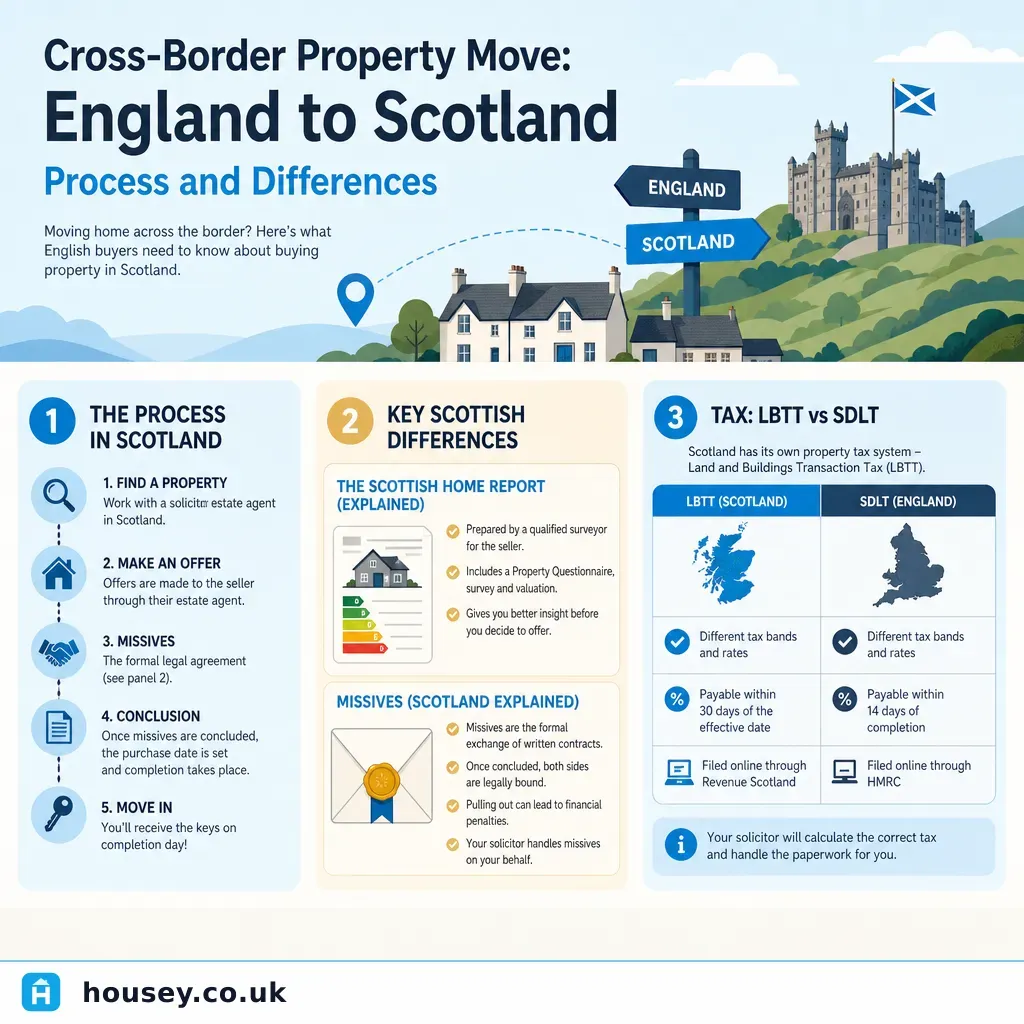
Moving from England to Scotland is one of the most common domestic relocations in the UK, yet the two nations operate entirely separate legal systems for property transactions. Processes familiar from the English market — making an offer, instructing a conveyancer, exchanging contracts — work quite differently north of the border. Misunderstanding the differences can produce delays, unexpected costs, or binding legal commitments made earlier than you anticipated.
Key points
- In Scotland, an accepted offer creates a binding contract once missives are concluded — there is no equivalent of the England and Wales exchange of contracts step, and gazumping is effectively eliminated once that point is reached.
- The Home Report (mandatory since December 2008 under the Housing (Scotland) Act 2006) must be provided by the seller before the property can be marketed; buyers in Scotland do not typically commission their own survey as a first step.
- Scottish property transactions require a solicitor regulated by the Law Society of Scotland; English solicitors and licensed conveyancers cannot act on a Scottish purchase.
- Land and Buildings Transaction Tax (LBTT), administered by Revenue Scotland, replaces Stamp Duty Land Tax (SDLT) for Scottish properties; rates, thresholds, and rules differ from England.
- Title is registered at the Land Register of Scotland (maintained by Registers of Scotland), not at HM Land Registry.
The Home Report: Scotland's pre-marketing requirement
Before a property can be marketed in Scotland, the seller must commission a Home Report from a RICS-qualified surveyor. The Home Report contains three documents:
Document | What it covers |
|---|---|
Single Survey | Condition inspection and market valuation (broadly comparable in scope to a RICS Level 2 survey) |
Energy Report | Energy Performance Certificate (EPC) and energy efficiency rating |
Property Questionnaire | Seller-declared information: council tax band, utilities, factoring arrangements, alterations, disputes |
As a buyer moving from England, you have the right to request the Home Report from the seller or their agent before submitting a formal offer. You may also instruct an additional independent survey — a RICS Level 3 Building Survey or a structural specialist report — if the property is older, of unusual construction, or the Single Survey reveals condition concerns. The Single Survey is instructed and paid for by the seller, so an independent assessment provides an extra layer of assurance.
How Scottish offers and missives work
In England, a verbal or written offer is not legally binding; you can withdraw at any point before exchange of contracts. In Scotland, the process works differently:
- Noting interest — your Scottish solicitor informs the selling agent of your interest. This is not binding but signals intent and means the agent should notify you if a closing date is set.
- Formal written offer — your solicitor submits a formal offer setting out price, conditions, and proposed date of entry (the completion date).
- Qualified acceptance and conclusion of missives — the seller's solicitor responds with qualifications; both sets of solicitors negotiate until all terms are agreed. When missives are concluded, a binding contract exists.
- Disposition and settlement — on the date of entry, the title is transferred by Disposition deed, funds are transferred, and keys are released.
Once missives are concluded, withdrawal exposes you to significant financial liability. Do not conclude missives until your mortgage offer is confirmed, survey concerns are resolved, and your proposed date of entry is genuinely achievable alongside any English sale.
Pricing conventions: offers over, fixed price, offers around
Scottish property listings use pricing conventions unfamiliar to many English buyers:
- Offers over (OO): a guide price; bids are typically submitted above it, often at a competitive closing date.
- Fixed price: the first buyer to offer the fixed price and be accepted generally wins; no competitive bidding process.
- Offers around (OA): an invitation to offer near the stated figure; more negotiable than offers over.
When multiple parties note interest, the selling solicitor sets a closing date for sealed bids. All offers must be submitted by that deadline; the seller then selects their preferred offer.
Land and Buildings Transaction Tax
In Scotland, LBTT replaces SDLT. Rates and thresholds are set by the Scottish Parliament and change periodically — always verify current figures with Revenue Scotland before budgeting.
An Additional Dwelling Supplement (ADS) applies if you complete the Scottish purchase while still owning your English home, since you will temporarily hold two residential properties. The ADS rate is set by the Scottish Parliament. If you sell your previous main residence within 18 months of completing the Scottish purchase, you may be eligible to reclaim the ADS from Revenue Scotland.
Which professionals you need
Role | England and Wales | Scotland |
|---|---|---|
Conveyancer | Solicitor or licensed conveyancer | Solicitor only (Law Society of Scotland) |
Survey / valuation | Buyer instructs independently after offer accepted | Home Report from seller; additional survey optional |
Tax authority | HMRC (SDLT) | Revenue Scotland (LBTT) |
Land registration | HM Land Registry | Registers of Scotland |
Mortgage lender | Standard UK lenders | Confirm lender is registered to lend in Scotland |
Instruct a Scottish solicitor before you note interest on a property, not after an offer has been accepted. Many Scottish solicitors also act as estate agents, which is a common arrangement north of the border.
Transaction timeline comparison
Stage | England and Wales | Scotland |
|---|---|---|
Survey or valuation | Buyer commissions after offer accepted | Home Report available before offer |
Binding contract created | Exchange of contracts | Conclusion of missives |
Withdrawal penalties apply | After exchange | After conclusion of missives |
Completion terminology | Completion date | Date of entry |
Typical transaction length | 8–16 weeks from offer | 6–12 weeks from offer to date of entry |
Important limitations
This article provides general information about the Scottish conveyancing process as it typically applies to residential purchases. Individual transactions vary considerably. Legal advice for a specific Scottish property purchase must come from a solicitor qualified and regulated by the Law Society of Scotland. Tax positions depend on individual circumstances; consult Revenue Scotland guidance and take professional tax advice for your specific situation.
When this becomes urgent
Seek professional advice immediately if:
- A closing date has been set and you are considering submitting a formal offer
- Your solicitor has indicated that missives are close to being concluded
- You are uncertain whether missives have been concluded on your transaction
- You have a bridging timeline pressure between selling your English property and completing in Scotland
- The Home Report Single Survey shows condition ratings of 3 (urgent attention required)
What to ask a qualified professional
Scottish solicitor:
- What are the current LBTT rates and will the Additional Dwelling Supplement apply to my purchase?
- Should I commission an additional independent survey beyond the Home Report Single Survey for this property?
- What conditions should I include in my formal offer to protect my position?
- Is the proposed date of entry realistic given my English sale timeline?
- Are there any title burdens or servitudes affecting the property that I should know about?
Mortgage adviser:
- Is my chosen lender registered to lend on Scottish properties?
- Will my lender accept the Home Report Single Survey valuation, or will they require their own?
When to get professional help
Almost every aspect of a Scottish property purchase requires a Scottish-qualified solicitor. Instruct one before you note interest. For older properties, stone-built homes, tenement flats, or any property where the Home Report Single Survey flags condition concerns, consider commissioning an additional RICS Level 3 Building Survey for a more detailed independent assessment.
How Housey can help
Housey can connect you with professionals experienced in Scottish conveyancing solicitors and with RICS surveyors who provide Scottish Home Reports and additional building surveys beyond the standard Home Report Single Survey. Whether you need a solicitor to navigate missives and LBTT or a surveyor for a detailed inspection of an older property, Housey's network covers cross-border transactions.
Frequently asked questions
Can my English solicitor handle my Scottish property purchase?
No. Scottish conveyancing requires a solicitor qualified and regulated by the Law Society of Scotland. English solicitors and licensed conveyancers are not authorised to carry out Scottish conveyancing. Instruct a Scottish solicitor as early as possible — ideally before noting interest on a property — so they can guide you through the offer process and missives from the outset.
Do I pay the Additional Dwelling Supplement if I have not yet sold my English home?
If you own another residential property when you complete the Scottish purchase, the Additional Dwelling Supplement applies on top of standard LBTT because you temporarily own two properties. If you sell your previous main residence within 18 months of completing the Scottish purchase, you may be eligible to reclaim the ADS from Revenue Scotland. Check current rules with your solicitor.
What happens if I withdraw after noting interest but before missives are concluded?
Noting interest is not legally binding; you can withdraw without penalty at any point before missives are concluded. Once missives are concluded, withdrawal exposes you to significant financial liability for the other party's losses. This is why Scottish solicitors stress resolving all due diligence — survey, mortgage, and timing — before concluding missives rather than after.
Is the Home Report Single Survey enough, or should I get my own survey?
The Single Survey provides condition ratings and an indicative valuation, but it is instructed by the seller. If the property is older, has visible defects, or is of unusual construction, consider commissioning an independent RICS Level 3 Building Survey. Your solicitor or the surveying firm that reviewed the Home Report can advise on whether an additional survey is appropriate for the specific property.
Sources and further reading
- Buying a home in Scotland — mygov.scot / Scottish Government
- Home Reports — mygov.scot / Scottish Government
- Land and Buildings Transaction Tax — Revenue Scotland
- Registers of Scotland — Land Register — Registers of Scotland
- Find a solicitor in Scotland — Law Society of Scotland
- Housing (Scotland) Act 2006 — legislation.gov.uk
Useful next reads
 Buying & Moving
Choosing a House Removal Company: What to Look For
Choose a UK removal company that belongs to the British Association of Removers (BAR) or the Removals Industry Ombudsman Scheme (RIOS), carries goods-in-transit and public liability insurance, and provides a written quote after properly surveying your home.
 Buying & Moving
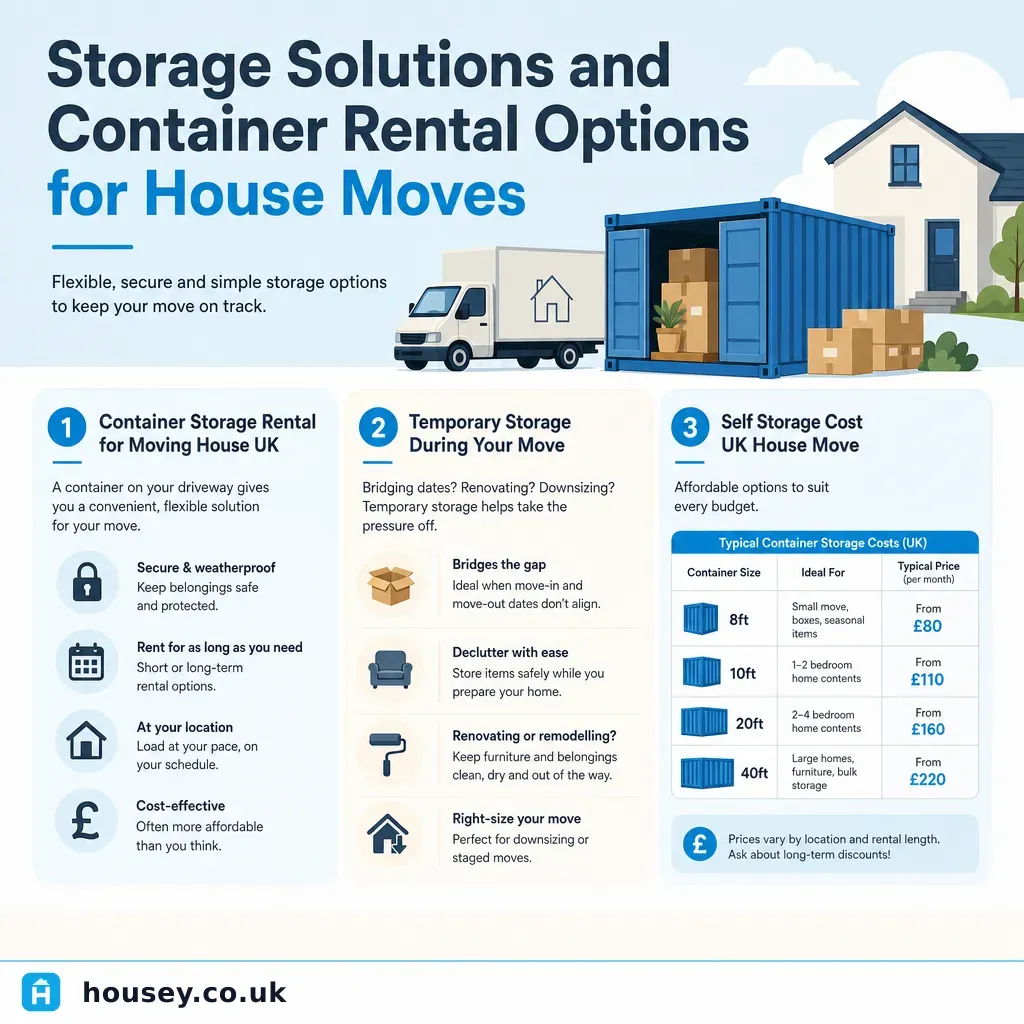
Storage Solutions and Container Rental Options for House Moves
When moving house in the UK, temporary storage options include self-storage units, portable storage containers delivered to your door, and removal company storage vans.
 Buying & Moving
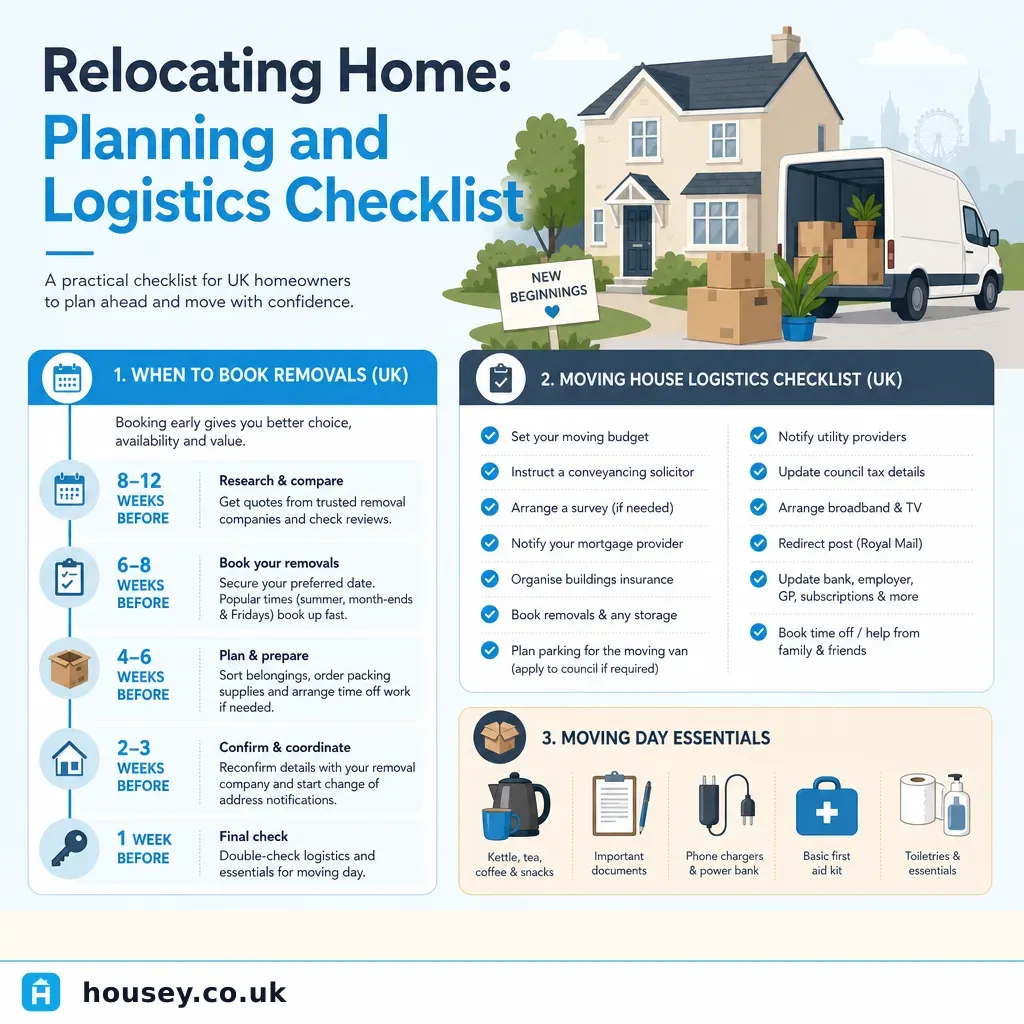
Relocating Home: Planning and Logistics Checklist
Successful home relocation in the UK typically requires 8–12 weeks of advance planning.
 Buying & Moving
Professional House Removal Services: Costs and Logistics
Professional house removal services in the UK typically cost £800–£2,000 for a 3-bedroom local move, rising to £1,500–£4,000 for long-distance relocations.
 Buying & Moving
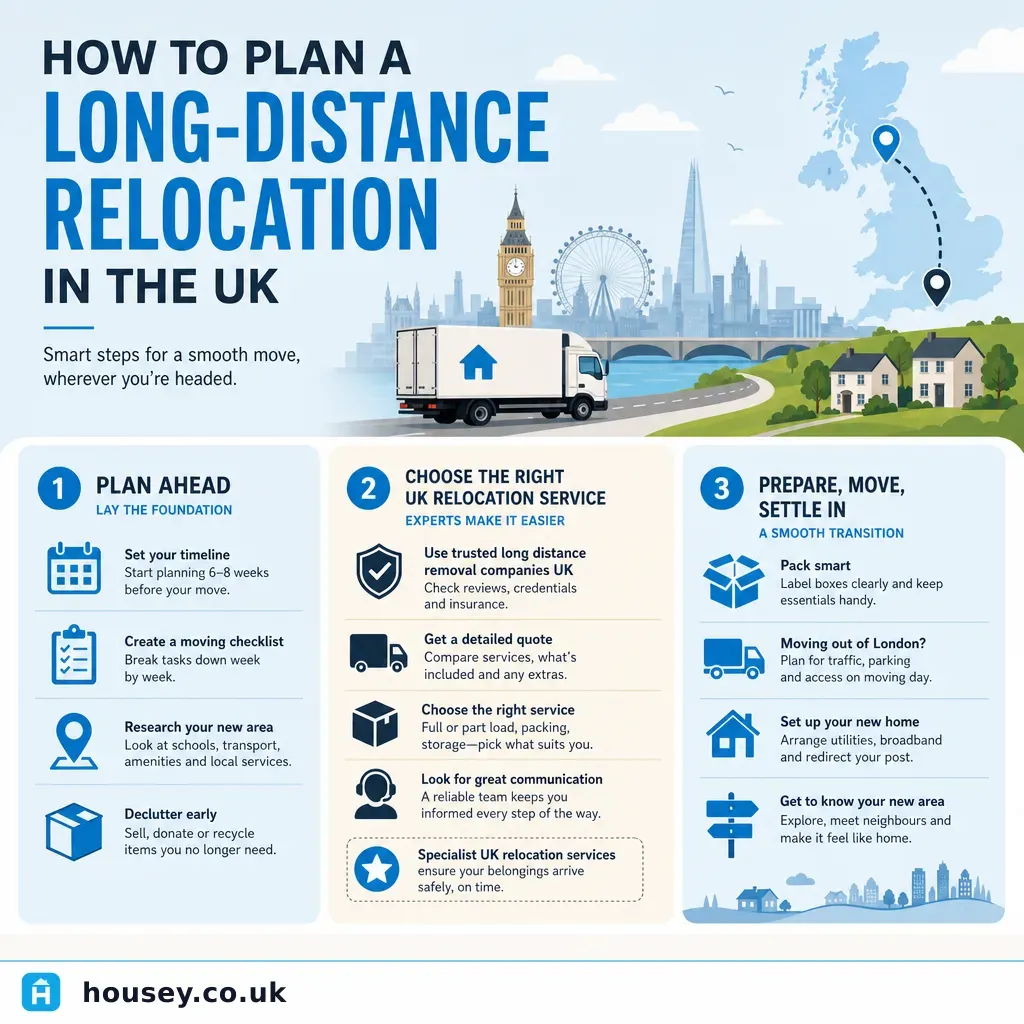
How to Plan a Long-Distance Relocation in the UK
A successful long-distance relocation in the UK involves coordinating removals, conveyancing, storage, and area research well in advance.