Expert Moving Services: Trusted House Removal Solutions
By Housey · Last reviewed 24th of May 2026
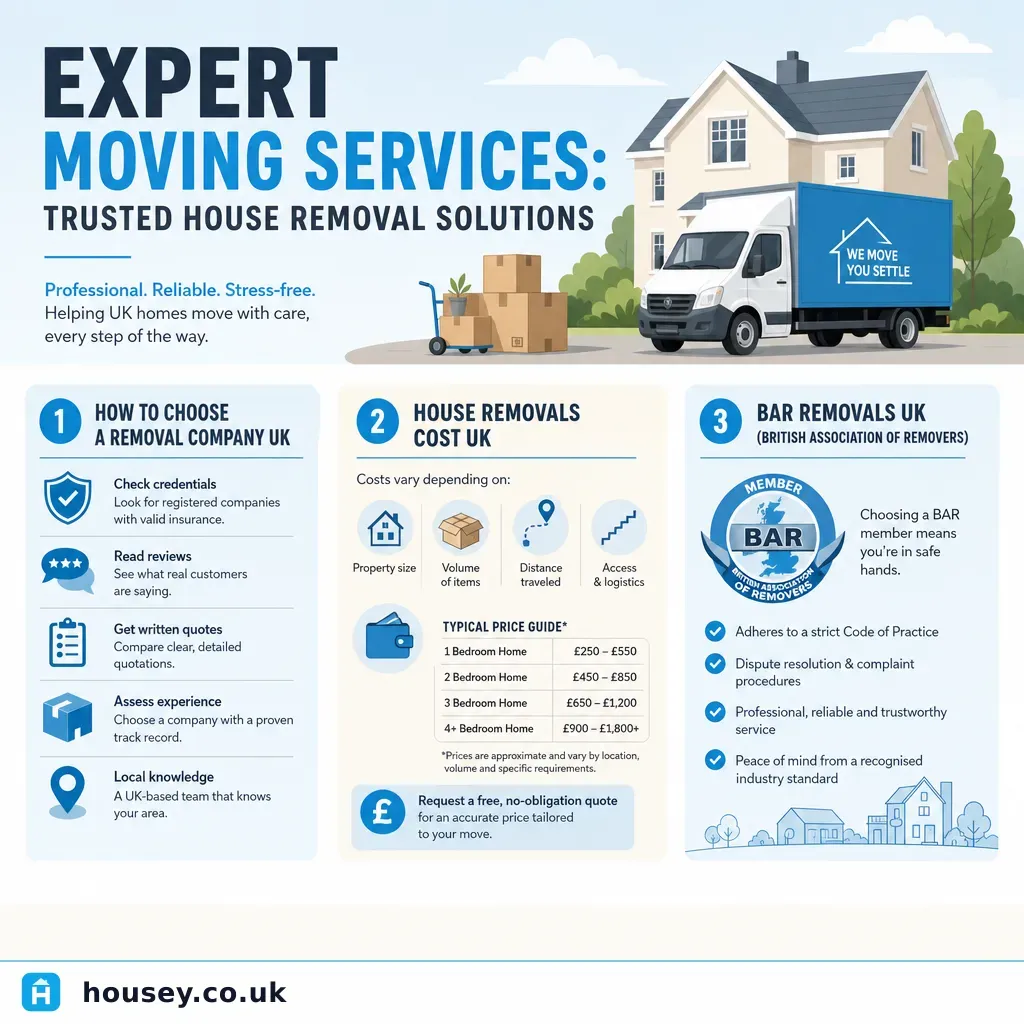
Expert Moving Services: Trusted House Removal Solutions
Moving house in the UK involves far more than loading a van: exchange and completion timelines, chain logistics, access restrictions, and the sheer volume of a family home all create pressure on moving day. Whether you are relocating across a postcode or across the country, choosing the right removal company and preparing methodically is what separates a manageable move from an exhausting one.
Key points
- The British Association of Removers (BAR) is the UK's principal trade body for removal companies; BAR membership requires an Advance Payment Guarantee (APG), which protects your deposit if the company ceases trading before your move.
- Goods-in-transit insurance provided by a removal company is not the same as home contents insurance — confirm the policy limit per item and whether high-value items such as antiques, jewellery, or specialist electronics require separate declaration.
- Completion day in a property chain is not confirmed until contracts are exchanged; book a provisional removal date before exchange and confirm terms for postponement or cancellation in writing before paying any deposit.
- A full packing service, part packing service, and self-pack (removal only) are the three main service tiers; the company's liability for damaged items differs significantly between them.
- Moving volumes peak in June, July, and August, and at calendar month-ends — aim to book at least 6–8 weeks in advance during these periods.
What services does a removal company provide?
Service tier | What is included | Typical scenario |
|---|---|---|
Full packing and removal | Company packs, loads, transports, unloads, and unpacks all items | Families with large volumes, high-value contents, or limited time |
Part packing | Company packs fragile or specialist items; homeowner packs the rest | Balanced approach reducing cost while protecting breakables |
Self-pack, removal only | Homeowner packs everything; company collects, transports, delivers | Budget-conscious moves where the homeowner is confident packing |
Man and van | Smaller-scale moves or single-item deliveries; typically no specialist packing | Studio flats, student moves, or single large items |
Specialist removal | Antiques, pianos, fine art, laboratory or commercial equipment | Items requiring bespoke crating, climate control, or specialist expertise |
A reputable house removal company will survey your property — in person or by video call — before quoting. No accurate price can be given for a family home without understanding the volume, access constraints, and any specialist items involved.
What to look for when choosing a removal company
BAR membership and consumer protection
BAR members must hold an Advance Payment Guarantee (APG) protecting deposits if the company ceases trading, subscribe to BAR's Alternative Dispute Resolution service, and meet BAR's quality and customer service standards.
Other positive signals include: FIDI membership for international moves, Which? Trusted Trader status, and independently verified reviews on recognised platforms.
Insurance cover
Removal companies typically provide:
- Goods-in-transit insurance: covers loss or damage during the move. Check the limit per item and whether self-packed items are excluded or subject to reduced cover.
- Public liability insurance: covers damage to property at loading or delivery addresses.
- Storage insurance: if using the company's facility, confirm your belongings are covered during the storage period.
Your home contents insurance may offer limited transit cover, but terms vary significantly. Clarify with both your insurer and the removal company before moving day.
Quote comparison template
When requesting quotations, ensure each company addresses the following points so you can compare them fairly:
Item to confirm | Notes |
|---|---|
Fixed or variable price | Fixed is preferable; variable estimates can increase if volume exceeds the survey |
What is included | Packing materials, fuel, mileage, loading, unloading, unpacking |
Goods-in-transit cover | Limit per item; excess applicable; self-pack exclusions |
Access survey | In-person or video call survey of both properties |
Cancellation and postponement terms | If completion is delayed in a chain, what fee applies? |
Storage provision | If overnight or bridging storage is needed, is it available and at what cost? |
VAT | Is VAT included in the quoted price? |
Team size and vehicle capacity | Is the crew and vehicle sized appropriately for your volume? |
Parking arrangements | Will they arrange parking suspension permits if required? |
Completion day procedure | What time does the crew arrive? What happens if keys are delayed? |
Obtain at least three written quotations and do not accept verbal-only pricing for a whole-house move.
Moving house checklist
6–8 weeks before:
2–4 weeks before:
Moving day:
Moving internationally?
If you are relocating overseas, the logistics, cost, and regulatory complexity increase substantially. International removals involve customs documentation, import duties, container or groupage shipping, and compliance with destination-country regulations.
FIDI-accredited companies (FAIM standard) are the professional benchmark for overseas moves — FIDI members undergo independent financial and quality audits. For European moves, HMRC's Transfer of Residence Relief may allow you to import household goods duty and VAT free, subject to eligibility and documentation requirements.
When to get professional help
For most domestic moves, a BAR-accredited removal company is all you need. Consider specialist assistance in these situations:
- Antiques, fine art, or musical instruments: standard removal companies may not provide the specialist packaging, crating, or environmental controls required.
- Pianos: require dedicated piano-moving operatives with appropriate lifting equipment.
- Unusually heavy or oversized items: gym equipment, pool tables, large safes — confirm the company has assessed these items before committing to a price.
- Probate and estate clearance: specialist house clearance companies handle sorting, donation, and disposal for estates.
- Difficult access: narrow streets, no-parking zones, or upper-floor properties without lift access — confirm the company has surveyed access before accepting the job.
How Housey can help
Housey connects you with vetted house removal company professionals across the UK, including specialists in storage solutions and international removals. Submit your move details once and receive competitive, written quotes from reputable, insured local companies.
Frequently asked questions
What does a removal company's goods-in-transit insurance cover?
Goods-in-transit insurance covers loss or damage to your belongings while they are in the removal company's care during the move. Most policies have a per-item or per-consignment limit, and many exclude or reduce cover for self-packed items. High-value items such as antiques or specialist electronics may need to be declared separately. Check your home contents insurer's terms too, as limited alternative transit cover may apply.
How far in advance should I book a removal company in the UK?
For summer moves in June, July, and August, and for moves at the end of calendar months, aim to book 6–8 weeks in advance. For quieter periods such as winter months or mid-month dates, 3–4 weeks is usually sufficient. Book provisionally and confirm once contracts are exchanged, and always confirm cancellation and postponement terms in writing before paying any deposit.
What is the difference between a removal company and a man-and-van service?
A removal company typically carries out a pre-move survey, provides goods-in-transit insurance, employs trained operatives, and uses purpose-built vehicles with protective equipment. A man-and-van service is usually smaller in scale and lower in cost, and may suit a studio flat or single-item move — but typically carries less insurance, has limited capacity, and offers fewer consumer protections. For family homes, a BAR-accredited removal company is generally more appropriate.
Can I use a removal company for an international move?
Many removal companies offer international services, but quality varies. For overseas moves, look for FIDI membership (FAIM-accredited companies undergo independent audits) or BAR Overseas Group membership. Confirm the company's experience with your destination country, its approach to customs documentation, and whether it uses groupage (shared container) or dedicated container shipping for your consignment.
Sources and further reading
- British Association of Removers (BAR) — trade body, member directory, Advance Payment Guarantee explained, and consumer rights guidance
- Citizens Advice: Moving home — consumer rights and practical guidance for movers
- GOV.UK: Transfer of Residence Relief — import duty and VAT relief for international movers
- Royal Mail Address Redirect — post redirection service for people moving home
- FIDI Global Alliance — international removals quality standard (FAIM) and member directory
Useful next reads
 Buying & Moving
Choosing a House Removal Company: What to Look For
Choose a UK removal company that belongs to the British Association of Removers (BAR) or the Removals Industry Ombudsman Scheme (RIOS), carries goods-in-transit and public liability insurance, and provides a written quote after properly surveying your home.
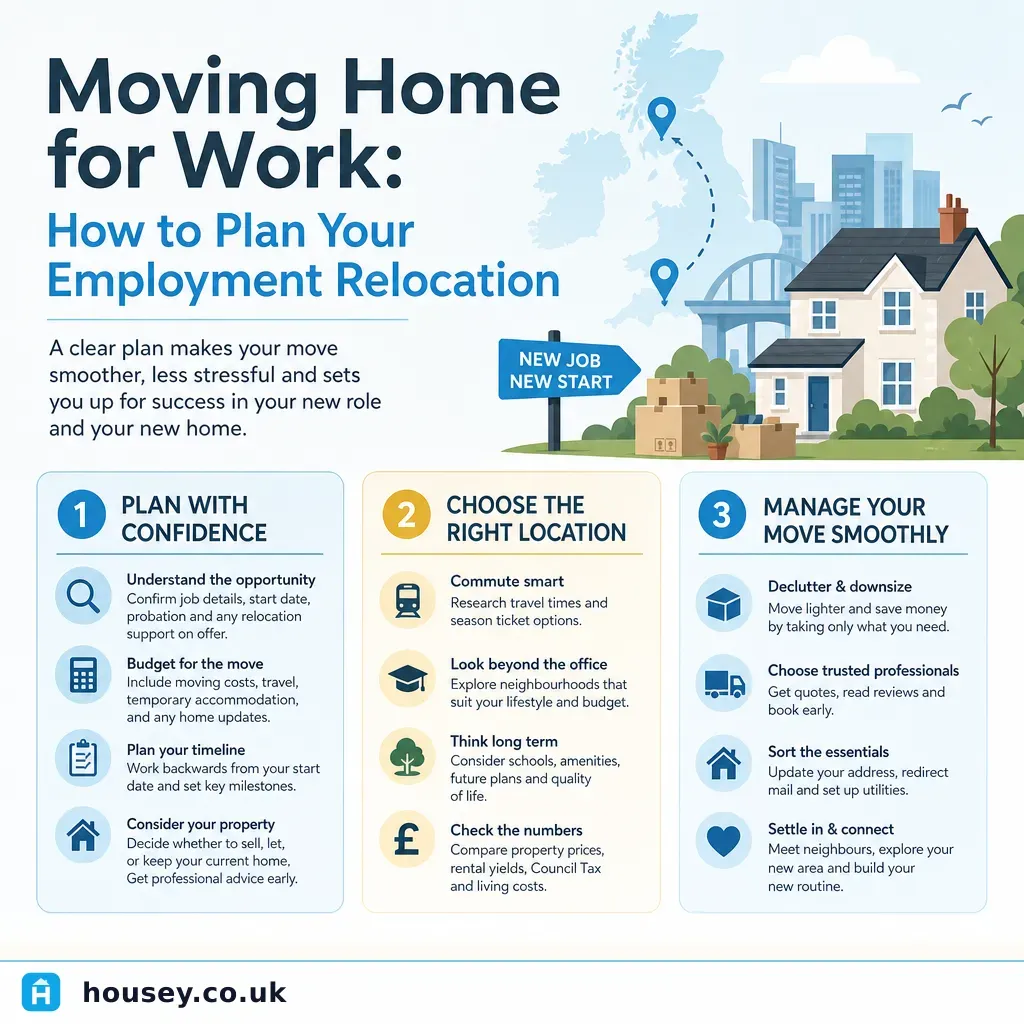 Buying & Moving
Moving Home for Work: How to Plan Your Employment Relocation
Moving home for a new job requires coordinating property timelines, removal logistics, and employer reimbursement simultaneously.
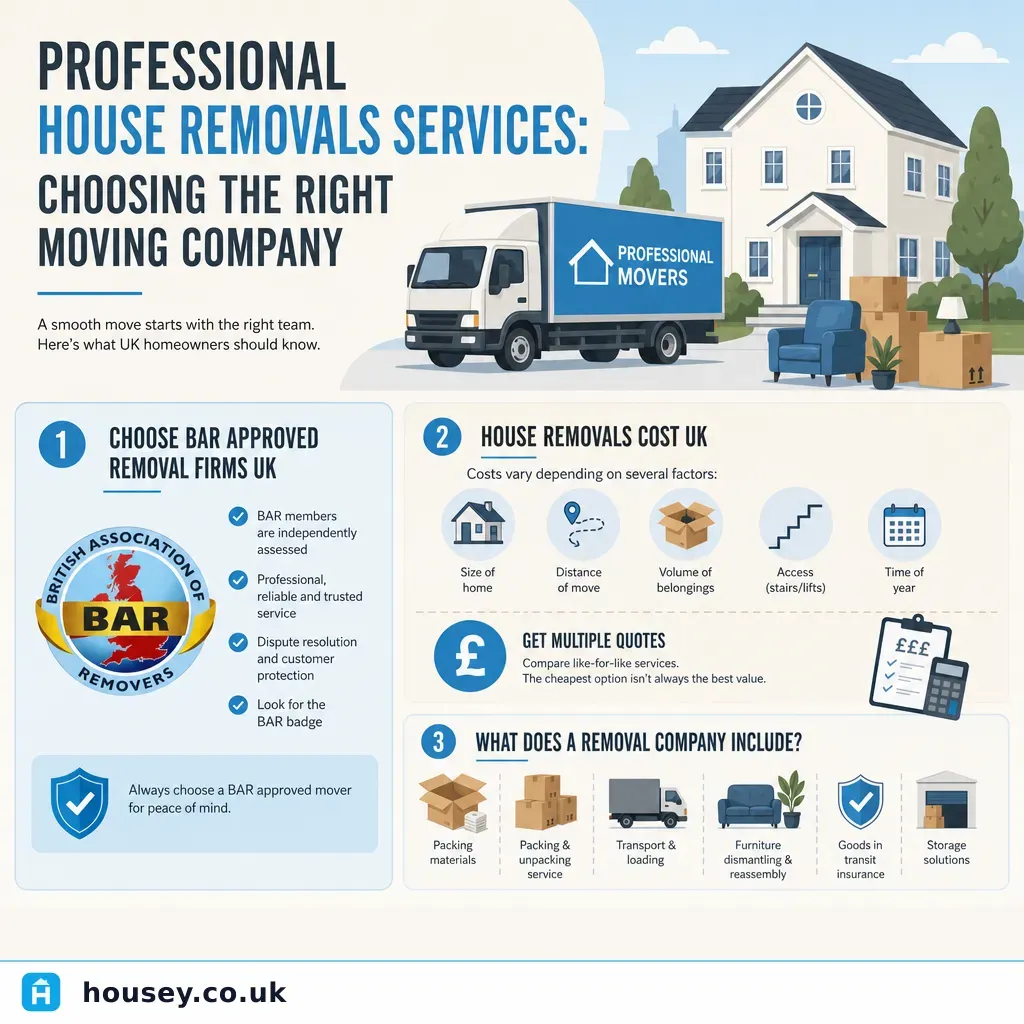 Buying & Moving
Professional House Removals Services: Choosing the Right Moving Company
A professional house removals company handles loading, transport, and unloading; full-service firms with BAR membership also offer deposit protection and independent dispute resolution.
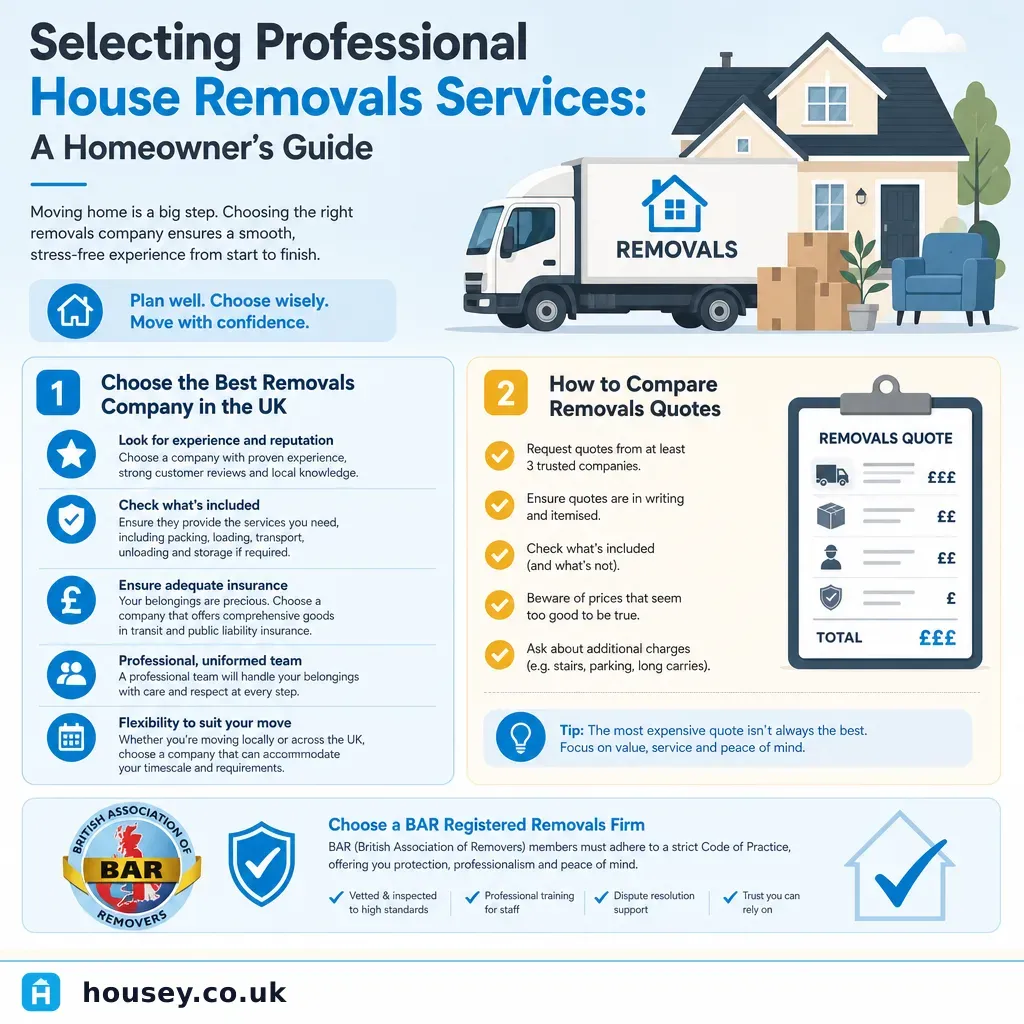 Buying & Moving
Selecting Professional House Removals Services: A Homeowner's Guide
Choose a removals firm registered with the British Association of Removers (BAR), which carries out a pre-move survey before quoting and provides a written binding quotation with goods-in-transit insurance.
 Buying & Moving
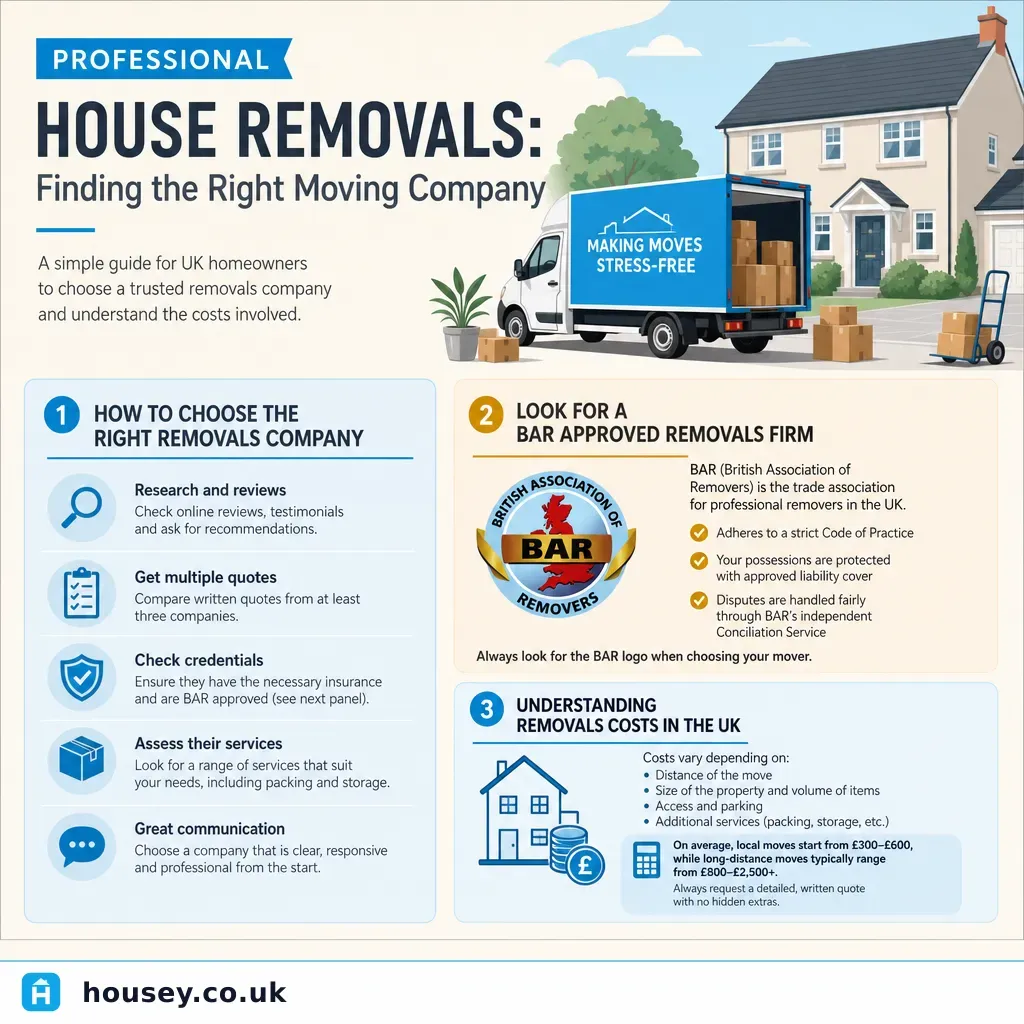
Professional House Removals: Finding the Right Moving Company
Finding the right house removals company involves checking membership of a recognised trade body such as the British Association of Removers (BAR), confirming goods-in-transit insurance cover, and comparing itemised written quotes.