Moving Home for Work: How to Plan Your Employment Relocation
By Housey · Last reviewed 30th of May 2026
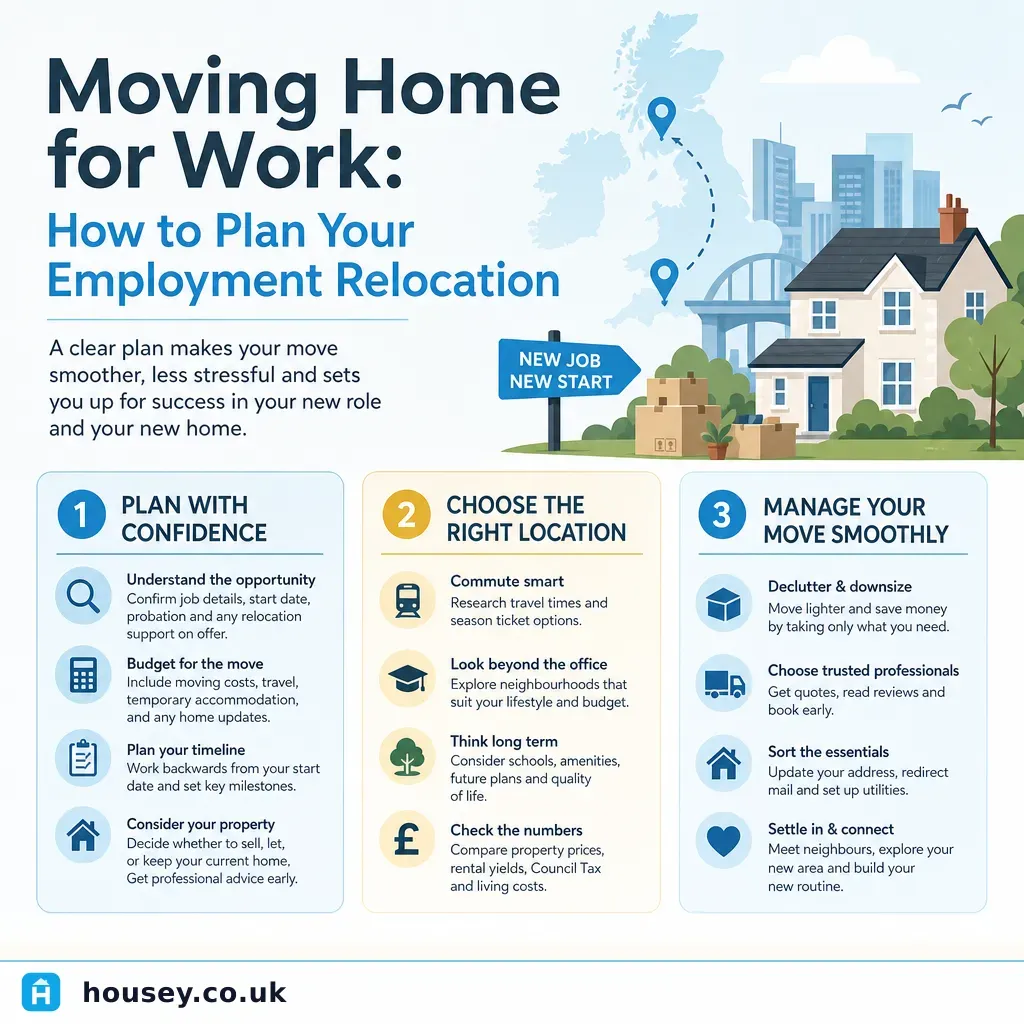
Moving Home for Work: How to Plan Your Employment Relocation
Relocating for a new job or career change puts immediate time pressure on what is already one of the most logistically demanding things a household can undertake. The overlap between a fixed employment start date and the unpredictable timelines of property transactions, tenancy notices, and removal bookings creates planning demands that a straightforward move does not, and the financial stakes — including potential tax relief, employer reimbursement, and storage costs — make a methodical approach worthwhile.
Key points
- HMRC allows employees to receive up to £8,000 in qualifying relocation expenses tax-free if the move is job-related and the new home is within a reasonable commuting distance of the new workplace, under the Income Tax (Earnings and Pensions) Act 2003 (ITEPA), sections 271–289.
- Full-load removal companies typically price based on volume (cubic metres), distance, and access complexity — the same household contents can attract materially different quotes depending on floor level and property access.
- You can legally serve notice on a rented property while simultaneously arranging a purchase, but timelines rarely align — bridging with short-term storage is a common and cost-effective solution.
- Employer relocation packages vary widely; some reimburse specific costs, others pay a lump sum — clarify in writing what documentation your employer requires before instructing any supplier.
- School admissions, GP registration, and council tax registration are each separate administrative tasks that usually require a confirmed new address before they can be completed.
Should you move before or after starting the new role?
Approach | Works well when | Watch out for |
|---|---|---|
Move before starting | Confirmed start date 6+ weeks away; family or school commitments require settling in first | Risk of carrying two sets of housing costs if tenancies overlap; no tolerance for an income gap |
Move after starting | Temporary commute is feasible; the new area is unfamiliar and renting first makes sense | Fatigue of commuting while adjusting to a new role; delayed school places |
Phased move (you first, family follows) | Partner has separate work commitments; school year timing matters | Extended separation; two sets of living costs simultaneously |
Rent first, buy later | You do not know the area well; your current property has not yet sold | Double moving costs; rents near desirable employers can be high |
Which type of removal service do you need?
- Choose a full-service removal company if you have a large household, multiple floors, or limited time — they pack, move, and unpack, and are more expensive but less demanding on moving day.
- Choose a man-and-van service if you are moving a small flat or single room, have flexible dates, and plan to pack yourself.
- Consider self-hire of a removal vehicle if your budget is tight, you have helpers, and the move is local or straightforward.
- Book containerised storage if there is a gap between leaving your old property and gaining access to the new one — a very common situation when an employment start date drives the overall timetable.
- Confirm insurance cover before booking — check whether your contents policy covers items in transit, and what the removal company's own liability covers per item.
Worked example: relocating from Leeds to Bristol
A household of four moving from a three-bedroom semi-detached house in Leeds to a similar property near Bristol:
- Volume: approximately 900–1,100 cubic feet of furniture and packed boxes.
- Distance: roughly 200 miles.
- Removal cost (Indicative UK costs, 2026-05-30): £1,200–£2,500 for a full-load removal, depending on access, number of operatives, and whether packing is included. Source: British Association of Removers (BAR).
- Storage: if there is a four-week gap between leaving Leeds and receiving keys in Bristol, a 200 cubic foot container typically costs £100–£200 per month at a mid-range self-storage facility.
- HMRC relief: the employer reimburses £6,000 in removal and travel-to-start costs — this falls within the £8,000 tax-free threshold and requires no P11D declaration.
All figures are indicative. Obtain at least three written quotes; costs vary materially by access, floor level, and time of year.
Relocation planning checklist
What to ask before accepting a removal quote
- What is included and excluded — does the price cover packing materials, furniture dismantling, and reassembly at the destination?
- Who carries out the work — are operatives employed directly by the company or subcontracted?
- Is the company a member of the British Association of Removers (BAR) or the Removals Industry Ombudsman Scheme?
- What is the liability for loss or damage — is this calculated per item, per load, or on a replacement-value basis?
- Is VAT included in the quoted figure?
- What happens if your completion date or tenancy start is delayed at the last minute?
- How is payment structured — avoid paying 100% upfront before the move has taken place.
When to get professional help
Most employment relocations can be self-managed with careful planning. Seek specialist help if:
- Your move includes items of high value (art, antiques, wine collections) that require specialist packing and insurance above standard household limits.
- You are relocating internationally and need customs documentation, container shipping, or overseas storage.
- Your employer is paying a relocation package and you are uncertain about the tax treatment of specific elements — speak to a tax adviser familiar with HMRC's relocation expenses rules under ITEPA 2003, sections 271–289.
- Your current property is leasehold with subletting restrictions that need legal review before you can let it during your absence.
How Housey can help
Housey connects you with trusted house removals companies and storage providers across the UK. Submit a single request and receive quotes from accredited local firms who understand the time constraints that come with employment relocations.
Frequently asked questions
Is there a deadline to claim HMRC relocation tax relief?
HMRC expects the move to be completed within a reasonable period of the employment start date — typically one year. If the move takes longer, your employer's payroll team or a tax adviser should review whether the relief remains available for expenses incurred after that point, as HMRC may treat later costs as a standard taxable employment benefit.
Can I port my mortgage when relocating for work?
Most major UK lenders offer a porting facility, allowing you to transfer your existing mortgage product to the new property. However, porting is subject to a fresh affordability assessment and the lender's approval of the new property. It is not automatic — speak to a mortgage adviser or broker before assuming your interest rate or product will transfer.
What if my employer offers a relocation lump sum rather than reimbursing specific costs?
A lump sum counts toward the £8,000 tax-free threshold in the same way as reimbursed individual costs. Any amount above £8,000 in qualifying relocation expenses is taxable income, which your employer should declare on a P11D. Keep receipts for all relocation expenditure in case HMRC queries how the payment was allocated.
How far ahead should I book a removal company?
For long-distance moves over 100 miles, booking 4–6 weeks ahead is advisable, particularly for Fridays, month-ends, and school holiday periods when availability is tightest. Last-minute bookings are possible but typically more expensive, with less choice of BAR-accredited firm and less flexibility on timing.
Sources and further reading
- HMRC guidance: relocation expenses and benefits — GOV.UK
- British Association of Removers — find a mover — British Association of Removers
- Income Tax (Earnings and Pensions) Act 2003 — relocation provisions — legislation.gov.uk
- Removals Industry Ombudsman Scheme — Removals Industry Ombudsman
- GOV.UK — tell HMRC about a change to your personal details — GOV.UK
Useful next reads
 Buying & Moving
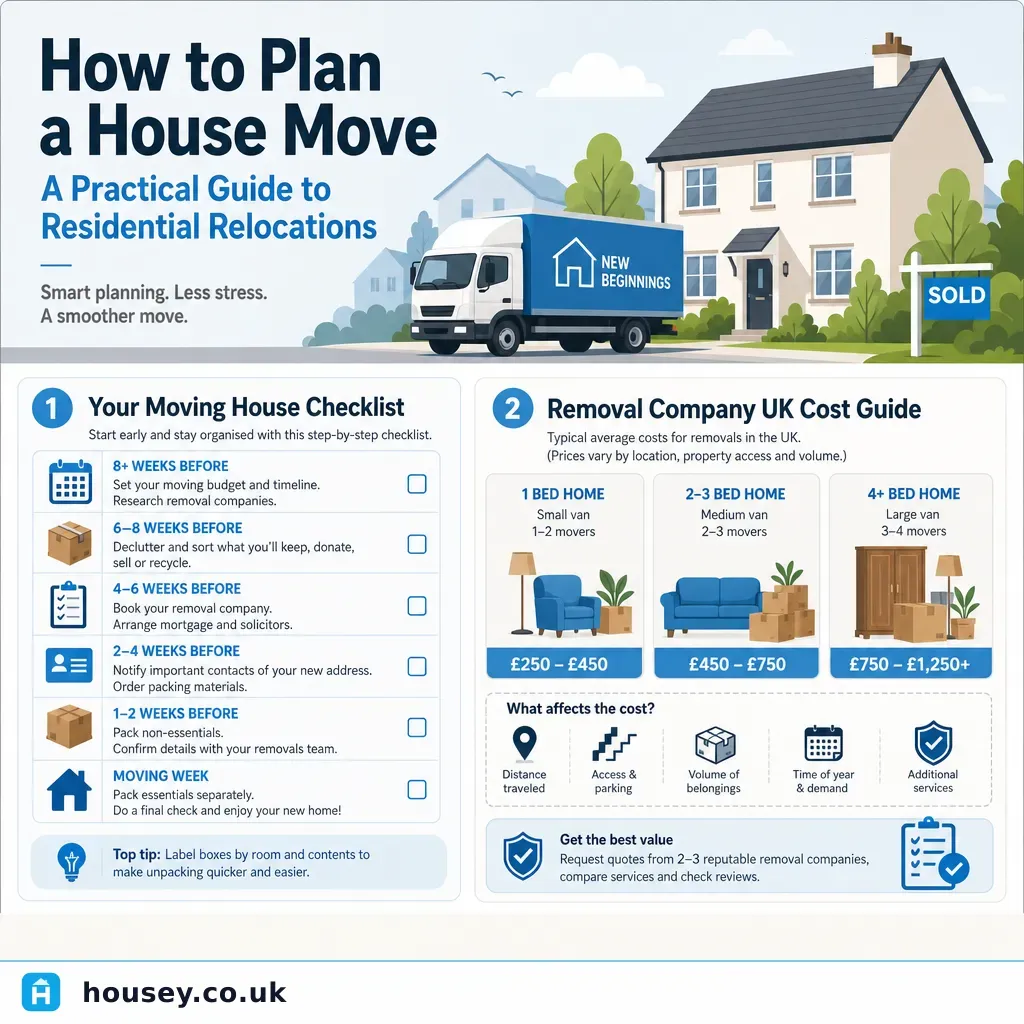
How to Plan a House Move: A Practical Guide to Residential Relocations
A UK house move goes more smoothly with planning that starts 6–8 weeks before moving day.
 Buying & Moving
Managing Property Relocation in Major Urban Centres
Urban house moves require planning beyond a standard removal, particularly around vehicle emission zone compliance, parking bay suspensions, and lift access in purpose-built flats.
 Buying & Moving
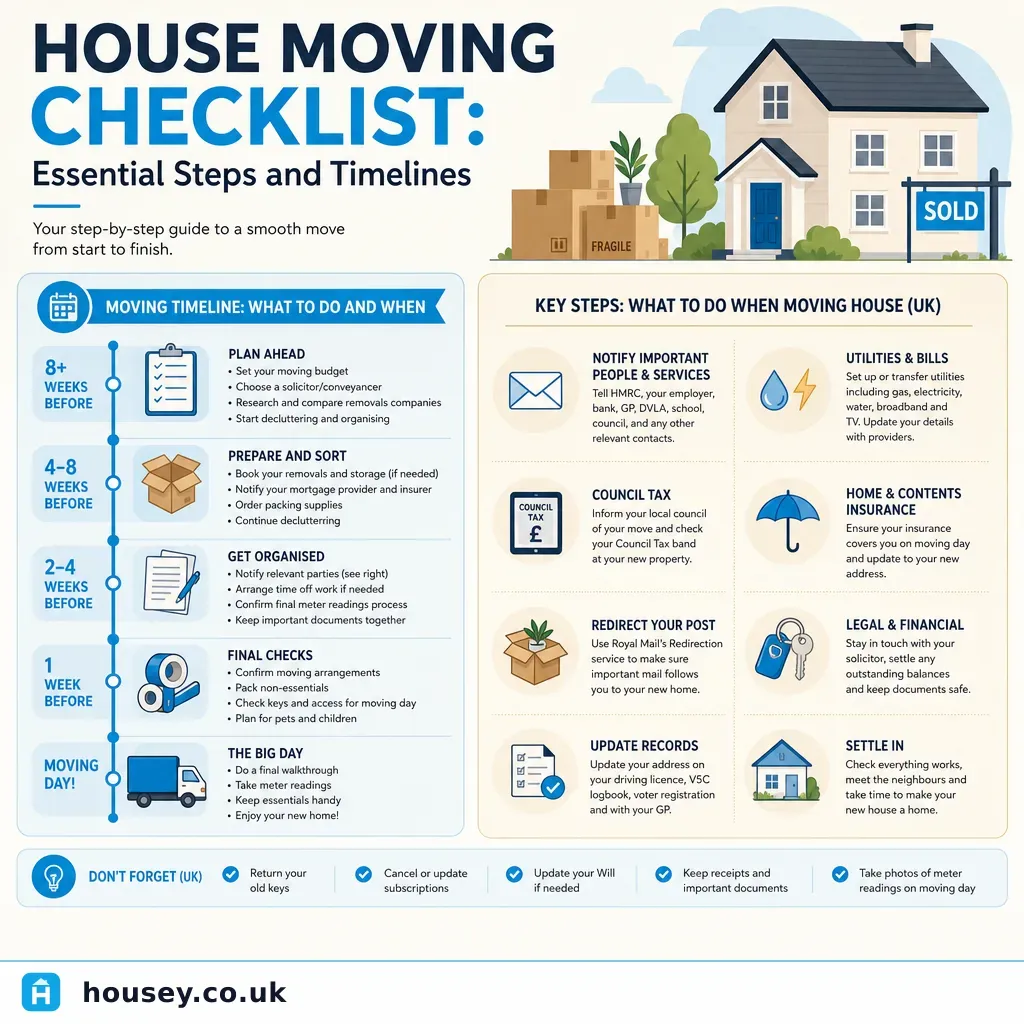
House Moving Checklist: Essential Steps and Timelines
A UK house move typically spans 8–12 weeks of preparation: book removals 4–6 weeks out, notify the DVLA, HMRC, and utilities as exchange approaches, take meter readings on moving day, and update Council Tax and the electoral register on arrival.
 Buying & Moving
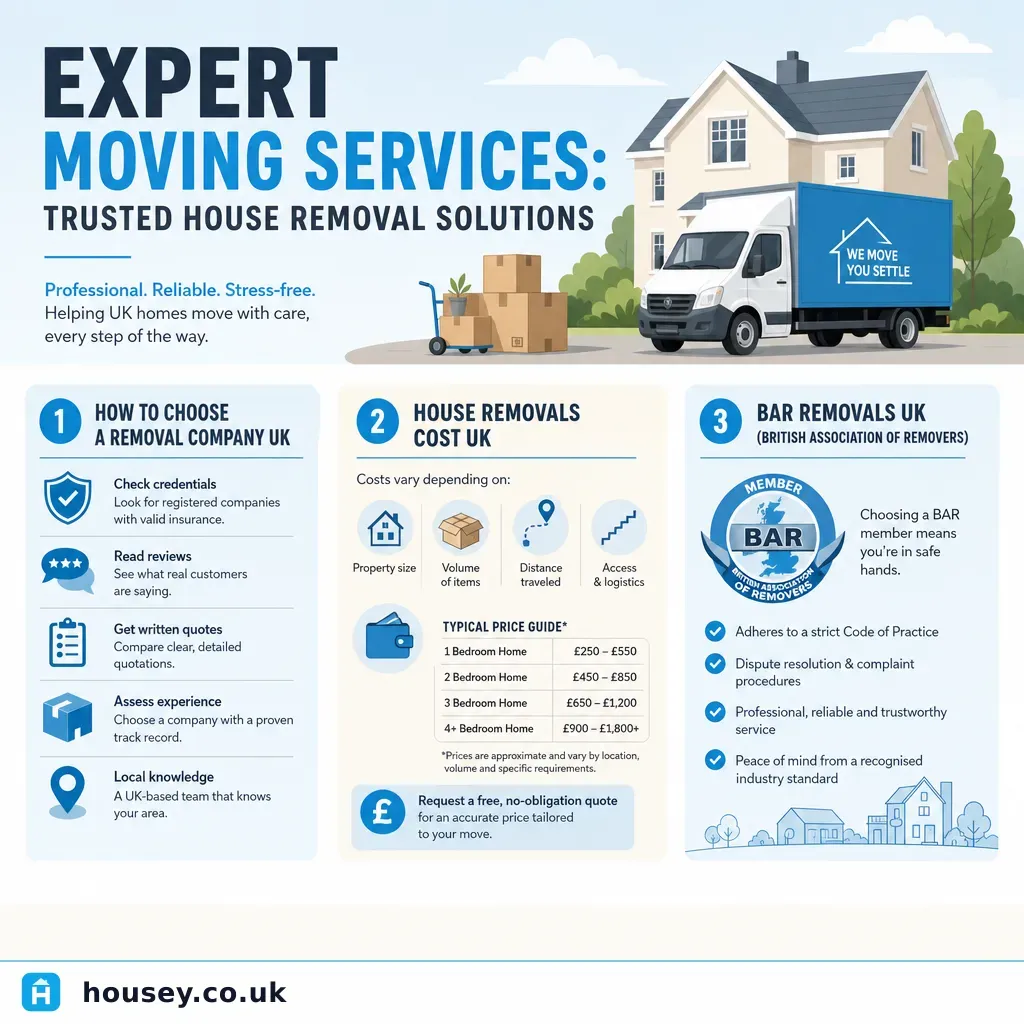
Expert Moving Services: Trusted House Removal Solutions
A professional house removal company handles packing, loading, transport, and unloading of your belongings.
 Buying & Moving
Managing Residential Moves During Major Urban Events
Moving house during a major urban event — a marathon, carnival, street festival, or large sporting occasion — requires advance planning around road closures, parking suspensions, and access restrictions.