House Moving Timeline: How Long Does A UK Property Transfer Really Take?
By Housey · Last reviewed 31st of May 2026
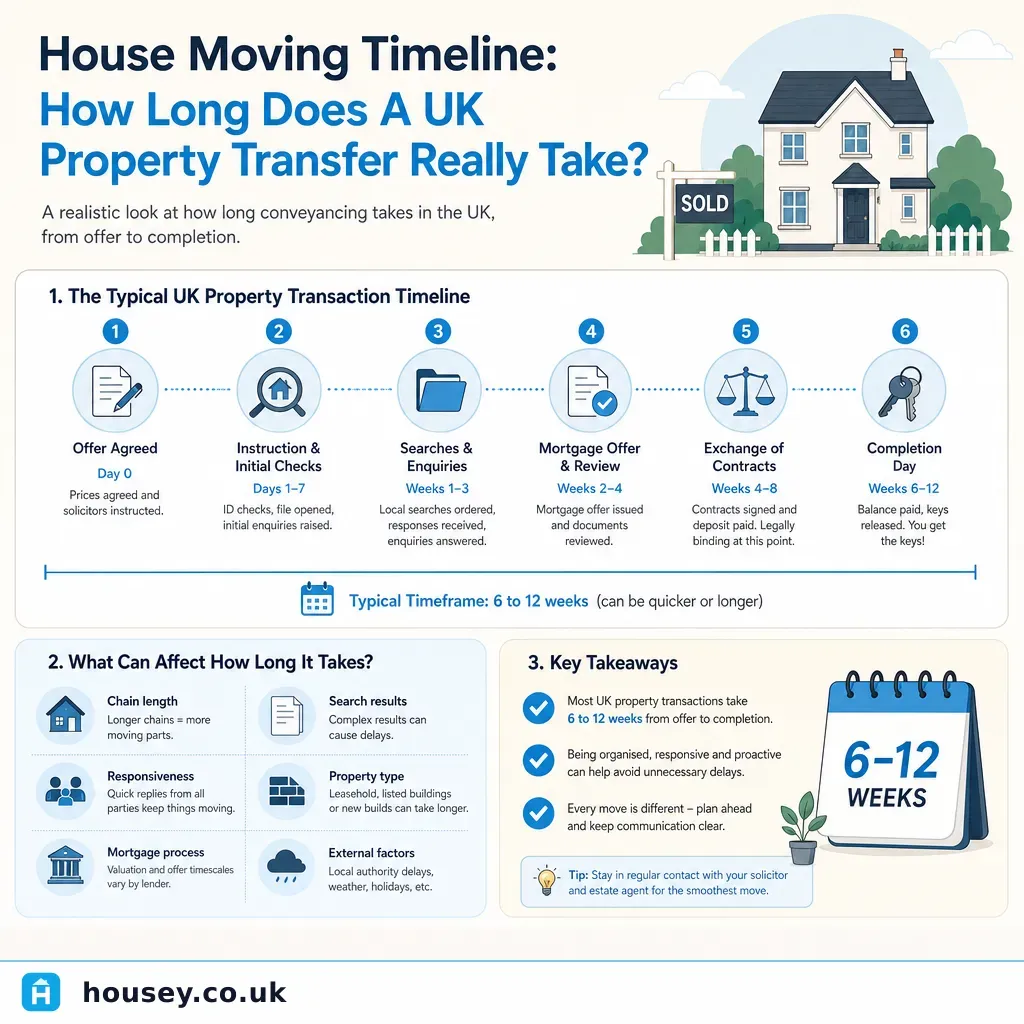
House Moving Timeline: How Long Does A UK Property Transfer Really Take?
One of the most common frustrations in UK property is the gap between expectation and reality when it comes to how long a transaction takes. An accepted offer is not the same as a moving date, and conveyancing — the legal process of transferring ownership — sits at the centre of a timeline that can be compressed or stretched by factors largely outside any individual party's control. Understanding each stage in sequence helps you plan removals, give notice at a rented property, and avoid committing to dates before a completion date has been legally confirmed.
Key points
- The average time from offer acceptance to completion in England and Wales is 12–16 weeks, though chains frequently extend this (HM Land Registry data).
- Exchange of contracts and completion are two separate legal events — completion is typically 1–4 weeks after exchange, though same-day exchange and completion can be agreed.
- Local authority searches take 1 to 20+ working days depending on the council; some authorities have significant backlogs that can add weeks to the overall timeline.
- A standard residential mortgage offer is valid for 3–6 months; a failed valuation or a change in the buyer's financial circumstances can require reapplication with a different lender.
- HM Land Registry registration of the new owner can take weeks or months after completion; the legal change of ownership takes effect on completion day, not registration day.
Important limitations
This article provides general guidance on typical UK property transaction timescales. Conveyancing involves legal, financial, and regulatory obligations that are specific to each property, lender, and transaction. Timescales and requirements vary significantly depending on property tenure (freehold or leasehold), chain length, mortgage lender, local authority, and the findings of surveys and searches. Always rely on your solicitor or licensed conveyancer for advice on your specific transaction. Nothing in this article constitutes legal advice.
Stage-by-stage timeline
Stage 1: Offer to instruction (Days 1–7)
Once an offer is accepted:
- Both buyer and seller instruct their respective solicitors or licensed conveyancers.
- The estate agent issues a memorandum of sale to all parties.
- The buyer applies formally for a mortgage if not already done at agreement-in-principle stage.
- The seller's solicitor begins preparing the draft contract pack, gathering title documents, and completing property information forms (TA6 and TA10).
What slows this stage: delays in instructing a solicitor, a slow return of the mortgage application, or a seller who does not have title documents or leasehold management information readily available.
Stage 2: Searches, survey, and mortgage valuation (Weeks 2–8)
This is typically the longest and most variable stage of the process.
Task | Typical duration | Risk of delay |
|---|---|---|
Local authority search | 1–20+ working days | High — varies significantly by council |
Water and drainage search | 2–5 working days | Low |
Environmental search | 1–3 working days | Low |
RICS Level 2 or Level 3 survey | Appointment within 1–2 weeks; report within 3–5 days | Low to medium |
Mortgage lender valuation | 1–3 weeks | Medium — lender queue |
Mortgage offer issued | 1–4 weeks after valuation | Medium |
Last reviewed 2026-05-31. Search turnaround times change frequently; check with your solicitor for current local authority performance in the area you are buying.
Stage 3: Enquiries and contract review (Weeks 4–12)
The buyer's solicitor raises formal enquiries on the contract and title. This is often where transactions slow down most:
- Enquiries may cover planning permissions, building regulations certificates, rights of way, boundary features, restrictive covenants, chancel repair liability, and invasive species such as Japanese knotweed.
- Leasehold transactions involve additional enquiries: lease length, service charge accounts, ground rent review clauses, freeholder consent for alterations, and management company details.
- The seller must respond to each enquiry through their solicitor; slow or incomplete responses extend this stage considerably.
What not to assume: A quick acknowledgement from the seller's solicitor does not mean enquiries are resolved. Complex issues — particularly missing building regulations completion certificates or unresolved boundary disputes — can take weeks to address and may require indemnity insurance to be arranged before exchange can proceed.
Stage 4: Exchange of contracts (Typically weeks 10–16)
Exchange is the legal point of commitment in England and Wales:
- The buyer pays the deposit (typically 5–10% of the purchase price) to the seller's solicitor to hold.
- A completion date is agreed and becomes legally binding on both parties.
- Both parties are contractually committed — withdrawing after exchange incurs significant financial penalties.
Only once contracts are exchanged should you confirm and pay a deposit to your removal company. Before exchange, any date is provisional and the transaction can still fall through without financial penalty.
Stage 5: Completion (1–4 weeks after exchange)
On completion day:
- Mortgage funds are transferred from lender to buyer's solicitor, then on to the seller's solicitor.
- Keys are released — typically midday or later, once funds have cleared.
- Stamp Duty Land Tax (SDLT) in England, Land Transaction Tax (LTT) in Wales, or Land and Buildings Transaction Tax (LBTT) in Scotland must be filed and paid by your solicitor within 14 days of completion.
Physical removal logistics: most households need one to two days for packing and loading, and one day for transport and unloading. Book your house removals as soon as exchange occurs — this is when a completion date is confirmed and legally binding.
After completion: what still needs to happen
Task | Who is responsible | Typical timescale |
|---|---|---|
HM Land Registry registration | Buyer's solicitor | 2 weeks to several months |
SDLT/LTT/LBTT filing and payment | Buyer's solicitor | Within 14 days of completion |
Title deeds issued to buyer | Land Registry → solicitor → buyer | After registration |
Mortgage discharge (if seller had one) | Seller's solicitor | Within 4–6 weeks |
What extends a UK property transaction beyond 16 weeks?
The following situations commonly push transactions well beyond the typical range:
- Long chains: A chain of four or more linked transactions must all complete simultaneously, meaning one party's delay affects everyone.
- Leasehold complications: Obtaining freeholder consent, management company information packs (often costing £100–£400 and taking 4–8 weeks to arrive), and extending a short lease each add weeks or months.
- Survey findings: A significant defect may trigger renegotiation, further specialist reports (structural engineer, damp specialist), or a price reduction — each requiring additional time.
- Mortgage complications: A failed valuation, change in lender criteria, or a change in the buyer's financial circumstances can require reapplying with a different lender from scratch.
- Probate or estate sales: If the seller is an executor, probate must be granted before exchange — this can take 3–9 months depending on the complexity of the estate.
When this becomes urgent
Stop relying solely on general guidance and contact your solicitor or a qualified professional immediately if:
- Your mortgage offer is approaching its expiry date and completion has not yet occurred — most lenders will consider an extension, but you must act promptly to avoid reapplying.
- A survey report identifies suspected structural movement, asbestos-containing materials, or active subsidence — specialist reports should be commissioned without delay.
- A leasehold management pack reveals a lease of under 80 years — extending a short lease significantly affects mortgage eligibility and resale value, and requires separate legal and valuation advice.
- The chain appears to have broken down and other parties have gone silent — your solicitor should be notified immediately to protect your legal and financial position.
What to ask a qualified professional
Before instructing a solicitor or licensed conveyancer for your transaction, ask:
- What is your current average time from instruction to exchange for a freehold or leasehold transaction of this type?
- Do you use a case management system with online progress tracking that I can access?
- Who will handle my case day-to-day, and what is their experience and qualification level?
- How quickly do you typically respond to enquiries and to client communications?
- Are you a member of the Law Society's Conveyancing Quality Scheme (CQS)?
- What are your full charges, including all disbursements, search fees, Land Registry fees, and SDLT filing costs?
- What is your policy if the transaction falls through before exchange — what fees remain payable?
When to get professional help
Conveyancing must be handled by a qualified solicitor or licensed conveyancer — it is not a process to manage without professional legal advice. Additionally:
- If your removal booking is at risk because a completion date has changed, contact your removal company immediately to discuss their delay policy and temporary storage options.
- If survey findings indicate structural issues or potential hazardous materials, commission specialist reports promptly rather than waiting for enquiries to address them.
- If you are comparing conveyancing solicitors, look beyond price — differences in responsiveness, online case tracking, and case management quality can significantly affect how smoothly your transaction progresses.
How Housey can help
Housey can connect you with qualified conveyancing solicitors and trusted house removals companies at the right stage of your transaction. Compare quotes from local professionals with real homeowner reviews before committing.
Frequently asked questions
How long does conveyancing take in 2026?
A straightforward freehold purchase in England and Wales typically takes 8–16 weeks from instruction. Leasehold transactions commonly take 12–20 weeks or longer. Chains and complications can push any transaction beyond six months. Scotland uses a different system — missives rather than exchange of contracts — and timescales differ.
Can I speed up the conveyancing process?
You can help by responding promptly to your solicitor's requests, having a mortgage in principle before making an offer, and choosing a solicitor with online tracking. However, many delays are outside your control — local authority search times, lender queues, and other parties in the chain are the most common bottlenecks.
What is the difference between exchange and completion?
Exchange is when signed contracts are legally swapped and the deposit is paid — both parties are committed and a completion date is set. Completion is when funds transfer and keys are released. In England and Wales these are typically separate events; in Scotland the process differs significantly.
When can I book removal companies?
Wait until exchange of contracts before confirming and paying a deposit to your removal company. Before exchange, any date is provisional and may change. Many people contact removal firms earlier to check availability, but should not commit financially until exchange has occurred.
Does the conveyancing timeline differ in Scotland?
Yes. Scottish property law uses a system of missives — a series of formal letters forming the contract — rather than the English exchange and completion model. Transactions can move faster once an offer is accepted, but the legal structure and obligations differ significantly. Seek advice from a Scottish solicitor if purchasing in Scotland.
Sources and further reading
- Buying or selling your home — GOV.UK
- HM Land Registry: processing times — HM Land Registry
- Stamp Duty Land Tax — GOV.UK
- Conveyancing Quality Scheme — The Law Society
- Local land charges — GOV.UK
Useful next reads
 Buying & Moving
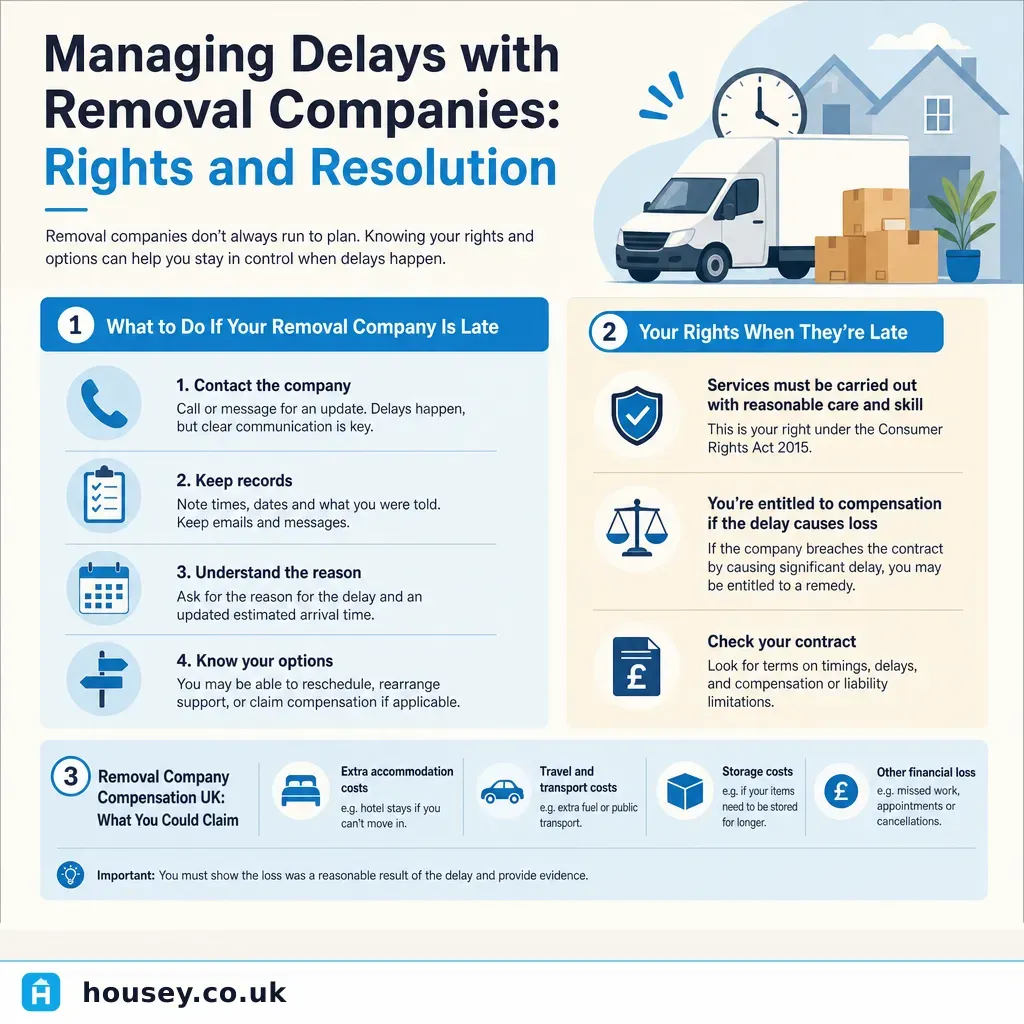
Managing Delays with Removal Companies: Rights and Resolution
If a removal company is late, your rights depend on your contract and whether the company is BAR-registered.
 Buying & Moving
How to Plan a House Move: A Practical Guide to Residential Relocations
A UK house move goes more smoothly with planning that starts 6–8 weeks before moving day.
 Buying & Moving
Managing Property Relocation in Major Urban Centres
Urban house moves require planning beyond a standard removal, particularly around vehicle emission zone compliance, parking bay suspensions, and lift access in purpose-built flats.
 Buying & Moving
Choosing the Right Removal Company for Your House Move
To choose the right removal company, get three quotes from British Association of Removers (BAR) members or similarly accredited firms.
 Buying & Moving
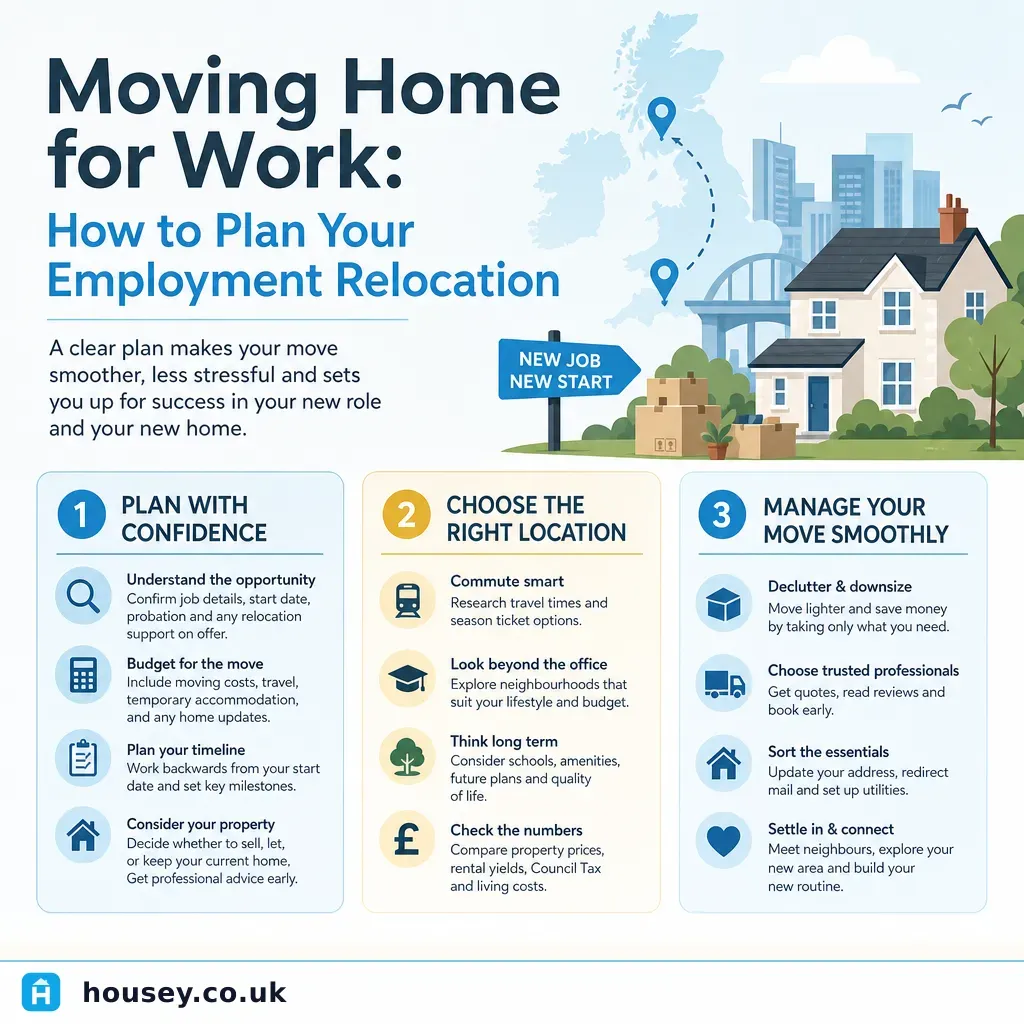
Moving Home for Work: How to Plan Your Employment Relocation
Moving home for a new job requires coordinating property timelines, removal logistics, and employer reimbursement simultaneously.