How to Plan a House Move: A Practical Guide to Residential Relocations
By Housey · Last reviewed 30th of May 2026
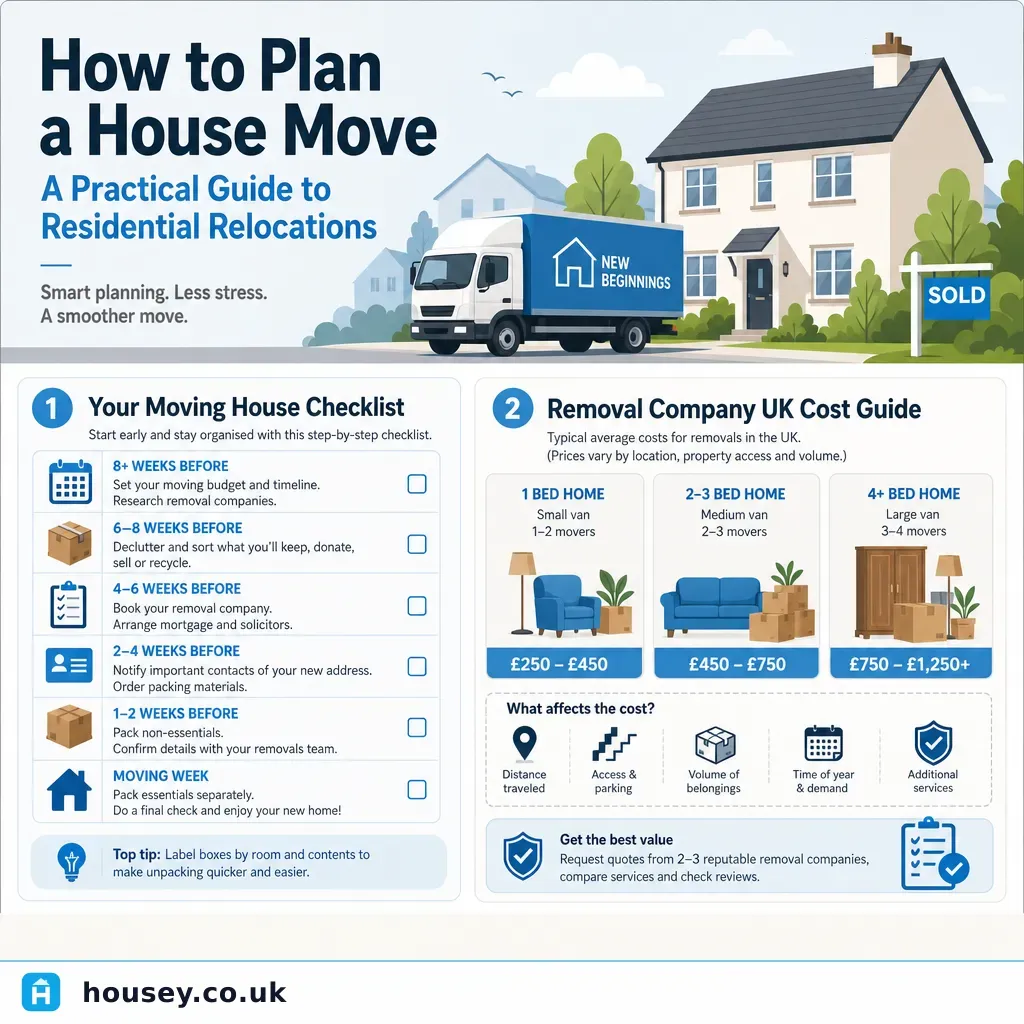
How to Plan a House Move: A Practical Guide to Residential Relocations
Moving house in the UK involves considerably more than loading boxes into a van. The combination of exchange and completion timelines, lease end dates, school term plans, and the sheer volume of personal belongings means that poor planning regularly turns moving day into a stressful scramble. Whether you are leaving a 1930s semi in Leeds or vacating a new-build flat in Bristol, a structured approach reduces the risk of damaged items, missed deadlines, and unexpected costs.
Key points
- Most removal companies in the UK recommend booking 4–8 weeks in advance, particularly for end-of-month or end-of-quarter completions, when demand peaks significantly.
- Contents insurance policies vary considerably in their cover during a move — most have specific exclusions or reduced limits for goods in transit; check your policy before packing begins.
- Self-storage units in the UK are typically rented on a rolling monthly basis; climate-controlled units are recommended for antiques, artwork, electronics, and soft furnishings.
- Redirecting post via Royal Mail requires at least 3 working days to set up and must be arranged before moving day — not after.
- You must notify the DVLA of a change of address for both your driving licence and the V5C vehicle registration document; this can be done at GOV.UK.
Choosing between a removal company and a DIY move
The decision between hiring a professional removal firm and managing the move yourself depends on volume, distance, access constraints, and budget.
Professional removal company vs DIY van hire
Factor | Professional Removal Company | DIY Van Hire |
|---|---|---|
Indicative cost (3-bed, local) | £600–£1,200 | £150–£350 hire and fuel |
Cover for belongings | Usually included (check limits and depreciation terms) | Not included; personal contents policy may partly apply |
Physical effort required | Low | High |
Speed | Typically 1 day | 1–2 days depending on team size |
Suitability for heavy or bulky items | High — trained handlers and equipment | Risk of damage without proper equipment |
Flexibility if completion is delayed | Good — experienced with chain delays | Limited — van must be returned on time |
Best for | Large volumes, longer distances, valuables | Small volumes, short distances, tight budgets |
Indicative UK costs, last reviewed 2026-05-30. Obtain at least three quotes; prices vary by location, date, access, and volume.
When choosing a removal firm, look for membership of the British Association of Removers (BAR) or registration with the Removals Industry Ombudsman Scheme (RIOS), both of which provide a complaints and redress framework.
How to plan your move: a timeline checklist
8 weeks before moving day
6 weeks before
4 weeks before
1–2 weeks before
Moving day
What to do if completion is delayed
Delays on completion day are common in UK conveyancing chains. If your removal van is loaded but legal completion has not yet occurred:
- Do not release keys or hand possession to a buyer until your solicitor confirms funds have cleared.
- Ask your removal company in advance what their policy is for delayed completions — many charge a waiting fee after a set period, and some will take goods into temporary storage overnight.
- If an upper link in the chain delays, your removal company may need to hold goods temporarily; confirm this option and its cost before moving day.
- Keep your solicitor's direct number accessible throughout moving day; delays in fund transfers are common and usually resolved within a few hours.
What not to assume when moving house
- Do not assume your belongings are insured during the move: most standard household contents policies have specific exclusions or sub-limits for goods in transit. Confirm in-transit cover explicitly with your insurer before packing begins.
- Do not assume removal company insurance covers full replacement value: most standard goods-in-transit policies cover at depreciated market value rather than full replacement cost. Ask the firm for their policy terms and limits before booking.
- Do not assume parking will be straightforward: on dense urban streets a large removal vehicle may need a parking suspension. Without one the van may be unable to stop outside your property and you risk fines. Apply to your local authority at least 2–3 weeks ahead.
- Do not assume broadband will be live on day one: broadband transfers or new installations typically take up to 2 weeks — arrange a mobile data backup or temporary solution for the first days.
- Do not assume utility accounts transfer automatically: contact your energy supplier with your move date and meter readings at both properties. Failing to do so can result in disputed bills for a previous occupier's energy usage.
- Do not assume the new property is clean and ready: carry cleaning materials, light bulbs, and a basic toolkit in your car rather than in the removal van so they are accessible on arrival.
When to get professional help
Standard residential moves do not require specialist consultancy beyond a reputable removal company and a conveyancing solicitor. Consider specialist services for:
- Pianos and grand pianos — these require specialist piano removal firms with appropriate equipment and insurance.
- Fine art, antiques, or significant wine collections — specialist art packers, climate-controlled vehicles, and tailored insurance.
- International relocations — freight forwarders, customs documentation, and specialist international removal firms.
- Long-term or multi-property storage solutions — particularly for high-value, temperature-sensitive, or moisture-sensitive items where climate control matters.
How Housey can help
Housey connects you with reliable, vetted house removal companies across the UK, as well as storage solutions if you need a gap solution between properties. Submit a single request and compare services and prices from multiple providers.
Frequently asked questions
How far in advance should I book a removal company?
For end-of-month or end-of-quarter completion dates — the busiest periods for removal firms — book at least 6–8 weeks in advance. For mid-month or mid-week moves, 2–4 weeks may suffice, though earlier is always better. Last-minute bookings are possible but choice is limited and premium pricing is common.
What does a removal company's goods-in-transit insurance actually cover?
Most removal companies include basic goods-in-transit cover, but limits, exclusions, and depreciation terms vary. Ask for the policy wording before booking: check the per-item limit, whether cover is at replacement or depreciated value, and what you must do to make a valid claim — such as noting damage on the delivery receipt at the time of unloading.
Should I pack my own boxes or pay for the removal company to pack?
Many removal companies offer full or partial packing as an add-on. This is particularly worthwhile for fragile or valuable items, as removal company insurance often only covers goods they have packed themselves. For general household goods, self-packing is cost-effective but requires at least one week of preparation time for a 3-bedroom property.
What is a parking suspension and when do I need one?
A parking suspension reserves a section of road outside your property for your removal vehicle on moving day. Applied for through your local authority, it typically costs £60–£200+ per day depending on the council. It is usually needed on controlled parking zone streets, narrow terraces, or city-centre properties where a large van cannot otherwise park close enough to load.
Sources and further reading
- British Association of Removers — BAR
- Removals Industry Ombudsman Scheme — RIOS
- Royal Mail Redirection — Royal Mail
- Tell DVLA you have changed address — GOV.UK
- Citizens Advice — Moving home — Citizens Advice
Useful next reads
 Buying & Moving
Managing Residential Moves During Major Urban Events
Moving house during a major urban event — a marathon, carnival, street festival, or large sporting occasion — requires advance planning around road closures, parking suspensions, and access restrictions.
 Buying & Moving
Essential Considerations For Planning A Property Relocation
Planning a UK property relocation means coordinating legal, financial, and practical steps across several months.
 Buying & Moving
Managing Property Relocation in Major Urban Centres
Urban house moves require planning beyond a standard removal, particularly around vehicle emission zone compliance, parking bay suspensions, and lift access in purpose-built flats.
 Buying & Moving
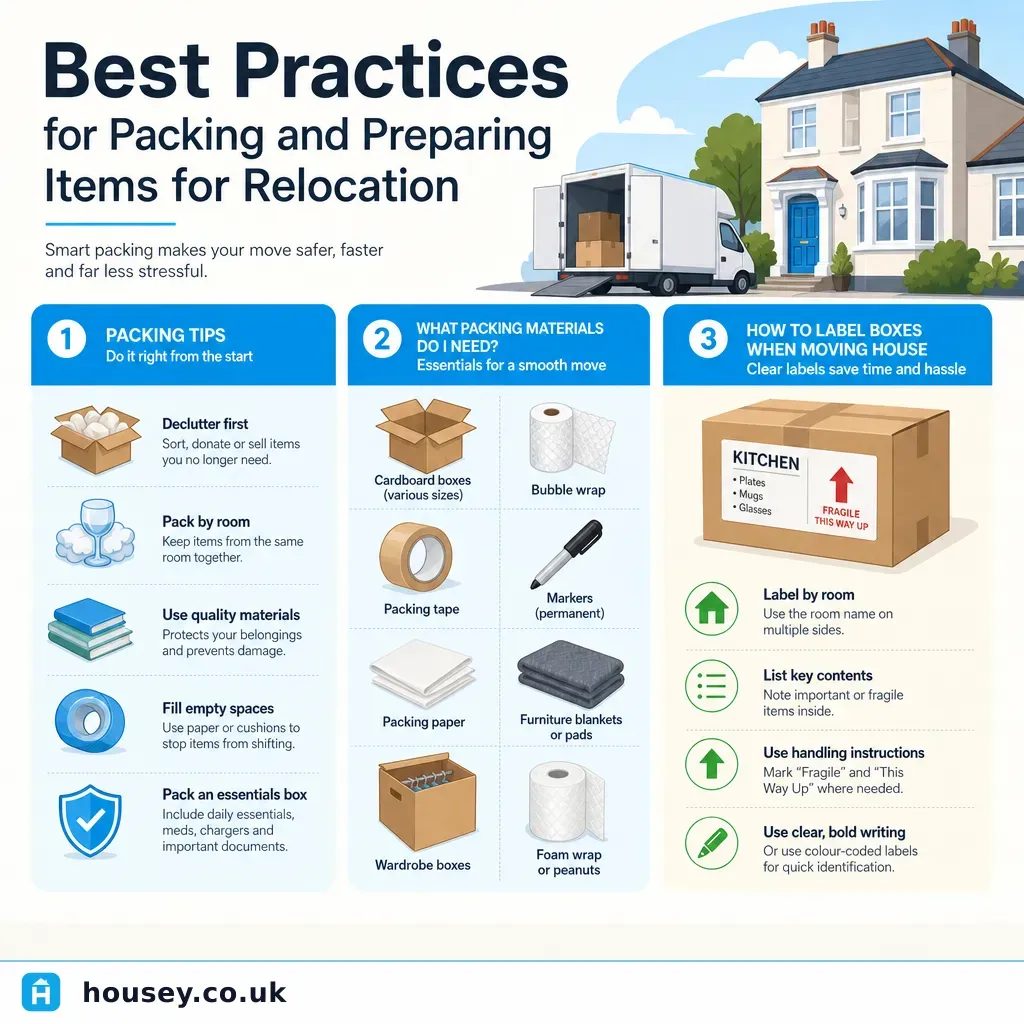
Best Practices for Packing and Preparing Items for Relocation
Good packing starts four to six weeks before moving day, following a room-by-room sequence from loft and rarely used spaces first.
 Buying & Moving
Moving Home During the Festive Season: Planning and Logistics Guide
Moving home during the festive season is achievable but requires extra planning.