How to Find and Evaluate Renovation Properties in the UK
By Housey · Last reviewed 30th of May 2026

How to Find and Evaluate Renovation Properties in the UK
Renovation properties appeal to buyers who want to add value, customise a home to their own specification, or acquire at a discount relative to finished equivalents on the same street. The challenge is that what looks like a bargain at the asking price can become expensive once hidden defects, structural repairs, or compliance work are factored in — and in many cases those costs are not apparent without professional assessment before purchase.
Key points
- A RICS Level 3 Building Survey is the most appropriate pre-purchase inspection for a property in poor condition or one requiring significant alteration, providing a detailed assessment of the building fabric and a prioritised repair schedule.
- Building Regulations approval is required for most structural, electrical, gas, and drainage works — separate from and in addition to any planning permission required.
- Properties sold at auction are legally purchased as seen; buyers cannot withdraw after the hammer falls, making a pre-auction survey and solicitor's legal pack review essential.
- Permitted Development Rights allow many single-storey rear extensions (up to 4m for detached dwellings, 3m for other house types) without a full planning application, subject to Prior Approval notification to the local planning authority.
- Always obtain at least three written contractor quotes with defined scopes before committing to purchase — verbal estimates for renovation work are frequently optimistic.
What makes a renovation property worth pursuing
Not all renovation opportunities carry the same profile of risk and reward. It is useful to distinguish between types before committing:
Cosmetic renovation: New finishes, kitchen and bathroom replacement, redecoration, garden works. Lower risk, shorter programme, costs more predictable for an experienced buyer.
System upgrade: Full rewire, new central heating, re-plumbing. Requires qualified contractors and either Competent Person Scheme self-certification or Building Control sign-off; costs can be significant in older properties.
Structural renovation: Underpinning, roof structure repair, removal of load-bearing walls, beam replacement. Requires structural engineer input, Building Regulations approval, and experienced contractors.
Change of use or extension: Converting outbuildings, creating a loft conversion, building an extension. May need planning permission and Building Regulations approval depending on scope and location.
Decision tree: is this renovation property worth pursuing?
- Is the property structurally sound — no visible subsidence, no evidence of roof collapse, no significant damp in structural elements?
- No or unsure: Commission a structural engineer's report before proceeding. Do not rely solely on the RICS Level 3 surveyor for properties showing significant structural warning signs.
- Yes: Continue.
- Is the property in a Conservation Area, National Landscape designation, or Listed Building?
- Yes: Check with the local planning authority what works are achievable. Some renovation plans — loft conversions, extensions, external changes — may not be grantable.
- No: Continue.
- Does the asking price plus realistic renovation costs leave a clear margin against comparable finished properties in the area?
- No or unclear: Obtain at least three contractor quotes before committing. A quantity surveyor can prepare an independent cost estimate for larger projects.
- Yes: Continue to survey and legal due diligence.
- Is the property sold at auction?
- Yes: Instruct a RICS Level 3 surveyor and a solicitor to review the legal pack before the auction date. You cannot withdraw after the hammer falls.
- No: A survey can follow acceptance of an offer subject to the usual conditions.
Which surveys do you need?
Survey type | What it covers | Best for |
|---|---|---|
RICS Level 3 Building Survey | Full assessment of construction, condition, defects, and repair priorities | Most renovation properties; older, altered, or visibly defective buildings |
Structural engineer's report | Diagnosis of specific structural concerns: cracking, movement, subsidence, roof structure | Properties with visible movement, major cracking, or significant alteration history |
Damp and timber survey | Moisture levels, rising damp, penetrating damp, woodworm, rot | Properties with damp staining, timber floors, old solid-wall or cellar construction |
CCTV drainage survey | Condition of underground drains and sewer connections | Older properties, suspected blocked or collapsed drains, pre-1970 construction |
Electrical Installation Condition Report (EICR) | Condition of existing wiring and consumer unit | Any property not rewired in the last 25 years or lacking a modern consumer unit |
A renovation property often warrants more than one of these. A RICS Level 3 survey followed by a specialist damp and timber report is a common combination when the surveyor flags moisture concerns.
Planning and permitted development: what applies to renovation works?
Type of work | Planning permission | Building Regulations | Notes |
|---|---|---|---|
Internal reconfiguration (non-structural) | No | No (usually) | Structural changes require Building Regs regardless of planning status |
Removing a load-bearing wall | No | Yes | Structural engineer and Building Control sign-off required |
Single-storey rear extension (within PD limits) | Not usually | Yes | Prior Approval required for larger householder extensions; limits vary by property type |
Loft conversion (within PD limits) | Not usually | Yes | 40m³ terraced, 50m³ detached or semi; must not raise the ridge height |
Full rewire | No | Yes (self-cert) | NICEIC or NAPIT registered electrician can self-certify |
New boiler or heating system | No | Yes (self-cert) | Gas Safe registered engineer must install and certify |
Change of use (e.g. garage to habitable room) | Sometimes | Yes | Check with local planning authority; depends on local plan |
Red flags in renovation properties
Stop and seek specialist advice if you notice any of the following during a viewing:
- Stepped or diagonal cracking in brickwork, especially at corners of door and window openings — potential subsidence or differential settlement.
- Sagging or noticeably bouncy floors in a property with timber ground floors — possible rot, woodworm, or joist failure.
- A visibly bowed or dipped roof ridge — may indicate structural rafter failure or inadequate support to the roof structure.
- Patches of conspicuously fresh plaster or redecoration incongruously new relative to the rest of the building — possible concealment of recent water ingress or damp.
- No gas or electricity currently connected — reconnection costs, safety assessments, and any required upgrades can add significantly to programme and budget.
- Absence of completion certificates for past works — indicates works may not have been signed off under Building Regulations, a problem that often surfaces at resale or remortgage.
When to get professional help
Before committing to a renovation property purchase, you should have at minimum a RICS Level 3 Building Survey and a solicitor's review of the planning history and title. If the survey identifies structural concerns, a structural engineer's assessment is strongly advisable before exchange. For auction properties, both must be completed before the sale date — there is no opportunity to withdraw afterwards.
How Housey can help
Housey connects you with professionals at every stage of a renovation project. Find damp proofing specialists to address moisture issues identified at survey stage, extension builders to scope and price structural or extension works, and loft conversion companies if unlocking roof space is part of your renovation plan. Compare quotes from qualified professionals before committing to purchase or starting works.
Frequently asked questions
Is buying a renovation property a good investment in the UK?
It depends on the acquisition price, the realistic cost of works, and the finished value relative to comparable properties in the same area. A renovation property can offer meaningful value uplift if purchased at a genuine discount and renovated cost-effectively. Renovation costs are often underestimated — particularly for structural works, services upgrades, and compliance-related repairs. A realistic cost schedule prepared with contractor input before purchase is essential.
Do I need planning permission to renovate a house?
Not always. Internal works, most like-for-like repairs, and many extensions fall within Permitted Development Rights and do not require a planning application. However, Building Regulations approval is a separate requirement and applies to most structural, electrical, drainage, and heating works regardless of whether planning permission is needed. Properties in Conservation Areas or subject to Article 4 Directions may have reduced Permitted Development Rights.
What contingency should I budget for a renovation project?
A contingency of 15–20% on top of estimated costs is a widely used figure for older properties. For properties in very poor condition or where surveys indicate hidden defects, the contingency may need to be higher. Budget separately for surveys, legal fees, structural engineer reports, Building Control fees, and any party wall surveyor costs — these are additional to construction costs.
Can I get a mortgage on an uninhabitable property?
Standard residential mortgages are rarely available on properties lenders classify as uninhabitable — typically those lacking a functional kitchen, bathroom, or heating system. Some specialist lenders offer renovation mortgages or bridging finance for these properties. Speaking to a mortgage broker experienced in renovation and development finance before making an offer is advisable.
Sources and further reading
- Planning Portal — permitted development for householders — Planning Portal (GOV.UK)
- Building regulations: apply for approval — GOV.UK
- RICS Home Survey Standards — RICS
- Party Wall etc. Act 1996 — legislation.gov.uk
- Gas Safe Register: check a business — Gas Safe Register
Useful next reads
 Improvement & Build
How to Plan and Prioritise Renovation Works in a UK Property
Start with structure and weatherproofing, then first-fix services, then plastering, then second fix, then decoration and fit-out.
 Improvement & Build
Renovation Opportunities Across the UK Property Market
Renovation properties in the UK range from cosmetic fixer-uppers needing decoration and new kitchens, to structural projects requiring new roofs, damp treatment, or extensions.
 Improvement & Build
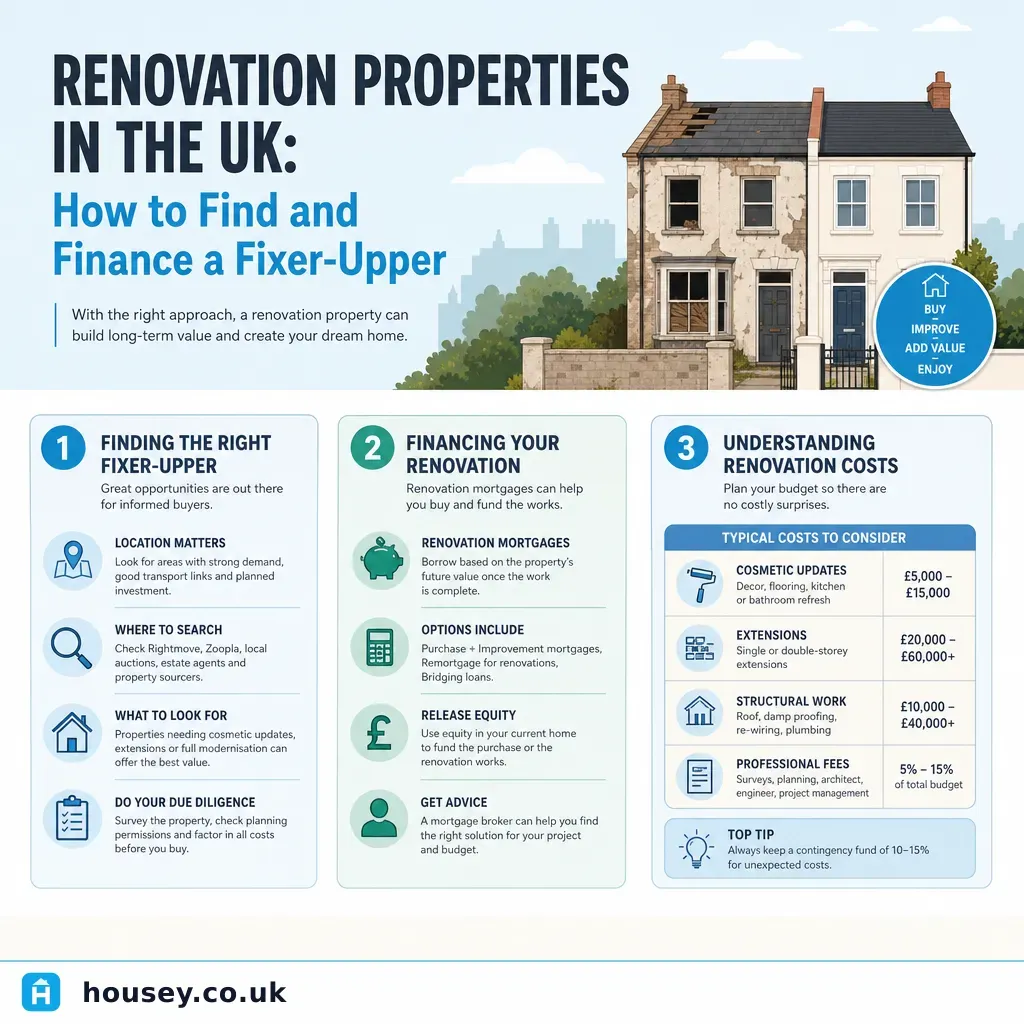
Renovation Properties in the UK: How to Find and Finance a Fixer-Upper
Renovation properties can offer genuine value, but success depends on thorough due diligence before exchange.
 Improvement & Build
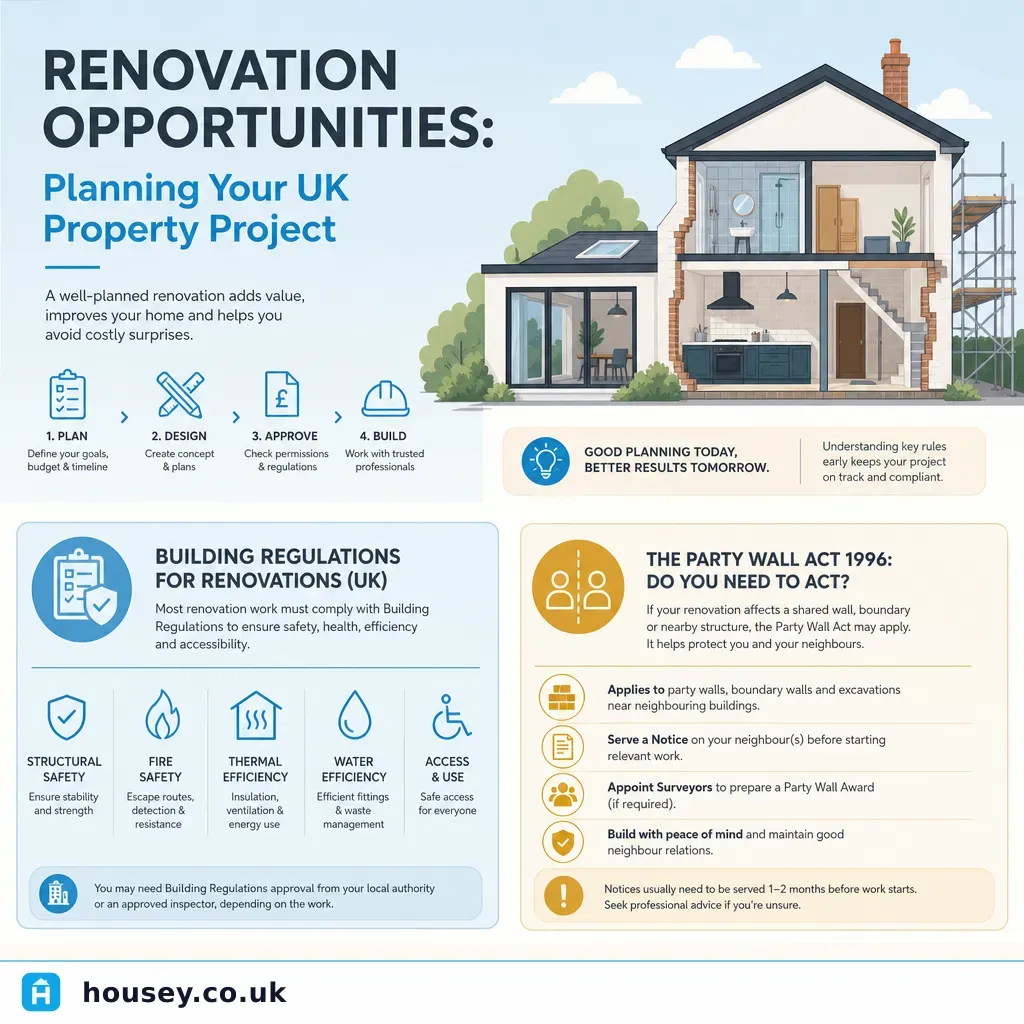
Renovation Opportunities: Planning Your UK Property Project
Planning a successful renovation in the UK means sequencing work correctly, securing building regulations approval where required, and budgeting for contingencies of at least 15–20%.
 Improvement & Build
Television-Featured Properties: Renovation and Improvement Opportunities
Television-featured renovation properties can offer genuine value, but assessing the full scope of works before exchange is critical.