Television-Featured Properties: Renovation and Improvement Opportunities
By Housey · Last reviewed 8th of May 2026

Television-Featured Properties: Renovation and Improvement Opportunities
UK property television has turned the fixer-upper into a familiar concept — from auction lots on Homes Under the Hammer to ambitious self-builds on Grand Designs, millions of viewers watch neglected or unusual properties transformed into comfortable homes. What these programmes rarely show in full is the due diligence, professional input, and realistic budgeting that separates successful renovation projects from costly regrets. Whether you are drawn to a rundown Victorian terrace, a barn conversion, or a property that recently appeared on screen, understanding what you are taking on before you exchange is essential.
Key points
- A RICS Level 3 Building Survey is the appropriate inspection for any renovation property, older building, or structurally altered home — RICS Level 2 is unlikely to provide sufficient detail for a property requiring significant works.
- Building Regulations approval is required for most renovation work including structural changes, electrical rewires at consumer-unit level, new bathrooms draining to a soil stack, and loft conversions.
- Planning permission may be required for extensions, external alterations, or any works on listed buildings or properties in conservation areas — permitted development rights can be restricted by Article 4 Directions issued by the local planning authority.
- Damp penetration, defective drainage, asbestos-containing materials (in properties built or refurbished between approximately 1930 and 1999), and outdated electrical installations are the most commonly found issues in renovation properties.
- A realistic contingency of 15–20% on top of estimated renovation costs is widely recommended by construction professionals, as renovation projects routinely uncover hidden defects once work begins.
What makes a TV renovation property different?
Properties that have appeared on television renovation or auction programmes — or that are marketed using similar language — share common characteristics: they are typically sold at a discount to reflect their condition, they may have been unoccupied for some time, and they often require works ranging from cosmetic redecoration through to full structural intervention.
The attraction is clear. A property priced below market value offers the opportunity to build equity through improvement. In practice, the gap between purchase price and post-renovation value depends heavily on the scope of works required, the local market, and the quality of execution.
What television often compresses or omits:
- The pre-purchase survey findings and how they shaped the budget
- Planning and Building Regulations processes and their timescales
- The period between purchase and habitation
- Cost overruns, which are common even on well-managed renovation projects
Understanding these factors before you make an offer is the difference between a sound investment and an extended financial burden.
Assessing the renovation scope
Before committing, a structured assessment of the property's condition allows you to build a realistic budget and identify any deal-breakers.
Cosmetic renovation covers decoration, flooring, kitchen and bathroom fitting, and landscaping. This is the least risky category and the easiest to cost accurately.
Moderate renovation includes replacing windows and doors, reroofing, rewiring, replumbing, and insulation upgrades. Each of these trades requires compliance with Building Regulations and may require installers with relevant certification — for example, FENSA-registered installers for replacement windows, or a Gas Safe registered engineer for any gas work.
Structural and significant renovation covers underpinning, chimney breast removal, load-bearing wall alterations, loft conversions, and extensions. These require structural engineering input, Building Regulations approval, and usually planning permission.
Renovation scope | Typical professional input needed | Building Regulations required? | Planning required? |
|---|---|---|---|
Cosmetic only | Decorator, kitchen and bathroom fitter | Usually not | Usually not |
New roof, rewire, replumb | Roofer, NICEIC/NAPIT electrician, plumber | Yes | Usually not |
Loft conversion | Builder, structural engineer, building control | Yes | Check permitted development rights |
Extension | Architect or architectural technologist, builder, building control | Yes | Yes, or Prior Approval |
Structural alterations | Structural engineer, builder, building control | Yes | Depends on scope and location |
Common defects in renovation properties
Renovation properties — and many older UK homes more generally — carry predictable categories of defect. Knowing what to look for before instructing a surveyor helps you ask the right questions.
Damp is the most frequently cited issue in renovation properties. Rising damp, penetrating damp, and condensation each have different causes and different remedies. A specialist damp and timber survey can distinguish between them and recommend appropriate treatment, rather than a blanket chemical damp-proof course that may not address the root cause.
Defective drainage is often invisible until tested. A CCTV drain survey can reveal root ingress, collapsed sections, or misaligned joints — problems that can cost several thousand pounds to remedy if they reach the point of failure inside the building.
Asbestos-containing materials may be present in properties built or refurbished before approximately 2000. Textured coatings (Artex), vinyl floor tiles, pipe lagging, and roof felt are common locations. A management survey or refurbishment survey carried out by a UKAS-accredited analyst is required before any intrusive work begins. If you suspect asbestos, do not disturb the material — arrange a professional survey first.
Electrical installations in older or long-unoccupied properties may be dangerous or non-compliant. An Electrical Installation Condition Report (EICR) carried out by a Part P-certified electrician establishes whether the installation is satisfactory, unsatisfactory, or potentially dangerous.
Structural movement may be historic and stable, or active and progressive. A RICS Level 3 Building Survey will record visible evidence; a chartered structural engineer may be needed to investigate further if the survey raises concerns.
Red flags that should affect your offer or decision
- Estate agent marketing that emphasises "priced to sell" or "buyers must accept the property as seen" without a seller's survey or formal disclosure
- Evidence of fresh decoration over suspicious staining or discolouration on walls and ceilings
- A property that has been tenanted and is now vacant — consider what prompted the sale
- Previous extensions or alterations with no evidence of Building Regulations completion certificates in the title documents
- No Gas Safety certificate history, or a boiler over 15 years old with no service records
- Neighbourhood planning constraints such as an Article 4 Direction removing permitted development rights that would restrict your improvement plans
- A property in a conservation area or on the local heritage at-risk register, where external works face greater scrutiny
What to ask before making an offer
- Has the seller commissioned any surveys or investigations, and will they be shared with prospective buyers?
- Are there any planning applications, enforcement notices, or building control records associated with the property?
- Has any structural, asbestos, or drainage work been carried out, and are there certificates or insurance-backed guarantees?
- What is the heating system, its age, and when was it last serviced by a Gas Safe registered engineer?
- Is the property freehold or leasehold — and if leasehold, does the lease permit the works you plan, and what is the remaining term?
When to get professional help
A renovation property should not be purchased on the basis of a mortgage valuation alone. Commission a RICS Level 3 Building Survey before exchange, and if the survey raises damp, drainage, or structural concerns, arrange specialist investigations before committing. For properties over approximately 20 years old, or any property where you plan significant structural works, consult a structural engineer and check the planning history with your local planning authority.
If you plan to let the property after renovation, additional compliance requirements apply, including minimum EPC rating (currently Band E for most private rentals in England), EICR every five years, and annual Gas Safety Record.
How Housey can help
Housey connects homeowners with qualified tradespeople and surveyors across the UK. If you have identified a renovation property and want to understand its condition before committing, request quotes from specialists through our damp and timber surveys service. When you are ready to plan an extension or significant structural improvement, our extension builders service helps you find and compare experienced contractors who can provide detailed quotes based on your specific scope.
Frequently asked questions
Do I need planning permission to renovate a property I have bought?
Most internal renovation work does not require planning permission. However, extensions, loft conversions, significant external alterations, and any works on listed buildings or in conservation areas usually do. Permitted development rights allow some works without a full application, but these can be restricted by Article 4 Directions or existing conditions attached to the property's planning history. Check with your local planning authority before starting work.
What survey should I get for a renovation property?
A RICS Level 3 Building Survey (formerly known as a Full Structural Survey) is the most appropriate choice for renovation properties, older buildings, those with visible defects, or homes you plan to alter significantly. It provides a more detailed assessment of condition than a Level 2 Home Survey and is better suited to identifying the full scope of issues in a property requiring works.
How much contingency should I budget for a renovation?
Construction professionals generally recommend a contingency of 15–20% on top of estimated renovation costs. Renovation projects regularly uncover unexpected problems — particularly hidden damp, wiring that does not meet current standards, or drainage defects — once walls are opened or floors are lifted. Building in contingency from the start reduces the risk of the project stalling mid-way.
Can I live in a renovation property while work is being done?
It depends on the scale of the works. Cosmetic or single-trade renovations can often be managed with minimal disruption to habitation. Structural work, full rewires, or complete bathroom and kitchen replacements may make the property unliveable for periods. Factor temporary accommodation costs into your budget, particularly for whole-house renovations.
Sources and further reading
- Planning Portal: Do you need permission? — Planning Portal
- RICS: Home surveys — Royal Institution of Chartered Surveyors
- GOV.UK: Building regulations approval — GOV.UK
- HSE: Asbestos in homes — Health and Safety Executive
- Electrical Safety First: EICR guidance — Electrical Safety First
Useful next reads
 Improvement & Build
How to Plan and Prioritise Renovation Works in a UK Property
Start with structure and weatherproofing, then first-fix services, then plastering, then second fix, then decoration and fit-out.
 Improvement & Build
Renovation Opportunities Across the UK Property Market
Renovation properties in the UK range from cosmetic fixer-uppers needing decoration and new kitchens, to structural projects requiring new roofs, damp treatment, or extensions.
 Improvement & Build
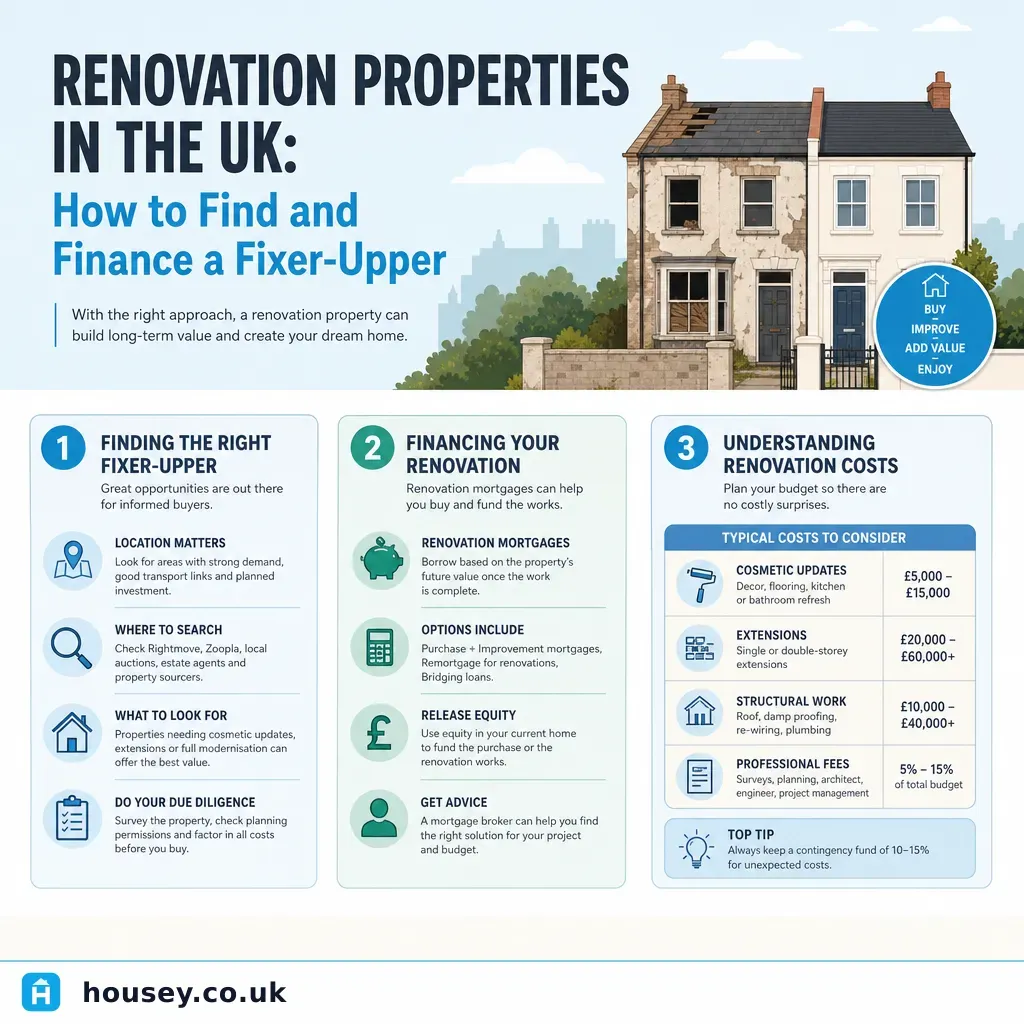
Renovation Properties in the UK: How to Find and Finance a Fixer-Upper
Renovation properties can offer genuine value, but success depends on thorough due diligence before exchange.
 Improvement & Build
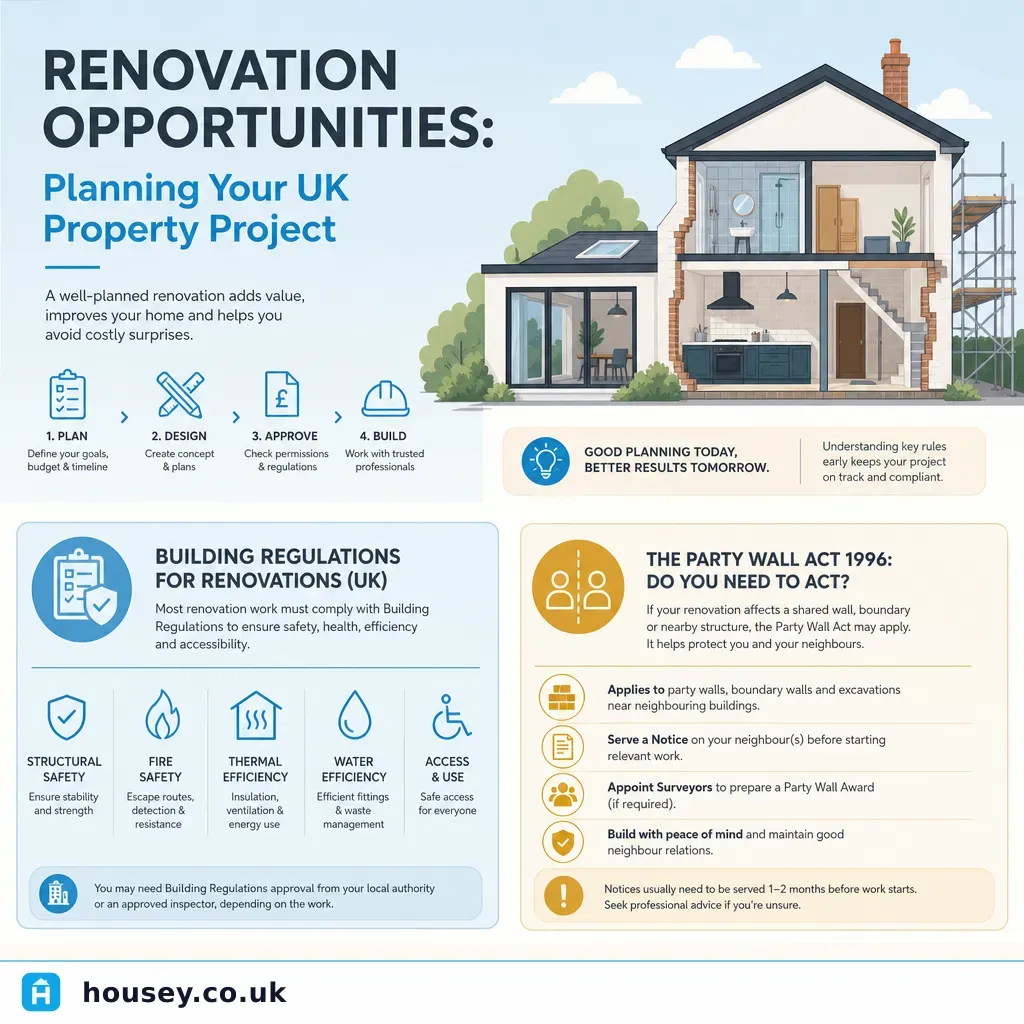
Renovation Opportunities: Planning Your UK Property Project
Planning a successful renovation in the UK means sequencing work correctly, securing building regulations approval where required, and budgeting for contingencies of at least 15–20%.
 Improvement & Build
How to Find and Evaluate Renovation Properties in the UK
A renovation property is worth pursuing when the acquisition price plus realistic renovation costs leaves a clear margin against comparable finished properties nearby.