Renovation Opportunities Across the UK Property Market
By Housey · Last reviewed 30th of May 2026

Renovation Opportunities Across the UK Property Market
Properties described as "requiring modernisation" or "in need of updating" are a regular feature of the UK housing market, appearing at every price point from two-bedroom terraces to large detached houses. For buyers willing to do the work — or to manage a team of tradespeople — a renovation purchase can offer the chance to acquire a home below market value and add significant equity through improvements. The critical challenge is distinguishing a genuinely rewarding project from one where the costs and complications will outweigh the upside.
Key points
- A RICS Level 3 Building Survey is strongly recommended before exchanging on any renovation property; it provides the most detailed assessment of defects, estimated repair costs, and structural condition.
- Damp can indicate a range of issues from minor condensation to serious rising damp requiring specialist treatment; a RICS-accredited damp survey should be commissioned separately if moisture concerns are flagged.
- Loft conversions, rear extensions, and kitchen renovations consistently rank among the highest-return renovation works relative to cost in the UK residential market.
- Building Regulations approval is required for most structural renovation work — including loft conversions, extensions, rewiring, and replacement heating systems — not just for planning permission.
- Local authority empty homes grants and renovation loans are available in some areas for properties vacant for more than two years; check your local council's website for current schemes.
Types of renovation opportunity in the UK
Not all renovation properties are alike. Understanding the type of project you are taking on is essential before making an offer.
Renovation type | Typical works | Indicative cost range | Complexity |
|---|---|---|---|
Cosmetic refresh | Decoration, flooring, kitchen and bathroom replacement | £10,000–£40,000 | Low |
System upgrades | Rewiring, replumbing, new boiler, insulation | £20,000–£60,000 | Medium |
Structural repair | Roof replacement, underpinning, damp treatment, wall tie replacement | £30,000–£100,000+ | High |
Extension or conversion | Rear extension, loft conversion, garage conversion | £40,000–£150,000+ | High |
Full gut renovation | All of the above combined, including new services | £80,000–£250,000+ | Very high |
Indicative UK costs, last reviewed 2026-05-30. Costs vary significantly by region, property size, specification, and contractor. Always obtain multiple quotes.
How to assess a renovation property before buying
The pre-purchase phase is where most renovation mistakes are made. A thorough assessment involves more than a viewing.
Commission a RICS Level 3 Building Survey. For any renovation property — particularly pre-1950s stock, or any home with visible defects — a RICS Level 3 (formerly Full Building Survey) is the appropriate level of inspection. It will assess all visible and accessible elements, identify defects, provide reinstatement cost guidance for insurance, and flag anything requiring further specialist investigation such as a structural engineer's report or a specialist damp survey.
Get specialist reports where flagged. If the Level 3 survey raises concerns about structural movement, damp, drainage, or hazardous materials such as asbestos, commission the relevant specialist before exchange. Never proceed on the assumption that a flagged issue is minor.
Get early contractor input. Before exchange is also the time to get indicative quotes from builders and specialist contractors. A rough cost from a trusted builder — even before detailed designs — can confirm whether the project stacks up financially at your intended purchase price.
Check planning history. Download the planning history for the property from the local planning authority's online register. Unauthorised works, lapsed permissions, or enforcement notices can create legal complications and affect mortgage eligibility and resale value.
Which renovation works add the most value?
The relationship between renovation cost and added value depends on the local market, the property type, and the standard of finish. However, some principles hold broadly across the UK.
Works that typically add more value than they cost
- A well-designed rear extension creating an open-plan kitchen-dining space, particularly in urban areas where extra square footage is scarce.
- A dormer or full loft conversion adding a bedroom and en-suite bathroom.
- Kitchen and bathroom upgrades when the existing rooms are significantly outdated.
- Improvements to energy performance — new windows, insulation, and an efficient heating system — increasingly valued by buyers under tightening EPC requirements.
Works that may not recoup their cost
- Very high-specification finishes in a lower-value area where comparable properties do not support a premium.
- Swimming pools, home cinemas, or bespoke features unlikely to appeal to the broad buyer market.
- Works carried out without planning permission or building control sign-off — these can create legal complications on resale and may need to be regularised at the seller's cost.
Red flags when assessing a renovation property
These indicators warrant careful investigation or specialist assessment before proceeding:
- Stepped cracking in external brickwork, particularly if diagonal and widening — may indicate structural movement or subsidence.
- Sagging or uneven roof lines — can indicate rafter damage, rot, or structural failure in the roof structure.
- Persistent damp throughout ground-floor walls — could indicate a failed damp-proof course, raised external ground levels, or drainage issues.
- Significantly out-of-plumb walls — may require underpinning or structural repair before any cosmetic works can begin.
- Evidence of Japanese knotweed in the garden — a legal and mortgage complication requiring specialist eradication treatment.
- Multiple layers of flat roofing — indicates repeated patch repairs rather than replacement; budget for full re-roofing.
- No EPC or a very low EPC rating (F or G) — for rental properties, tightening minimum energy efficiency standards may require costly upgrades to comply.
Renovation property buyer checklist
When to get professional help
Renovation projects of any significant scope require a team of regulated professionals. Engage professional advice promptly if:
- Structural defects are suspected — a chartered structural engineer should assess before any work is carried out.
- The property is listed or in a conservation area — additional consents are required for most alterations.
- You are considering a loft conversion, extension, or change of use — planning permission and building control involvement is usually required.
- Any asbestos-containing materials are present or suspected — do not disturb them; commission an asbestos survey from a UKAS-accredited surveyor.
How Housey can help
Housey connects homeowners and renovation buyers with experienced professionals across the full project lifecycle. Whether you need extension builders for rear additions and renovations to design and build a rear addition, loft conversion companies to unlock roof space, or damp proofing specialists to address moisture issues before works begin, you can request quotes and compare providers in one place.
Frequently asked questions
Do I need planning permission to renovate a house internally?
Internal renovation work — such as replacing kitchens, bathrooms, flooring, and decoration — does not usually require planning permission. However, Building Regulations approval is required for certain internal works, including rewiring, new boilers, replacement windows, and structural alterations. If the property is listed, Listed Building Consent is required for many internal works regardless of scope.
How do I find renovation properties in the UK?
Renovation properties are listed on the major portals (Rightmove, Zoopla, OnTheMarket) and can be filtered by keywords such as "in need of modernisation", "renovation project", or "sold as seen". Estate agents often know of renovation properties before they reach the portals; making direct contact with local agents in your target area can be effective.
What contingency should I budget for a renovation project?
A contingency of 15–20% of the estimated build cost is widely recommended for renovation projects. For older properties or those with suspected hidden defects, 20–25% is more prudent. Contingencies are particularly important for pre-1919 properties where unexpected structural, damp, or drainage issues are more common.
Can a loft conversion be done without planning permission?
Many loft conversions in England can be carried out under Permitted Development rights, meaning planning permission is not required. However, these rights do not apply if the property is in a conservation area, if the roof has already been altered, or if the proposed extension exceeds the volume or height limits set in the General Permitted Development Order. Always confirm with your local planning authority or an architect before starting work.
Sources and further reading
- RICS Home Survey Standard — Royal Institution of Chartered Surveyors
- Planning Portal — Do I need planning permission? — Planning Portal / GOV.UK
- Building Regulations approval — GOV.UK
- Party Wall etc. Act 1996 — legislation.gov.uk
- Minimum energy efficiency standards for private rented properties — GOV.UK
Useful next reads
 Improvement & Build
How to Plan and Prioritise Renovation Works in a UK Property
Start with structure and weatherproofing, then first-fix services, then plastering, then second fix, then decoration and fit-out.
 Improvement & Build
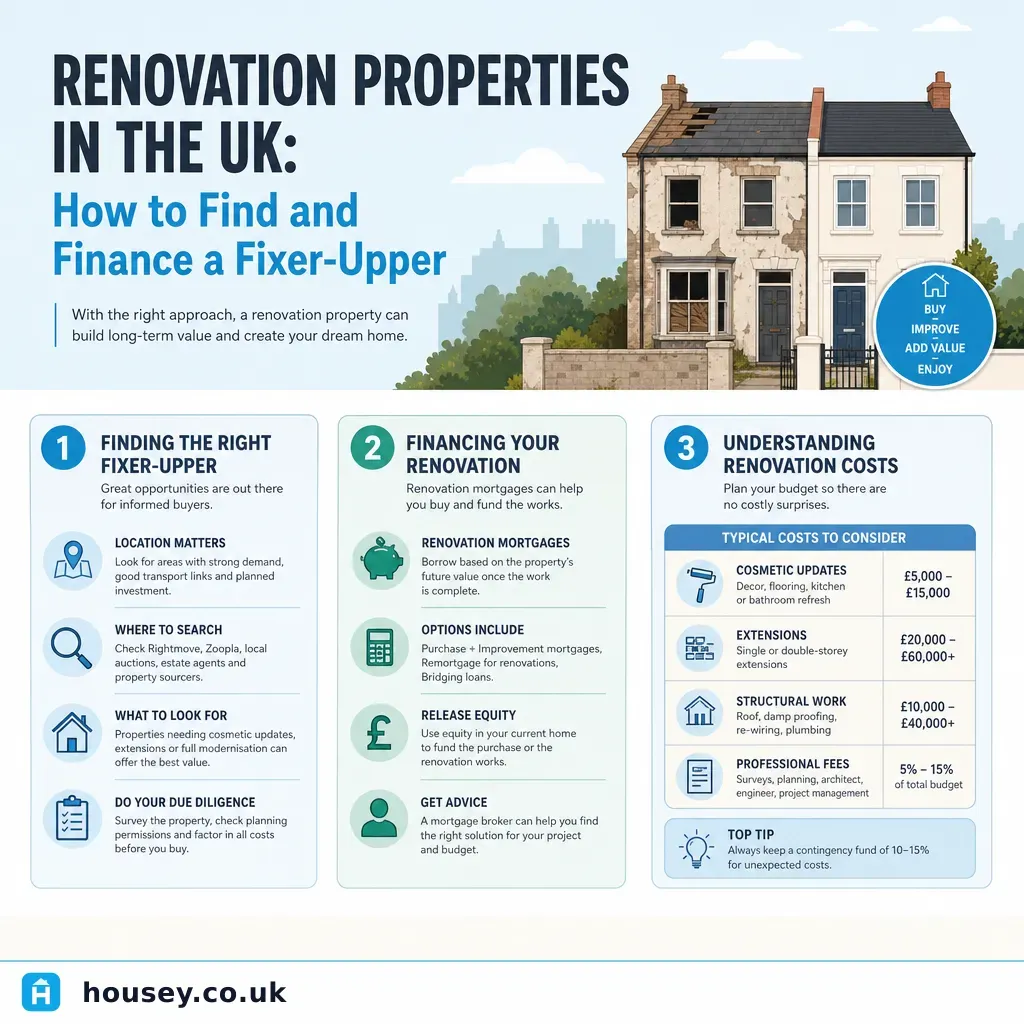
Renovation Properties in the UK: How to Find and Finance a Fixer-Upper
Renovation properties can offer genuine value, but success depends on thorough due diligence before exchange.
 Improvement & Build
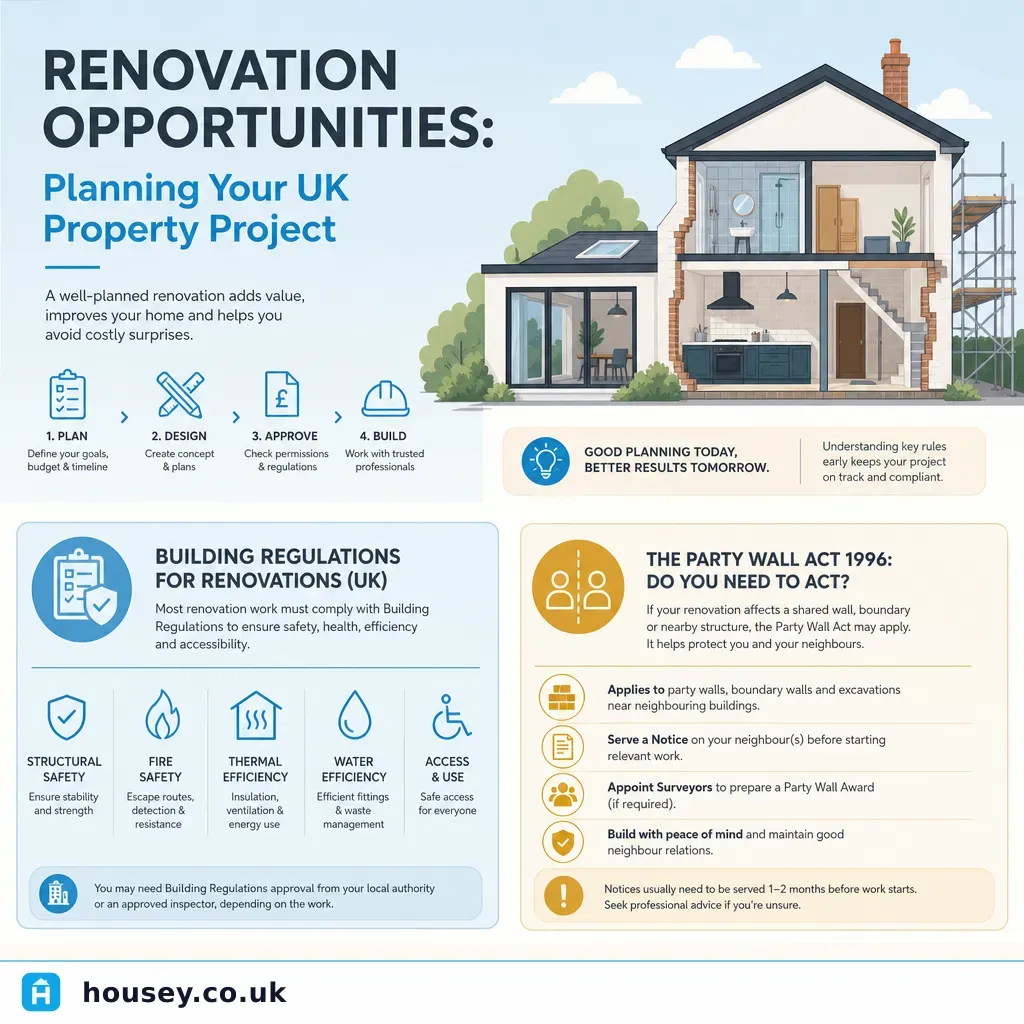
Renovation Opportunities: Planning Your UK Property Project
Planning a successful renovation in the UK means sequencing work correctly, securing building regulations approval where required, and budgeting for contingencies of at least 15–20%.
 Improvement & Build
How to Find and Evaluate Renovation Properties in the UK
A renovation property is worth pursuing when the acquisition price plus realistic renovation costs leaves a clear margin against comparable finished properties nearby.
 Improvement & Build
Television-Featured Properties: Renovation and Improvement Opportunities
Television-featured renovation properties can offer genuine value, but assessing the full scope of works before exchange is critical.