Renovation Properties in the UK: How to Find and Finance a Fixer-Upper
By Housey · Last reviewed 8th of May 2026
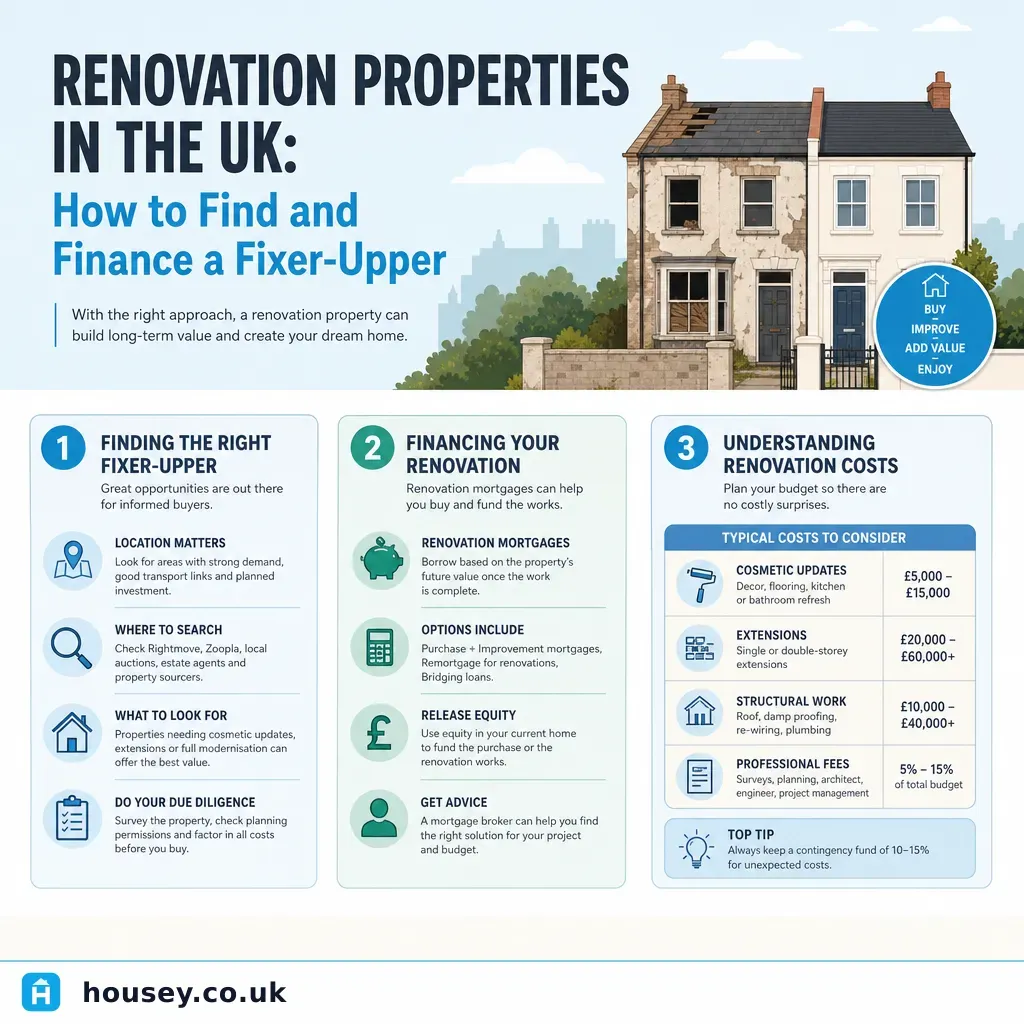
Renovation Properties in the UK: How to Find and Finance a Fixer-Upper
Finding a property that needs work can offer genuine value in a competitive market, but the difference between a profitable renovation and a money pit often comes down to the quality of due diligence before exchange. Renovation projects vary enormously — from cosmetic refreshes in a 1990s semi to full structural repairs in a pre-1919 terrace — and understanding the true scope and cost of what you are taking on is essential before you commit.
Key points
- A RICS Level 3 Building Survey is the only residential survey type that assesses all accessible areas, identifies defects, and outlines repair implications in detail — it is strongly recommended for any renovation property regardless of age.
- Permitted development rights allow many single-storey rear extensions, loft conversions, and garage conversions without a full planning application, subject to property-specific conditions under the Town and Country Planning (General Permitted Development) (England) Order 2015.
- Renovation mortgage products from lenders including Aldermore and Shawbrook release funds in stages tied to completion milestones, making them suited to properties considered uninhabitable at the point of purchase.
- Properties in conservation areas, Article 4 direction zones, or listed on the Statutory List of Buildings of Special Architectural or Historic Interest face additional controls that limit what can be changed without specific consent.
- Damp, subsidence, and roof defects are the three most costly categories of defect found in renovation properties, and each requires specialist assessment before you can budget with any confidence.
What makes a good renovation property?
The best renovation opportunities share consistent characteristics: structural soundness — or a clearly scoped structural repair with known costs — a practical layout, a realistic path to planning or permitted development approval for the improvements you have in mind, and a purchase price that genuinely reflects the cost of works outstanding.
Property types that frequently present renovation potential include:
- Pre-1919 terraced houses with original features, often needing updated services, roof repairs, or damp treatment.
- 1930s semis with potential for single-storey kitchen extensions, loft conversions, or garage conversions within permitted development.
- Ex-local authority houses on generous plots, typically structurally sound but requiring cosmetic or energy-efficiency upgrades.
- Rural properties and farm buildings subject to planning constraints but offering substantial floor area or associated outbuildings.
- Probate or repossession sales priced below market value to reflect condition and a vendor's preference for an unconditional sale.
Not every discounted property is a sound renovation project. Properties with contaminated land, mining subsidence risk, flood zone designations, or historic illegal building work can present risks that outweigh the purchase discount.
Types of renovation work and planning requirements
Understanding which works require planning permission — and which fall under permitted development — is critical to accurate pre-purchase budgeting.
Work type | Typically permitted development? | Key conditions | Professional typically needed |
|---|---|---|---|
Single-storey rear extension | Yes (England), within limits | Max depth 4m detached / 3m other; max height 4m; not in conservation area | Architect or architectural technologist for drawings; building control |
Two-storey rear extension | No — requires planning permission | Assessed against local policies and neighbour impact | Planning consultant or architect |
Loft conversion (no roof alteration) | Often yes | Within 40m³ terraced / 50m³ other; no front dormers; not on designated land | Structural engineer; specialist loft conversion company |
Rear dormer loft conversion | Permitted development on rear elevation for many properties | Conservation area and listed building exemptions apply | Architect, structural engineer |
Garage conversion (internal) | Usually yes | Local authority may require retained parking; check planning conditions | Architectural technologist for building regs drawings |
FENSA-registered window/door replacement | Usually permitted development | Must match appearance in conservation areas | FENSA-registered installer (avoids separate building control certificate) |
Basement conversion | Rarely — usually requires planning | Party wall implications common; engineering assessment essential | Structural engineer, party wall surveyor |
Permitted development rights can be removed by Article 4 directions, conservation area designations, conditions attached to earlier planning permissions, or listed building status. Always check with your local planning authority before starting work.
Assessing renovation costs before you buy
Getting accurate costs before exchange is difficult but critical. The following indicative ranges are a starting point for budgeting; always obtain multiple quotes from qualified contractors before making a financial commitment.
Indicative UK renovation cost ranges, last reviewed 2026-05-08. These are broad market estimates and will vary by property, location, specification, and contractor — always obtain site-specific quotes.
- Full rewire (3-bed house): £3,500–£6,500
- New gas central heating system (boiler + radiators): £3,500–£6,000
- Roof re-covering (3-bed semi, plain tiles): £5,000–£12,000
- Single-storey rear extension (30m², mid-spec): £45,000–£70,000 (higher in London and the South East)
- Dormer loft conversion (20m²): £35,000–£60,000
- Damp treatment (rising damp, one wall): £700–£2,500
- Full kitchen refit (supply and fit, mid-range): £8,000–£20,000
A RICS-qualified building surveyor or independent cost consultant can provide a more accurate preliminary estimate after physically inspecting the property.
What to ask before accepting a renovation quote
- What is included and excluded from the scope of works?
- Who will carry out the work, and what qualifications or accreditations do they hold (Gas Safe, NICEIC, FMB membership)?
- What building control applications are included in the price, and who submits them?
- What assumptions is the quote based on, and what could change the price if hidden defects are uncovered?
- Is VAT included, and does the 5% reduced rate apply to any elements?
- What is the programme, and what happens if structural or damp issues are found once works start?
Renovation mortgages and financing options
Standard residential mortgages are sometimes declined on properties deemed uninhabitable or in very poor structural condition. Options for renovation buyers include:
- Renovation or refurbishment mortgage: stage-release products from lenders such as Aldermore and Shawbrook, suited to properties that cannot be occupied immediately on purchase.
- Bridging loan: short-term finance at higher interest rates, used when speed of purchase matters and a standard mortgage is unavailable — an exit strategy must be planned before drawdown.
- Self-build mortgage: suited to more extensive rebuilds; funds released at defined construction stages such as foundations, wall plate, and first fix.
- Remortgage or further advance on an existing property: if you own a home with equity, this can fund renovation works on a second property without a specialist product.
- ECO4 and Great British Insulation Scheme: Government-backed funding for insulation and heating upgrades in eligible properties, delivered through energy suppliers and TrustMark-registered contractors — worth checking eligibility on before finalising a works budget.
Red flags when viewing a renovation property
Some defects are cosmetic and straightforward to address. Others are serious and costly. A few can render a property unviable at the purchase price. Watch for:
- Stepped or diagonal cracking running from window corners or through brickwork: may indicate differential settlement or active subsidence — requires a structural engineer assessment before purchase.
- Damp patches, tide marks, or white efflorescence (salt deposits) on internal walls: could indicate rising damp, penetrating damp, or condensation — each has different causes and treatment costs, and each needs specialist diagnosis rather than a cosmetic fix.
- Sagging roof ridge, missing or slipped tiles, or heavy moss growth: roof replacement is one of the most expensive single renovation items and should be specifically priced before exchange.
- No building regulations completion certificate for visible extensions or structural alterations: this can complicate resale and remortgaging, and may require retrospective regularisation or indemnity insurance.
- Large trees on clay soils close to the building: root shrinkage can cause seasonal subsidence; obtain a structural engineer opinion if significant trees are within 10–15 metres of the foundations.
- Back-addition (outrigger) construction common in Victorian terraces: these rear extensions often have shallow foundations, poor thermal performance, and separate roof structures that deteriorate faster than the main house.
- Non-standard construction (concrete panel, prefabricated, or timber frame): may affect mortgage availability and require specialist contractors who may not be easy to source locally.
Homeowner checklist: before you make an offer on a renovation property
When to get professional help
A RICS Level 3 Building Survey should be treated as essential, not optional, for any renovation property. If the survey identifies structural movement, damp penetration, or evidence of asbestos-containing materials, commission specialist follow-up surveys before proceeding. Do not rely on the vendor's account of defects or the estate agent's characterisation of the works involved.
For planning decisions, a planning consultant or architect can advise on what is likely to be permitted before you incur drawing costs. For asbestos, commission a licensed asbestos surveyor before any intrusive works or demolition — disturbing asbestos-containing materials without an assessment is a legal offence under the Control of Asbestos Regulations 2012.
How Housey can help
Housey connects homeowners with qualified tradespeople and specialists across every stage of a renovation project. Whether you need extension builders to price a rear extension, loft conversion companies to assess your roof space potential, or damp proofing specialists to investigate moisture issues before purchase or during works, Housey can help you request multiple quotes from vetted providers.
Frequently asked questions
Do I always need planning permission for a renovation?
Not always. Internal alterations, most like-for-like repairs, and many extensions fall under permitted development rights and do not require a planning application. However, all structural works and changes to building services — such as new electrics or gas installations — require building regulations approval regardless of planning status. Always check with your local planning authority if you are unsure of the position.
Is it worth buying a property that needs a full rewire?
Often yes, if the purchase price reflects the cost of works. A full rewire is a significant but predictable expense — typically £3,500–£6,500 for a three-bedroom house. The more important question is whether the rewire is the only major issue, or whether it sits alongside roof, structural, and damp defects. A RICS Level 3 survey helps establish the full picture before you commit.
Can I live in a property while renovating?
In many cases yes, depending on the extent of works. Kitchens, bathrooms, and decoration can often be managed in stages while you occupy the property. Full rewires, major replumbing, or structural works are more disruptive and may require temporary decanting. Discuss the programme with your contractor before exchange if you plan to remain on-site throughout the works.
How do I find renovation properties for sale?
Beyond Rightmove and Zoopla, renovation properties often appear in probate sales handled by specialist solicitors, property auctions (including Allsop, Savills, and iamsold), and direct-to-vendor marketing. Properties described as needing modernisation, updating, or sold as seen typically warrant investigation and a RICS Level 3 Building Survey — particularly before auction, where exchange is normally immediate on the fall of the hammer.
Do I pay VAT on renovation works?
Standard rate VAT at 20% applies to most renovation and improvement works. However, a reduced rate of 5% applies to certain energy-saving measures and, in some circumstances, to the conversion of a non-residential building or renovation of a property that has been empty for more than two years. Check the current position with your contractor and HMRC VAT Notice 708 on GOV.UK.
Sources and further reading
- Permitted development rights for householders: technical guidance — GOV.UK
- Energy Company Obligation (ECO4) scheme — GOV.UK
- RICS Home Survey Standard — RICS
- Planning Portal: house extension and loft conversion guidance — Planning Portal
- VAT on construction and building services (Notice 708) — HMRC / GOV.UK
- Flood map for planning — Environment Agency
Useful next reads
 Improvement & Build
How to Plan and Prioritise Renovation Works in a UK Property
Start with structure and weatherproofing, then first-fix services, then plastering, then second fix, then decoration and fit-out.
 Improvement & Build
Renovation Opportunities Across the UK Property Market
Renovation properties in the UK range from cosmetic fixer-uppers needing decoration and new kitchens, to structural projects requiring new roofs, damp treatment, or extensions.
 Improvement & Build
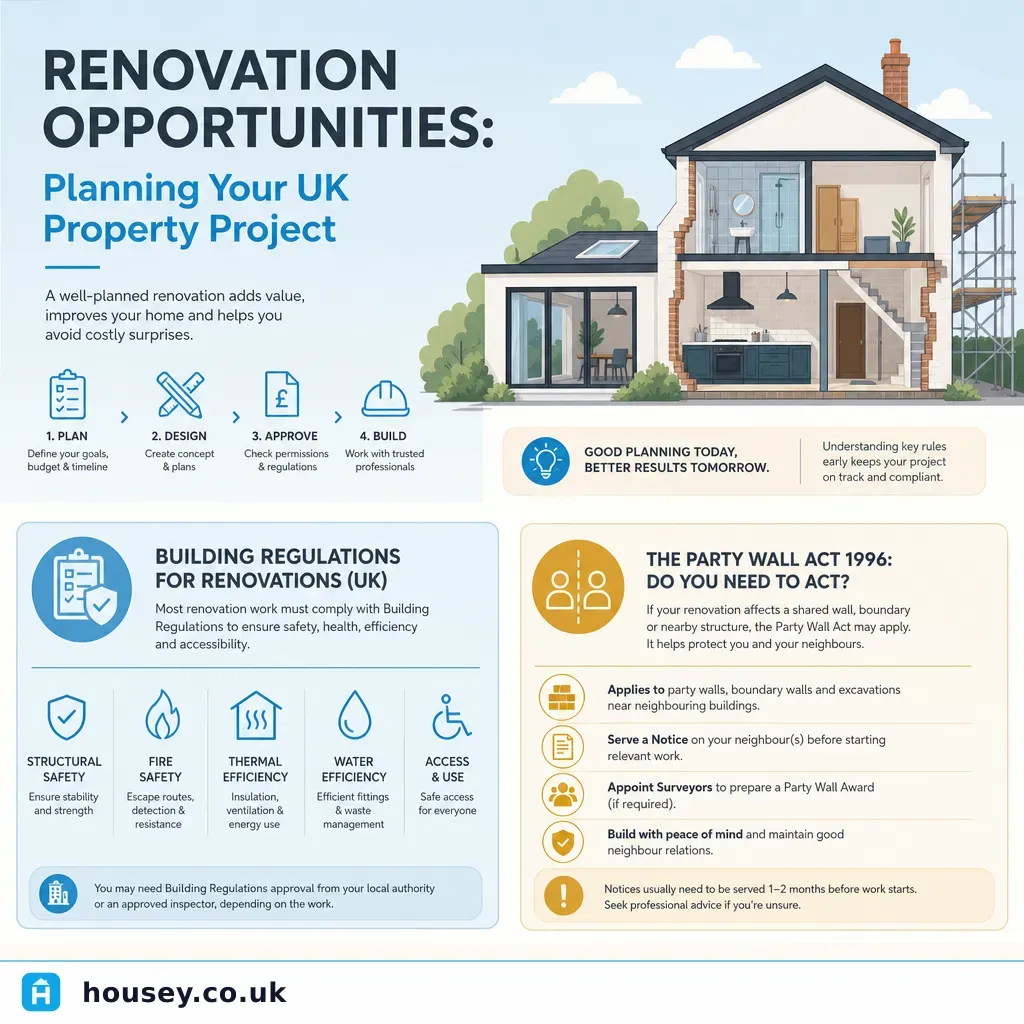
Renovation Opportunities: Planning Your UK Property Project
Planning a successful renovation in the UK means sequencing work correctly, securing building regulations approval where required, and budgeting for contingencies of at least 15–20%.
 Improvement & Build
How to Find and Evaluate Renovation Properties in the UK
A renovation property is worth pursuing when the acquisition price plus realistic renovation costs leaves a clear margin against comparable finished properties nearby.
 Improvement & Build
Television-Featured Properties: Renovation and Improvement Opportunities
Television-featured renovation properties can offer genuine value, but assessing the full scope of works before exchange is critical.