How to Find and Hire a Qualified Roofer
By Housey · Last reviewed 18th of May 2026
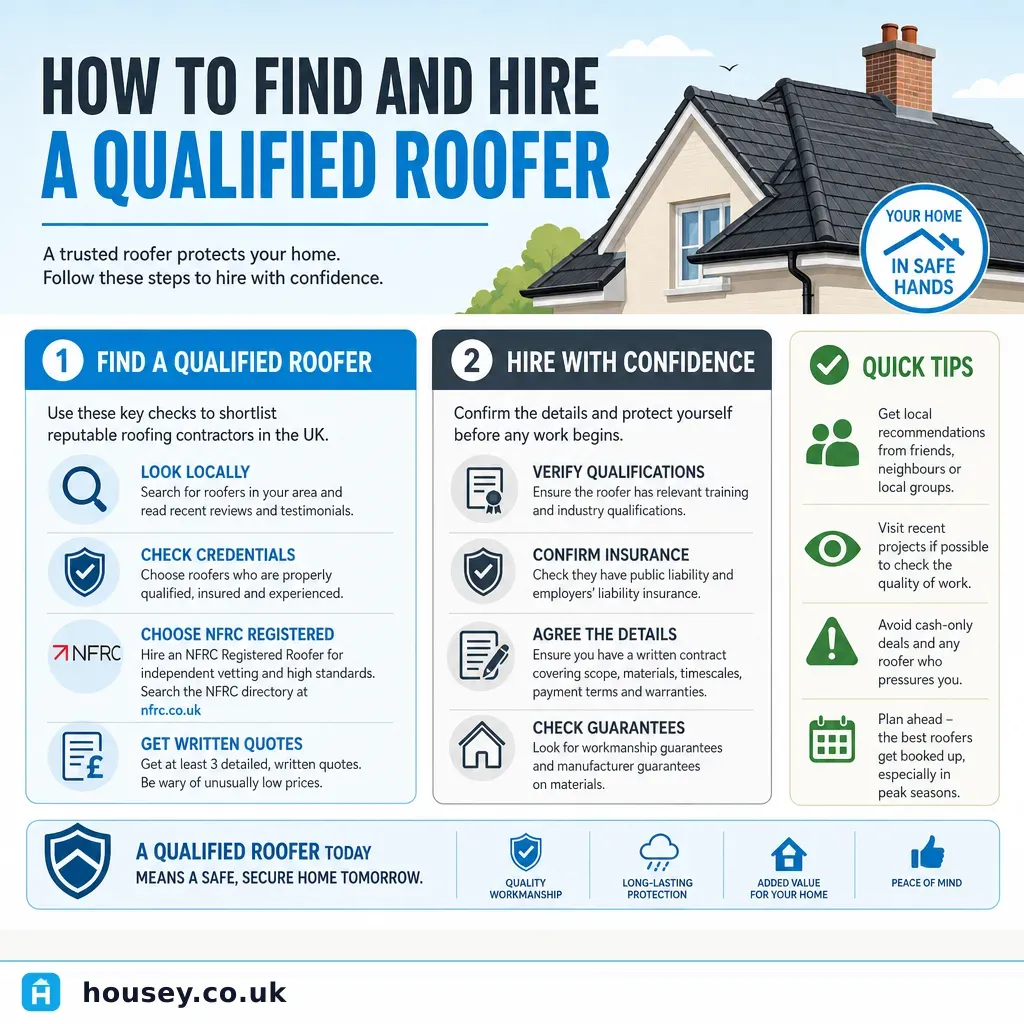
How to Find and Hire a Qualified Roofer
Roof repairs and replacements are among the highest-value maintenance jobs a UK homeowner can commission, and a failed installation can allow water ingress that damages roof timbers, insulation, and ceilings over months before it becomes visible indoors. Because roofing is largely unregulated by statute — anyone may legally trade as a roofer in the UK — the burden of vetting falls almost entirely on you before you sign a contract.
Key points
- The National Federation of Roofing Contractors (NFRC) is the UK's largest specialist roofing trade body; membership requires evidence of technical competence, health and safety compliance, and public liability insurance of at least £2 million.
- Work at Height Regulations 2005 require any contractor working above 2 m to have a safe system of work, appropriate scaffold or access equipment, and a documented risk assessment — ask to see this before work starts.
- Flat and pitched roofing are distinct trades: EPDM rubber, GRP fibreglass, and built-up felt flat systems require different skills from clay plain tiles, concrete interlocking tiles, and natural or artificial slate.
- Any roofing work on a listed building or within a conservation area may require listed building consent or planning permission even for like-for-like material replacement — check with your local planning authority first.
- Written guarantees covering both materials and workmanship for at least 10 years are standard among reputable contractors; manufacturer product warranties on EPDM membranes can extend to 20–25 years.
What memberships and accreditations should a roofer hold?
Unlike gas engineers (who must be Gas Safe registered) or electricians (who may self-certify under NAPIT or NICEIC), roofers have no statutory licensing requirement. This makes professional memberships and third-party accreditations the most reliable indicators of quality.
NFRC (National Federation of Roofing Contractors) is the benchmark trade body. NFRC members are assessed on technical competence, hold adequate insurance, and follow the NFRC Code of Practice. The NFRC maintains a publicly searchable contractor directory at nfrc.co.uk.
TrustMark is a government-endorsed quality scheme covering trades including roofing. TrustMark registration requires third-party vetting of workmanship standards, customer service, and business practices. Verify registration at trustmark.org.uk.
CSCS (Construction Skills Certification Scheme) cards confirm that a roofer has passed a health and safety test and holds relevant NVQ or SVQ qualifications. Ask to see the operative's CSCS card before work begins.
Manufacturer training certificates are relevant for specialist flat-roofing systems. Installers of Sarnafil, Bauder, IKO, and similar systems are often required to complete manufacturer training to issue a contractor-backed warranty on the installed system.
Pitched versus flat roofing: choosing the right specialist
Not all roofers are competent across all roof types. Use this table to identify the right specialist for your project.
Roof type | Common materials | Specialist to look for | Watch out for |
|---|---|---|---|
Pitched (standard) | Clay plain tiles, concrete interlocking tiles, Welsh slate, artificial slate | NFRC member with experience in your specific tile type | Incorrect nailing patterns; missing lead or code work to flashings |
Pitched (heritage/listed) | Handmade plain tiles, natural Welsh or Westmorland slate, stone tiles | NFRC member with conservation or listed-building experience | Modern substitutes used without listed building consent |
Flat (modern) | EPDM rubber membrane, GRP fibreglass, liquid waterproofing | Manufacturer-trained installer; NFRC flat-roofing specialist | Incorrect fall gradient; poor drainage; badly joined seams |
Flat (older) | Built-up felt, mastic asphalt | Specialist in legacy systems | Temporary patch repairs presented as full replacement |
Green or sedum roof | Specialist build-up including root barrier and drainage layer | Landscape and roofing hybrid contractor | Load-bearing implications not checked with a structural engineer |
How to vet contractors before accepting a quote
Verify memberships independently. Do not rely on a logo on a van or website. Check NFRC membership at nfrc.co.uk and TrustMark registration at trustmark.org.uk directly.
Obtain at least three written quotes. Quotes should specify: the exact scope of work; materials by manufacturer, product name, and specification; scaffold or access arrangements; waste disposal; any building control notifications required; and a payment schedule tied to stages of completion.
Ask for evidence of insurance. At minimum, a roofing contractor should carry public liability insurance (typically £2–5 million cover) and employers' liability insurance if they employ others. Ask to see the certificate; do not accept a verbal assurance.
Check references for comparable work. Ask for two or three UK homeowner references for similar projects — re-roofing a 1930s semi with concrete interlocking tiles or replacing a chimney stack on a Victorian terrace, for example. A brief call can reveal a great deal about finish quality and site tidiness.
Confirm scaffold arrangements upfront. Reputable roofers erect proper scaffold for pitched re-roofing work. Any contractor who proposes to carry out a full re-roof from ladders alone is raising a safety and quality concern worth investigating before proceeding.
Homeowner checklist before work starts
Red flags to watch for
- Contractors who knock on your door unsolicited claiming to have spotted damage from the pavement or a passing vehicle.
- Requests for large cash payments upfront before materials are delivered or work has begun.
- No fixed business address, and no public liability insurance certificate when asked.
- Quotes dramatically lower than all others without a clear explanation of what is excluded.
- Pressure to sign quickly to secure a "special price" or because a cancelled job has freed up a slot.
- A contractor who cannot name the specific materials, manufacturer, or product grade they will use.
- Proposals to carry out a full re-roof without proper scaffold from a working platform.
When to get professional help
If you notice missing or slipped tiles, water staining on ceilings or in the loft, persistent damp patches, moss growth blocking gutters and valleys, or any visible sagging of the roof line, arrange a professional inspection without delay. The UK climate means water ingress can cause progressive damage to roof timbers, insulation, and ceilings before it becomes obvious inside the house.
For listed buildings or properties within a conservation area, consult your local planning authority or a conservation-accredited architect before commissioning any roofing work — even a replacement in kind. If a contractor has carried out substandard work and is unresponsive, the NFRC operates a complaints and conciliation process for its members, and Trading Standards can advise on further options.
How Housey can help
Housey connects homeowners with vetted qualified roofers who have been checked for professional memberships, insurance, and customer feedback, helping you compare quotes with confidence rather than starting from scratch with unverified directories.
Frequently asked questions
Do roofers need to be licensed in the UK?
No statutory licensing applies to roofing in the UK, which makes independent vetting particularly important. Professional membership of the NFRC or TrustMark registration is the nearest equivalent to a quality assurance standard. For roofing work on listed buildings, check with your local planning authority or Historic England about any consent requirements before work begins.
Should I pay a deposit for roofing work?
A small deposit to cover initial material procurement is reasonable for larger jobs, but you should never pay the full contract sum upfront. Stagger payments to agreed stages — for example, materials delivered, scaffold erected, work completed, and final inspection passed. Get payment terms in writing before work starts, and be cautious of any contractor who insists on full payment in advance.
How long does a new roof last in the UK?
Lifespan varies by material. Natural slate and clay plain tiles can last 80 to 100 years with good maintenance. Concrete interlocking tiles typically last 40 to 60 years. EPDM flat roof membranes usually carry a 20 to 25 year manufacturer warranty. GRP fibreglass systems have a typical life of 25 to 30 years. Workmanship quality influences longevity as much as the material itself.
What building regulations apply to re-roofing in England?
In England, replacing more than 25% of a roof area triggers a requirement to meet current thermal performance standards under Building Regulations Part L. Your contractor should notify building control or use a competent-person scheme where applicable. Check with your local building control authority if you are unsure whether your specific project requires a notification before work begins.
Sources and further reading
- NFRC: Find a Roofing Contractor — National Federation of Roofing Contractors
- Work at Height Regulations 2005 — legislation.gov.uk
- Approved Document L: Conservation of Fuel and Power — GOV.UK
- TrustMark Find a Tradesperson — TrustMark
- CSCS: Construction Skills Certification Scheme — CSCS
Useful next reads
 Improvement & Build
How to Hire a Professional Window Installer
Use a FENSA or CERTASS-registered installer so your window replacement complies with Building Regulations Part L and Part Q and you receive a certificate registered with your local authority.
 Improvement & Build
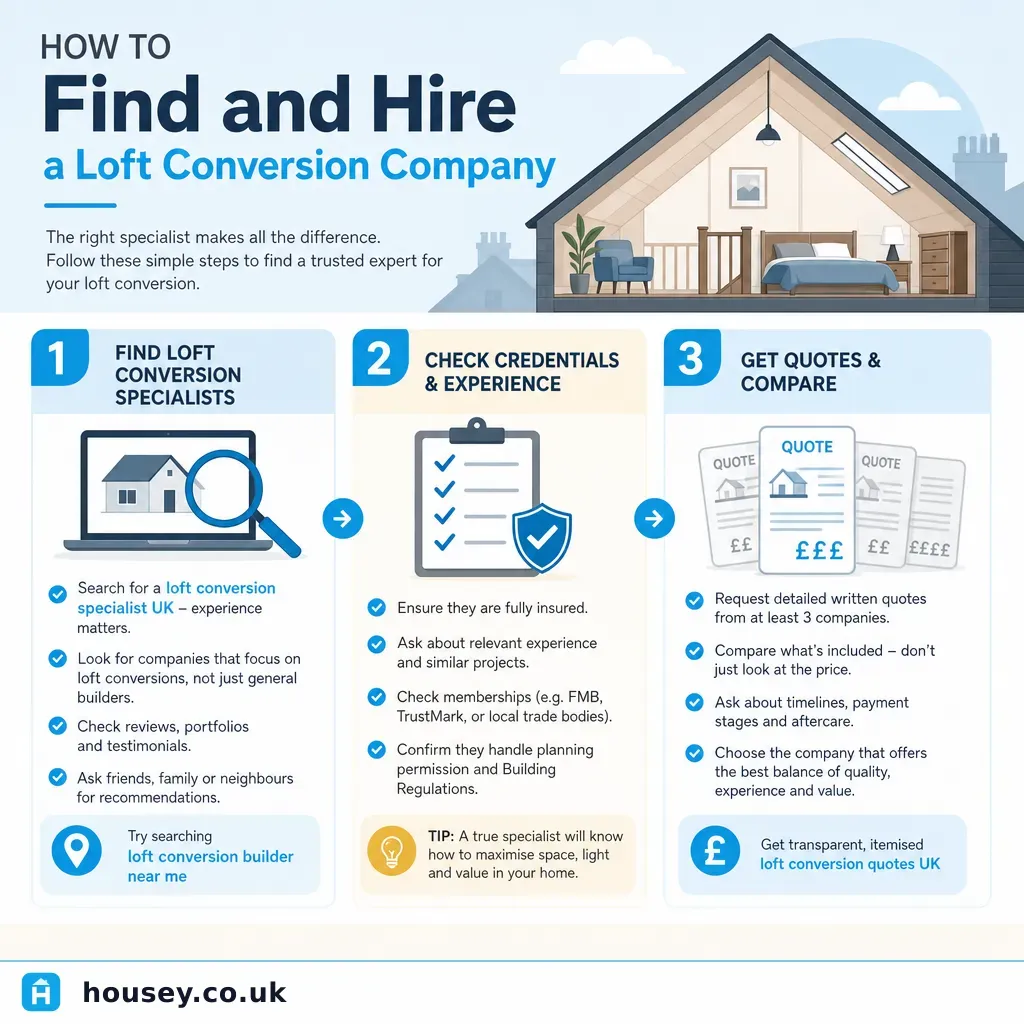
How to Find and Hire a Loft Conversion Company
To hire a loft conversion company, get at least three quotes from TrustMark-registered or FMB-member firms.
 Improvement & Build
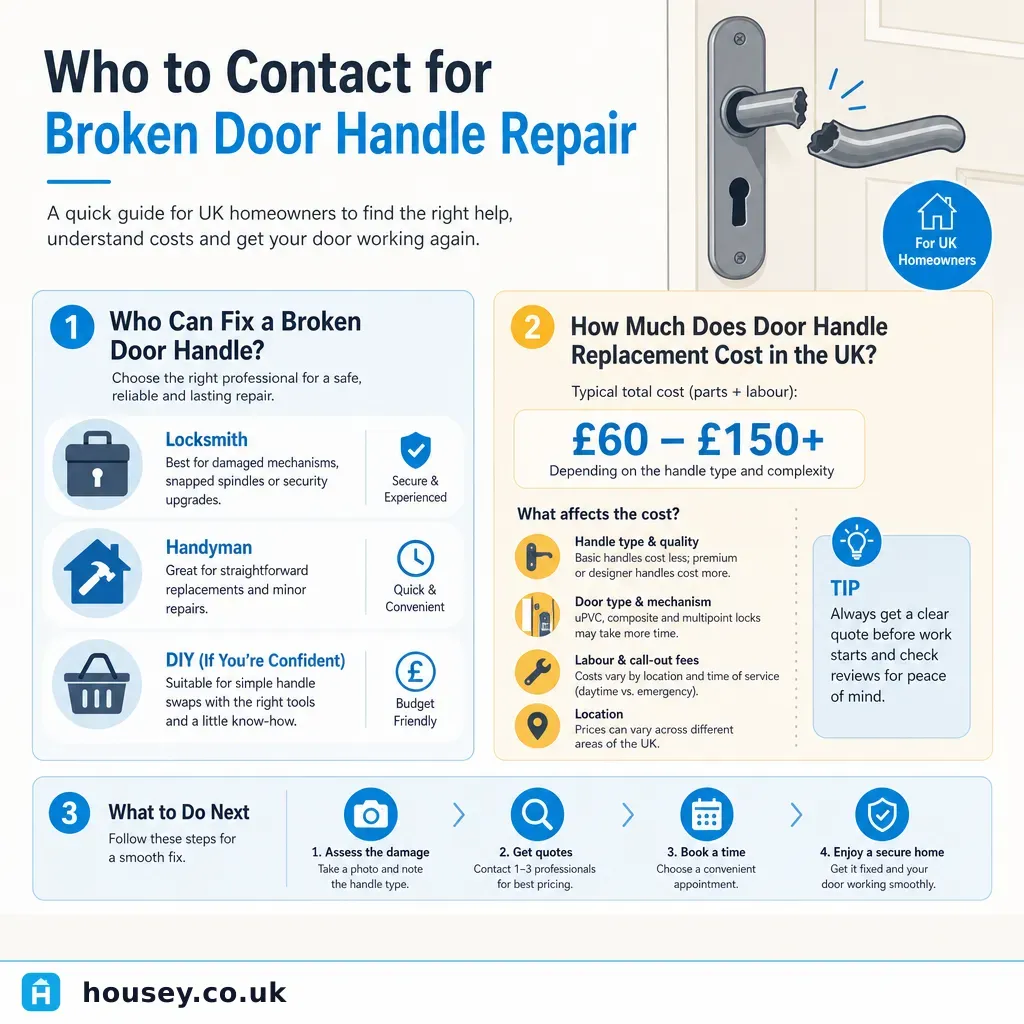
Who to Contact for Broken Door Handle Repair
For a broken door handle, a general handyperson can handle most internal timber door repairs, while a joiner or locksmith is better suited to external doors, particularly if the lock mechanism is affected.
 Improvement & Build
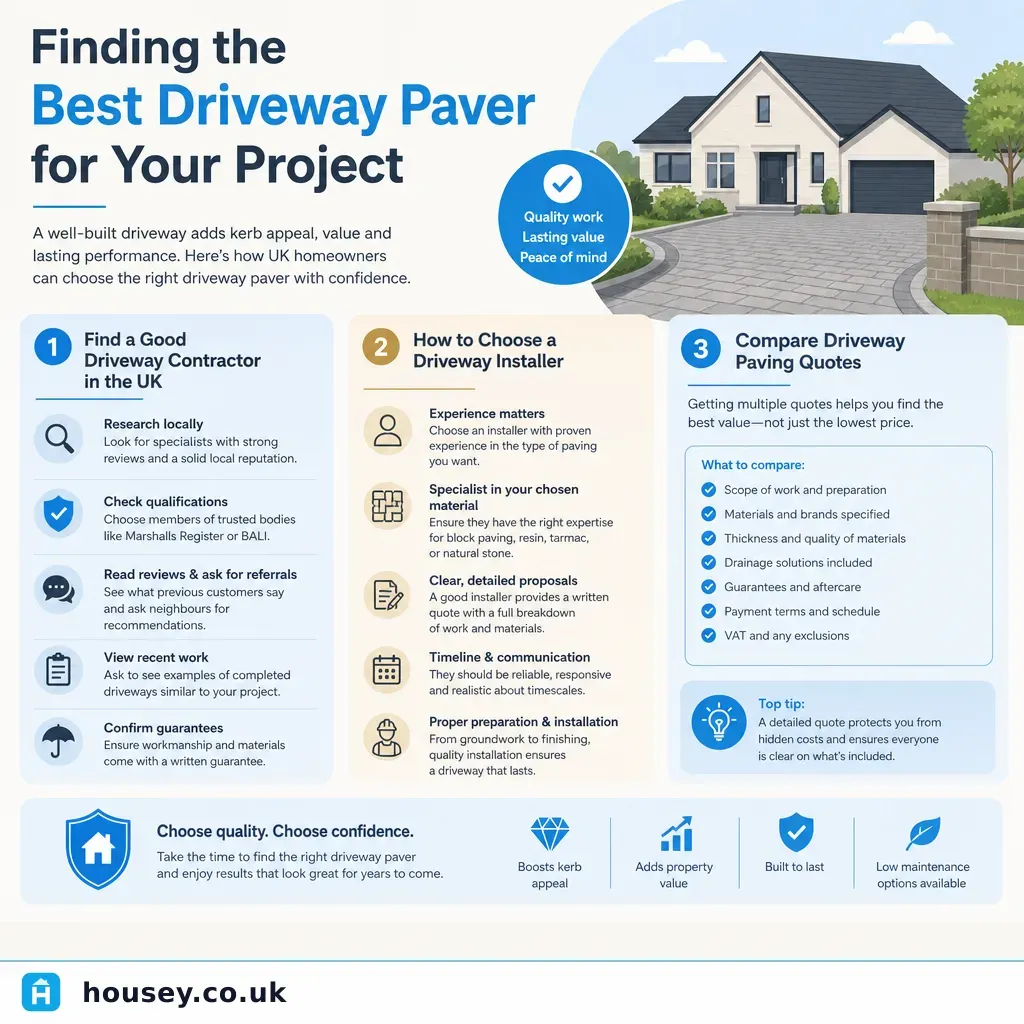
Finding the Best Driveway Paver for Your Project
To find a reliable driveway paver in the UK, get at least three written quotes, check the installer is registered with a trade body such as the National Federation of Builders or Marshalls Approved Installer scheme, ask to see recent local work, and confirm the quote covers drainage, edging, and planning.
 Improvement & Build
Selecting Renovation Contractors for Your Property Project
When selecting a renovation contractor, get at least three written, itemised quotes from contractors who have visited the site, verify membership of a recognised trade body such as the Federation of Master Builders, check references from comparable recent projects, and agree a detailed written contract before work starts.