Finding the Best Driveway Paver for Your Project
By Housey · Last reviewed 12th of May 2026
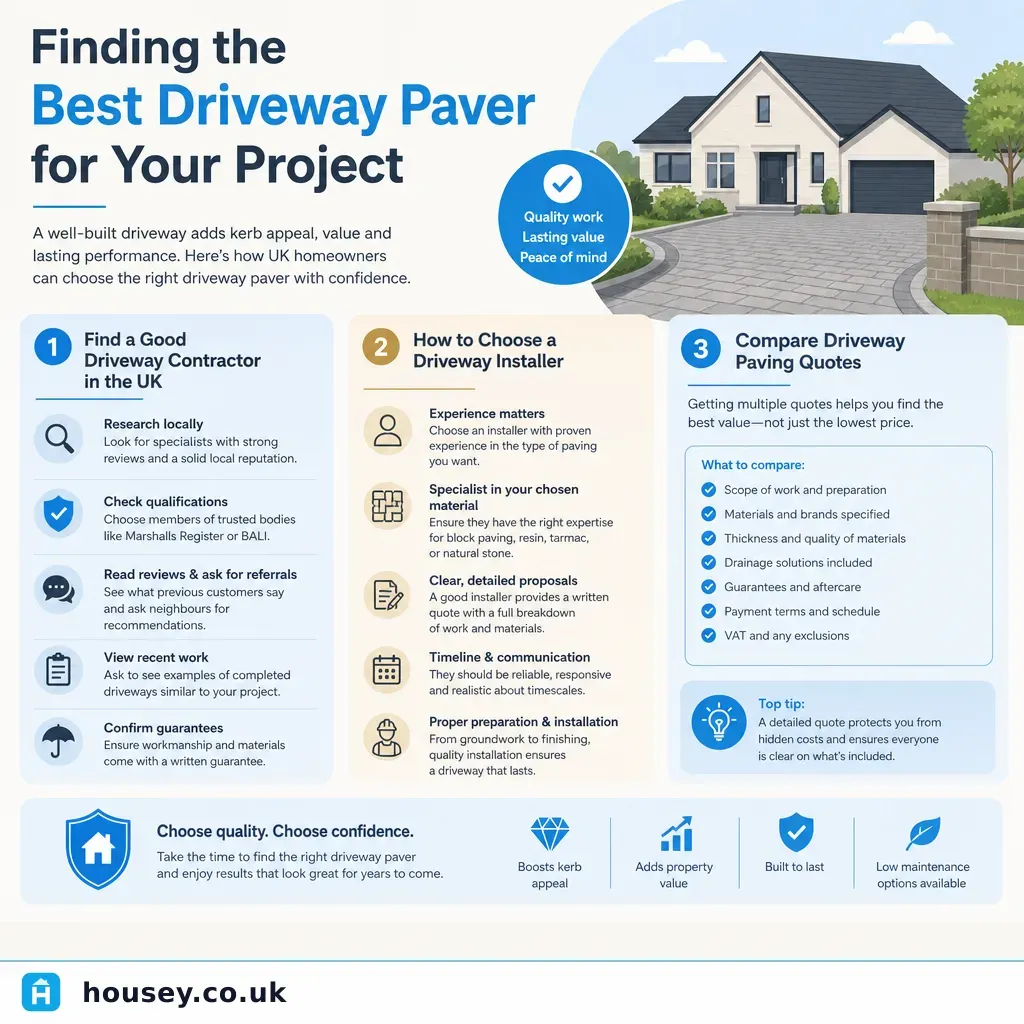
Finding the Best Driveway Paver for Your Project
Choosing the right driveway contractor is one of those decisions where getting it wrong can be expensive to undo. A poorly installed driveway — inadequate sub-base, missing drainage, incorrect edging — can fail within a few years, leaving you with cracked surfaces, pooling water, or blocked drainage gulleys. Whether you are replacing an old tarmac drive, upgrading to block paving, or considering resin-bound gravel, the contractor you choose matters as much as the material.
Key points
- Under the Town and Country Planning (General Permitted Development) (England) Order 2008, replacing a front garden driveway with a non-permeable surface over 5m² requires planning permission unless a permeable alternative is used.
- The Marshalls Approved Installer scheme and the National Federation of Builders (NFB) maintain searchable registers of vetted driveway contractors across the UK.
- A written quotation should break out sub-base preparation, surface material, edging, drainage, and any kerb drop separately — a single lump sum makes it hard to compare quotes meaningfully.
- Reputable installers typically offer a minimum five-year workmanship guarantee on block paving and resin-bound surfaces; ask for this in writing before work begins.
- A kerb drop (crossover) onto a public road requires consent from your local highway authority and may take several weeks to approve.
What to look for in a driveway installer
Not all driveway companies are equal. The market ranges from large regional firms with manufacturer accreditations to sole traders working independently. Neither is inherently better — what matters is verifiable experience with your specific material and drive size.
Start by looking for contractors who hold membership with recognised trade bodies:
- Marshalls Approved Installer: specific to Marshalls products but indicates training and quality standards.
- National Federation of Builders (NFB): a broader construction trades body with a formal vetting process.
- British Association of Landscape Industries (BALI): relevant where the project combines hard standing with landscaping.
- TrustMark: a government-endorsed quality scheme covering many home improvement trades.
Membership alone is not a guarantee of quality, but it creates accountability — members can be reported to the body if work falls below standard.
Driveway materials: a comparison
The material choice affects both cost and the type of contractor you need. Resin-bound gravel and permeable block paving in particular require specialist installation skills.
Material | Typical lifespan | Permeable? | Specialist installer needed? | Relative cost |
|---|---|---|---|---|
Tarmac (hot-rolled) | 20–30 years | No (unless permeable mix) | Yes — hot-lay requires equipment | Low–medium |
Block paving | 20–40 years | Permeable options available | Standard experienced paver | Medium |
Resin-bound gravel | 15–25 years | Yes — inherently permeable | Yes — UV-stable resin mixing | Medium–high |
Loose gravel | Ongoing maintenance | Yes | No | Low |
Natural stone setts | 50+ years | Limited (depends on jointing) | Yes — cutting and laying skills | High |
Concrete | 20–30 years | No (unless specially designed) | Experienced concreter | Medium |
Indicative UK costs, last reviewed 2026-05-12. Always obtain itemised quotes from at least three contractors.
Planning permission and drainage rules
Many homeowners are caught out by the 2008 permitted development change. If your proposed front driveway uses any non-permeable material and the area exceeds 5m², planning permission is required.
Permeable alternatives — resin-bound gravel, permeable block paving with open jointing, or grasscrete — are generally exempt. Confirm this with your local planning authority before choosing a material if you want to avoid the planning process.
Additional considerations:
- Listed buildings or Conservation Areas: always check with your local planning authority before any driveway works, as conditions are stricter.
- Pavement crossover: if the driveway requires a new or altered dropped kerb onto the public highway, you must apply to the local highway authority. This is a separate process from planning permission.
- Wales: Schedule 3 of the Flood and Water Management Act 2010 requires new drainage associated with certain developments to use Sustainable Drainage Systems (SuDS). Check current requirements with Natural Resources Wales if applicable.
How to get and compare quotes
Getting multiple quotes is essential — not just to find the lowest price, but to confirm that contractors are specifying the same standard of work. A cheaper quote may exclude sub-base preparation or use thinner edging, making direct comparison misleading.
What to ask before accepting a quote
- Is the sub-base depth specified? (Standard is 100–150mm MOT Type 1 aggregate for block paving.)
- Does the quote include removal and disposal of the existing surface?
- How will drainage be managed — is a drainage channel or gulley included?
- Is a kerb drop application included if required?
- What edging material is specified — concrete haunching, block edging, or steel?
- What is the guarantee period, and does it cover materials, workmanship, or both?
- Will the work be carried out by the quoting company or subcontracted?
- Is VAT included?
- What are the stage payment terms?
A single lump sum without an itemised breakdown is a warning sign. Ask for the quote to be broken down by element.
Red flags to watch for
- Request for a large cash upfront payment: reputable contractors may ask for a deposit (commonly 10–25%) but demanding half or more before work begins is unusual.
- No written contract or quote: verbal agreements leave you with no recourse if the work is substandard.
- Unsolicited cold calls or door knocking: rogue traders frequently target homeowners this way. Always seek contractors independently.
- No verifiable local address or landline number: a contractor with only a mobile number and no traceable address is harder to hold accountable.
- Pressure to decide immediately or "today-only" pricing: genuine contractors do not need to pressure you.
- Unusually low price with a vague specification: this often means the sub-base depth or drainage provision will be cut short.
When to get professional help
For a straightforward driveway replacement on a level urban plot, a competent approved installer is usually sufficient. Consider independent advice if:
- Your property is listed or within a Conservation Area.
- The driveway involves complex gradients or drainage challenges — for example, a slope that directs water towards the house.
- You are near a watercourse or in a flood-risk area.
- There are underground utilities beneath the proposed driveway area — check with your utility providers before work begins.
- The project involves building close to a boundary wall that may be structurally affected.
How Housey can help
Housey connects homeowners with vetted driveway installers across the UK. Submit your project details once and receive quotes from local contractors who have been assessed for relevant experience, saving you the time of searching and vetting individually.
Frequently asked questions
Do I need planning permission for a new driveway in the UK?
In England, planning permission is required for a non-permeable front driveway larger than 5m². Permeable surfaces such as resin-bound gravel or permeable block paving are generally exempt. Rules differ in Wales, Scotland, and Northern Ireland, and stricter conditions apply in Conservation Areas and for listed buildings. Always confirm with your local planning authority.
How long does a driveway installation take?
Most residential driveway installations take between one and four days depending on size, material, and whether significant excavation is needed. Resin-bound surfaces need curing time of 24–48 hours before use. Larger or more complex projects involving drainage work or a new crossover may take longer.
What is a reasonable deposit for a driveway contractor?
A deposit of 10–25% of the total cost is typical from reputable contractors. Be cautious of requests for more than 30–50% upfront, and never pay the full amount before the job is complete and you are satisfied with the result.
Can I get a dropped kerb installed at the same time as the driveway?
Yes, but the application to the local highway authority is usually made separately and can take several weeks. Some councils require the crossover to be installed by a contractor on their approved list. Confirm the process with your local authority before scheduling work.
Sources and further reading
- Driveways and dropped kerbs — Planning Portal
- Permitted development rights for householders: technical guidance — GOV.UK
- National Federation of Builders: Find a Member — National Federation of Builders
- TrustMark: Find a Tradesperson — TrustMark (Government Endorsed Quality Scheme)
- Approved Installer Scheme — Marshalls
Useful next reads
 Improvement & Build
Finding a Good Tradesperson: Selection and Vetting Guide
To find a good tradesperson, check mandatory registrations first: Gas Safe for gas work, NICEIC or NAPIT for electrical, FENSA for window and door installations.
 Improvement & Build
Selecting and Hiring a Remodelling Contractor
Hiring a remodelling contractor starts with a written scope of works and a shortlist of at least three companies registered with TrustMark or the Federation of Master Builders.
 Improvement & Build
How to Find and Hire a Qualified Roofer
Look for NFRC-registered contractors or TrustMark-verified roofers and verify membership directly on each body's website rather than trusting a logo.
 Improvement & Build
Finding a Reliable Renovation Contractor: What to Look For
To find a reliable renovation contractor, verify FMB or TrustMark membership directly on the scheme website, obtain at least three itemised written quotes, and check public liability insurance documentation.
 Improvement & Build
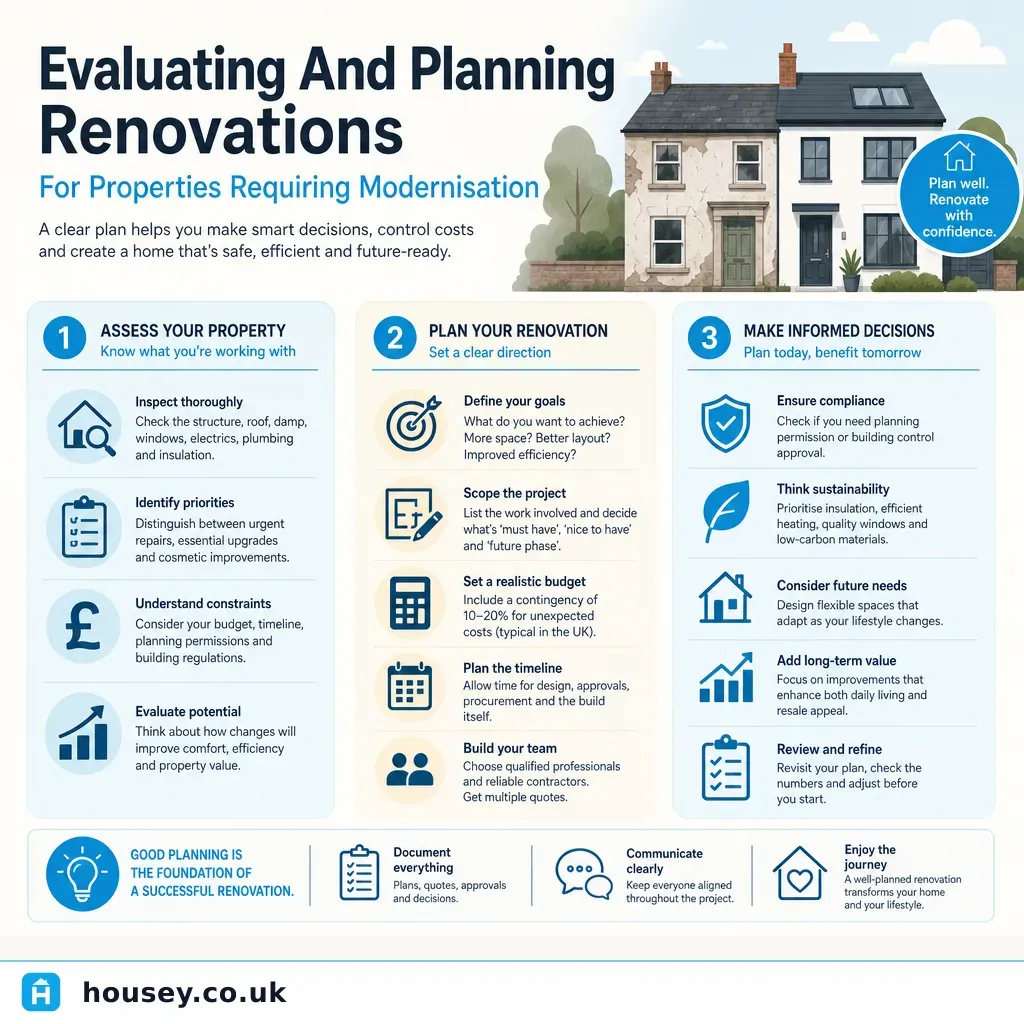
Evaluating And Planning Renovations For Properties Requiring Modernisation
Start by commissioning a condition survey — RICS Level 3 for pre-1919 properties — to identify structural defects, damp, and services issues before finalising a budget.