Man Van and Removal Service Pricing
By Housey · Last reviewed 7th of May 2026
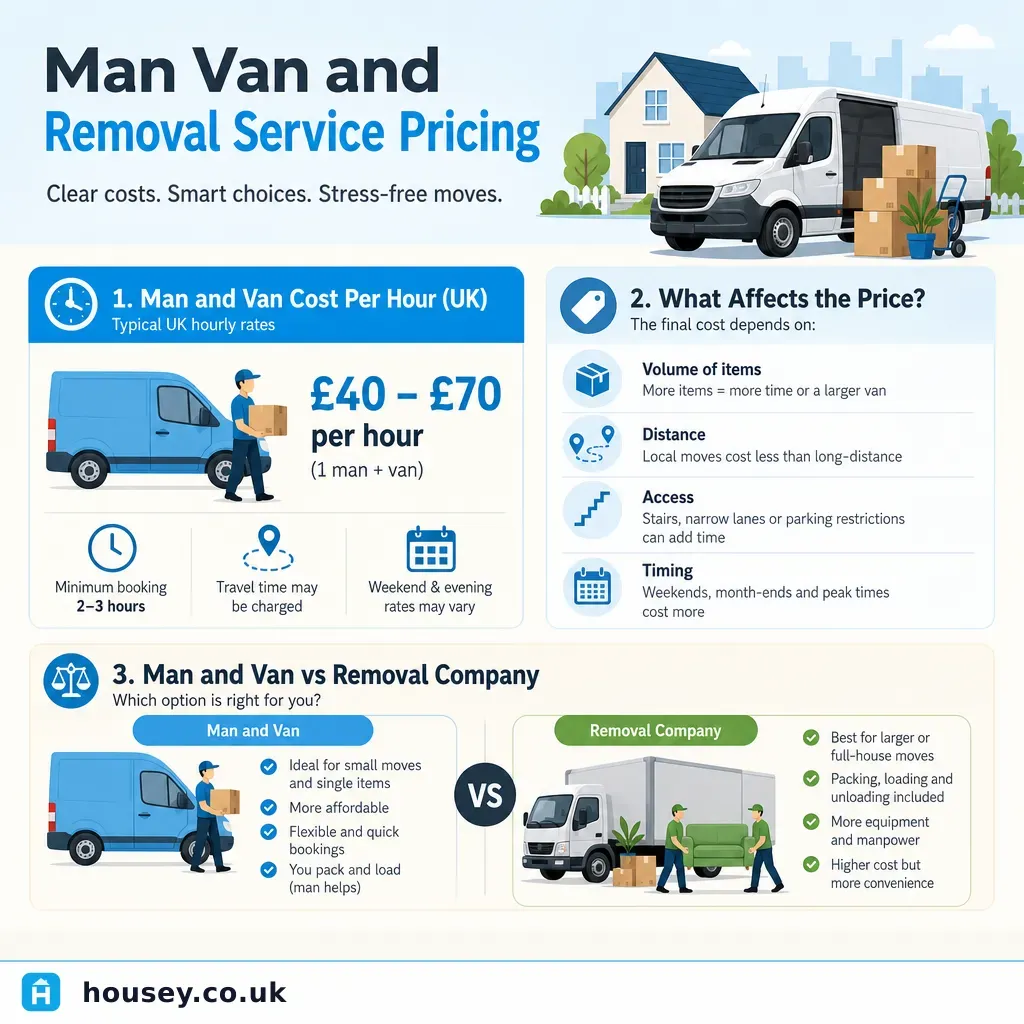
Man Van and Removal Service Pricing
Moving house or transporting bulky furniture involves decisions that affect both budget and logistics. Whether you're clearing a studio flat, moving a single bedroom load, or shifting large items between properties, understanding how a man and van service is priced helps you avoid unexpected costs and choose the right level of help. The question of man-and-van versus a full removal company comes up early in most moves — and the answer usually depends on volume, distance, and how much packing support you need.
Key points
- Man and van services in the UK typically charge between £30 and £80 per hour for a single operative with a transit-sized vehicle, with London and South East rates often at the higher end of that range.
- Most operators set a minimum hire period of 2–3 hours; a half-day booking (4 hours) is the most common unit for small moves.
- A standard man-and-van hire does not include packing materials, insurance for fragile items, or disassembly unless explicitly stated in the quote.
- The British Association of Removers (BAR) accredits full removal companies but does not cover man-and-van sole traders; checking public liability insurance is essential before booking.
- Distance, floor level, parking restrictions, and whether you need same-day loading and unloading all affect final cost significantly.
How man and van services are typically priced
Most man and van operators use one of three pricing structures: hourly rates, fixed-price half or full days, or flat-rate jobs quoted after a video or in-person assessment.
Hourly rates suit smaller, local moves where the volume and time are hard to predict. You pay for the operative's time from arrival to job completion, including loading, transit, and unloading. Travel time from the operator's base is sometimes charged separately — worth confirming before you book.
Half-day and full-day rates are common for moves requiring 4–8 hours of work. A half-day (typically 4 hours) reduces the uncertainty of an open-ended hourly meter and is usually priced as a slight discount on the equivalent hourly total.
Fixed quotes are offered for larger or more complex jobs, often after you share a room-by-room inventory or take a video call walkthrough. These give cost certainty but may include penalty clauses if the scope changes on the day.
Indicative UK costs, last reviewed 2026-05-07. Figures vary by region, vehicle size, and operator.
Job type | Typical cost range | Notes |
|---|---|---|
Single item / small load (1–2 hours) | £60–£160 | Minimum hire often 2 hours |
Studio or 1-bed flat move (half day) | £150–£350 | Higher at top end in London |
2-bed move, local (full day) | £300–£600 | May need second operative |
Long-distance move (100+ miles) | £400–£900+ | Fuel, tolls, return journey |
Additional operative | £20–£40/hr extra | Needed for heavy or bulky items |
Source: indicative ranges based on publicly available trade pricing guides and BAR member data, 2025–2026.
Man and van versus a full removal company
The choice between a man-and-van operator and a full removal firm depends on the scale of your move and the level of service you need.
Choose a man and van if:
- You are moving the contents of one or two rooms.
- You have already packed and boxed everything.
- You are moving locally (within 30–40 miles) and the job fits in a single transit or Luton van.
- Budget is the main driver and you are comfortable coordinating the logistics yourself.
Choose a full removal company if:
- You are moving a 3+ bedroom property.
- You need packing, wrapping, or specialist handling for antiques, artwork, or pianos.
- You want goods-in-transit insurance as standard.
- You need storage between properties.
- You are moving long distance or internationally and want a single point of accountability.
Factor | Man and van | Full removal company |
|---|---|---|
Typical cost | Lower | Higher |
Insurance | Public liability only (check) | Goods in transit usually included |
Packing | Usually extra or not offered | Often included in full-service packages |
BAR accreditation | Rare | Available; worth seeking |
Flexibility | High — available at short notice | Requires more planning |
Best for | Small, local, self-packed moves | Whole-house moves, fragile items, long distance |
What affects the price of a man and van booking
Several variables move the final cost well beyond the headline hourly rate.
Volume and weight: A transit van holds roughly the equivalent of a 1-bedroom flat. If you underestimate your load, you may need a Luton van (larger, typically £10–£20/hr more) or a second trip, both of which add cost.
Floor level and access: Carrying items down flights of stairs, through narrow doorways, or without a lift adds time and physical effort — most operators factor this into their quote or charge an access surcharge.
Parking and congestion zones: If your collection or delivery address is in a Controlled Parking Zone or London ULEZ/congestion area, the operator may add charges for permits, penalties, or zone fees. Confirm in writing who is responsible for parking costs.
Day of the week: Saturdays and bank holidays often attract a 10–25% premium. Mid-week bookings are usually the cheapest option.
Notice period: Last-minute bookings (fewer than 48 hours) may be priced higher if demand is high, particularly around the 25th–31st of each month when house completions cluster.
Packing materials: Boxes, bubble wrap, and furniture blankets are usually priced separately unless the quote explicitly includes them. A standard removal kit for a 1-bedroom flat costs roughly £30–£70 to buy or £0–£30 to hire.
A worked example: moving a 1-bedroom flat in Birmingham
This is a hypothetical illustration to show how costs build up.
A homeowner in Selly Oak needs to move a 1-bedroom furnished flat (approximately 20–25 boxes plus furniture) to a property 6 miles away. She has packed everything herself.
- Man and van booking: 5 hours at £45/hr = £225
- Second operative for 2 hours to assist with sofa and wardrobe: 2 × £30 = £60
- Parking permit for loading bay at destination: £12
- Total: approximately £297
She compares this against a full-service removal quote of £480 (including packing of remaining loose items and goods-in-transit insurance). She books the man and van, noting the insurance exclusion in writing and arranging her own contents insurance extension to cover goods in transit.
What to check before you book
- Is the operative self-employed or employed by a registered company?
- Does the quote include VAT? (Sole traders below the £90,000 VAT threshold may not charge VAT; registered companies will.)
- What public liability insurance does the operator hold, and what is the claim limit?
- Is goods-in-transit insurance included, or is fragile/high-value property excluded?
- Who is responsible for parking costs, fines, or congestion charges at either address?
- What happens if the job overruns the booked time? Is there an hourly rate for overtime?
- Is there a cancellation policy and, if so, what notice period applies?
When to get professional help
A man-and-van hire is appropriate for many small moves, but there are situations where upgrading to a BAR-accredited removal company or specialist service is the safer choice:
- You are moving items worth more than £1,000 individually (artwork, antiques, musical instruments).
- You are moving a piano, gym equipment, or anything requiring specialist lifting equipment.
- Your property has access restrictions requiring a parking suspension or skip permit from your local council.
- You are making a long-distance or international move where goods-in-transit insurance and customs paperwork are essential.
- You have a short completion window between properties and cannot afford a no-show or significant overrun.
How Housey can help
If you need quotes from vetted removal companies for a whole-house move or a smaller transport job, Housey connects you with local providers. Compare quotes and services through our house removals service to find the right level of help for your move.
Frequently asked questions
How much does a man and van cost per hour in the UK?
Hourly rates for a single operative with a transit-sized van typically range from £30 to £80 depending on location and vehicle size. London and South East rates tend to be at the higher end. Most operators apply a minimum charge of 2–3 hours, so even short jobs usually cost at least £60–£160 before add-ons such as a second operative or parking costs.
Do man and van operators include insurance?
Most sole-trader man-and-van operators carry public liability insurance covering injury or damage to property during the job, but few include goods-in-transit insurance as standard. This means your belongings are not automatically covered if they are damaged in transit. Check what insurance the operator holds before booking, and consider extending your home contents insurance to cover goods in transit if needed.
Is a man and van cheaper than a removal company?
For small, local, self-packed moves, a man and van is usually cheaper than a full removal company. For a one-bedroom flat move, the saving may be £100–£300. However, full removal companies typically include goods-in-transit insurance, packing materials, and more rigorous accountability — costs that should be factored into any comparison.
Do I need to tip my man and van driver?
There is no obligation to tip. If the job has gone smoothly and the operative has gone above what was agreed — for example, navigating awkward access or disassembling furniture not included in the quote — a discretionary tip of £10–£20 is common but entirely optional.
Can a man and van move me to a different city?
Yes. Most operators will quote for long-distance moves on a fixed or day-rate basis rather than an hourly rate. For moves of 100 miles or more, expect to pay for return travel and potentially overnight accommodation if the job spans two days. Get a written fixed quote rather than an open-ended hourly rate for long-distance work.
Sources and further reading
- Moving house guide — Citizens Advice
- Find a BAR member remover — British Association of Removers
- London Congestion Charge guidance — Transport for London
- Home contents insurance: what is covered — Association of British Insurers
Useful next reads
 Buying & Moving
Small-Load Removals: Services and Providers for Flexible Moves
Small-load removal services in the UK include man-and-van hire, groupage (shared-load) removals, and small specialist removal companies.
 Buying & Moving
Property Removal Service Costs and Options
UK house removal costs typically range from £300 for a small local flat move to over £3,000 for a large long-distance house move.
 Buying & Moving
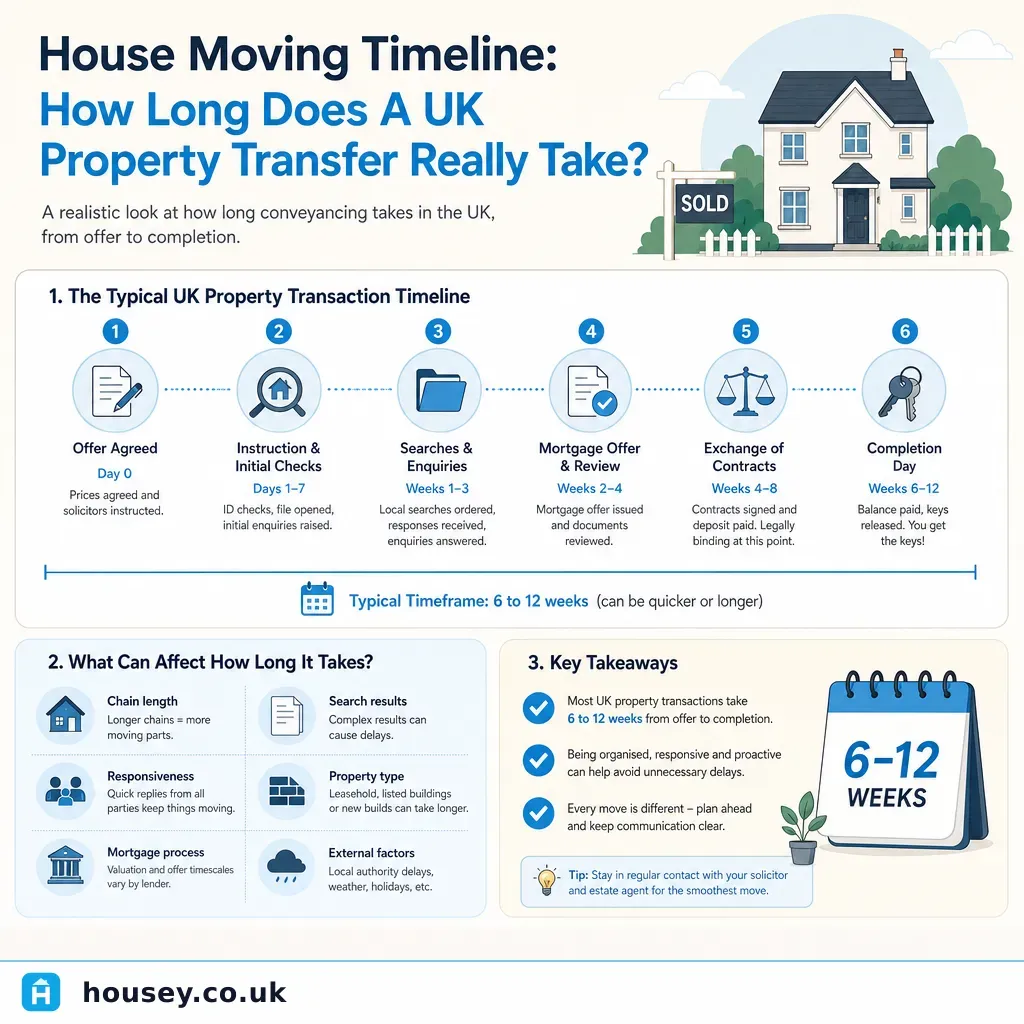
House Moving Timeline: How Long Does A UK Property Transfer Really Take?
A UK property transfer typically takes 12–16 weeks from offer acceptance to completion, though chains, mortgage requirements, and survey findings can extend this considerably.
 Buying & Moving
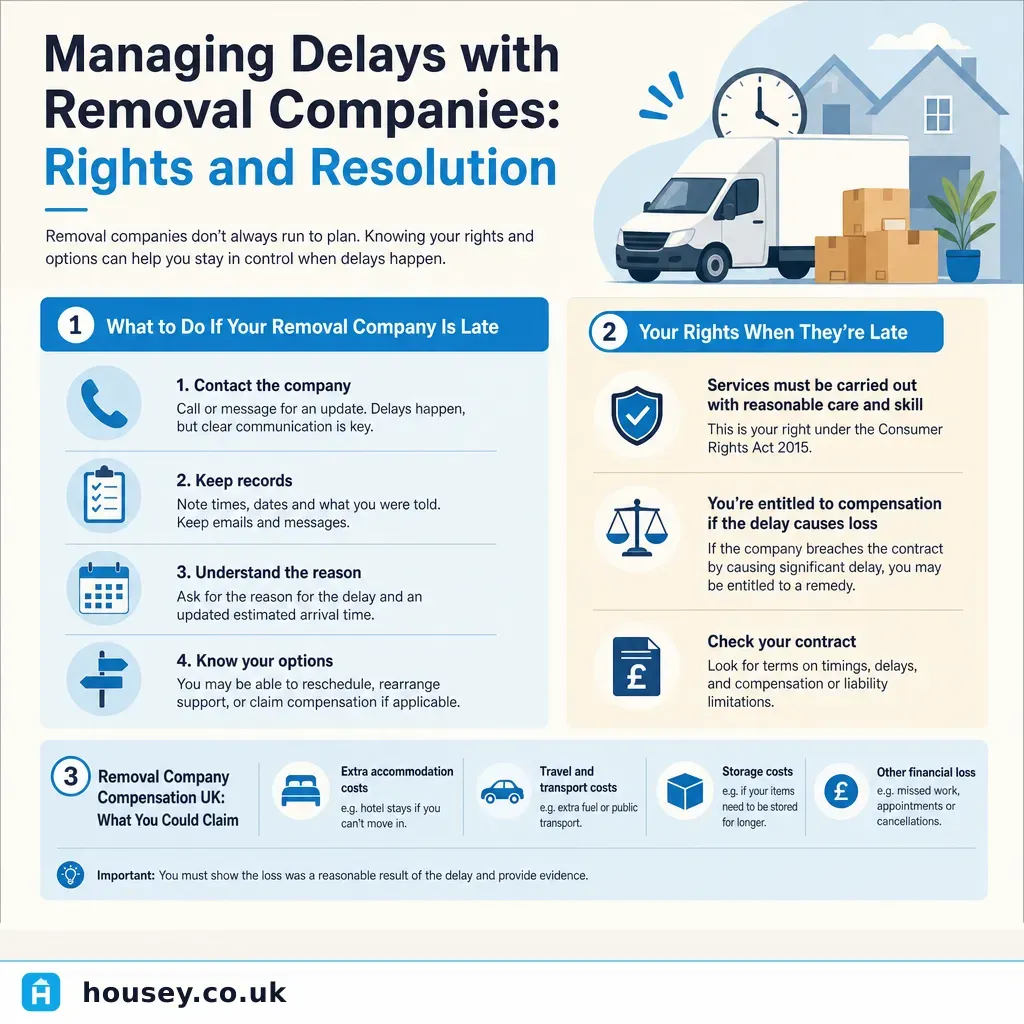
Managing Delays with Removal Companies: Rights and Resolution
If a removal company is late, your rights depend on your contract and whether the company is BAR-registered.
 Buying & Moving
Understanding Leasehold Property: Rights and Responsibilities
Leasehold means you own a time-limited interest in a property while the freeholder owns the land and building.