Small-Load Removals: Services and Providers for Flexible Moves
By Housey · Last reviewed 11th of May 2026

Small-Load Removals: Services and Providers for Flexible Moves
Not every move involves a three-bedroom house, a full removal lorry, and several weeks' planning. Many UK homeowners, renters, and students need to move the contents of a single room, a studio flat, or a handful of large pieces of furniture — circumstances where a standard full-service removal company may be oversized, overpriced, or simply unavailable at short notice. Small-load removals have become a distinct sector within the UK moving industry, with several service models suited to different volumes, distances, and budgets. Understanding the differences — and the protections that come with each — is worthwhile before booking.
Key points
- Man-and-van services in the UK typically charge £30–£60 per hour plus VAT, or a fixed rate per job; groupage (part-load) services generally charge by volume, usually per cubic metre.
- Groupage removals consolidate goods from multiple customers into one vehicle on a scheduled run — useful for studio flat moves, single-room contents, or long-distance moves with small volumes.
- Under the Consumer Rights Act 2015, removal services must be carried out with reasonable care and skill; if goods are damaged, the service provider bears the burden of proving the damage is not their fault.
- The British Association of Removers (BAR) and the Removals Industry Ombudsman Service (RIOS) offer free dispute resolution to consumers who use member companies — an important protection if something goes wrong.
- Standard goods-in-transit insurance from man-and-van providers is often capped at £10,000–£20,000 total (not per item); verify the limit and any per-item cap before booking if you are moving high-value or irreplaceable items.
What counts as a small-load removal?
There is no industry-standard definition, but small-load or part-load removals in the UK typically cover:
- Studio flat or bedsit contents — the full belongings of a small dwelling, usually fitting in one Transit-sized van.
- Single-room moves — a bedroom, home office, or living room's worth of furniture and boxes.
- Furniture-only moves — a sofa, wardrobe, dining table, or a small number of large items that cannot travel by car or standard courier.
- Student moves — term-start and term-end moves between halls of residence, shared houses, and family homes.
- Post-breakup or co-habitation splits — dividing shared property contents between two separate destinations.
- Storage moves — moving items into or out of self-storage, often following a downsizing sale or bereavement clearance.
Which type of service is right for my move?
Service type | How it works | Typical cost model | Best for | Watch out for |
|---|---|---|---|---|
Man and van | One driver (sometimes plus one helper); customer usually provides own boxes; same-day collection and delivery | Hourly or fixed price per job | Small, local, same-day moves | Fewer consumer protections if the provider is unregistered; always verify insurance |
Groupage / part-load | Your goods share a vehicle with other customers' items on a scheduled run | Price per cubic metre or per consignment | Long-distance moves with small volumes; budget-conscious movers | Transit times are typically 1–5 days; goods may be loaded and unloaded more than once |
Small specialist removal company | Professional team with full insurance; packing service often available | Fixed price per job | Fragile or high-value items; moves needing professional packing | Higher cost than man-and-van for equivalent volume |
Self-drive van hire | Hire a van and move yourself; standard car licence covers most vans up to 3.5 tonnes | Van hire rate plus fuel and insurance top-up | Very confident drivers on a tight budget | Physical effort required; you are responsible for loading, securing, and any damage |
Specialist freight courier | Parcel or pallet courier for a single item or small number of pieces | Per item or per pallet | Single furniture items, artwork, musical instruments | Variable handling care; check that the policy covers the individual item value |
Indicative UK costs, last reviewed 2026-05-11. Prices vary by distance, volume, provider, and time of year.
What to ask before accepting a quote
Before confirming a booking with any small-load removal provider:
- What is the exact scope — loading only, or loading and unloading at the destination?
- Will the team disassemble and reassemble furniture, or is that the customer's responsibility?
- What goods-in-transit insurance is included, and what is the maximum claim per item and in total?
- Are there items the provider will not carry (plants, hazardous materials, high-value jewellery, cash, perishables)?
- Is the quoted price fixed, or could it increase if the move takes longer or additional items are added?
- If my goods will be in a shared vehicle, when is delivery expected and how is the vehicle secured overnight?
- Is VAT included in the quoted price, and what are the payment terms?
- What is the cancellation and rescheduling policy?
- Is the provider a member of BAR, RIOS, or another trade body, and what dispute resolution process applies if something goes wrong?
How to compare providers
When gathering quotes, ask each provider to confirm in writing:
- Their full business name and company registration number — verify on Companies House at no cost.
- Their goods-in-transit insurance policy limit, per-item cap, and the name of the insurer.
- Whether they hold public liability insurance.
- Whether they carry out the work themselves or subcontract to a third party.
- Independent references or verifiable reviews from previous customers.
Red flags to watch for:
- No written quote or contract — any legitimate removal provider should confirm price and scope in writing before the move.
- Cash-only payment in full, requested in advance — a common indicator of an unregistered or unreliable trader.
- Inability or refusal to confirm goods-in-transit insurance details.
- Pressure to commit immediately without time to check reviews or compare quotes.
- Quotes that appear unusually low compared to others — the UK removals sector has seen incidents of rogue operators who inflate prices on the day or, in rare cases, withhold goods pending additional payment.
Your small-move preparation checklist
Before move day:
When to get professional help
Small moves can be straightforward, but a properly accredited removal company is worth the additional cost in certain situations:
- Moving antiques, artwork, musical instruments, or items with high sentimental value where standard goods-in-transit insurance limits are insufficient.
- Moving into or out of a property with difficult access — narrow stairs, multiple floors without a lift, or a tight delivery road.
- Long-distance moves, including cross-border moves between England, Scotland, Wales, and Northern Ireland, where longer transit and multiple handling increases the risk of damage.
- Any move where a dispute is foreseeable — a BAR-member company gives you formal access to the Removals Industry Ombudsman Service for independent resolution.
How Housey can help
Housey connects UK homeowners and renters with vetted house removals providers who offer flexible options for small loads, part-loads, and full-service moves — so you can compare written quotes with confidence whether you are moving a single room or the entire contents of a flat.
Frequently asked questions
What counts as a small-load removal?
There is no fixed industry definition, but in practice a small-load move covers anything from a single large item to the full contents of a studio flat — typically a volume fitting in one Transit-sized van. Groupage services often start pricing at 1–2 cubic metres. Single-room moves, student moves between term-time addresses, and post-breakup household splits all commonly use small-load services.
How do I find a reputable small-load removal company in the UK?
Look for providers who are members of the British Association of Removers (BAR) or registered with the Removals Industry Ombudsman Service (RIOS). Check reviews on independent platforms, verify the company on Companies House, and ask for written confirmation of the price, scope, and insurance limits before booking. Avoid providers who demand full cash payment in advance or cannot confirm goods-in-transit cover.
Is my furniture insured during a small move?
Most professional removal companies include goods-in-transit insurance, but total and per-item limits vary widely — some policies cap liability at £10,000 total or as little as £500 per item. If you are moving high-value items, ask the provider to confirm the exact policy limits in writing and consider taking out additional all-risks insurance to cover the replacement value of specific pieces.
Can I use a man-and-van service for a single-room move?
Yes — a man-and-van service is often the most cost-effective and flexible option for a single-room move over a short distance. The key steps are to verify the provider has goods-in-transit insurance, check their reviews on independent platforms, confirm the price in writing, and clarify what is included — particularly whether the driver will help carry items or only drive.
Sources and further reading
- Advice for consumers: choosing a removal company — British Association of Removers (BAR)
- Consumer Rights Act 2015 — legislation.gov.uk
- Problems with removals: your rights — Citizens Advice
- Removals Industry Ombudsman Service — Removals Industry Ombudsman Service (RIOS)
Useful next reads
 Buying & Moving
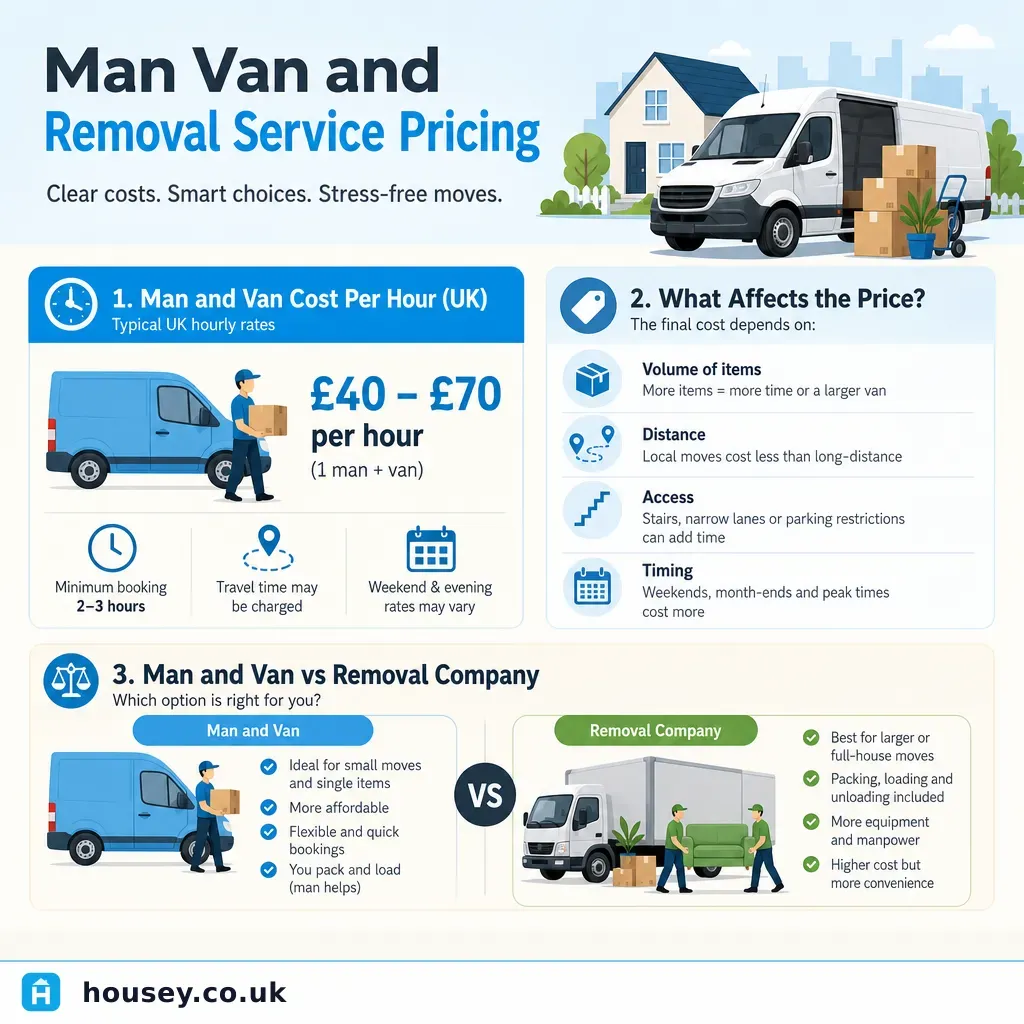
Man Van and Removal Service Pricing
A man and van in the UK typically costs £30–£80 per hour, with most small moves priced as a half or full day.
 Buying & Moving
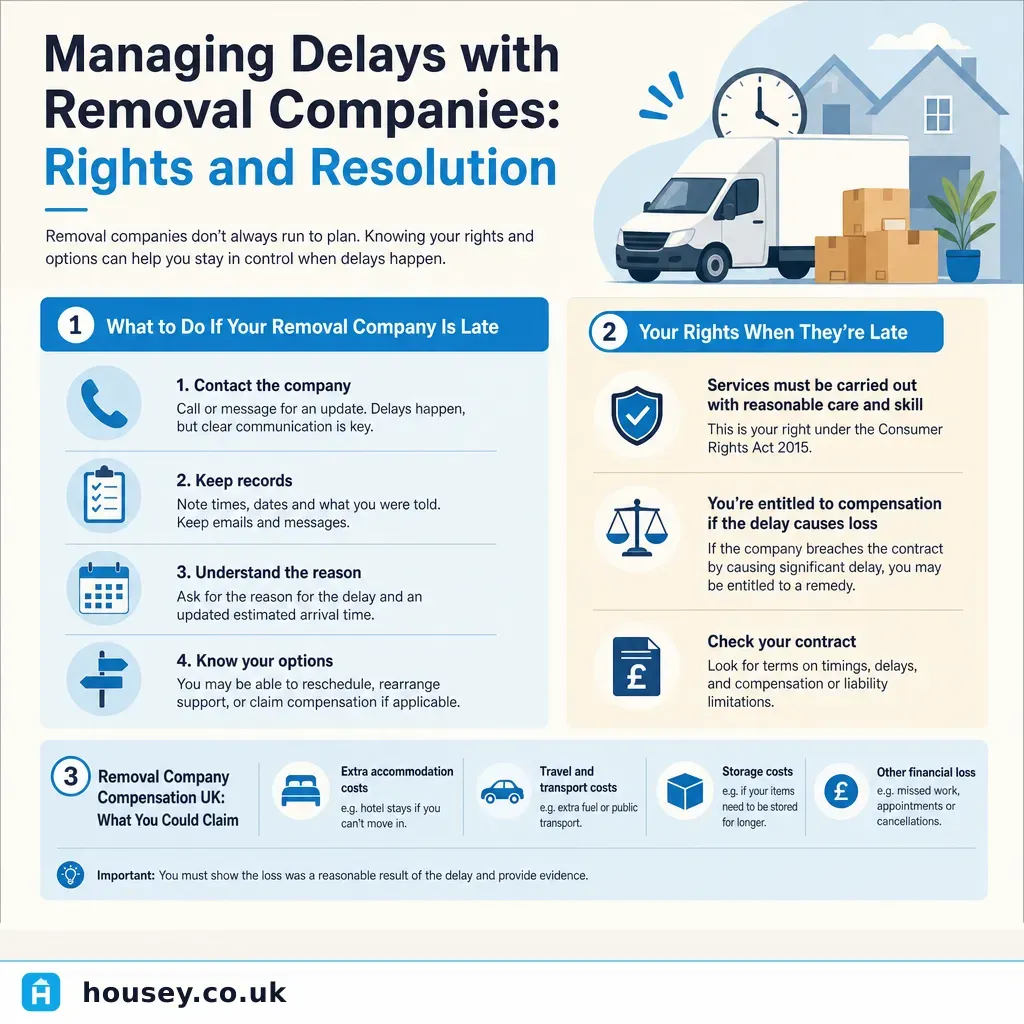
Managing Delays with Removal Companies: Rights and Resolution
If a removal company is late, your rights depend on your contract and whether the company is BAR-registered.
 Buying & Moving
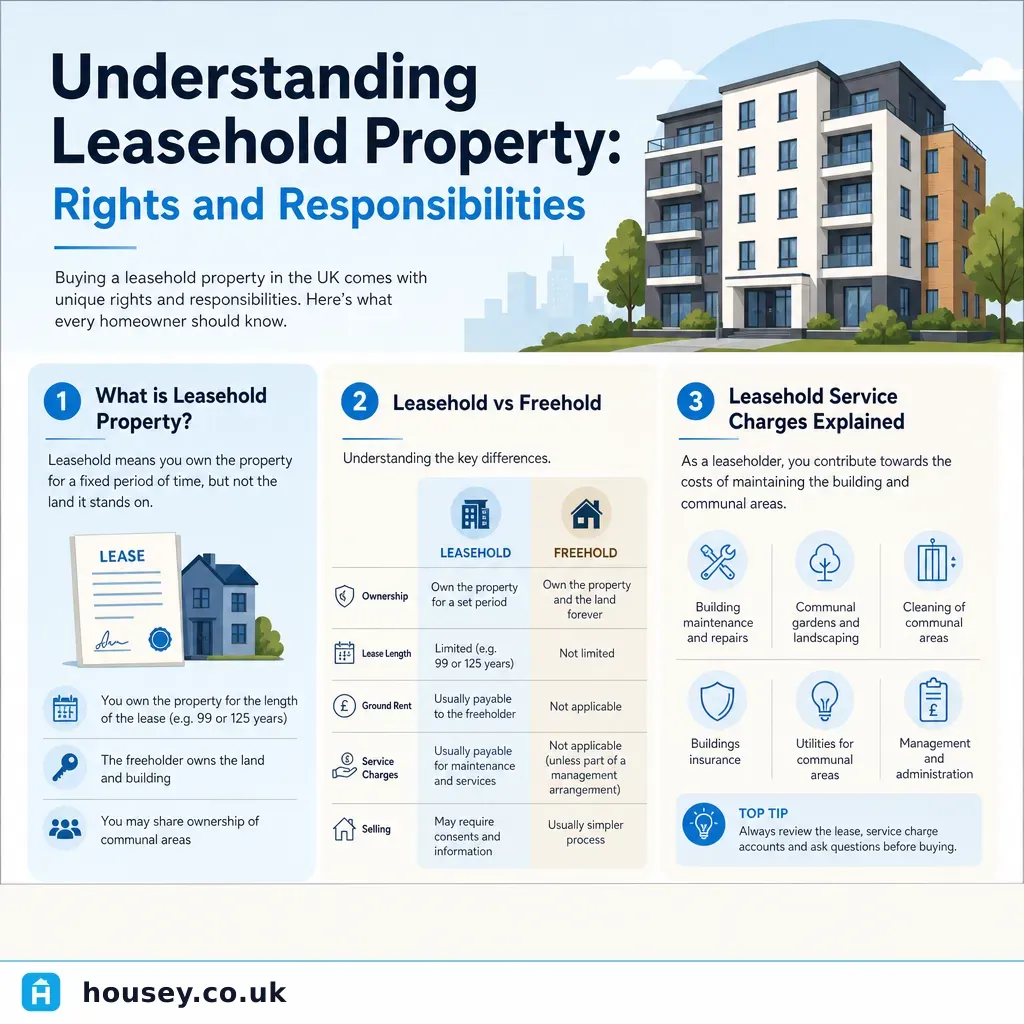
Understanding Leasehold Property: Rights and Responsibilities
Leasehold means you own a time-limited interest in a property while the freeholder owns the land and building.
 Buying & Moving
The Complete Property Buying Guide: From Search to Purchase
Buying a property in England and Wales typically takes 3–6 months from accepted offer to completion.
 Buying & Moving
Leasehold Property Purchase: Complexity and Key Considerations
Buying a leasehold property means purchasing the right to occupy for a fixed term rather than owning the land outright.