Understanding Leasehold Property: Rights and Responsibilities
By Housey · Last reviewed 25th of May 2026
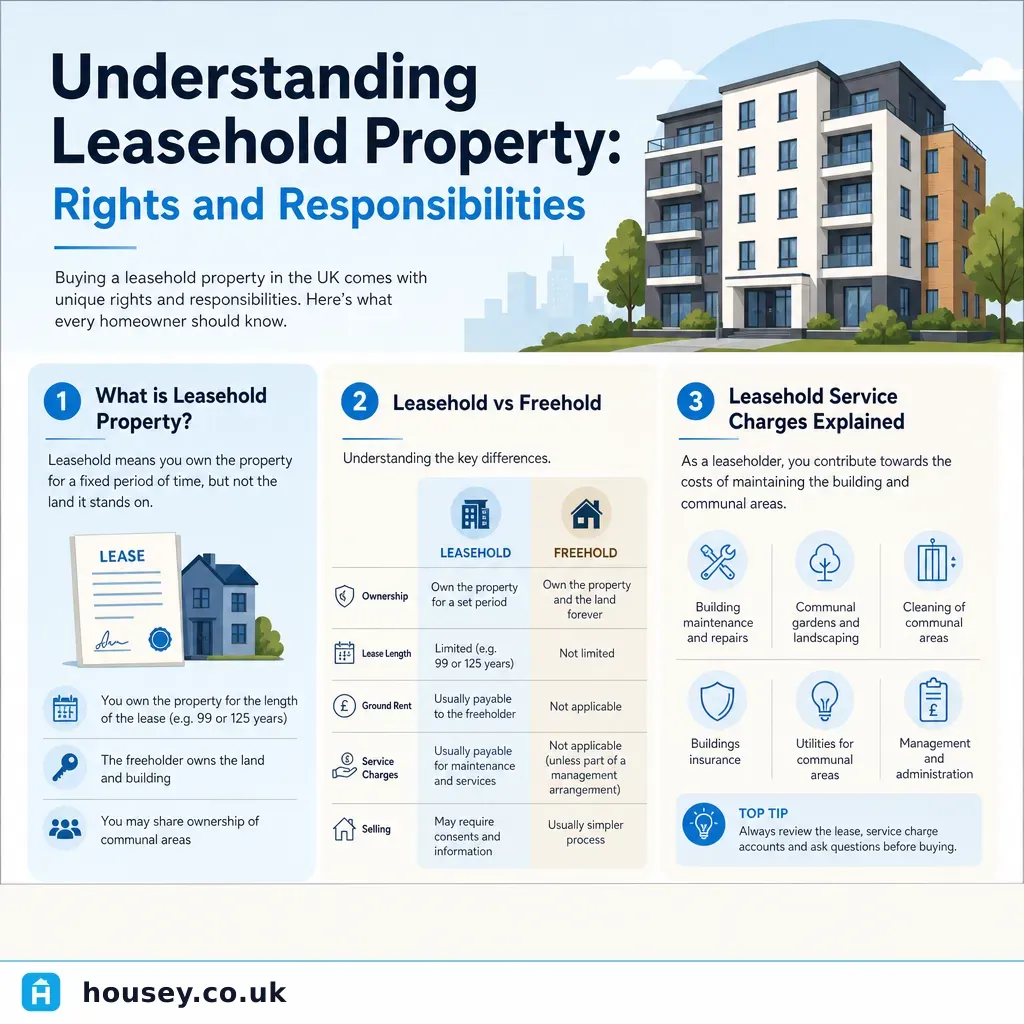
Understanding Leasehold Property: Rights and Responsibilities
Leasehold ownership affects millions of homeowners across England and Wales, yet many buyers — particularly first-time flat purchasers — do not fully understand what it means until they are already committed to a purchase. The distinction between owning a lease and owning a property outright shapes everything from your monthly costs and permitted alterations to your long-term asset value and ability to sell or remortgage. Recent legislation has significantly changed the landscape, making it more important than ever to know your rights before signing anything.
Key points
- Approximately 4.98 million leasehold dwellings exist in England, the majority of which are flats, according to the Ministry of Housing, Communities and Local Government.
- The Leasehold Reform (Ground Rent) Act 2022 banned ground rent for new residential leases granted after 30 June 2022 — existing leases with ground rent clauses remain in force and must be reviewed carefully before any purchase.
- The Leasehold and Freehold Reform Act 2024 extended leaseholders' statutory rights, including making it easier and less costly to extend leases and to collectively purchase the freehold.
- A lease below 80 years remaining is a key threshold: below this point, "marriage value" is added to any statutory lease extension premium, often substantially increasing the cost.
- Service charges must be "reasonable" under section 19 of the Landlord and Tenant Act 1985, and leaseholders can challenge unreasonable charges at the First-tier Tribunal (Property Chamber).
Leasehold, freehold, and commonhold: what is the difference?
Tenure | What you own | Who owns the building and land | Ground rent | Service charge | Right to extend or buy freehold |
|---|---|---|---|---|---|
Leasehold | A time-limited interest in the property | Freeholder (landlord) | Possible for pre-June 2022 leases; banned for new leases | Usually payable to freeholder or managing agent | Yes — subject to qualifying criteria and statutory process |
Freehold | The property and the land it stands on | You | None | None (unless an estate charge applies on new developments) | Not applicable |
Commonhold | A share of the freehold with other flat owners | The Commonhold Association (all flat owners collectively) | No | Yes — managed collectively by all owners | No lease to extend; ownership is outright |
Commonhold was reintroduced under the Commonhold and Leasehold Reform Act 2002 but remains rare in England and Wales. The government has indicated its intention to make commonhold the default tenure for new flats; as of 2026 most flat purchases remain leasehold.
Your key rights as a leaseholder
The right to extend your lease
Under the Leasehold Reform, Housing and Urban Development Act 1993 (as amended by the Leasehold and Freehold Reform Act 2024), qualifying leaseholders of flats have a statutory right to extend their lease by 990 years at zero ground rent.
- You must have owned the property for at least two years to exercise the statutory right.
- The premium paid to the freeholder is calculated using a statutory formula, assessed by a RICS-qualified leasehold valuation surveyor.
- Below 80 years remaining, "marriage value" — the increase in the property's market value attributable to the extension — is added to the premium, often substantially increasing the cost.
- Informal (non-statutory) extensions can be negotiated at any time but provide less legal protection over the terms agreed.
The right to manage
Under the Commonhold and Leasehold Reform Act 2002, leaseholders in a building can collectively take over day-to-day management through a Right to Manage (RTM) company, without needing to prove the freeholder is at fault. At least 50% of qualifying flats in the building must participate.
Collective enfranchisement
Leaseholders in a building can collectively purchase the freehold under the Leasehold Reform, Housing and Urban Development Act 1993. The Leasehold and Freehold Reform Act 2024 has extended and simplified these rights, including removing the two-year ownership requirement in certain circumstances.
Challenging service charges
Service charges must be reasonable, and for qualifying works where the contribution from any single tenant exceeds £250, the landlord must follow the Section 20 consultation procedure under the Landlord and Tenant Act 1985. Charges can be challenged at the First-tier Tribunal (Property Chamber) in England.
Your key responsibilities as a leaseholder
- Pay service charges promptly for the maintenance, repair, and insurance of the building as required by your lease.
- Pay ground rent on time if your lease requires it and was granted before 30 June 2022 — persistent non-payment can, in rare cases, expose you to forfeiture proceedings, though leaseholders have significant statutory protections.
- Comply with lease covenants — common restrictions include subletting rules, pet restrictions, noise obligations, and requirements to obtain the landlord's consent before making alterations.
- Obtain landlord's consent for structural alterations, changes of use, or any work affecting shared or structural parts of the building.
- Maintain your interior — most leases place responsibility for internal repairs and decoration on the leaseholder.
Red flags when buying a leasehold property
Be cautious if any of the following apply before you exchange contracts:
- The lease has fewer than 85 years remaining — harder to mortgage and more expensive to extend.
- Ground rent exceeds £250 per year (or £1,000 per year in Greater London) — this can trigger assured tenancy status under the Housing Act 1988, with significant additional legal implications.
- The lease contains a "doubling ground rent" clause that causes ground rent to double every 10 to 25 years.
- Service charge accounts are unavailable or show large, unexplained year-on-year variations.
- The managing agent cannot provide a sinking fund balance or details of planned major works.
- The freeholder is difficult to identify, based offshore, or uncontactable.
- The buildings insurance certificate is unavailable or the cover appears inadequate for the building.
Which professional do you need?
Situation | Professional to instruct |
|---|---|
Buying a leasehold property | Conveyancing solicitor with leasehold experience |
Extending your lease | Specialist leasehold solicitor plus a RICS-qualified leasehold valuation surveyor |
Challenging service charges | Leasehold solicitor or specialist managing agent; First-tier Tribunal for disputes |
Collective enfranchisement | Specialist enfranchisement solicitor plus a RICS valuation surveyor |
Right to Manage application | Specialist leasehold solicitor |
Reviewing or breaching a lease covenant | Leasehold solicitor |
Important limitations
This guide provides a general overview of leasehold law as it applies in England and Wales. Leasehold law is complex, has changed significantly in recent years, and continues to evolve following the Leasehold and Freehold Reform Act 2024. Rules differ substantially in Scotland (where the feudal system was abolished in 2004 and most residential property is owned outright) and Northern Ireland. Nothing in this guide constitutes legal advice. Always instruct a solicitor with leasehold experience and ensure the full lease is reviewed by your conveyancer before exchange of contracts.
What to ask a qualified professional
Before buying a leasehold property or instructing a solicitor on a lease extension, ask:
- What is the exact unexpired lease term, and what will a statutory extension cost at this length?
- Are there any ground rent clauses, and how does the rent escalate over the remaining term?
- What is the current annual service charge, and what do the last three years of accounts show?
- Is there a sinking or reserve fund, and what is the current balance?
- Are there any planned or ongoing major works, and what is the estimated leaseholder contribution?
- Has the Section 20 consultation procedure been followed for any recent major works?
- Is there any history of disputes between leaseholders and the freeholder or managing agent?
When to get professional help
Every leasehold purchase requires a solicitor familiar with leasehold law — a general conveyancer unfamiliar with leasehold can miss serious issues before exchange. Seek specialist advice if:
- The lease term is below 85 years, or you wish to extend your lease.
- Ground rent is above £250 per year (or £1,000 in Greater London).
- You wish to participate in a Right to Manage or collective enfranchisement exercise.
- You want to challenge service charges or a major works contribution.
- You are planning alterations that require the landlord's consent.
- The lease contains unusual or highly restrictive covenants you do not fully understand.
How Housey can help
Housey connects homeowners with experienced professionals across the leasehold lifecycle. Use our conveyancing service to find regulated solicitors with leasehold experience, and our lease extension valuations service to identify RICS-qualified surveyors who can advise on lease extension premiums and collective enfranchisement valuations.
Frequently asked questions
How long should a leasehold lease be when I buy?
Most mortgage lenders require at least 70 to 85 years remaining after the end of the mortgage term before they will lend against a leasehold property. As a practical benchmark, any lease below 85 years is worth investigating for an extension before or shortly after purchase. Below 80 years, the cost of extending increases substantially due to the addition of marriage value to the premium.
Can I sell a leasehold property?
Yes. You can sell a leasehold property in the usual way. A very short lease — typically below 70 years — can make it harder to find a buyer who can obtain a mortgage, so extending before sale often makes the property more marketable and may increase its value. Your conveyancing solicitor can advise on how the remaining lease term may affect the sale.
What is a sinking fund in leasehold property?
A sinking fund (also called a reserve fund) is money collected from leaseholders over time to pay for future major works — such as roof replacement or exterior redecoration — without requiring a large, unexpected special levy. A healthy sinking fund is a positive indicator when buying; a very low or absent fund may mean a significant unexpected charge in the near future.
What changed under the Leasehold Reform (Ground Rent) Act 2022?
The Act set ground rent to zero (a peppercorn) for all new residential leases granted after 30 June 2022. It does not affect existing leases retrospectively. If you are buying a property with an existing lease that includes a ground rent clause, check the amount and escalation terms carefully with your conveyancing solicitor before exchanging contracts.
Sources and further reading
- GOV.UK — Leasehold property: overview — GOV.UK
- Leasehold Reform (Ground Rent) Act 2022 — legislation.gov.uk
- Leasehold and Freehold Reform Act 2024 — legislation.gov.uk
- First-tier Tribunal (Property Chamber) — GOV.UK
- LEASE — Leasehold Advisory Service — LEASE
- Commonhold and Leasehold Reform Act 2002 — legislation.gov.uk
Useful next reads
 Buying & Moving
Understanding Leasehold Property Terminology and Rights
Leasehold means owning occupation rights for a fixed term, not the land or structure.
 Buying & Moving
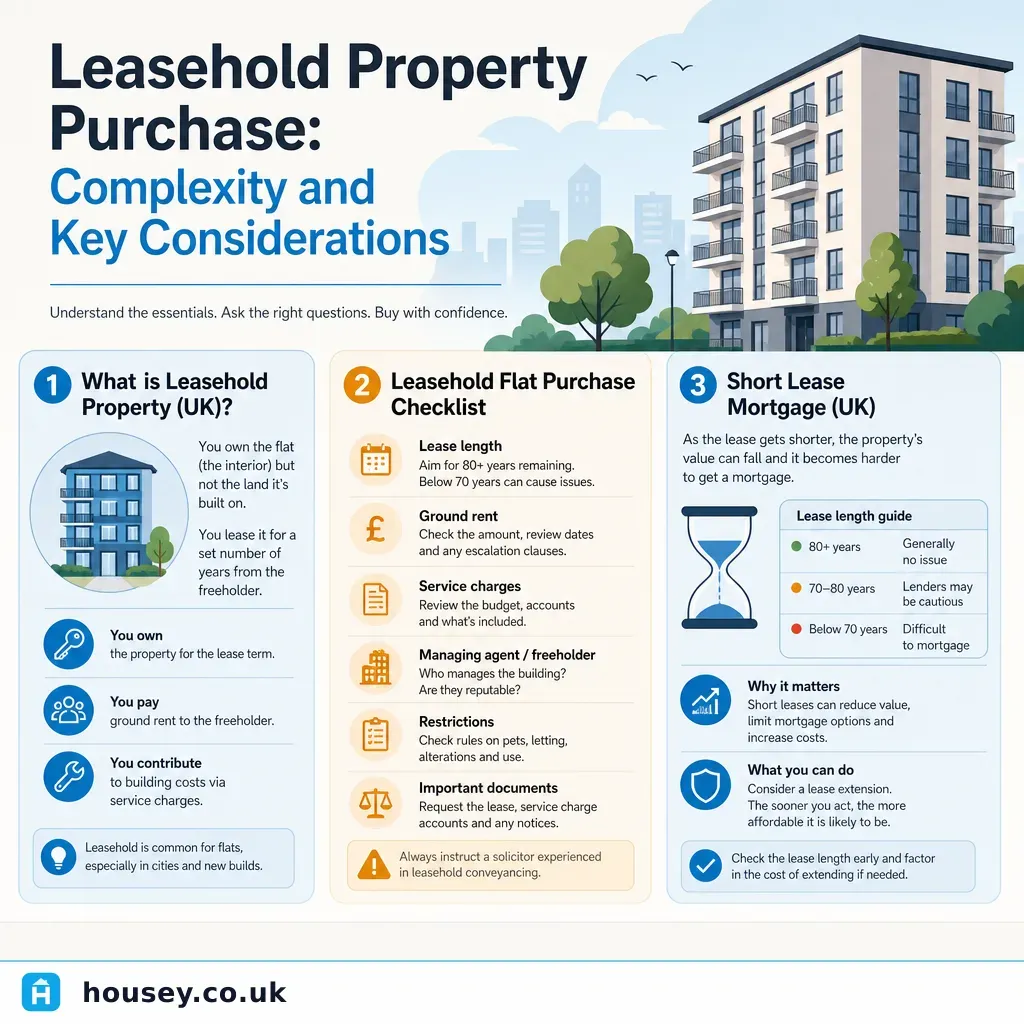
Leasehold Property Purchase: Complexity and Key Considerations
Buying a leasehold property means purchasing the right to occupy for a fixed term rather than owning the land outright.
 Buying & Moving
Navigating Simultaneous Purchase and Sale of Property
When buying and selling simultaneously in England and Wales, both sets of contracts are exchanged on the same day — this is called simultaneous exchange.
 Buying & Moving
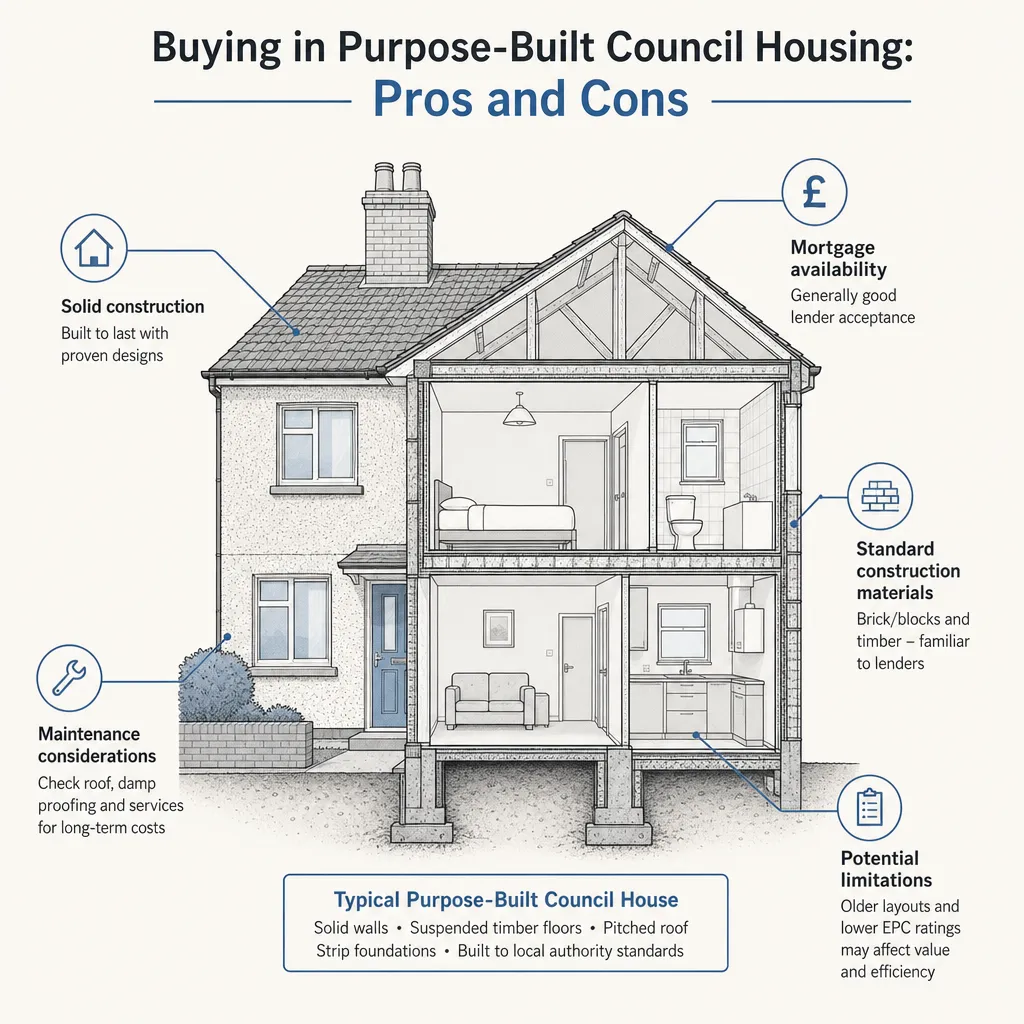
Buying in Purpose-Built Council Housing: Pros and Cons
Purpose-built council housing — typically 1950s–1980s blocks, maisonettes, or estate houses — can offer good value and generous room sizes, but buyers should check construction type before applying for a mortgage.
 Buying & Moving
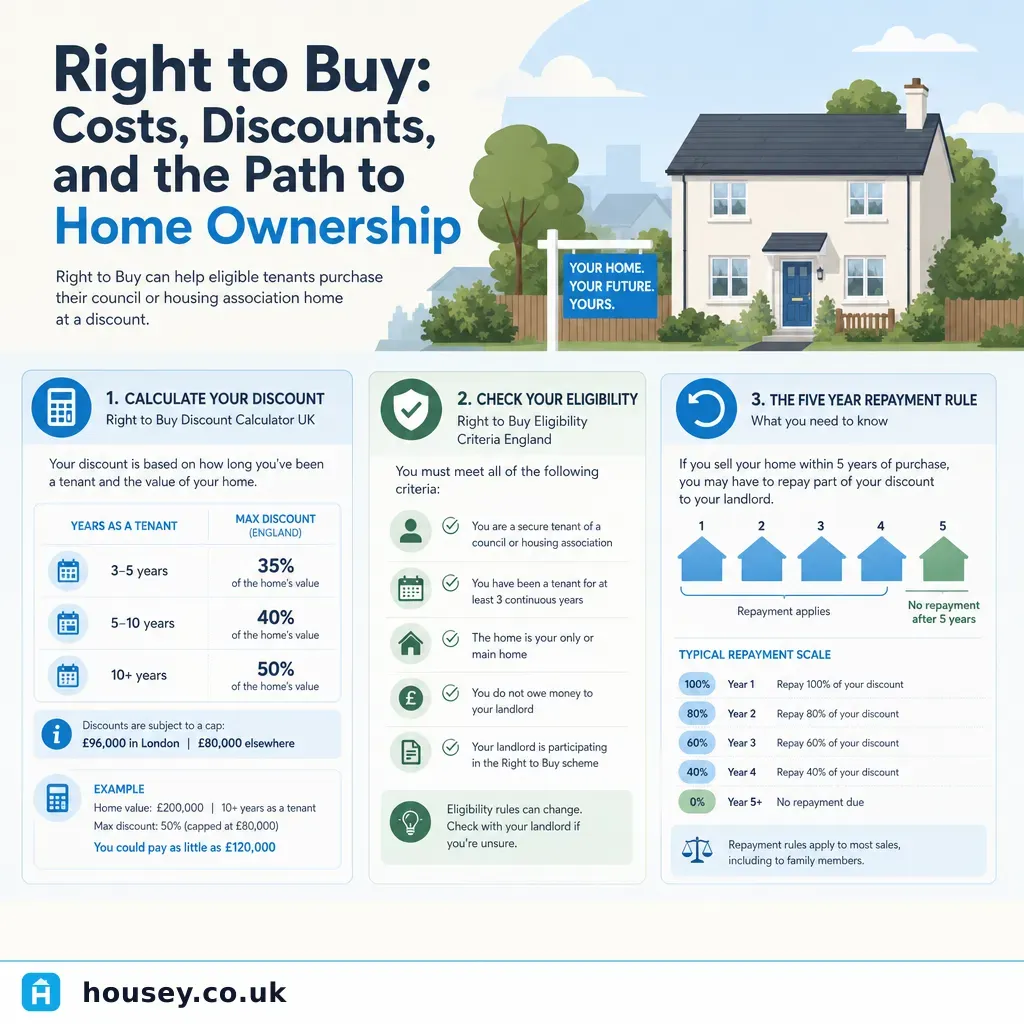
Right to Buy: Costs, Discounts, and the Path to Home Ownership
Right to Buy lets eligible council tenants in England buy their home at a government-funded discount — between 35% and 70% of its value, depending on tenancy length and property type.