Preparing Your Home for Sale: Flooring and First Impressions
By Housey · Last reviewed 8th of May 2026
Preparing Your Home for Sale: Flooring and First Impressions
When a property goes on the market in England or Wales, most buyers form their first impressions from portal listings — often before they have booked a viewing. Flooring condition, room presentation, and listing photograph quality directly influence whether a buyer clicks through to arrange a visit, and whether they hold their offered price after seeing the property in person. Getting presentation right before instructing an estate agent is one of the few genuinely controllable variables in a sale process that can otherwise feel out of your hands.
Key points
- A valid Energy Performance Certificate (EPC) must be commissioned before a residential property is marketed, under the Energy Performance of Buildings (England and Wales) Regulations 2012 — this is a legal requirement, not optional.
- Flooring in hallways and reception rooms has the greatest impact on buyer first impressions, both during physical viewings and in portal photography.
- Neutral mid-tone flooring — warm grey carpet, oatmeal, or natural oak — appeals to the broadest buyer demographic and photographs well in most lighting conditions.
- A professional carpet clean typically costs £50–£100 per room (indicative, last reviewed 2026-05-08) and is often sufficient for lightly worn carpet, making replacement unnecessary.
- Under the Consumer Protection from Unfair Trading Regulations 2008, material defects (including structural or damp problems discovered under flooring) cannot be concealed by sellers or estate agents.
Why flooring matters to buyers
Flooring covers more visible surface area per room than any other single feature. Worn or stained carpet in a hallway signals that maintenance may have been deferred before a buyer has seen anything else. Cracked or lifted vinyl in a kitchen suggests moisture problems. Scuffed laminate in a reception room looks dated in portal photographs and sets a low baseline for perceived value.
The right decision on flooring depends on several factors:
- Current condition: visibly worn, stained, or damaged flooring is worth addressing; tired but clean flooring usually needs only a professional clean.
- Property price bracket: buyers at or above the local average expect quality finishes; at the lower end, buyers may prefer a reduced asking price over renovated floors.
- Target buyer profile: a leasehold flat aimed at young professionals has different expectations than a four-bedroom detached house aimed at families.
- Likely return on spend: a valuation survey can calibrate how much pre-sale investment is justified before you commit to flooring costs.
Flooring options: a practical comparison
Option | Indicative cost (last reviewed 2026-05-08) | Best for | Caution |
|---|---|---|---|
Professional carpet clean | £50–£100 per room | Lightly soiled carpet in good structural condition | Will not restore heavily worn or permanently stained carpet |
Mid-range carpet replacement | £10–£25/m² fitted | Living rooms, bedrooms, stairs | Neutral tones only; avoid bold patterns or strong colours |
Laminate flooring | £15–£35/m² fitted | Hallways, reception rooms | Can sound hollow; lower perceived value in premium properties |
Engineered wood | £35–£70/m² fitted | Open-plan areas, period properties | Check subfloor condition before installation |
Luxury vinyl tile (LVT) | £25–£50/m² fitted | Kitchens, bathrooms, hallways | May require subfloor levelling compound |
Tile cleaning and regrouting | £80–£200 | Existing tiles in reasonable condition | Cost-effective alternative to full tile replacement |
Indicative UK costs only; regional variation, subfloor preparation, and underlay are not included. Obtain at least three quotes from local contractors.
Room-by-room priorities
Not all rooms carry equal weight in a buyer's decision. Focus resources where buyers spend the most time.
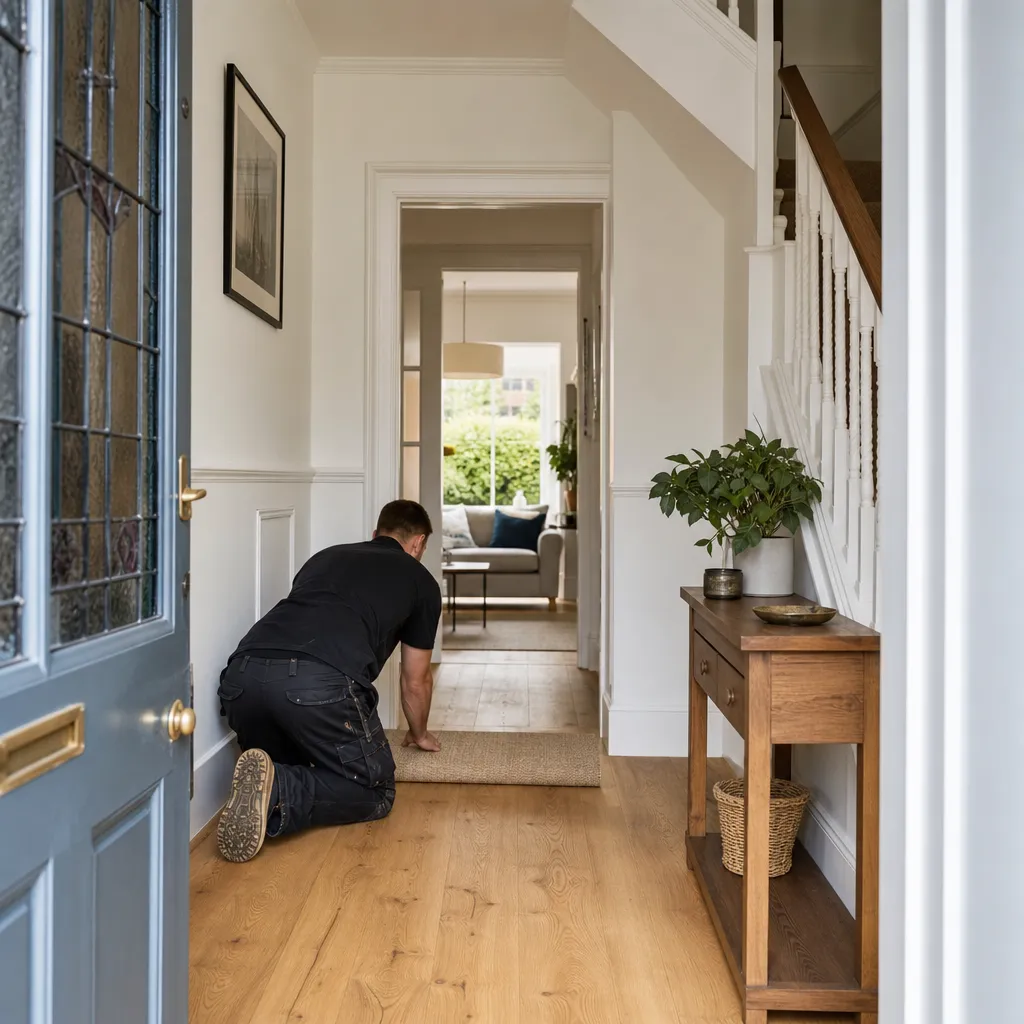
Hallway and entrance: The first physical space buyers experience. A neutral, durable surface — stone-effect LVT, engineered wood, or a dark-toned carpet — sets a strong first impression and photographs well in listing images.
Living room and main reception rooms: Where buyers spend most of their viewing time. Clean, intact carpet can stay. Visibly stained or flattened carpet justifies replacement; the return is more reliable here than in any other room in the property.
Kitchen: Clean, intact flooring next to dated units reads as well-maintained. Cracked or peeling vinyl alongside other signs of wear compounds an impression of neglect and disproportionately affects buyer confidence.
Bathrooms: Grouting condition matters more than tile age. Fresh, clean grout on sound tiles is often sufficient. Cracked or mouldy grout is inexpensive to fix and disproportionately affects how buyers read the bathroom's condition.
Bedrooms: Lower priority. Buyers typically expect to redecorate bedrooms to their own taste. Neutral carpet or clean hard flooring is sufficient unless actively damaged.
Upstairs hallway and landings: Often overlooked but visible from the staircase and in photography. Consistent flooring across upper levels reads well in portal listings.
What not to assume
'Buyers will overlook cosmetic issues if the price is right.' Poor presentation reduces the number of viewings a property receives. Buyers who do not book a viewing never make an offer.
'Any improvement adds to the sale price.' Spending £8,000 on premium flooring in a £200,000 property is unlikely to add £8,000 to the agreed price. Improvements only need to justify themselves in terms of viewings received, time on market, and offer level — not pound-for-pound recovery.
'Portal photography does not really show flooring.' Flooring is one of the largest visible surfaces in most room photographs. Worn, dark, or cluttered floors reduce click-through rates from portal listings before buyers have even read the description.
'A fresh coat of paint is enough.' Paint lifts walls, but buyers look down as much as they look around. Flooring condition consistently influences offer levels and post-survey renegotiations.
'Buyers can see potential.' Most buyers are not buying a renovation project — they are picturing the property as a finished home. Visible work to be done translates into reduced offers or conditions attached to sale.
Pre-sale preparation checklist
Work through this before instructing your estate agent:
When to get professional help
Most pre-sale preparation can be managed directly. Seek professional advice if:
- You discover damp, rot, subsidence evidence, or structural problems under lifted flooring — these are material defects that must be disclosed and may require specialist assessment before marketing begins.
- A buyer's post-offer survey flags a defect you were unaware of — a structural or damp specialist may need to assess the extent before you decide whether to renegotiate or withdraw.
- The property has been tenanted and flooring condition is a disputed dilapidations issue — take legal advice before making any deductions from a deposit.
- You are uncertain what the property is worth in its current state versus with improvements — a valuation survey gives you a calibrated baseline before committing to pre-sale spend.
How Housey can help
Before instructing an estate agent, a professional valuation survey gives you a realistic figure for the property in its current condition and helps you decide where pre-sale spend is likely to be justified. Once preparation is complete, professional property photography and floorplans present the property at its best on the portals where most buyers begin their search. If the property needs clearing before preparation work begins, house clearance can handle bulky furniture and accumulated items quickly.
Frequently asked questions
Should I replace flooring before selling my house?
It depends on condition and property bracket. Visibly worn, stained, or damaged flooring is usually worth addressing — particularly in hallways and reception rooms. Flooring that is clean and intact rarely needs replacing; a professional clean is usually sufficient and much cheaper. For higher-value properties, buyers expect quality finishes and investment in flooring is more likely to be reflected in offers received.
What is the cheapest way to improve flooring before a sale?
A professional carpet clean at £50–£100 per room (indicative, last reviewed 2026-05-08) is the most cost-effective option for lightly soiled carpet in reasonable condition. For hard floors, a thorough clean and fresh grout where needed cost very little. Decluttering and removing bulky furniture also improves perceived floor area in portal photographs without any direct spend.
Do I need an EPC before selling my house?
Yes. Under the Energy Performance of Buildings (England and Wales) Regulations 2012, a valid EPC must be commissioned before a residential property is placed on the market. The certificate must be available to buyers on request. EPCs are valid for 10 years from the date of issue. If the existing one has expired, arrange a new assessment before marketing begins.
What flooring colours work best when selling a house?
Neutral mid-tones are the safest choice: warm grey, oatmeal, natural oak, or light stone. These appeal to the widest range of buyers and photograph well in most lighting conditions. Bold patterns, very dark tones, and bright colours divide opinion and can make rooms appear smaller in photographs. Consistency across connected spaces reads well in portal listings.
Do I have to disclose flooring defects to buyers?
Sellers and agents cannot conceal material facts under the Consumer Protection from Unfair Trading Regulations 2008. If you discover structural problems, damp, or significant damage under flooring during pre-sale preparation, this will typically need to be disclosed or remediated before exchange. A buyer's survey will likely identify such issues independently. Pre-sale remediation is usually preferable to post-offer renegotiation.
Sources and further reading
- Energy Performance of Buildings (England and Wales) Regulations 2012 — legislation.gov.uk
- Consumer Protection from Unfair Trading Regulations 2008 — legislation.gov.uk
- GOV.UK: Buying or selling your home — GOV.UK
- Citizens Advice: Selling your home — Citizens Advice
- Propertymark: Preparing your property for sale — Propertymark
Useful next reads
 Buying & Moving
Essential Steps to Selling Your Home Successfully
Selling your home successfully in the UK involves obtaining a valid EPC, choosing an estate agent or alternative method, instructing a solicitor or conveyancer early, and completing the Seller's Property Information Form accurately.
 Buying & Moving
Achieving Show-Home Presentation and Professional Styling
Show-home presentation involves decluttering, deep cleaning, neutral redecoration, and optimising lighting before photography and viewings.
 Buying & Moving
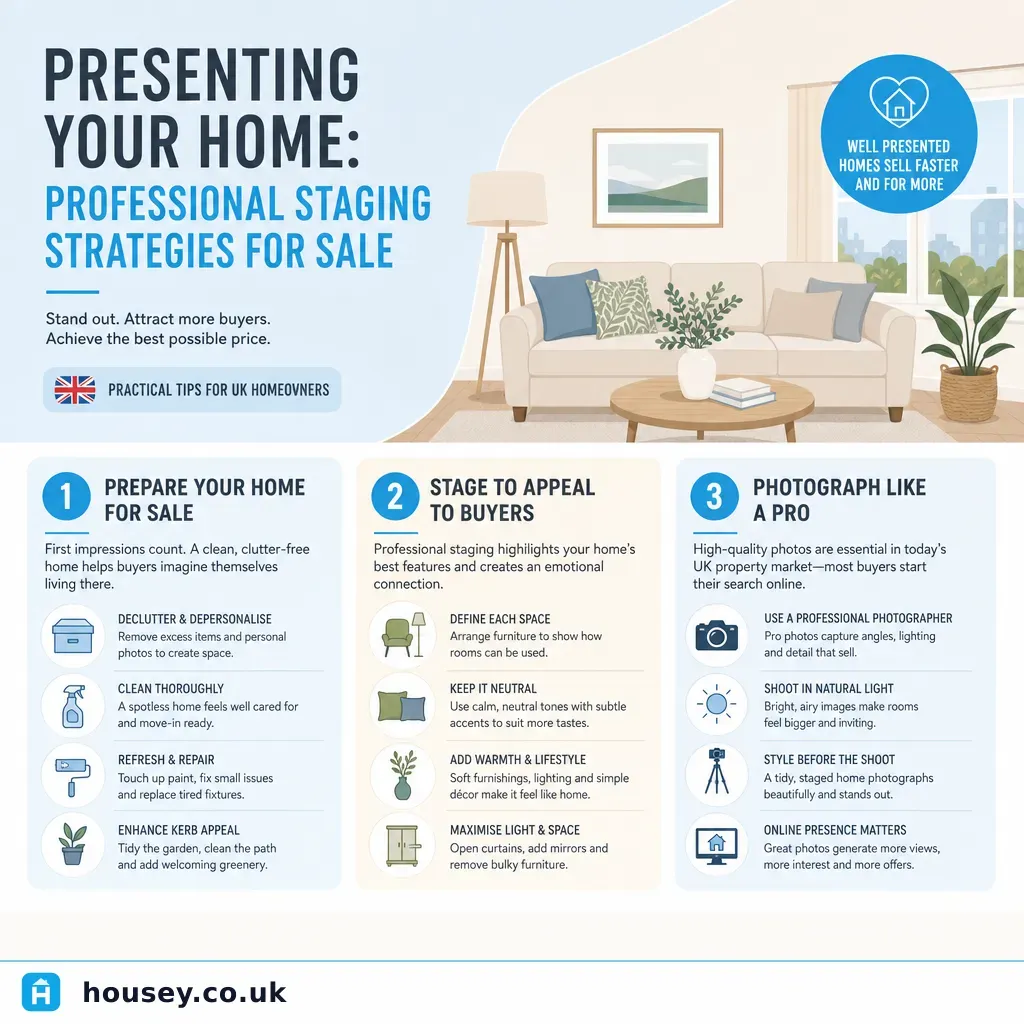
Presenting Your Home: Professional Staging Strategies for Sale
Home staging for a UK property sale means presenting each room to look spacious, neutral, and well-lit — primarily through decluttering, cleaning, and considered styling rather than expensive renovation.
 Buying & Moving
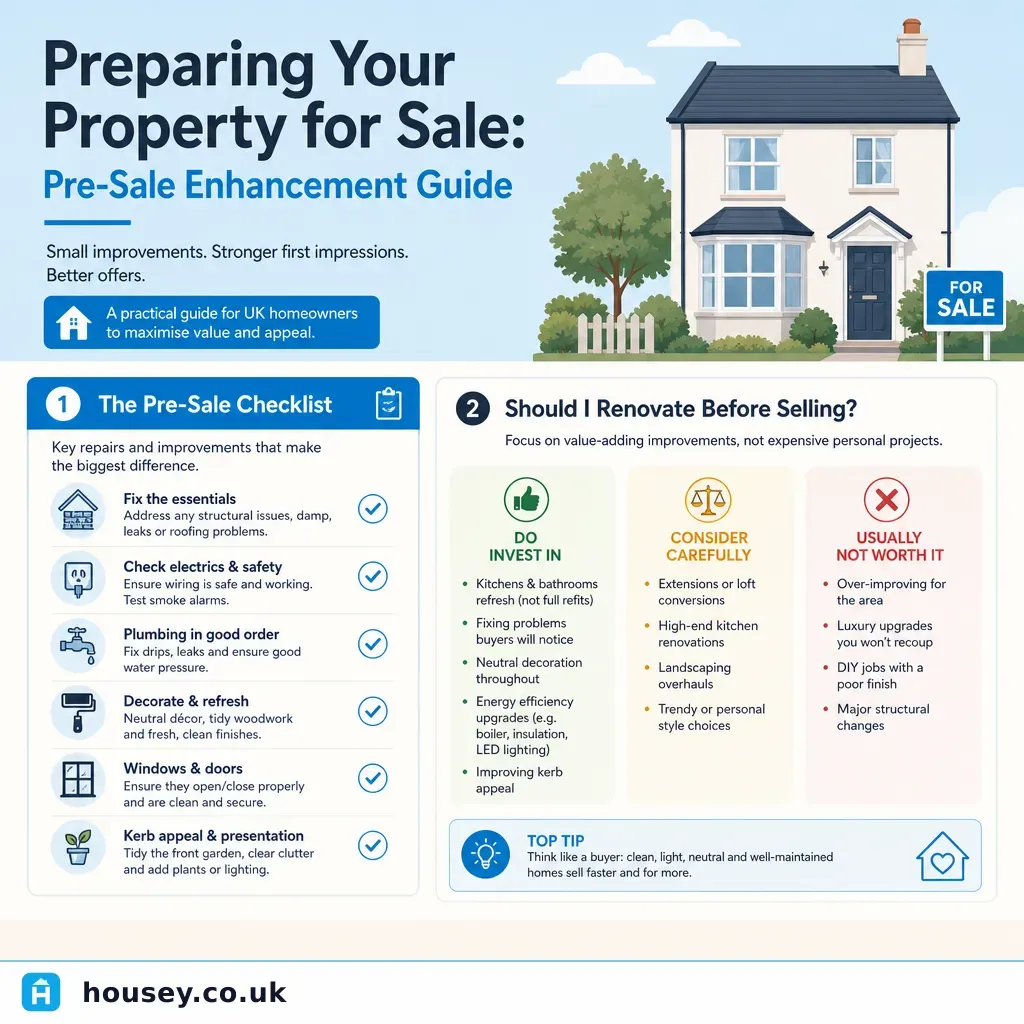
Preparing Your Property for Sale: Pre-Sale Enhancement Guide
Getting a property ready to sell usually means fixing visible defects, refreshing décor to neutral tones, improving kerb appeal, gathering documentation, and commissioning professional photography.
 Buying & Moving
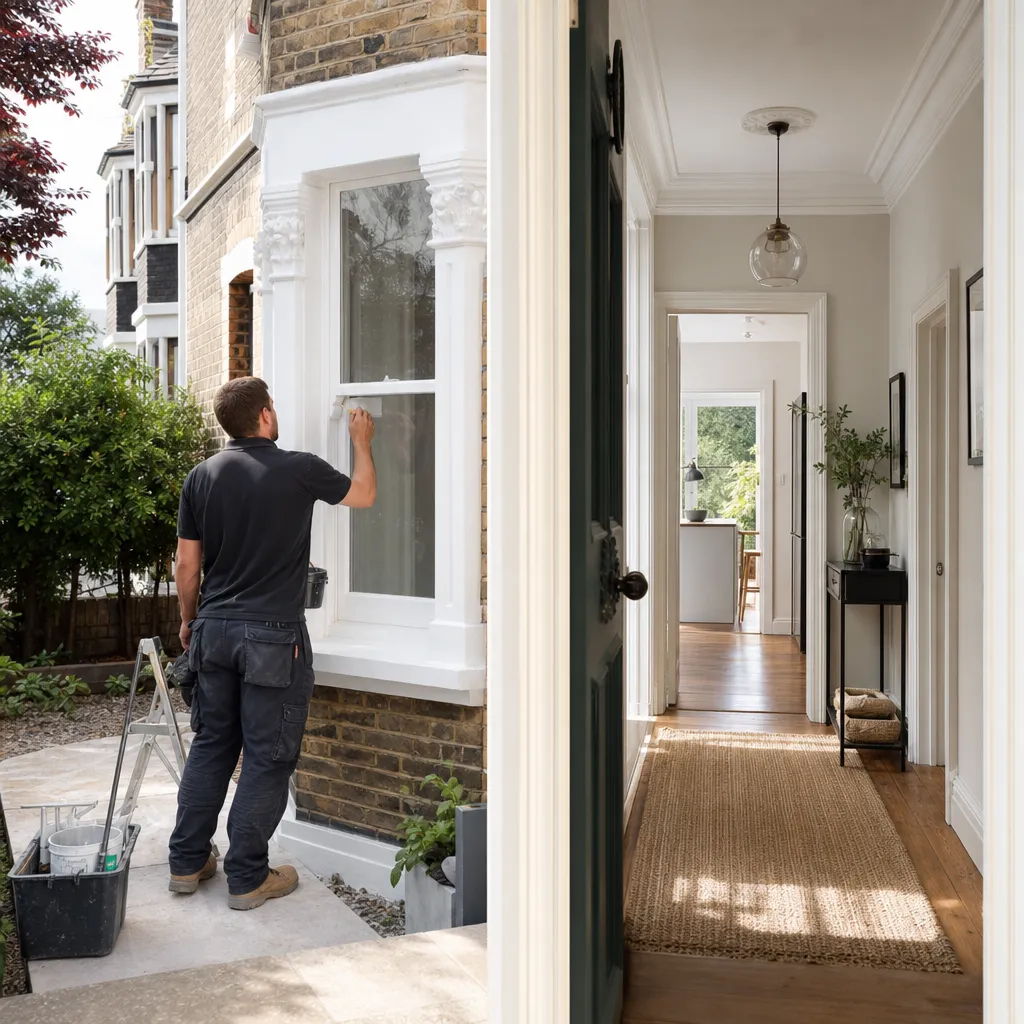
Preparing Your Home for Sale: Interior and Exterior Improvements
Preparing your home for sale means prioritising presentation over renovation.