Removal Company Services: Full Packing and Unpacking Options
By Housey · Last reviewed 3rd of May 2026
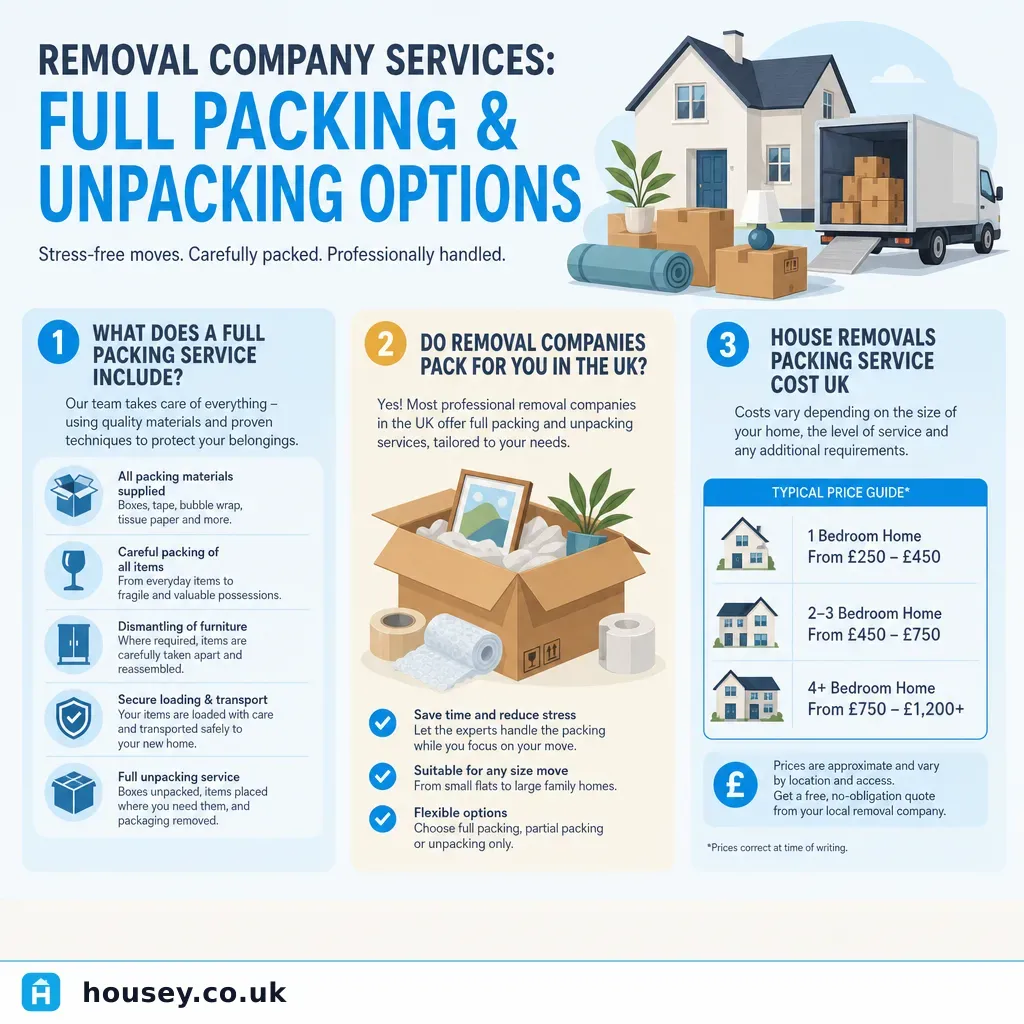
Removal Company Services: Full Packing and Unpacking Options
Most people's first instinct when moving house is to do the packing themselves to save money — then discover how long it actually takes. UK removal companies offer a range of packing services, from supplying boxes and materials through to a full pack-and-unpack service where their team handles everything from the kitchen cupboards to the loft. Knowing what each service level includes — and how insurance, materials costs, and scheduling differ — helps you choose the right option and compare quotes fairly.
Key points
- A full packing service means removal company staff pack all your belongings before moving day and can unpack them at your new address — not just load and transport boxes.
- Insurance cover typically differs between self-packed and professionally packed boxes; always check the removal company's goods-in-transit policy and compare it with your home contents insurance.
- UK removal companies are not legally required to hold British Association of Removers (BAR) membership, but BAR members must follow a Code of Practice overseen by the Trading Standards Institute.
- Most removal companies charge for packing materials (boxes, tissue paper, bubble wrap, wardrobe boxes) separately from labour — always confirm whether materials are included before accepting a quote.
- A full packing service on a three-bedroom house typically adds one to two days to the moving schedule, so exchange and completion timelines should account for this.
What packing service levels are available?
UK removal companies typically offer three levels of packing support:
Service level | What it includes | Best for | Not ideal for |
|---|---|---|---|
Self-pack (DIY) | Company supplies boxes and materials; you do all the packing | Tight budget; straightforward move with few fragile items | Busy households; fragile or valuable collections; time-poor movers |
Partial packing | Removal team packs fragile or specialist items; you pack the rest | Balance of cost and protection for valuables | Those wanting maximum speed and minimum involvement |
Full packing | Removal team packs all rooms, loads, moves, unloads, and optionally unpacks | Maximum convenience; complex or long-distance moves; elderly or mobility-limited movers | Very tight budgets; movers with privacy concerns about strangers handling all belongings |
What does a full packing service include?
A full packing service typically covers:
- Pre-move packing visit — Staff attend one or two days before moving day to pack all rooms systematically.
- Packing materials — Professional double-walled boxes, tissue paper, bubble wrap, garment bags, and specialist containers for mirrors, artwork, and televisions.
- Wardrobe boxes — Hanging garments transfer directly into wardrobe boxes to avoid creasing.
- Labelling — Every box should be labelled by room and contents to speed up unpacking.
- Loading and transport — Packed boxes and furniture are loaded into the removal vehicle on moving day.
- Delivery and placement — Items are placed in the rooms you specify at your new address.
- Unpacking (if included) — Staff unpack boxes and place items; they do not typically arrange belongings aesthetically but will clear packing materials.
Some companies offer unpacking as an optional add-on rather than a standard part of the full service — confirm this when getting quotes.
Insurance and liability: what you need to know
Insurance is one of the most important and least-discussed aspects of choosing a packing service.
- Self-packed boxes: Most removal companies will not accept liability for damage to items packed by the homeowner, as they cannot verify how items were wrapped. Your home contents insurance may cover transit damage if your policy includes 'all risks' or 'in transit' cover — check the policy wording carefully.
- Professionally packed boxes: When removal staff pack your items, most reputable companies accept liability for breakages in transit under their goods-in-transit insurance. The value per item and total claim limit will be stated in the contract.
- High-value items: Antiques, jewellery, art, and items over £1,000 per piece may need a separate specialist declaration or additional cover. Do not assume they are automatically covered at full replacement value.
Before signing, ask:
- What is the maximum liability per item and per move?
- Is there an excess on claims?
- Are self-packed items excluded from the goods-in-transit policy?
- Does the policy cover items left in a property overnight between packing day and moving day?
Quote comparison template
When comparing removal quotes that include packing, ask each company to break down:
Item | Company A | Company B | Company C |
|---|---|---|---|
Packing labour (per person, per day) |
|
|
|
Packing materials (itemised or flat fee) |
|
|
|
Loading and transport |
|
|
|
Unpacking labour (if included) |
|
|
|
Goods-in-transit insurance limit |
|
|
|
Self-packed items covered? |
|
|
|
VAT included? |
|
|
|
Total |
|
|
|
Insisting on an itemised quote makes it easy to see where costs differ and avoids comparing a full-service price against a transport-only one.
Homeowner checklist: preparing for a full packing service
When to get professional help
A full packing service is particularly worth considering if:
- You have a large property or many years of accumulated possessions.
- Your move involves elderly or mobility-limited household members.
- You are moving into storage — professional packing reduces damage risk over longer periods.
- You face a short completion date or a chain requiring a swift turnaround.
Specialist removal companies exist for fine art, antiques, pianos, and wine collections — for high-value or fragile items, a general removal firm may not be the most appropriate choice.
How Housey can help
Housey helps UK homeowners request quotes from local and national house removal companies, including those offering full packing and unpacking services. You can compare quotes on a like-for-like basis and identify companies with BAR membership or RIO registration.
Frequently asked questions
Is it worth paying for a full packing service when moving house?
For most households it is, if budget allows. Professional packers are faster and better at protecting fragile items than most homeowners — a team of two can pack an average three-bedroom house in six to eight hours. On complex, long-distance, or time-pressured moves the cost is usually justified by the time and stress saved. On a tight budget, a partial packing service for fragile items is a sensible middle ground.
Are my belongings better insured if the removal company packs them?
In most cases, yes. When removal staff pack your items they can accept liability for packing-related damage under their goods-in-transit insurance. Self-packed boxes are typically excluded from transit claims because the removal company cannot verify how items were wrapped. If you pack yourself, check whether your home contents insurance includes in-transit cover for your belongings during the move.
How far in advance should I book a removal company with a packing service?
For peak periods — late spring, summer school holidays, and end-of-month completions — book at least six to eight weeks ahead. A full packing service requires the company to schedule packing visits one to two days before moving day, so advance notice matters more than for a transport-only move. Out-of-peak moves may be available at shorter notice, but choice reduces as dates approach.
What should I keep out of removal company boxes even with a full packing service?
Always keep a personal bag with house keys, passports, identification documents, essential medication, children's comfort items, phone chargers, jewellery, and anything you need on your first night. These items should travel with you personally. Important legal documents — such as conveyancing paperwork — are also best kept with you rather than packed into removal boxes.
Sources and further reading
- British Association of Removers (BAR) — BAR (code of practice and member directory)
- Moving house checklist — Citizens Advice
- Removals Industry Ombudsman (RIO) — Removals Industry Ombudsman
- Consumer rights when buying services — GOV.UK
Useful next reads
 Buying & Moving
Types of Removal Companies: Choosing the Right Mover for Your Relocation
UK removal companies range from man-and-van operators for small moves to full-service firms that pack, transport, store, and unpack.
 Buying & Moving
Choosing a House Removal Company: What to Look For
Choose a UK removal company that belongs to the British Association of Removers (BAR) or the Removals Industry Ombudsman Scheme (RIOS), carries goods-in-transit and public liability insurance, and provides a written quote after properly surveying your home.
 Buying & Moving
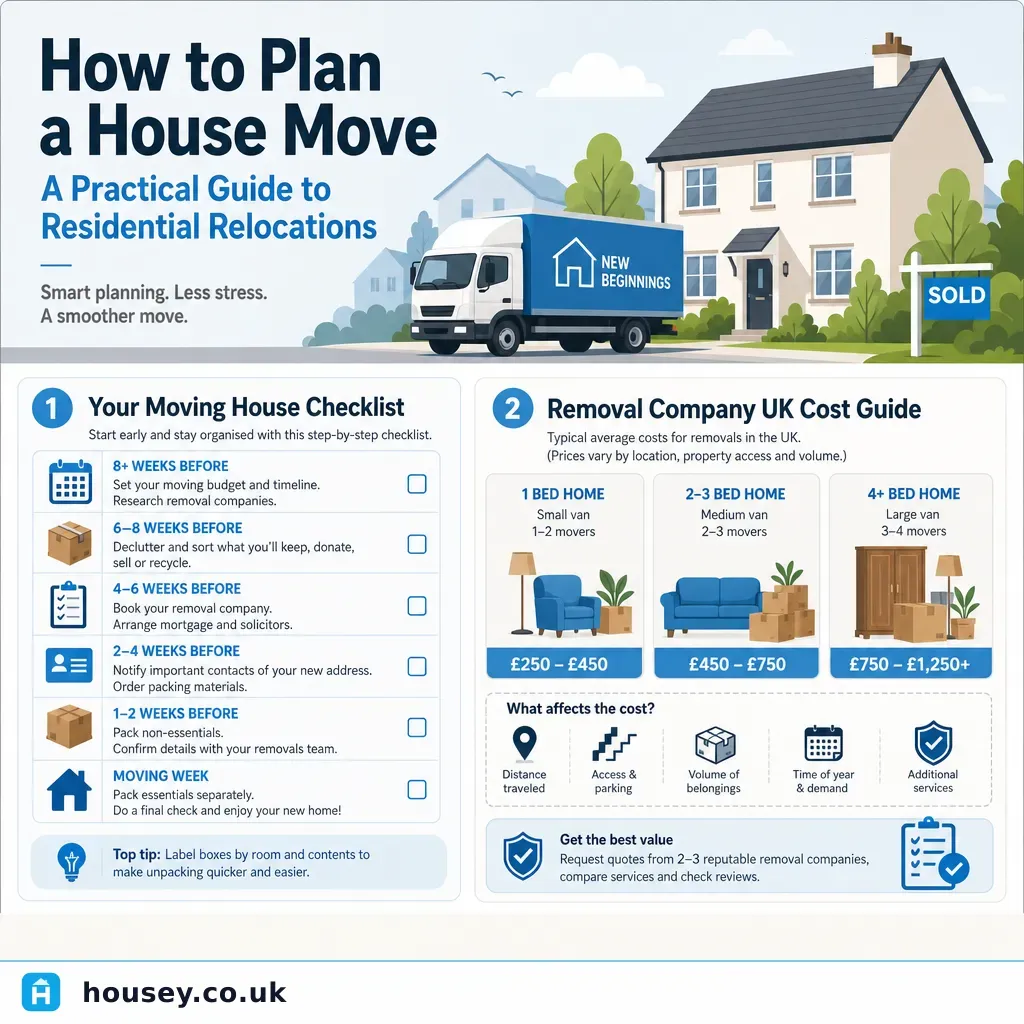
How to Plan a House Move: A Practical Guide to Residential Relocations
A UK house move goes more smoothly with planning that starts 6–8 weeks before moving day.
 Buying & Moving
Managing Property Relocation in Major Urban Centres
Urban house moves require planning beyond a standard removal, particularly around vehicle emission zone compliance, parking bay suspensions, and lift access in purpose-built flats.
 Buying & Moving
Choosing the Right Removal Company for Your House Move
To choose the right removal company, get three quotes from British Association of Removers (BAR) members or similarly accredited firms.