Types of Removal Companies: Choosing the Right Mover for Your Relocation
By Housey · Last reviewed 26th of May 2026

Types of Removal Companies: Choosing the Right Mover for Your Relocation
Whether you're upsizing from a one-bed flat in Leeds or relocating a five-bedroom family home to Edinburgh, the type of removal company you choose can shape the entire moving experience. The UK removal industry ranges from sole traders with a Transit van to large logistics firms handling overseas shipping and specialist art transport — understanding what each service covers prevents costly surprises on moving day.
Key points
- The British Association of Removers (BAR) and the National Guild of Removers and Storers (NGRS) both operate trade membership schemes with codes of conduct and independent dispute resolution via the Furniture and Home Improvement Ombudsman.
- Man-and-van operators are typically sole traders; they are not regulated by BAR or NGRS, and goods-in-transit insurance is not guaranteed — always ask for the policy certificate before booking.
- Full-service removal firms usually offer three tiers: transport-only, part-pack, and full-pack — each carries a different price and level of crew involvement.
- International removals require customs export documentation for both UK and destination countries post-Brexit; a domestic-only removal firm cannot manage this.
- Storage-in-transit is a removals-company warehouse bridge between completion dates; it differs from self-storage and is often priced per week or included within the move package.
What types of removal company operate in the UK?
The UK market divides into roughly five categories, each suited to different move sizes and budgets:
Type | Best for | Not ideal for | Typical service | Main risk if wrong choice |
|---|---|---|---|---|
Man and van | Small moves, studios, students, single items | Large family homes, long distances, fragile antiques | Transit or Luton van, driver plus one helper | No formal insurance guarantee, limited capacity, no packing support |
Independent local remover | 2–4 bed homes, local or regional moves | International moves, specialist items | 3.5–7.5t lorry, crew of 2–3, optional packing | Variable insurance levels — check BAR or NGRS membership |
National full-service firm | Larger homes, complex moves, long distance | Very tight budgets | Fleet vehicles, packing, storage, unpacking | Higher cost; confirm what is and is not included |
International specialist | Overseas relocations (EU, US, Australia) | Domestic UK moves only | Container shipping, airfreight, customs documentation, destination delivery | Non-specialist firms cannot handle customs or destination compliance |
Specialist or niche remover | Pianos, fine art, antiques, IT equipment, laboratory equipment | General household goods | Custom crating, climate control, specialist vehicles | Using a generalist for items requiring specialist handling |
Man-and-van services: what to know
Man-and-van operators are the most common choice for smaller moves — a studio flat, student room, or a single piece of furniture. They are usually sole traders or small partnerships advertising on local platforms.
Key checks before booking:
- Confirm the operator holds goods-in-transit insurance, which covers your belongings during transport. Ask for the policy number or certificate.
- Public liability insurance protects against property damage caused during the move; not all man-and-van operators carry it.
- Check the van's payload capacity matches your volume — a Luton van typically holds around 550–600 cubic feet; a Transit van considerably less.
- Man-and-van operators are outside BAR and NGRS membership schemes, so formal dispute resolution routes are not available if something goes wrong.
Full-service removal companies
Full-service firms manage the complete chain: packing, loading, transport, unloading, and in some cases unpacking and furniture reassembly. Most offer three tiers:
- Transport-only: You pack everything; the crew loads, drives, and unloads.
- Part-pack: The firm packs fragile items — china, glassware, artwork — while you handle everything else.
- Full-pack: The firm packs, transports, unpacks, and removes packing materials. The most expensive option.
BAR-member firms follow the BAR Code of Practice, backed by an independent complaints process via the Furniture and Home Improvement Ombudsman. For NGRS members, a similar ombudsman route is available. This provides meaningful recourse if a dispute arises over damaged or missing goods.
International removal companies
An overseas move involves significantly more logistics than a domestic one. A specialist international removal company or freight forwarder handles:
- Sea freight (full or shared container loads) and airfreight.
- Export packing to shipping standards, including ISPM 15 heat-treated timber requirements for some destinations.
- UK customs export documentation and destination customs clearance.
- Destination delivery and, in some cases, unpacking and debris removal.
For EU destinations post-Brexit, customs declarations are required at both the UK and EU border. A domestic-only removal firm will not have the systems or relationships to manage this — always confirm international capability explicitly before booking.
The International Association of Movers (IAM) and FIDI (Fédération Internationale des Déménageurs Internationaux) accredit international removal firms to defined quality standards — check membership for intercontinental moves.
Storage-in-transit and self-storage
Completion and exchange dates rarely align perfectly. When a gap opens between leaving your old home and moving into the new one, two main options exist:
- Storage-in-transit: Your removal company stores your containerised belongings in their warehouse, charged per week. Items remain sealed in your dedicated container until delivery to your new address.
- Self-storage unit: You transport to and access a unit directly. More flexible if you need ongoing access, but requires separate transport arrangements.
Some removal firms include a short period of free storage-in-transit within their move package. Always ask whether this is included or priced separately, and confirm the insurance position for stored goods.
Which type of removal service should you choose?
- Choose a man-and-van if you're moving a few boxes or a single room, on a tight budget, and your belongings are low-value and low-risk.
- Choose a local independent remover if you're moving a 2–4 bed home within the UK and want crew support without paying national firm rates.
- Choose a full-service national firm if you have a large home, complex logistics, or want the protection of BAR membership and formal dispute resolution.
- Choose an international specialist for any overseas move — do not use a domestic-only firm for customs-clearance destinations.
- Choose a specialist niche remover if you have pianos, fine art, antiques, or scientific equipment requiring custom crating or climate control.
- Check BAR or NGRS membership at bar.co.uk or ngrs.org for any firm you shortlist.
What to ask before accepting a quote
Before confirming any removal company, ask:
- What does the quote include and exclude — packing materials, furniture dismantling, parking charges, stair and floor surcharges?
- What goods-in-transit and public liability insurance does the company hold, and what is the claims process if something is damaged?
- Who carries out the work on the day — the firm's own employees or subcontractors?
- Is the company a BAR or NGRS member?
- What is the cancellation and rescheduling policy if your completion date changes?
- For international moves: who manages customs documentation at both ends, and are there destination-country restrictions on specific items?
- Is VAT included in the quoted price?
- What happens if the volume of belongings is larger than estimated on survey?
When to get professional help
Most domestic moves do not require specialist advice beyond comparing quotes from reputable firms. Consider additional guidance if:
- You are relocating internationally and are uncertain about customs requirements for specific items — vehicles, food, restricted goods, firearms, or pets all carry rules that vary significantly by destination country.
- You have high-value items such as fine art, antiques, or jewellery that may need separate specialist insurance or bespoke transport rather than standard goods-in-transit cover.
- You are moving business assets or IT infrastructure alongside household goods — commercial removal firms handle these differently from domestic operators.
- Your new or old property has very narrow access, shared entrances, or listed building restrictions affecting vehicle size or how goods can be handled.
How Housey can help
Housey connects you with vetted house removals companies and international removals specialists across the UK. Submit a single request and receive comparable quotes from local and national providers — no cold calling and no chasing.
Frequently asked questions
Do removal companies need to be licensed in the UK?
There is no statutory licence required to operate as a removal company in the UK. However, BAR and NGRS membership signals that a firm meets defined conduct and insurance standards, and provides access to independent dispute resolution. Always verify membership directly on the trade body's website — membership can lapse.
What insurance should a removal company have?
Look for goods-in-transit insurance, which covers your belongings during transport, and public liability insurance, which covers damage to your property. Ask for policy details — standard policies often have per-item limits, so high-value items may need to be separately declared. Check whether your home contents insurance extends to cover a move.
How far in advance should I book a removal company?
For peak periods — end of month, school holiday starts, and summer — book at least 6–8 weeks ahead for a reputable full-service firm. Man-and-van operators are often available at shorter notice. For international moves involving container shipping, allow at least 8–12 weeks to arrange logistics and documentation.
Can I move abroad without using an international specialist?
It is possible to arrange your own freight shipping, but customs clearance, import duties, and prohibited goods lists vary significantly by destination country. For most overseas relocations, using a FIDI- or IAM-accredited specialist is strongly advisable to avoid delayed, impounded, or misdeclared goods at the port of entry.
Sources and further reading
Useful next reads
 Buying & Moving
Choosing a House Removal Company: What to Look For
Choose a UK removal company that belongs to the British Association of Removers (BAR) or the Removals Industry Ombudsman Scheme (RIOS), carries goods-in-transit and public liability insurance, and provides a written quote after properly surveying your home.
 Buying & Moving
How to Plan a House Move: A Practical Guide to Residential Relocations
A UK house move goes more smoothly with planning that starts 6–8 weeks before moving day.
 Buying & Moving
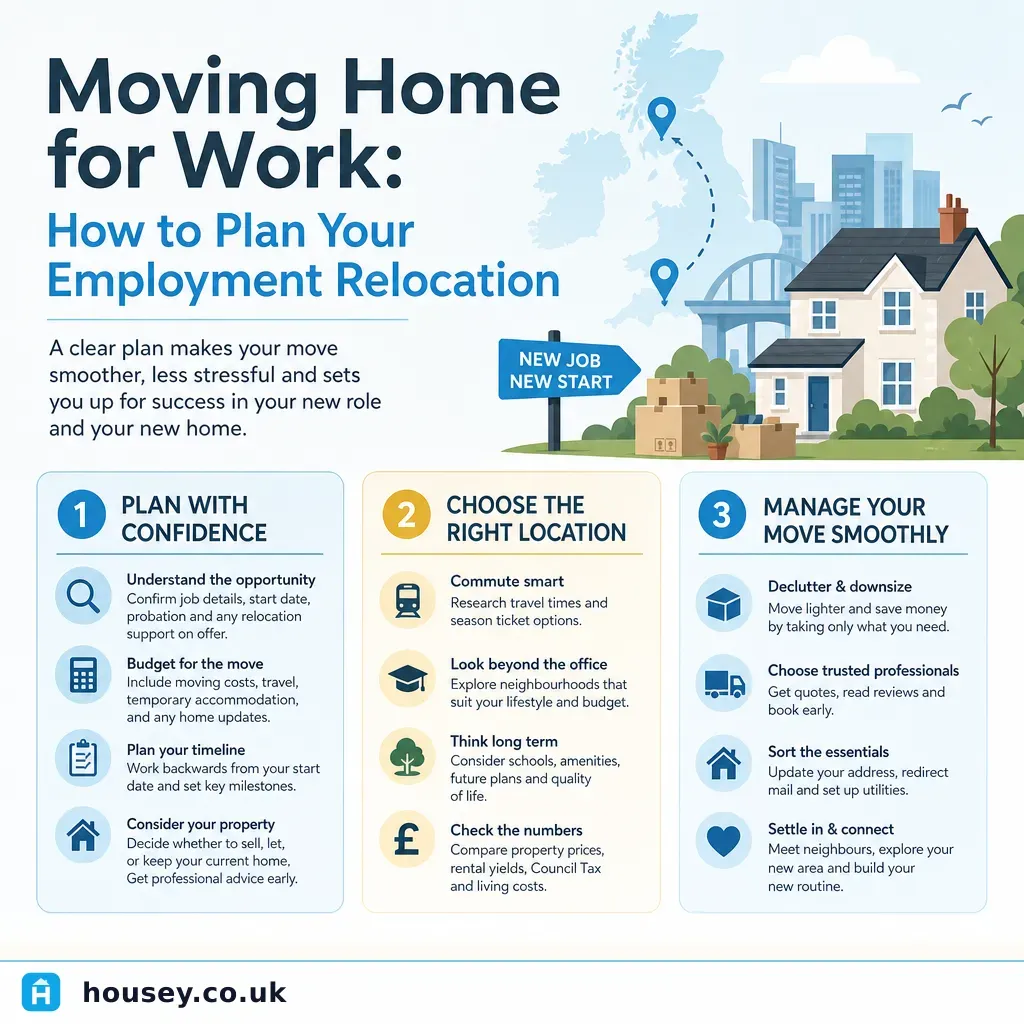
Moving Home for Work: How to Plan Your Employment Relocation
Moving home for a new job requires coordinating property timelines, removal logistics, and employer reimbursement simultaneously.
 Buying & Moving
Planning Your Home Removal: What to Expect from Professional Services
A professional removal company loads, transports, and unloads your household belongings between properties.
 Buying & Moving
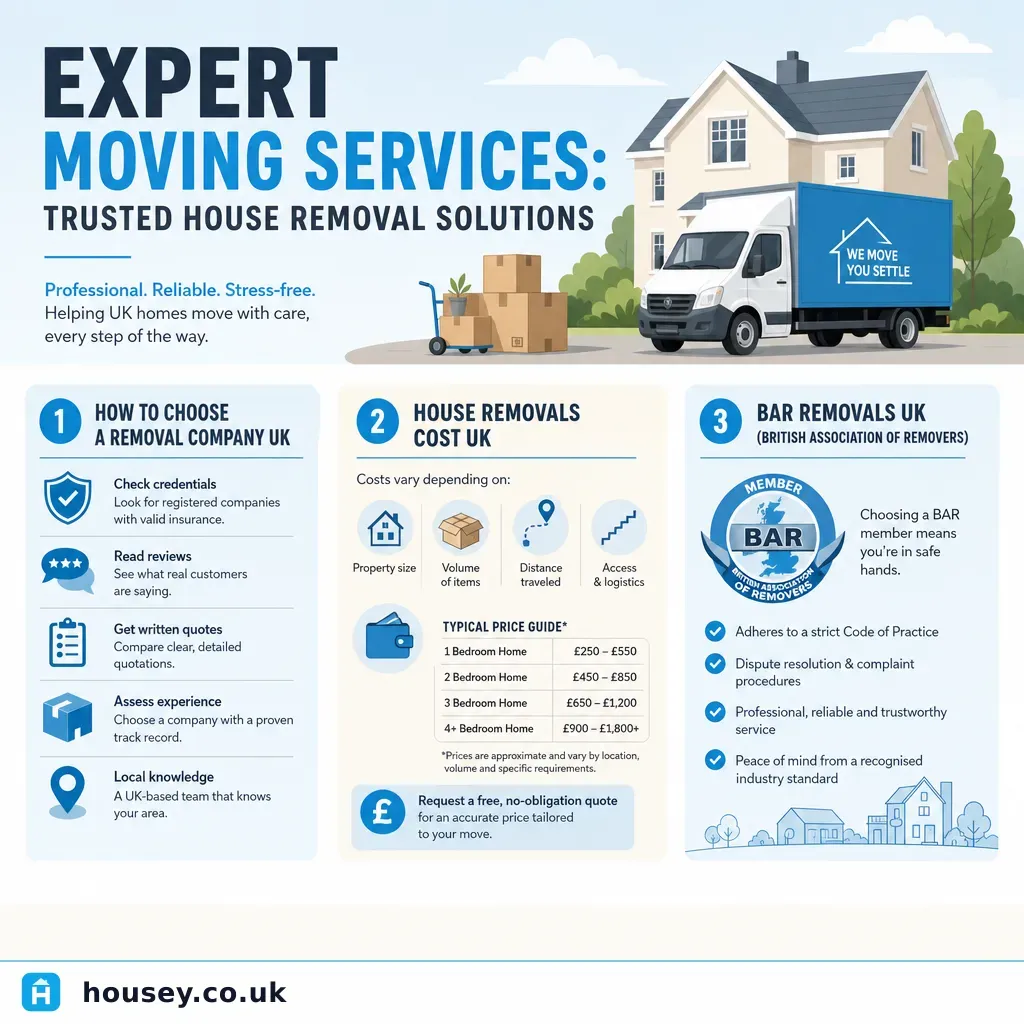
Expert Moving Services: Trusted House Removal Solutions
A professional house removal company handles packing, loading, transport, and unloading of your belongings.