Second-Time Buyer's Guide: Next Steps in Your Property Journey
By Housey · Last reviewed 18th of May 2026
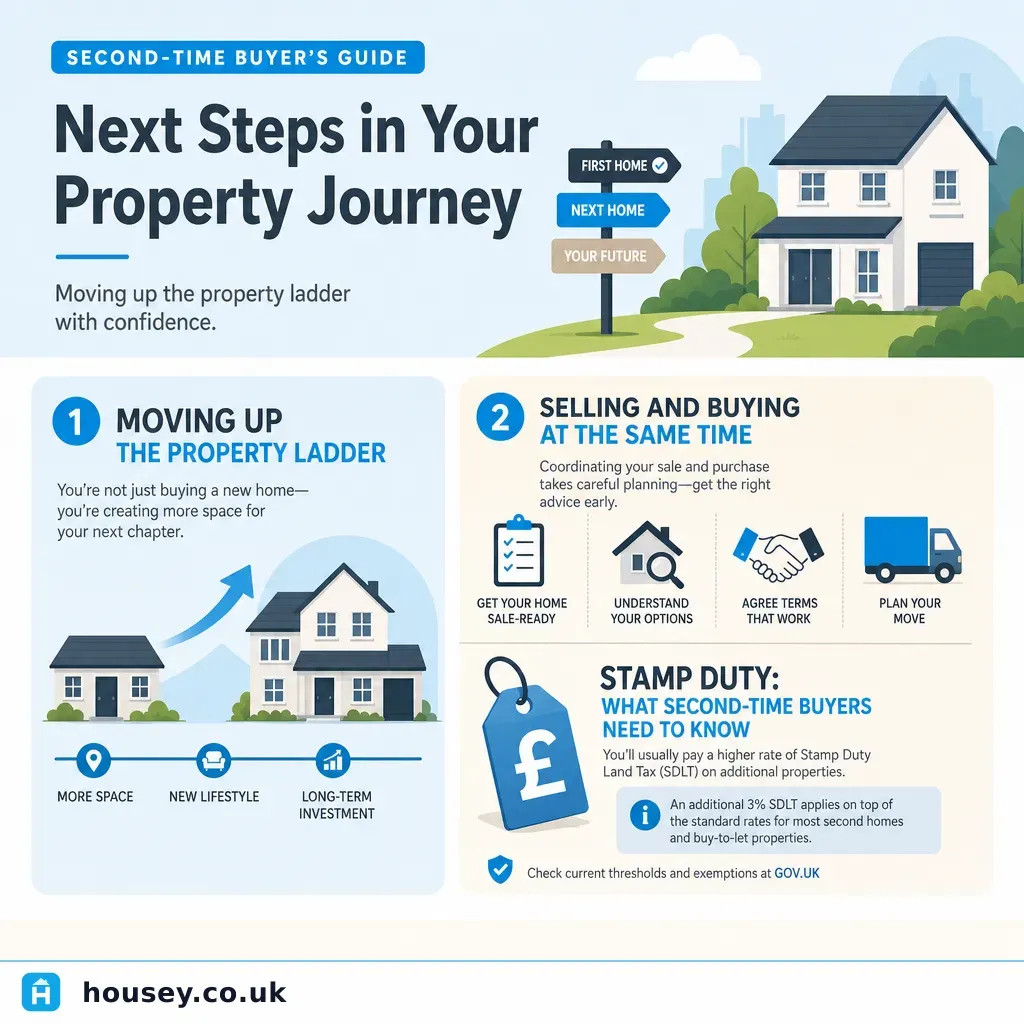
Second-Time Buyer's Guide: Next Steps in Your Property Journey
Moving up the property ladder introduces a layer of complexity that first-time buyers never face: you are simultaneously a seller and a buyer, often within the same chain. For most homeowners, this is the transaction where the stakes — equity, timing, survey choice, and legal costs — matter most. Getting the sequence right from the outset reduces the risk of chain collapse and the financial exposure that can follow.
Key points
- A simultaneous sale and purchase in England and Wales creates a property chain; completion depends on every party in the chain exchanging and completing on the same day.
- Stamp Duty Land Tax (SDLT) applies at standard rates with no first-time buyer relief; if you complete a new purchase before selling your existing home, a 3% additional dwelling surcharge applies, reclaimed within 12 months of the sale.
- A RICS Level 2 Home Survey is usually sufficient for post-1930s conventional properties in reasonable condition; a RICS Level 3 Building Survey is advisable for older, structurally complex, or visibly defective homes.
- Your conveyancer must obtain a mortgage redemption statement from your lender before exchange of contracts on your current home, confirming the exact amount required to clear the debt.
- Estate agents operating in England and Wales must belong to a government-approved redress scheme under the Consumers, Estate Agents and Redress Act 2007.
How second-time buying differs from your first purchase
When you bought your first home, you had one solicitor instruction, one set of searches, and no chain on your side. Now you have a sale and a purchase running simultaneously, each dependent on the other. Your buyer could withdraw and delay your purchase; your seller could accept a higher offer and leave you without a property to move to.
You also arrive with equity — the difference between your current property's market value and your outstanding mortgage — which typically forms your deposit for the next purchase. Before you begin searching, establish your equity position clearly. A formal valuation survey to establish your equity position from a RICS-registered professional gives you a defensible figure to take to your mortgage broker, rather than relying on automated online estimates.
Financial checklist before you start searching:
- Obtain a mortgage Agreement in Principle (AIP) for the price range you intend to buy in.
- Request a redemption statement from your current lender — this shows your outstanding balance including any early repayment charges (ERCs).
- Calculate available equity: estimated current value minus outstanding mortgage, estate agent fees, and conveyancing costs.
- Budget for Stamp Duty Land Tax, survey costs, conveyancing fees, and removal costs on the new purchase.
- Check whether your current fixed-rate mortgage has ERCs — penalties of 1–5% of the outstanding balance are not uncommon.
Managing the chain: selling and buying at the same time
A property chain connects multiple buyers and sellers; your completion depends on everyone else completing too. Chains of three to five properties are common in England and Wales. Scotland operates differently under the missives system, where a binding contract is concluded at an earlier stage, making the process more predictable, though timescales still vary.
Practical ways to reduce chain risk:
- Accept an offer on your current home before actively viewing your next one — this gives you a realistic timeline and stronger negotiating position.
- Favour a chain-free buyer for your current home (a cash buyer or first-time buyer) where possible; it reduces the number of dependent transactions.
- Instruct a conveyancer immediately after accepting an offer; delays in instruction are among the most common reasons chains collapse.
- Keep all parties updated through your estate agent — communication gaps cause anxiety and sometimes lead buyers or sellers to withdraw.
Being chain-free on the purchase side — where the seller is not buying onward — materially reduces completion risk and can be a deciding factor when choosing between similar properties.
Which survey do you need second time around?
Second-time buyers often make more informed survey choices than they did on their first purchase. The RICS Home Survey Standard defines three levels; the right one depends on the property's age, construction, and visible condition.
Survey type | Best for | Not ideal for | Typical output | Main risk if wrong |
|---|---|---|---|---|
RICS Level 2 Home Survey | Post-1930s conventional properties in reasonable condition | Victorian or Edwardian homes, prior alterations, visible defects | Condition ratings 1–3 with recommendations | Missing hidden structural or damp defects |
RICS Level 3 Building Survey | Pre-1930s, non-standard construction, extended or altered properties | New-build properties | Full structural narrative and recommended actions | Serious risk if skipped on the wrong property |
Structural engineer's report | Specific defect flagged in a Level 2 or Level 3 report | General pre-purchase decision-making | Engineering assessment and remediation options | Underestimating structural risk and associated repair cost |
Snagging survey | New-build properties within the developer warranty period | Older or substantially altered homes | Defect schedule for the developer to remedy | Accepting defects the builder is obliged to fix |
If you are purchasing a Victorian terrace, a 1930s semi with extensions, or any property showing visible damp or cracking, a RICS Level 3 Building Survey is generally the more appropriate choice. Reputable RICS home surveyors will advise on the right level once they know the property details — confirm this before commissioning.
Decision tree: which survey level should you choose?
Use this as a starting framework; your surveyor confirms the final recommendation.
- Choose a RICS Level 2 Home Survey if: the property is post-1930s, conventional brick-and-tile construction, in apparently good condition, with no obvious alterations or visible defects.
- Choose a RICS Level 3 Building Survey if: the property was built before 1930; has a flat roof, solid walls, or non-standard construction; has been extended, converted, or substantially altered; or shows any signs of cracking, damp, or roof deterioration.
- Commission a structural engineer's report if: your Level 2 or Level 3 survey flags suspected movement, subsidence, or cracking that requires engineering diagnosis beyond the surveyor's scope.
- Ask your mortgage lender if: the property is of non-standard construction (concrete, timber frame, pre-cast concrete) or is a leasehold flat — lenders sometimes require additional specialist reports before they will lend.
Second-time buyer pre-exchange checklist
Confirm each item with your conveyancer before authorising exchange of contracts.
Important limitations
This guide provides general information about the second-time buying process in the UK. Property law differs between England and Wales, Scotland, and Northern Ireland. Individual transactions vary significantly by property type, tenure (freehold or leasehold), chain length, mortgage product, and local authority area. Nothing in this article constitutes legal or financial advice. A licensed conveyancer or solicitor regulated by the Solicitors Regulation Authority (SRA) or the Council for Licensed Conveyancers (CLC) should review your specific transaction.
What to ask a qualified professional
Before instructing a conveyancer:
- Will you handle my sale and purchase together, and if not, how do you coordinate with the other firm?
- What are your total fees, and which disbursements — searches, Land Registry fees, bank transfer charges — are additional?
- Are you accredited under the Law Society's Conveyancing Quality Scheme (CQS)?
- What is your expected timeline for a transaction at this price and chain length?
- What is your process if the chain collapses?
Before commissioning a survey:
- Is a Level 2 or Level 3 survey more appropriate for this property in your professional view?
- Are you RICS-registered and do you carry professional indemnity insurance?
- Will you recommend specialist reports — structural, damp, drains — if the survey warrants it?
- How long will the report take to produce, and will you talk me through the findings?
When to get professional help
Instructing a licensed conveyancer or solicitor is strongly advisable for any simultaneous sale and purchase. Seek specialist professional guidance if:
- The property is leasehold with fewer than 80 years remaining on the lease, as this affects mortgage eligibility and resale value.
- Your survey identifies suspected subsidence, Japanese knotweed, or significant structural defects.
- There is a boundary, access, or rights-of-way dispute.
- The property is listed or in a conservation area, as this may restrict works you intend to carry out after completion.
- Your chain involves more than four properties.
How Housey can help
Housey connects second-time buyers with vetted local professionals across every stage of the transaction. Whether you need a valuation survey to establish your equity position before listing, a RICS Level 3 Building Survey on an older property, or a conveyancing solicitor to manage your sale and purchase, you can compare quotes from accredited specialists through the Housey platform.
Frequently asked questions
Do second-time buyers pay stamp duty?
Yes. Second-time buyers pay Stamp Duty Land Tax at standard rates — no first-time buyer relief applies. In England and Northern Ireland, rates are tiered: 0% up to £125,000, 2% on £125,001–£250,000, 5% on £250,001–£925,000. If you complete your purchase before selling your existing home, a 3% additional dwelling surcharge applies; this can be reclaimed within 12 months of your original sale. Scotland uses LBTT; Wales uses LTT.
How long does a second-time purchase typically take?
In England and Wales, a simultaneous sale and purchase in a chain of two to three properties typically completes within 10–16 weeks of offer acceptance. Longer chains, leasehold properties, or those requiring specialist surveys can extend this to 20 weeks or more. Instructing a conveyancer quickly and returning paperwork promptly are among the most effective ways a buyer can maintain pace.
Can I use my first property's conveyancer again?
Yes, if they are still practising. Many buyers return to a conveyancer they were satisfied with. It is worth obtaining two or three quotes regardless — fees vary significantly. Look for Law Society Conveyancing Quality Scheme (CQS) accreditation as a quality indicator, as this signals adherence to recognised professional standards in residential conveyancing.
What happens to my costs if the chain collapses?
If the chain collapses, you may lose some or all of your survey, search, and solicitor fees for work already completed. These costs are generally not recoverable from the party who withdrew. Home buyer protection insurance can cover abortive costs in some circumstances — ask your conveyancer whether this is appropriate before committing to significant upfront expenditure.
Sources and further reading
- Stamp Duty Land Tax — GOV.UK — Current SDLT rates and calculator for England and Northern Ireland
- RICS Home Survey Standard — Survey level definitions and scope
- Conveyancing Quality Scheme — Law Society — CQS accreditation for residential conveyancers
- Buying a home — Citizens Advice — Independent guidance on the purchase process
- UK House Price Index — HM Land Registry — Official sold price data by region
Useful next reads
 Buying & Moving
Choosing a House Removal Company: What to Look For
Choose a UK removal company that belongs to the British Association of Removers (BAR) or the Removals Industry Ombudsman Scheme (RIOS), carries goods-in-transit and public liability insurance, and provides a written quote after properly surveying your home.
 Buying & Moving
Identifying and Resolving Delays in Property Transactions
Delays in UK property transactions most often arise from slow local authority searches, incomplete identity documents, mortgage hold-ups, leasehold complications, or a problem elsewhere in the chain.
 Buying & Moving
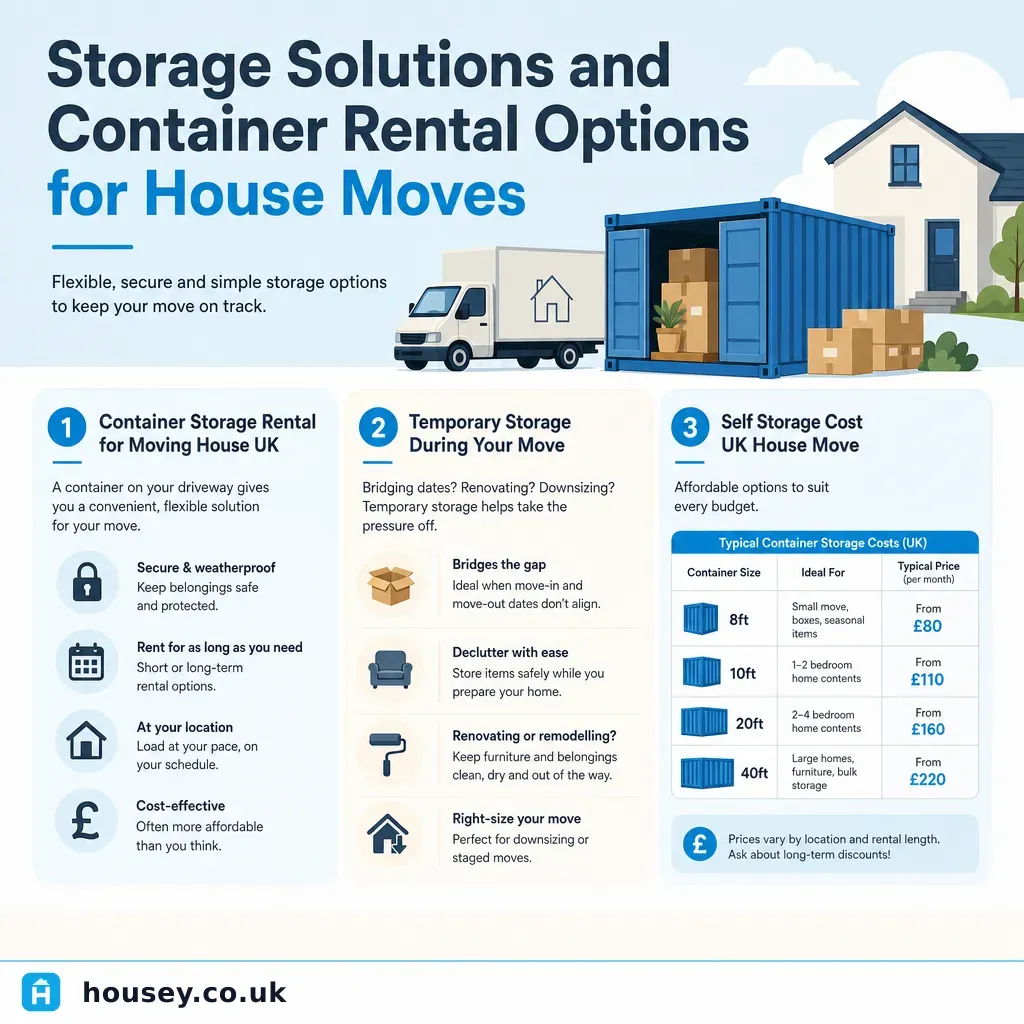
Storage Solutions and Container Rental Options for House Moves
When moving house in the UK, temporary storage options include self-storage units, portable storage containers delivered to your door, and removal company storage vans.
 Buying & Moving
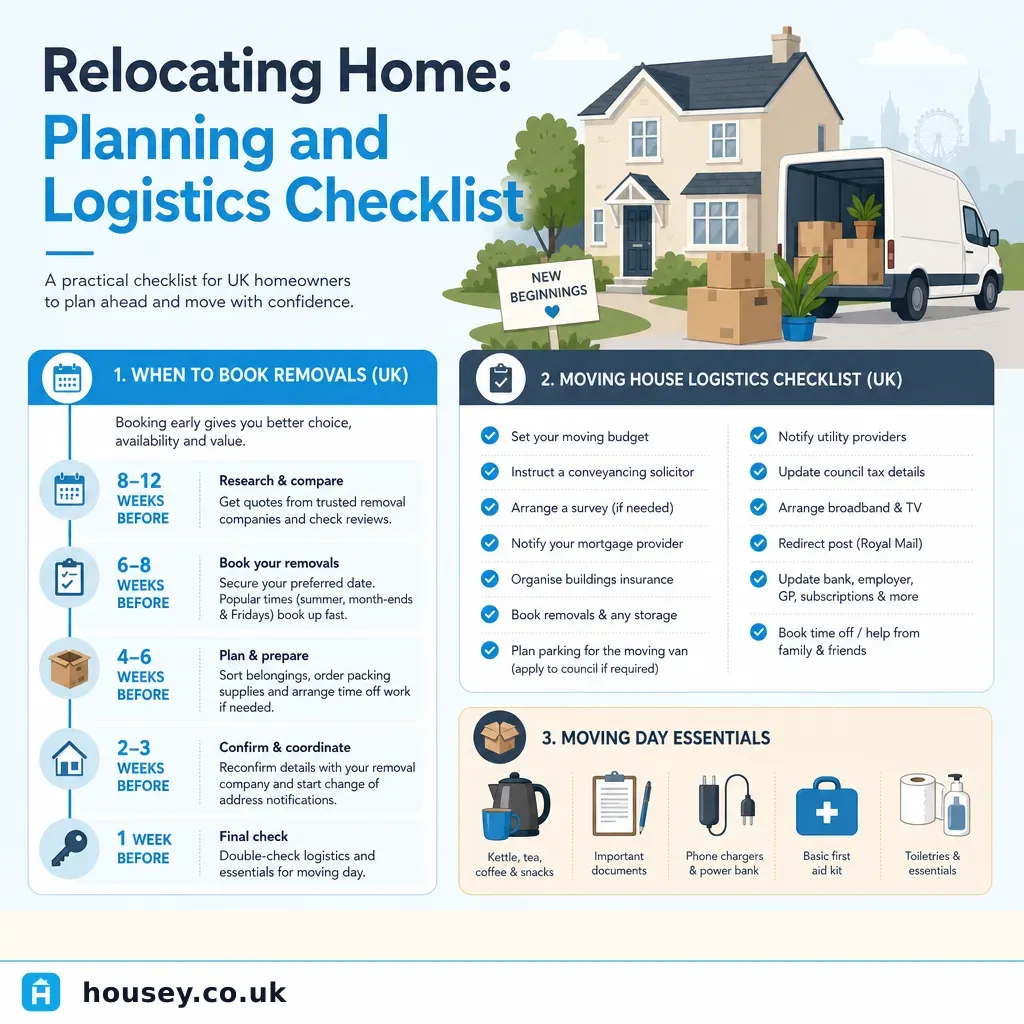
Relocating Home: Planning and Logistics Checklist
Successful home relocation in the UK typically requires 8–12 weeks of advance planning.
 Buying & Moving
Professional House Removal Services: Costs and Logistics
Professional house removal services in the UK typically cost £800–£2,000 for a 3-bedroom local move, rising to £1,500–£4,000 for long-distance relocations.