Identifying and Resolving Delays in Property Transactions
By Housey · Last reviewed 25th of May 2026

Identifying and Resolving Delays in Property Transactions
Delays are among the most stressful aspects of buying or selling a home in England, Wales, and Scotland. Weeks — sometimes months — can pass between offer acceptance and exchange, and the reasons are rarely obvious to buyers or sellers waiting on the sidelines. Understanding which party is causing a hold-up, and what practical steps you can take, is the fastest route to getting a stalled transaction moving again.
Key points
- The average time from offer acceptance to exchange in England and Wales was approximately 12–16 weeks in 2024, but a significant proportion of transactions take considerably longer, particularly those in chains of three or more parties.
- Local authority searches in some council areas take 4–10 weeks or more; personal (indemnity-backed) searches, carried out by a regulated third party, may offer a faster alternative in certain areas.
- Solicitors are legally required to carry out Anti-Money Laundering (AML) identity checks on all clients — delays in submitting documentation at the outset of a transaction frequently create bottlenecks several weeks later.
- A lender's down-valuation — where the mortgage lender values the property below the agreed purchase price — is a common cause of renegotiation and delay; an independent RICS survey commissioned before offer can provide an early-warning view on value.
- In Scotland, transactions become legally binding at conclusion of missives (a formal written exchange between solicitors), rather than at exchange of contracts as in England and Wales — this structural difference affects how and when each party can withdraw without liability.
What causes property transaction delays?
Delays in conveyancing rarely have a single cause. The table below identifies the most common causes and what each party can do.
Cause | Who is typically affected | What can help |
|---|---|---|
Slow local authority search returns | Buyer | Ask your solicitor how long searches take in that council area; consider personal searches |
Incomplete AML or identity documents | All parties | Submit all ID documents on day one; use digital verification if the firm offers it |
Mortgage offer delays | Buyer | Apply promptly; ensure the lender's valuation is booked early; respond to lender queries within 24 hours |
Leasehold complications (short lease, absent freeholder, service charge disputes) | Buyer of leasehold property | Check lease length before offering; ask your solicitor to flag leasehold risks at the outset |
Slow solicitor response times | All parties | Request weekly written updates; escalate to the firm's supervisor if replies are consistently late |
Down-valuation by the mortgage lender | Buyer and seller | Renegotiate the price, formally challenge the valuation with comparable evidence, or seek a different lender |
Title defects (missing planning history, restrictive covenants, absent building regulations sign-off) | Seller | Ask the seller's solicitor to assemble and check title documents during or before the marketing period |
Chain collapse or withdrawal by another party | All parties | Maintain regular communication through estate agents; ask about lockout agreements at an appropriate stage |
Probate delays (sale involving a deceased estate) | All parties | Confirm that probate has been granted before making an offer on a probate sale |
New-build completion slippages | Buyer of new build | Review longstop date provisions in the contract carefully before exchange |
Red flags that suggest a serious delay is developing
Some situations warrant immediate escalation rather than patient waiting.
- Your solicitor has not acknowledged correspondence within five working days, consistently across multiple contacts.
- Exchange was agreed verbally but your solicitor cannot confirm a written exchange date.
- Searches were not ordered within two weeks of your offer being accepted.
- The seller's solicitor has raised enquiries that require documents the seller cannot or will not produce.
- Your lender has issued a mortgage retention — withholding part of the loan pending remedial works — without discussing this with you in advance.
- Your mortgage offer expiry date is approaching and exchange has not taken place.
- A party in the chain has changed solicitors mid-transaction.
How to resolve a conveyancing delay
Step 1 — Identify who is responsible. Ask your solicitor to list every outstanding item holding up exchange and confirm which party is responsible for each. A well-organised conveyancer should be able to tell you this clearly in writing.
Step 2 — Communicate in writing. Email creates a record and prompts written responses. Set a specific deadline: ask your solicitor to confirm the status of outstanding enquiries by a named date. Avoid relying solely on phone calls for progress updates.
Step 3 — Escalate within the firm if needed. If your solicitor is persistently unresponsive, contact the firm's supervisor or client relations manager. Most regulated law firms in England and Wales operate a complaints procedure overseen by the Legal Ombudsman; in Scotland, the Law Society of Scotland handles complaints.
Step 4 — Propose a fixed exchange date. If your own legal position is ready and the delay is elsewhere in the chain, ask your solicitor whether proposing a firm exchange date can be used to focus other parties.
Step 5 — Understand your legal position. In England and Wales, either party can withdraw before exchange without legal liability, though they will lose any costs incurred. After exchange, completion is legally binding. Knowing which stage you are at tells you how much pressure you can reasonably apply.
When the delay is caused by the other party's solicitor
If the hold-up is clearly on the other side of the transaction:
- Ask your estate agent to apply commercial pressure — agents have a direct financial incentive to see the transaction complete and can often unlock communication between solicitors.
- Your solicitor can formally request written progress updates from the other side.
- In extreme circumstances, after exchange, a Notice to Complete can be served — but this is a formal legal step that should only be taken on specific advice from your solicitor.
Important limitations
Conveyancing law and process differs between England and Wales, Scotland, and Northern Ireland. The description of exchange of contracts, AML obligations, and lender valuations in this article applies primarily to England and Wales. In Scotland, the regulatory framework for solicitors is governed by the Law Society of Scotland and the process of concluding missives differs from exchange. This article provides general guidance only; your solicitor should advise on the circumstances of your specific transaction.
What to ask a qualified professional
When instructing a solicitor or conveyancer:
- How long do local authority searches typically take in the area I am buying in, and do you offer personal searches as an alternative?
- How will you keep me updated — and how often can I expect proactive communication from you?
- What is the most common cause of delay on transactions involving properties like this one?
- At what point does the transaction become legally binding, and what are the financial consequences of withdrawing before then?
- If the property is leasehold, what specific checks will you carry out, and at what stage in the process?
When to get professional help
Every property transaction in England, Wales, and Scotland requires a qualified solicitor or licensed conveyancer — you cannot proceed without legal representation. If your transaction has stalled and your solicitor appears unable to move it forward:
- Review the Legal Ombudsman's guidance on making a formal complaint about a solicitor in England and Wales.
- Seek a second opinion from another solicitor on your options and legal position.
- Engage your estate agent as an intermediary to communicate urgency to the other party's representatives.
How Housey can help
If your transaction is held up or you have not yet instructed a solicitor, Housey can connect you with qualified conveyancers through our residential conveyancing service. Compare quotes and read verified reviews to find a firm suited to your transaction.
Frequently asked questions
How long should conveyancing take in England?
A straightforward freehold purchase with no chain in England typically completes in 8–12 weeks from offer to exchange. A leasehold purchase or one involving a chain of three or more parties may take 16–24 weeks. Chains involving probate properties or new builds can take considerably longer. Ask your solicitor at the outset what timeline is realistic for your specific transaction.
Can I change solicitors if my conveyancing is seriously delayed?
Yes — you can change solicitors at any point before exchange of contracts. Doing so causes a short-term delay while the new firm takes over the file, but if poor communication or unexplained inaction is the cause, changing firms may save time overall. Be aware that you will still owe fees to the departing firm for work they have already completed.
What is a local authority search and why does it sometimes take weeks?
A local authority search (LLC1 and CON29 forms) asks the council for information on planning history, road adoption, environmental notices, and other matters affecting the property. Processing times vary widely — some councils complete searches in two to three weeks, while under-resourced teams may take eight to ten weeks or longer. Personal searches, carried out by a regulated third party, are often faster and come with indemnity insurance.
What happens if my mortgage offer expires before exchange?
Mortgage offers in England and Wales typically last three to six months. If exchange is unlikely before yours expires, contact your mortgage broker and solicitor immediately. Lenders may grant extensions of one to three months, but this is not guaranteed and may require a reassessment of your application. Alert your solicitor as soon as you anticipate the offer may expire before exchange.
Sources and further reading
- Legal Ombudsman — Legal Ombudsman
- Buying or selling your home — GOV.UK
- Conveyancing practice guidance — Law Society of Scotland
- Leasehold property — GOV.UK
- Housing advice — Citizens Advice
Useful next reads
 Buying & Moving
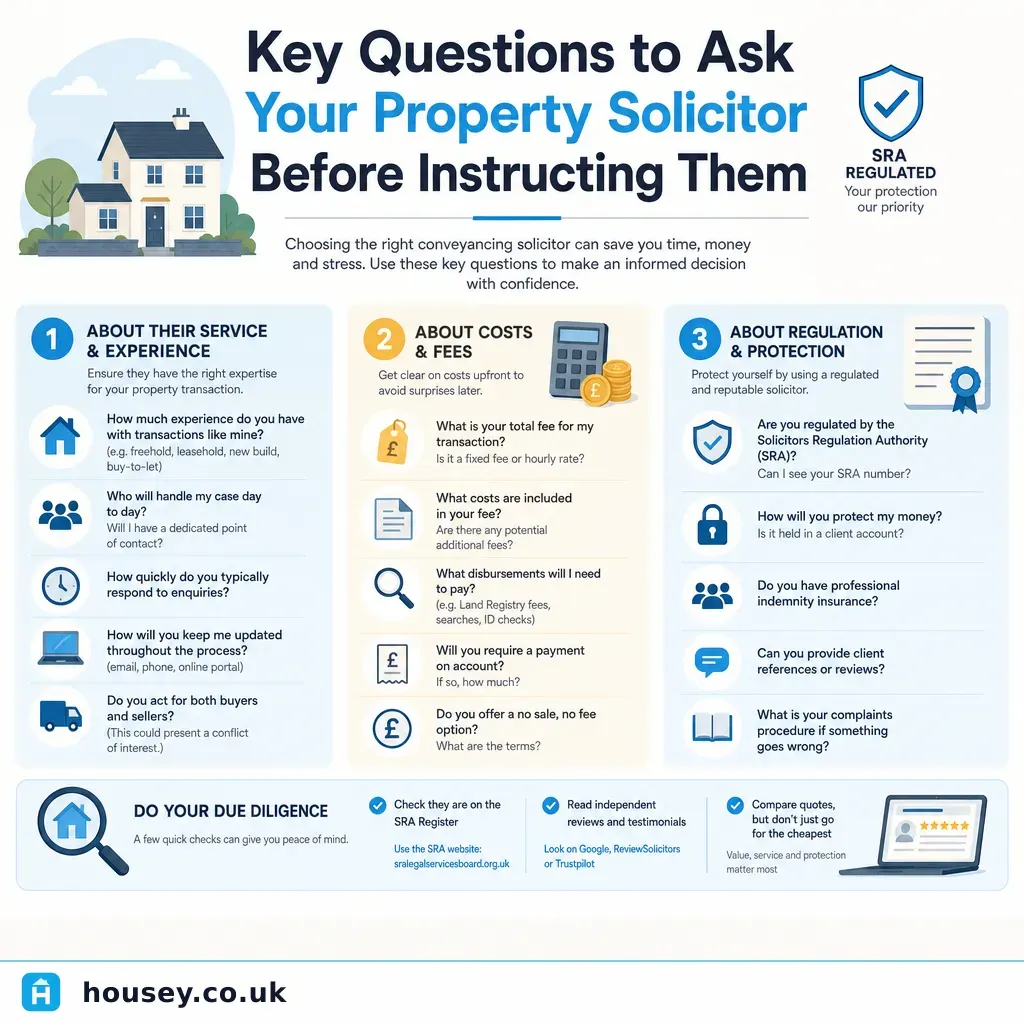
Key Questions to Ask Your Property Solicitor Before Instructing Them
Before instructing a property solicitor, ask whether they are on your mortgage lender's approved panel, whether their quote is fixed and includes VAT and all disbursements, who will personally handle your case, and what their abortive-fee policy is.
 Buying & Moving
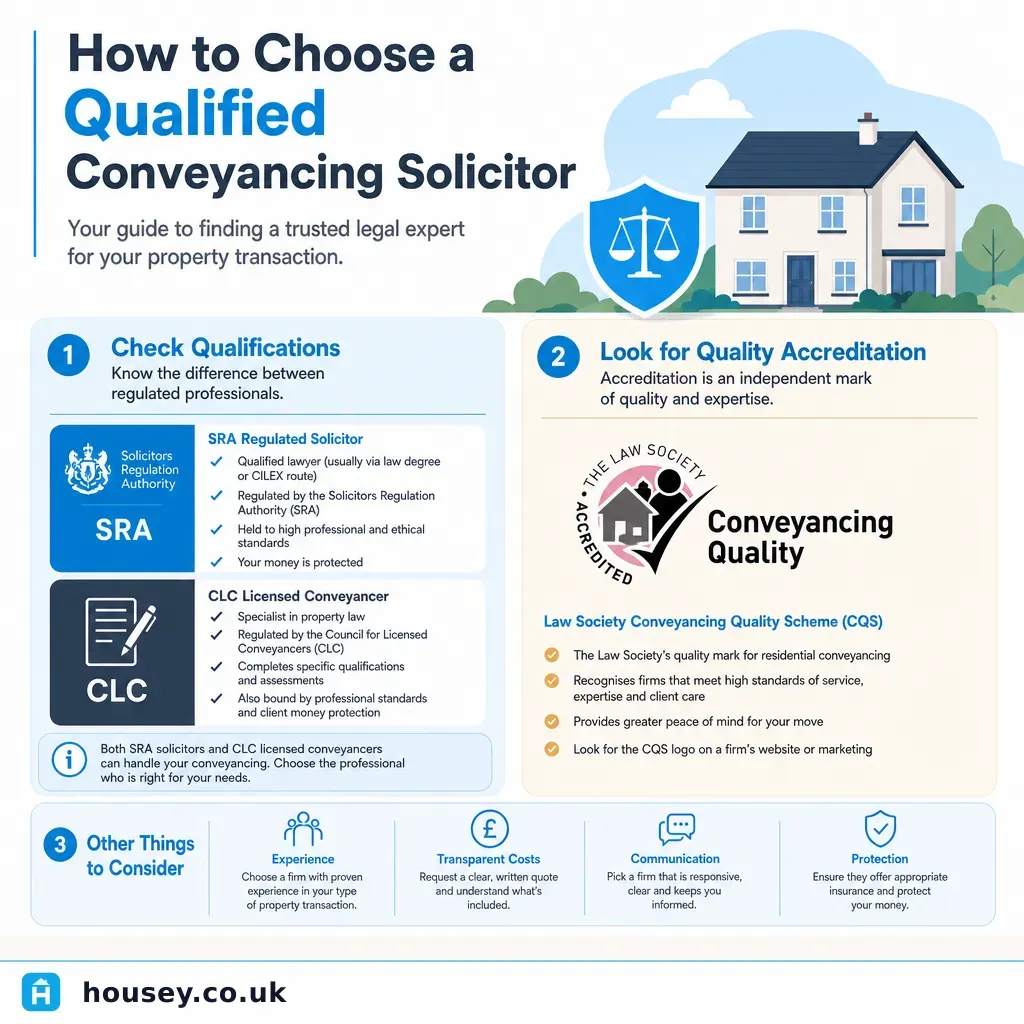
How to Choose a Qualified Conveyancing Solicitor
To choose a qualified conveyancing solicitor, verify they are regulated by the Solicitors Regulation Authority (SRA) or the Council for Licensed Conveyancers (CLC), check whether they hold Law Society CQS accreditation, and confirm they are on your mortgage lender's approved panel.
 Buying & Moving
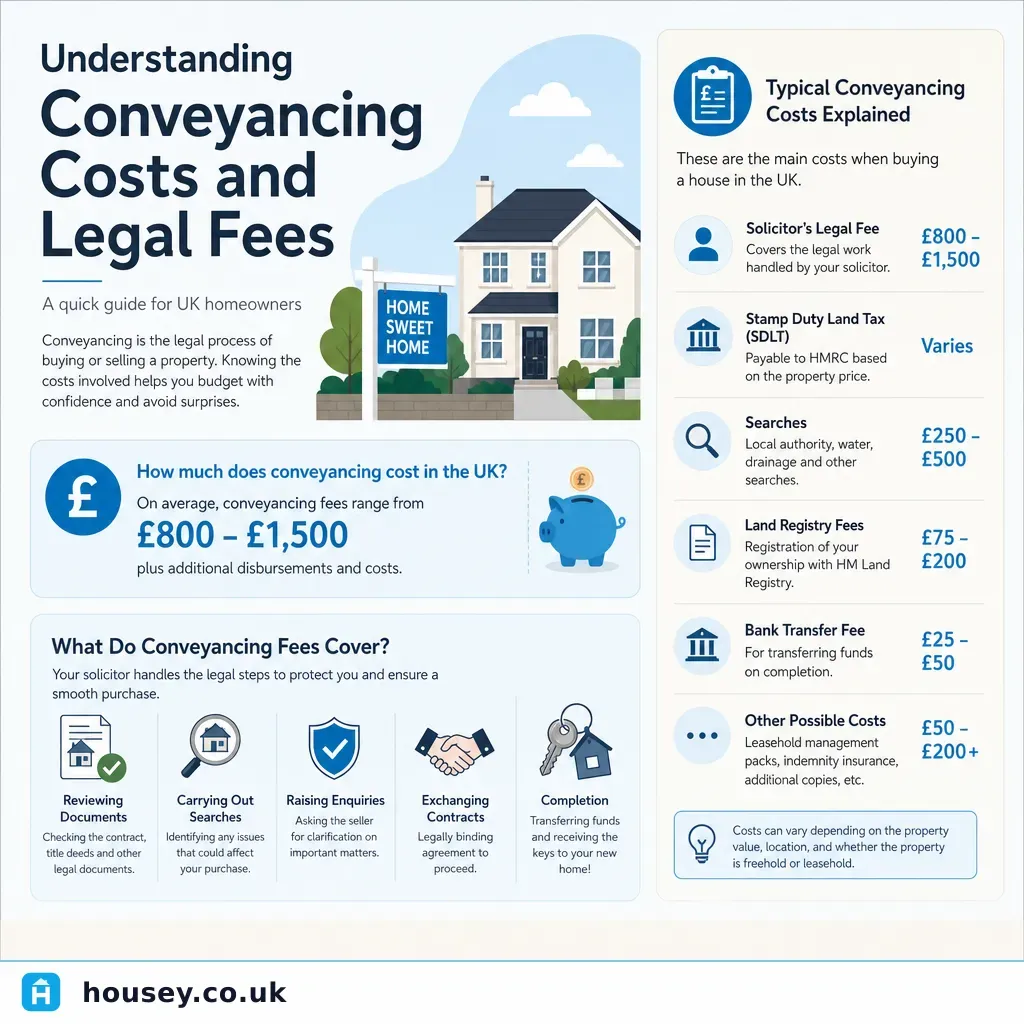
Understanding Conveyancing Costs and Legal Fees
Conveyancing costs in England and Wales include a solicitor's or licensed conveyancer's professional fee plus disbursements such as searches, Land Registry registration, and bank transfer charges.
 Buying & Moving
London Property Market Conditions And Buyer Advisory For Investors
London's property market varies enormously by borough, tenure, and property type.
 Buying & Moving
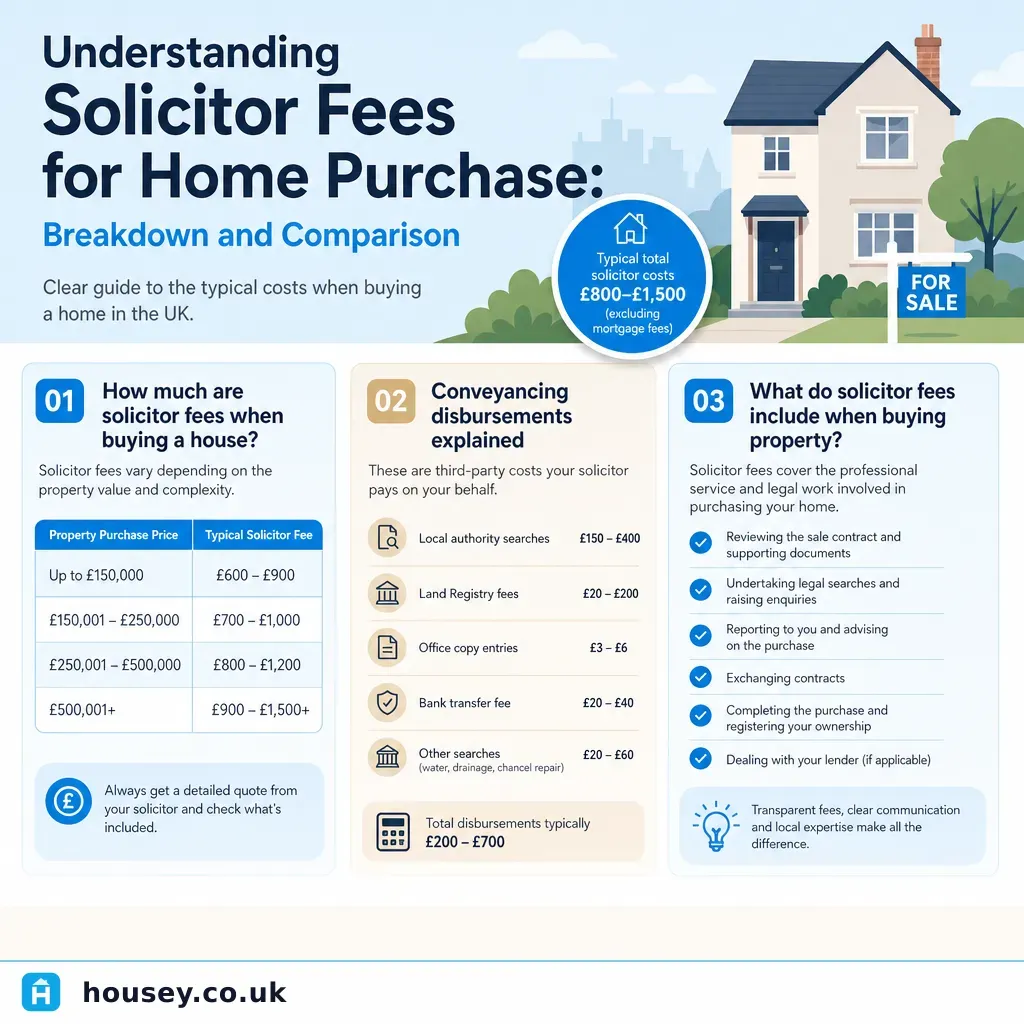
Understanding Solicitor Fees for Home Purchase: Breakdown and Comparison
Solicitor fees for buying a house in England and Wales have two parts: the professional legal fee, typically £850–£1,500 plus VAT for a standard freehold purchase, and disbursements — third-party costs such as search fees, Land Registry registration, and an electronic transfer charge.