Signs It May Be Time to Move Home
By Housey · Last reviewed 24th of May 2026
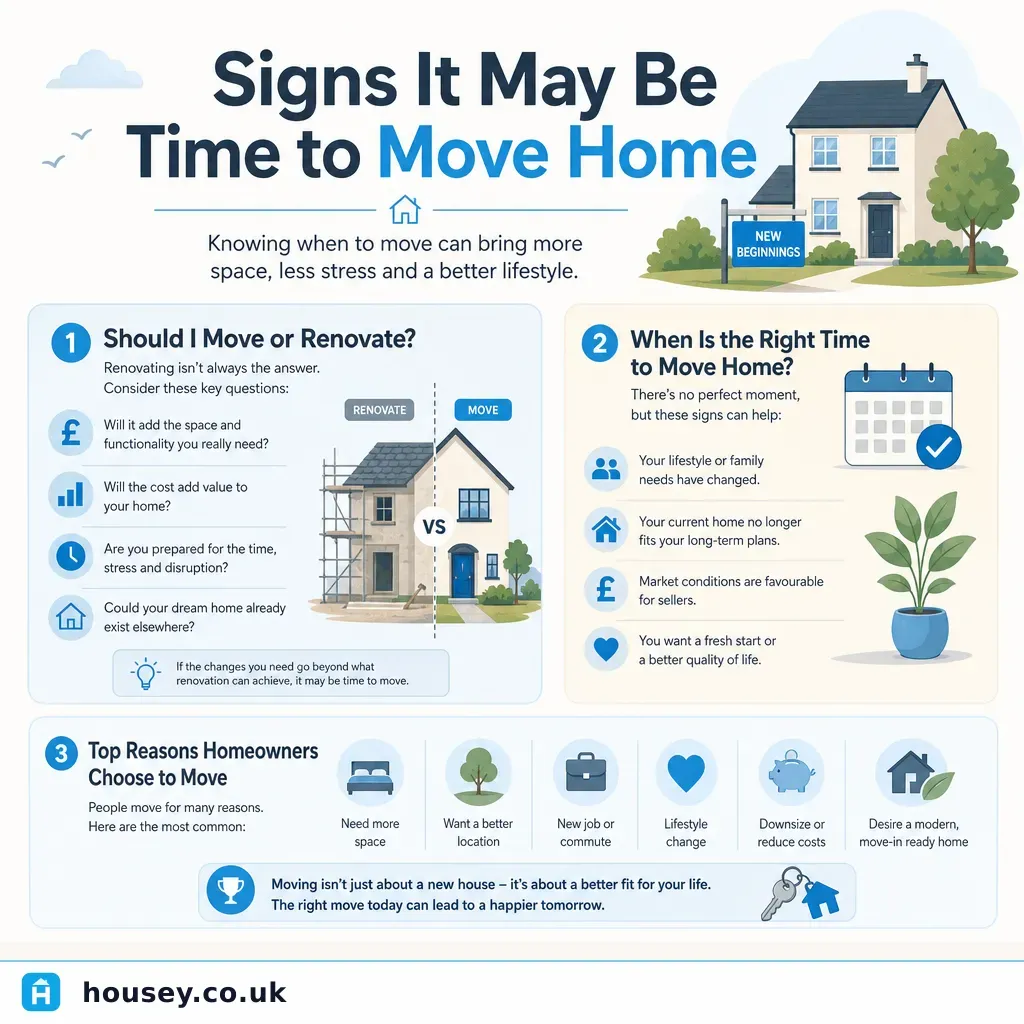
Signs It May Be Time to Move Home
The decision to move home is rarely made overnight. For most UK homeowners, it follows months of weighing up whether to extend, adapt, or sell — often prompted by a specific trigger that makes the status quo feel unworkable. Understanding which signals genuinely indicate that a move is warranted, rather than a renovation or a period of patience, can save time, money, and considerable stress.
Key points
- Stamp Duty Land Tax (SDLT) in England applies on residential purchases above £125,000 for standard buyers; first-time buyers pay no SDLT on the first £300,000 of a purchase priced up to £500,000 (rates as of April 2025).
- The full cost of a move — estate agent fees, conveyancing, SDLT, removals, and a survey on the new property — can easily reach £10,000–£20,000 on a typical transaction; this must be weighed against the cost of staying and adapting.
- Leasehold properties with fewer than 80 years remaining on the lease are harder to sell at full market value; buyers relying on a mortgage may be unable to obtain finance on short-lease properties.
- A valid EPC must be in place before a property can be marketed for sale in England; check the GOV.UK EPC register to confirm whether yours is still within its 10-year validity period.
- An independent RICS-registered valuation, unlike an estate agent appraisal, is not linked to commission and provides a reliable baseline for the stay-or-move financial calculation.
Common signs it may be time to move
There is no universal trigger, but these situations regularly prompt UK homeowners to seriously consider a move.
Space and lifestyle needs have changed. A growing family that has outgrown a two-bedroom flat, adult children who have left making a large semi feel unmanageable, or a persistent need for a home office the current layout cannot accommodate — these are among the most common practical prompts.
Your location no longer suits your needs. Proximity to schools, workplaces, family, or transport links is one of the most frequently cited reasons for moving. If a life change — a new job, a child approaching secondary school age, or a shift in mobility — has made your postcode less suitable, no amount of renovation will resolve a location problem.
A significant life event has changed your circumstances. Relationship breakdown, bereavement, retirement, or a material change in financial circumstances can each make a current home unsuitable in ways that go beyond the physical. These are often the clearest signals that a move is appropriate.
Renovation would cost more than it adds in value. If the changes needed to make the property work — a large extension, a full rewire, or a new roof — would cost more than the likely uplift in market value, moving may be the more financially rational choice. An RICS-registered property valuation can help you quantify whether the numbers stack up.
The property no longer suits your physical needs. Downsizing, adapting for mobility changes, or moving closer to support networks are increasingly relevant considerations for older homeowners. If adapting the property would require significant structural work, a purpose-suited property may be a better long-term answer.
Move or extend? A decision framework
Situation | Lean towards moving | Lean towards extending or adapting | Check first |
|---|---|---|---|
Need more bedrooms | Move if loft conversion or extension is not feasible | Extend if a loft or rear extension is viable and within budget | Permitted development rights; structural feasibility |
Location no longer suits your needs | Move | Rarely resolved by renovation | School catchment areas; commute distances |
Significant structural defects | Move if repair cost exceeds value added | Repair if defect is isolated and fully costed | Full structural survey; building regulations compliance |
Retirement or downsizing | Move | Adaptation rarely addresses a size mismatch | Independent financial advice on equity, SDLT, and mortgage implications |
Leasehold with short lease (under 80 years) | Move or extend the lease first | Extension rarely removes tenure-related risk | Lease length remaining; cost of a statutory lease extension |
Need a home office or additional storage only | Adapt or convert existing space | Move only if other significant factors also apply | Permitted development; planning permission requirements |
What moving actually costs in the UK
Before deciding to move, understand the full cost of a transaction. Indicative UK costs, last reviewed 2026-05-24; actual figures depend on property price, location, and the professionals you instruct.
For a property sold at £350,000 with a purchase at a similar price:
- Estate agent fees: approximately 1–1.5% plus VAT (roughly £4,200–£6,300)
- Conveyancing (sale and purchase combined): approximately £2,000–£4,000
- Removal costs: £600–£2,500 depending on volume and distance
- EPC if not current: approximately £60–£120
- Stamp Duty Land Tax on purchase: use the GOV.UK SDLT calculator for your specific price
- Survey on the new purchase: £400–£1,500 depending on survey level
- Mortgage arrangement and valuation fees: varies by lender and product
Total transaction costs on a £350,000 move can easily reach £10,000–£20,000 before SDLT is added. This is a critical input to any stay-or-move analysis, and one that is often underestimated at the outset.
What not to assume
- Moving will automatically solve the problem — if the root cause is financial stress, relationship difficulty, or an unrealistic expectation of a new property, moving may not resolve it. Being clear about what is actually driving the desire to move makes the decision much more reliable.
- Extending always adds more value than it costs — this is highly property- and location-dependent. In some markets, significant extension costs are not recovered at sale. Get a valuation both before and after a hypothetical extension before committing.
- I can sell quickly if I need to — UK property transactions typically take 3–6 months. If urgency is a factor, plan around the realistic timeline rather than assuming a fast sale.
- Online valuations are accurate enough — automated valuation models are indicative only. They do not account for condition, access issues, or local market nuances that affect what a buyer will actually pay.
- The market will be better if I wait — property markets are difficult to time reliably. A decision based on personal need and financial readiness is more dependable than a bet on market movement.
When to get professional help
If you are genuinely undecided, consider:
- An independent RICS-registered property valuation of your current home to establish what it would realistically sell for in its current condition.
- A structural survey if your property has known defects, to understand the realistic scope and cost of remediation before committing to a renovation.
- Independent financial advice on the implications of selling, the total cost of the next purchase, and how any mortgage changes would affect your affordability.
- A solicitor or licensed conveyancer for conveyancing advice if your current property is leasehold with a short lease or a complex service charge situation.
How Housey can help
Whether you are testing the idea of moving or have already decided, Housey connects you with the professionals you need. An RICS-registered property valuation gives you a reliable baseline for the decision, and professional conveyancing ensures the legal side moves efficiently when you are ready to proceed.
Frequently asked questions
How do I know whether to move or extend my home?
Start with two figures: what would the work cost, and what would the property be worth with and without it? An estate agent or RICS valuer can help with the latter. If the uplift in value is less than the cost of the work, or if it would not resolve the underlying issue such as location, moving is usually the more rational choice.
What are the main financial costs of moving home in the UK?
The main costs are estate agent fees (typically 1–1.5% plus VAT of the sale price), conveyancing fees for your sale and purchase, Stamp Duty Land Tax on your new purchase, removal costs, and survey fees on the property you are buying. On a mid-range transaction these can total £10,000–£20,000. The GOV.UK Stamp Duty calculator gives you the SDLT figure for any specific purchase price.
Is it better to move or renovate for more space?
This depends on whether the space you need is achievable within your planning constraints, what it would cost, and whether your location still suits your needs. A rear extension may be permitted development on one property type but require full planning permission in a conservation area. If your location is otherwise ideal and the cost is manageable, adapting your home may be the better financial choice.
At what point should I get a valuation before deciding to move?
Getting a valuation early in your thinking is sensible — it costs relatively little for an estate agent appraisal and gives you a concrete number to work with. An independent RICS-registered valuation costs more but is not linked to commission and is a more reliable basis for a significant financial decision. You do not need to have made a firm decision before obtaining one.
Sources and further reading
- Stamp Duty Land Tax residential property rates — GOV.UK
- Selling your home — Citizens Advice
- Search the property register — HM Land Registry
- Leasehold Reform (Ground Rent) Act 2022 — legislation.gov.uk
- Selling your home guidance — Propertymark
- RICS Home Survey Standard — RICS
Useful next reads
 Buying & Moving
Choosing a House Removal Company: What to Look For
Choose a UK removal company that belongs to the British Association of Removers (BAR) or the Removals Industry Ombudsman Scheme (RIOS), carries goods-in-transit and public liability insurance, and provides a written quote after properly surveying your home.
 Buying & Moving
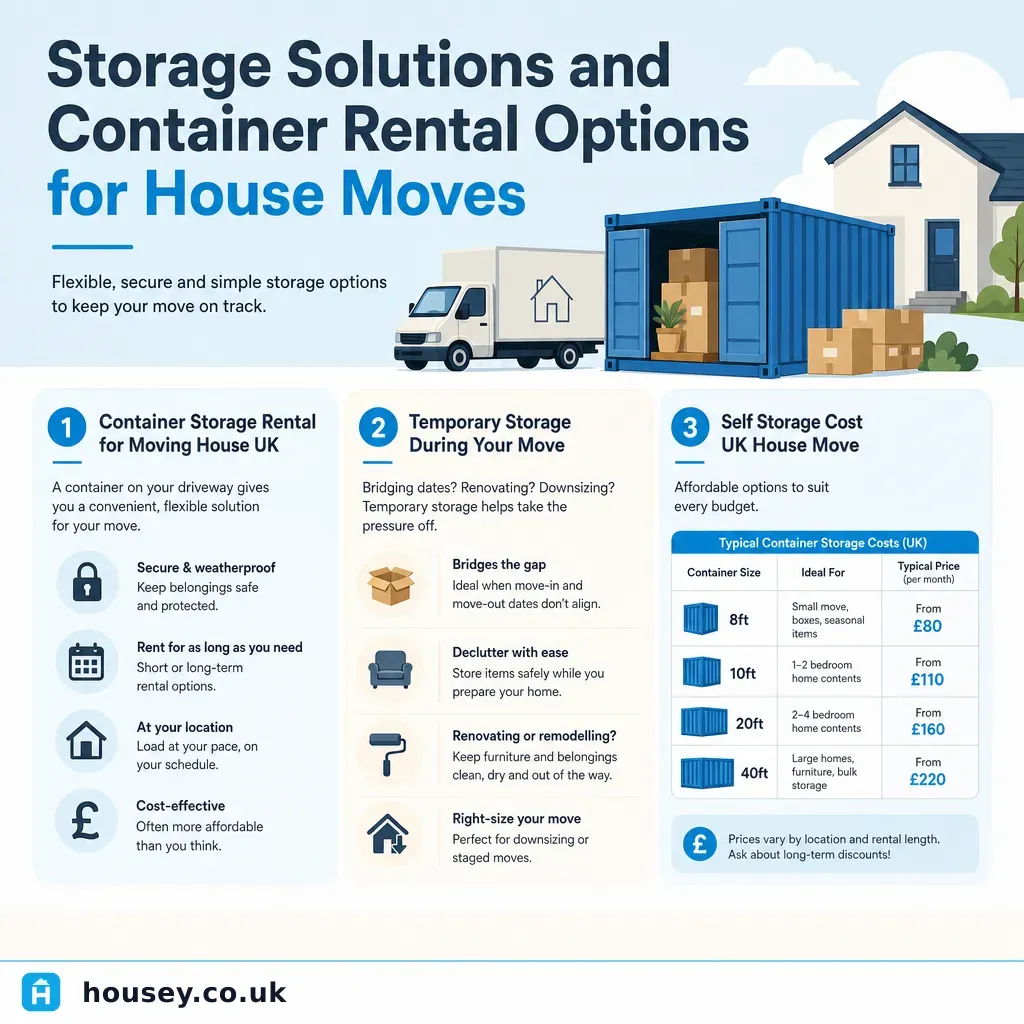
Storage Solutions and Container Rental Options for House Moves
When moving house in the UK, temporary storage options include self-storage units, portable storage containers delivered to your door, and removal company storage vans.
 Buying & Moving
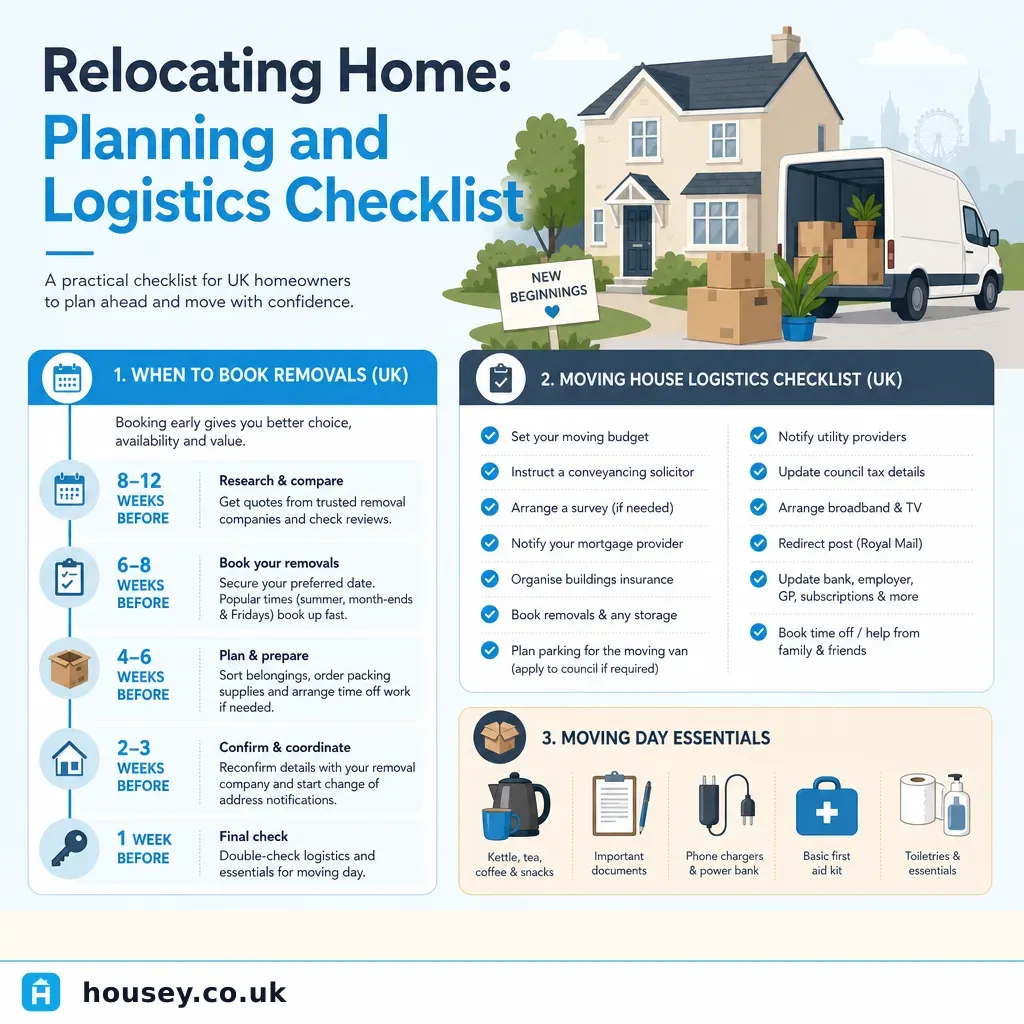
Relocating Home: Planning and Logistics Checklist
Successful home relocation in the UK typically requires 8–12 weeks of advance planning.
 Buying & Moving
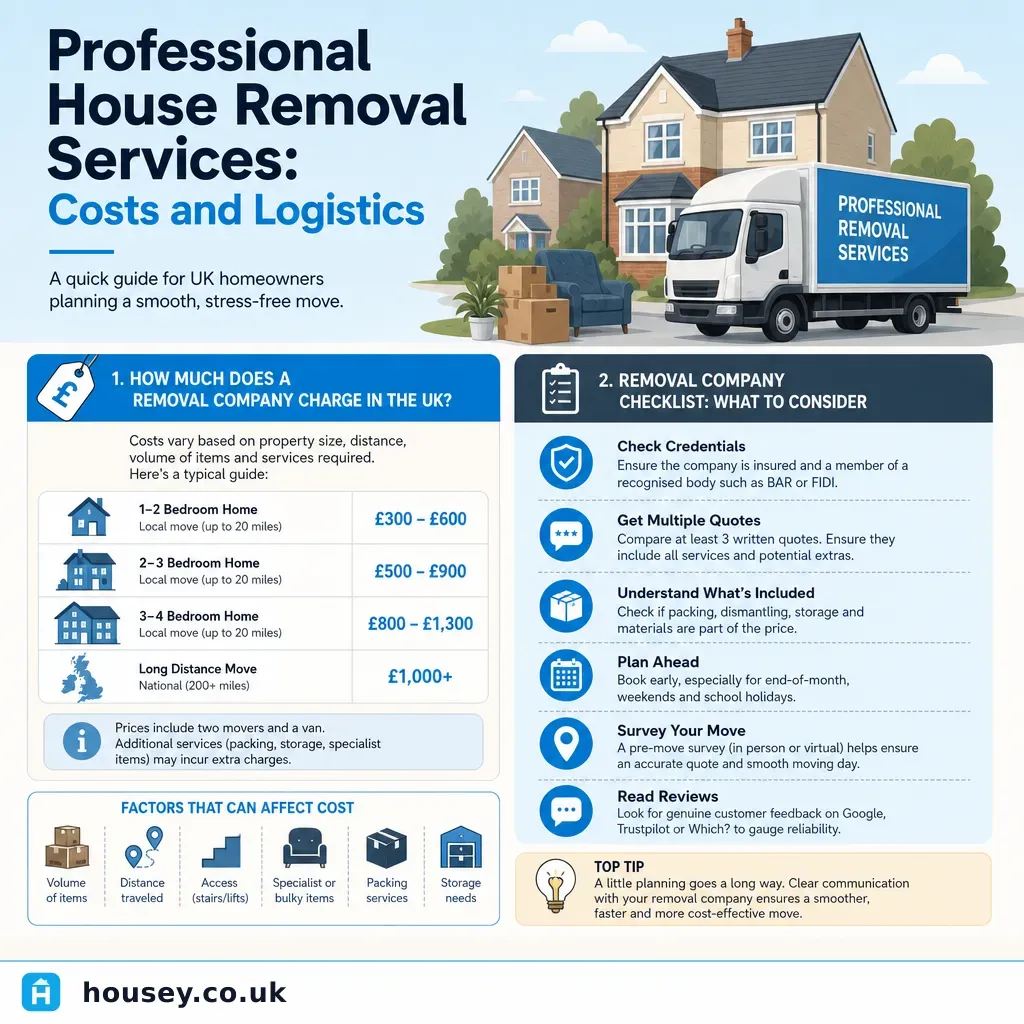
Professional House Removal Services: Costs and Logistics
Professional house removal services in the UK typically cost £800–£2,000 for a 3-bedroom local move, rising to £1,500–£4,000 for long-distance relocations.
 Buying & Moving
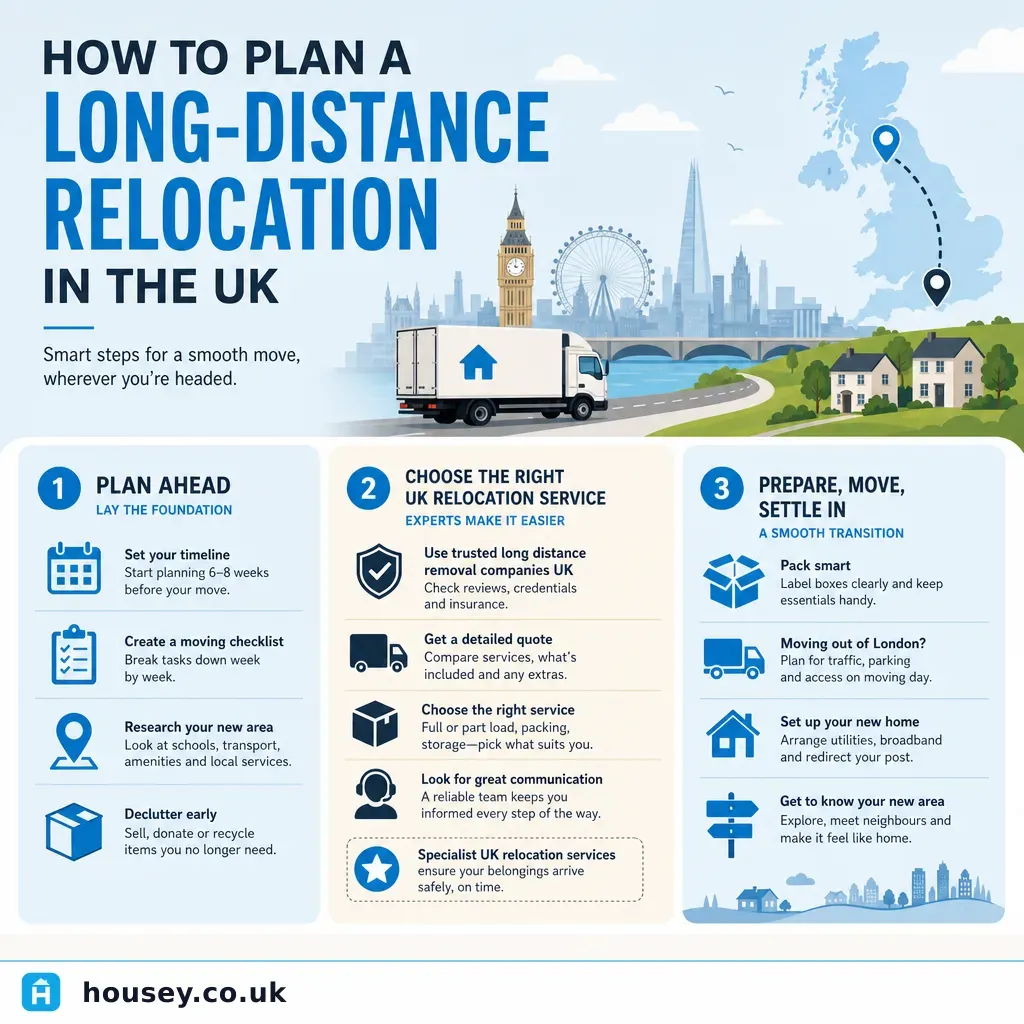
How to Plan a Long-Distance Relocation in the UK
A successful long-distance relocation in the UK involves coordinating removals, conveyancing, storage, and area research well in advance.