Six Property Types Ready for Comprehensive Renovation
By Housey · Last reviewed 30th of May 2026
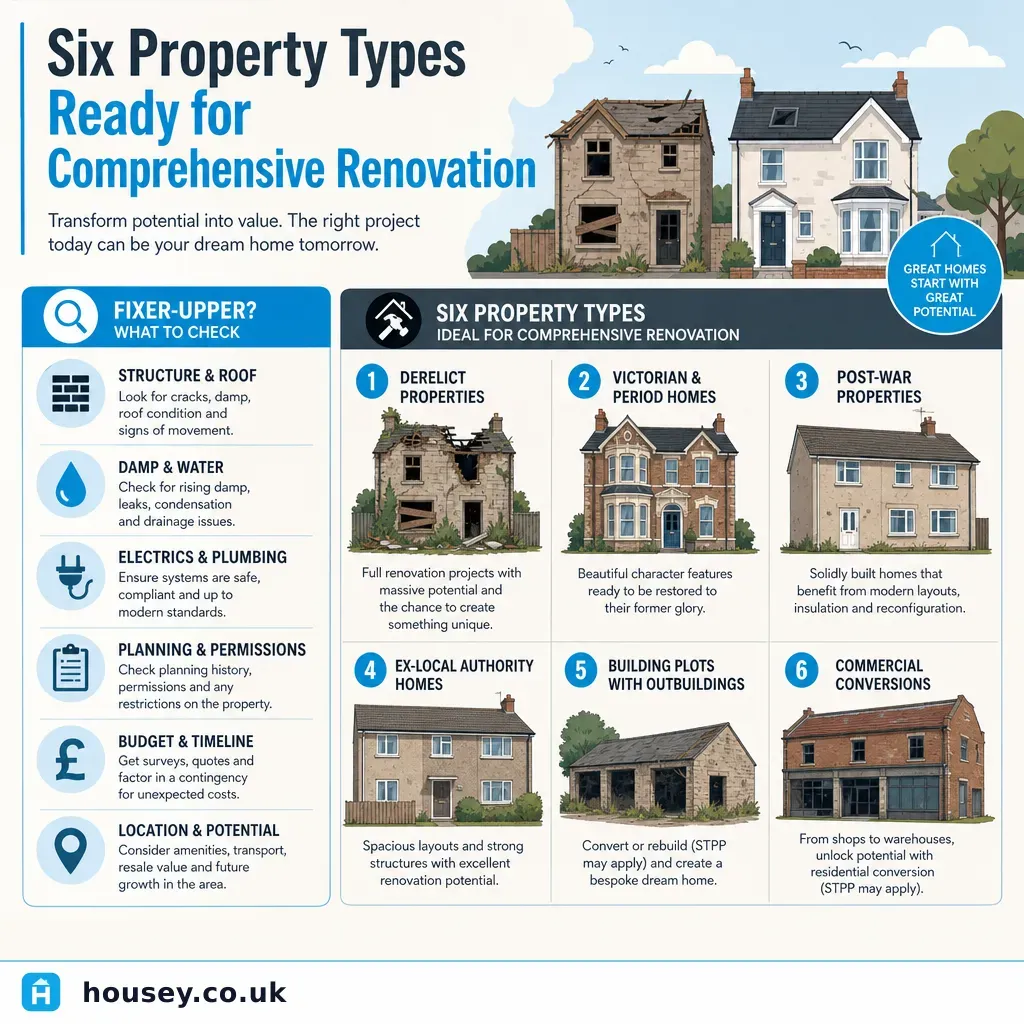
Six Property Types Ready for Comprehensive Renovation
Buying a property with the intention of renovating it fully is one of the most rewarding ways to add value in the UK housing market — and one of the riskier. The attraction is clear: lower purchase prices, the ability to tailor the final result, and potential uplift on resale or rental. The complexity is equally real: structural problems discovered mid-project, planning constraints that limit the scope of works, and costs that regularly exceed initial estimates. Understanding the six most common renovation-ready UK property types — and what each demands before you commit — gives you a far more reliable foundation than making an offer on instinct alone.
Key points
- A RICS Level 3 Building Survey is the minimum recommended inspection for any property earmarked for substantial renovation; a Level 2 Home Survey is unlikely to provide sufficient detail on construction defects.
- Building regulations completion certificates should exist for any previous extensions or conversions; their absence may require retrospective compliance assessment or indemnity insurance.
- Asbestos-containing materials (ACMs) are commonly present in properties built before 2000, particularly in textured ceilings (Artex), floor tiles, roof panels, and pipe lagging; a management survey by a UKAS-accredited analyst is advisable before any intrusive works.
- Planning permission may be needed for extensions, changes of use, subdivision, and certain types of cladding or roof alteration; permitted development rights depend on property history, location, and local restrictions.
- Renovation projects typically carry a 10–20% contingency in professional cost plans; complex or derelict properties may warrant 25% or more.
The six renovation property types
1. The unloved Victorian or Edwardian terrace
Victorian and Edwardian terraces built between roughly 1840 and 1910 form a large part of the UK's older urban housing stock. Many come to market with solid-wall construction, outdated electrics (sometimes pre-1990s wiring), no central heating or a first-generation gas system, and bathroom and kitchen fittings unchanged for decades. Solid brick construction is generally robust and original features add character. The main risks are damp in solid walls (rising or penetrating), timber decay in floor joists and roof structures, and the possible presence of lead paint or Artex in older examples. These properties respond well to a comprehensive thermal retrofit programme alongside services and cosmetic upgrades.
2. The 1960s–1970s semi-detached
Cavity-wall semis built in the 1960s and 1970s frequently need complete rewiring, a new heating system, window replacement, roof reslating or replacement, and full kitchen and bathroom overhaul. Insulation is often absent from the cavity, loft, and ground floors. Many have had previous owners carry out DIY alterations — check for missing building regulation certificates for any extensions or garage conversions. Pre-2000 construction means ACMs may be present, particularly in floor tiles, textured ceilings, and boiler flue pipes.
3. The derelict rural cottage
Rural cottages that have been empty for years — or decades — attract buyers seeking character and seclusion, but they demand the most rigorous pre-purchase investigation of any property type. Likely issues include structural movement from inadequate or shifted foundations, failed roof covering, absent or severely deteriorated mains service connections, extensive timber decay, and possible invasive species such as Japanese knotweed. Planning permission for reinstatement or extension varies significantly by local authority; some permitted development rights may have lapsed if a property has been vacant long enough to be treated as a ruin rather than an existing dwelling. A structural engineer's report alongside a RICS Level 3 survey is strongly advisable before exchange.
4. The 1980s–1990s ex-local-authority or estate property
Ex-council houses and housing association properties often come to market at below-average prices and offer significant scope for improvement. Structural quality is generally reliable; renovation priorities are usually full modernisation of internal finishes, a replacement heating system (often original storage heaters or an early gas installation), and double glazing where not already fitted. Some types used non-traditional construction methods (large-panel system, no-fines concrete) — these can affect mortgage availability and must be identified at survey stage. Check whether the property was sold under the Right to Buy scheme and whether any restrictive covenants remain in place.
5. The unloved listed or heritage property
Grade II listed buildings represent over 90% of all listed properties in England and are not necessarily expensive to purchase, but they carry the highest regulatory complexity of any renovation type. All works affecting the character of the building — internal and external — require Listed Building Consent in addition to any planning permissions. Traditional materials (lime render, timber windows, natural slate) must typically be used in repairs, which increases cost and lead times. Professional fees are significant: architects with conservation experience, conservation officers' pre-application advice, and specialist contractors all add to the budget. A pre-application discussion with the local planning authority before exchange is strongly advisable.
6. The large, subdivided, or part-converted property
Former houses of multiple occupation (HMOs), large Victorian or Edwardian villas partly converted into flats, and commercial buildings with residential planning consent all offer scope but require careful planning. Issues include inadequate fire separation (which must meet current Building Regulations Part B standards for HMOs or conversions), missing or non-compliant Electrical Installation Condition Reports (EICRs), and potentially conflicting tenancy or lease arrangements. If the property is held leasehold, review the lease before purchase to understand what alterations are permitted and whether the freeholder's consent is required for structural changes.
Renovation property comparison
Property type | Typical structural risk | Key planning consideration | ACM risk | Mortgage ease |
|---|---|---|---|---|
Victorian/Edwardian terrace | Damp, timber decay | Conservation area possible | Lower (pre-2000 possible) | Generally good |
1960s–70s semi | Low–moderate | Standard permitted development | Moderate–high | Generally good |
Derelict rural cottage | High — movement and decay | PD rights may have lapsed | Lower | Complex — specialist lenders often needed |
1980s–90s estate property | Low | Standard PD; possible covenants | Moderate | May depend on construction type |
Listed heritage property | Variable — specialist survey required | Listed Building Consent required | Lower | Specialist lenders often needed |
Subdivided/HMO/conversion | Moderate — fire separation key | Change of use may apply | Moderate | Complex — leasehold scrutiny required |
Pre-purchase checklist for renovation properties
Before making an offer or instructing solicitors:
Red flags that mean get expert advice before proceeding
- Visible diagonal or step-pattern structural cracks through brickwork — may indicate active foundation movement
- Evidence of recent cosmetic work concealing damp or defects (fresh plaster over stained walls, new boarding over floors)
- A certificate of lawful use or planning consent that does not match the current layout of the property
- No drainage inspection report available for a property with older or unknown pipework
- Japanese knotweed or bamboo present in the garden — mortgage lenders may decline on an affected property
- A vendor unwilling to provide access for specialist surveys before exchange
When to get professional help
Any renovation project beyond cosmetic decoration warrants professional input before and during construction. In particular:
- Commission a RICS Level 3 survey before exchange on any property you plan to renovate substantially.
- Use an architect or specialist design-and-build firms to scope and project-manage works involving structural alterations or extensions — their fees are typically recovered through better cost control and building control compliance.
- If the property predates 2000 and you plan intrusive work, arrange an asbestos management survey from a UKAS-accredited analyst before any works begin. Do not disturb suspect materials yourself.
- Engage building control consultants to advise on compliance requirements where previous works lack completion certificates.
How Housey can help
Whether you need a team to manage the full scope of works or specific professionals for particular elements, Housey connects you with vetted extension builders, experienced design-and-build firms who can take a project from brief to handover, and specialist building control consultants who can advise on retrospective compliance and sign off new works.
Frequently asked questions
Do renovation projects always need planning permission?
Not always. Many renovation works — internal reconfigurations, like-for-like reroofing, and certain extensions — fall within permitted development rights. However, permitted development can be restricted by conservation area designation, Article 4 directions, or prior planning history. Extensions beyond the permitted development size thresholds require full planning permission. Always check with your local planning authority, particularly if the property has been extended before or is in a designated area.
What survey should I get before buying a renovation property?
A RICS Level 3 Building Survey is recommended for any property earmarked for significant renovation. It provides detailed reporting on construction type, defects, and recommendations for further investigation. For derelict properties or those showing signs of structural movement, a separate structural engineer's inspection may be advisable alongside the RICS survey. A Level 2 Home Survey is unlikely to be sufficient for properties in poor or unknown condition.
How much contingency should I budget for a full renovation?
Professional cost plans for full renovation typically include 10–20% contingency above the main contract sum. Properties in poorer condition — derelict buildings, listed structures, or those with non-traditional construction — may warrant 25% or more. Contingency accounts for defects uncovered during stripping out, including hidden timber decay, concealed asbestos-containing materials, or undersized drainage, that are difficult to identify reliably at survey stage.
Can I convert a derelict barn or outbuilding to residential use?
Barn conversions in England may qualify under Class Q permitted development, allowing certain agricultural buildings to be converted to dwellings without full planning permission, subject to prior approval and a structural assessment. The rules are complex and do not apply to all building types; the process also differs in Wales, Scotland, and Northern Ireland. A planning consultant or architect familiar with rural permitted development should advise before purchase.
Sources and further reading
- Planning permission: when you need it — GOV.UK
- RICS Home Survey Standard — RICS
- Managing and working with asbestos — HSE
- Listed buildings: making changes — GOV.UK
- Building regulations approval — GOV.UK
Useful next reads
 Improvement & Build
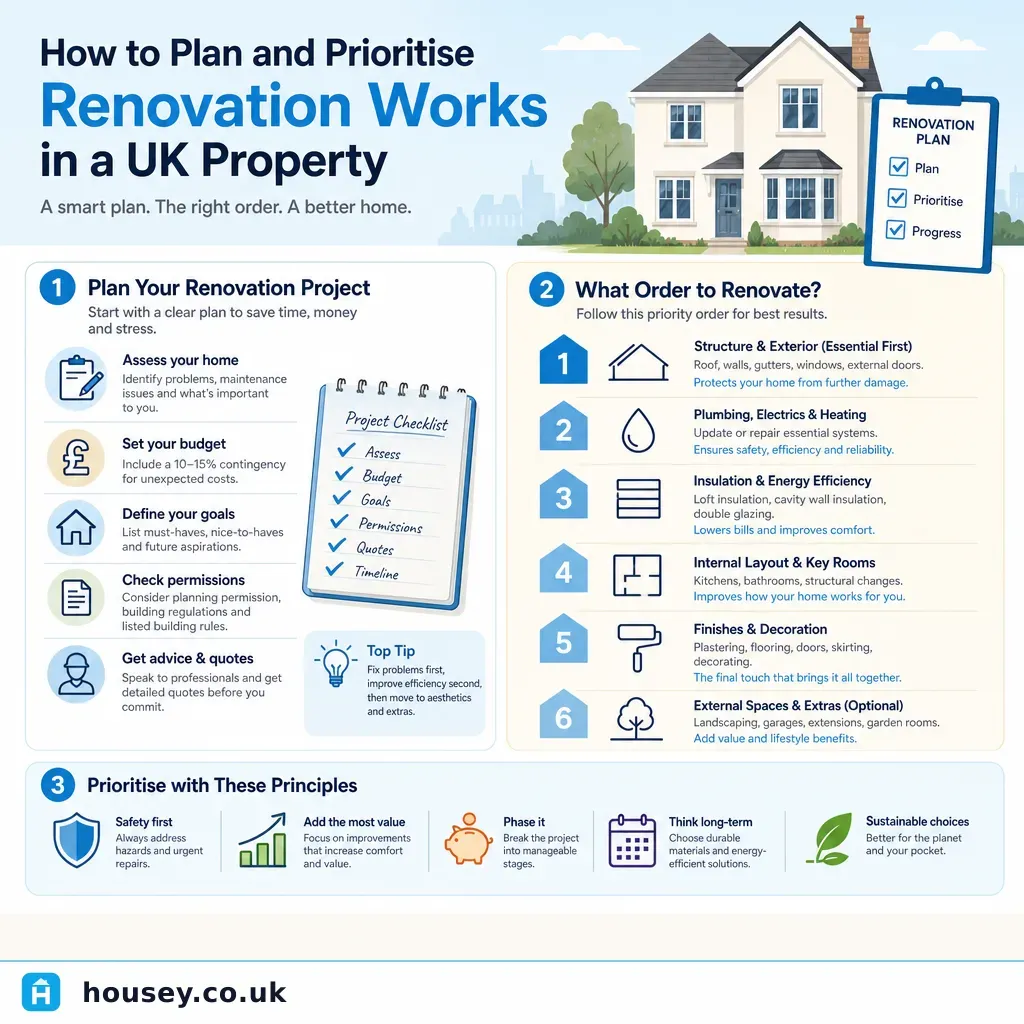
How to Plan and Prioritise Renovation Works in a UK Property
Start with structure and weatherproofing, then first-fix services, then plastering, then second fix, then decoration and fit-out.
 Improvement & Build
Renovation Opportunities Across the UK Property Market
Renovation properties in the UK range from cosmetic fixer-uppers needing decoration and new kitchens, to structural projects requiring new roofs, damp treatment, or extensions.
 Improvement & Build
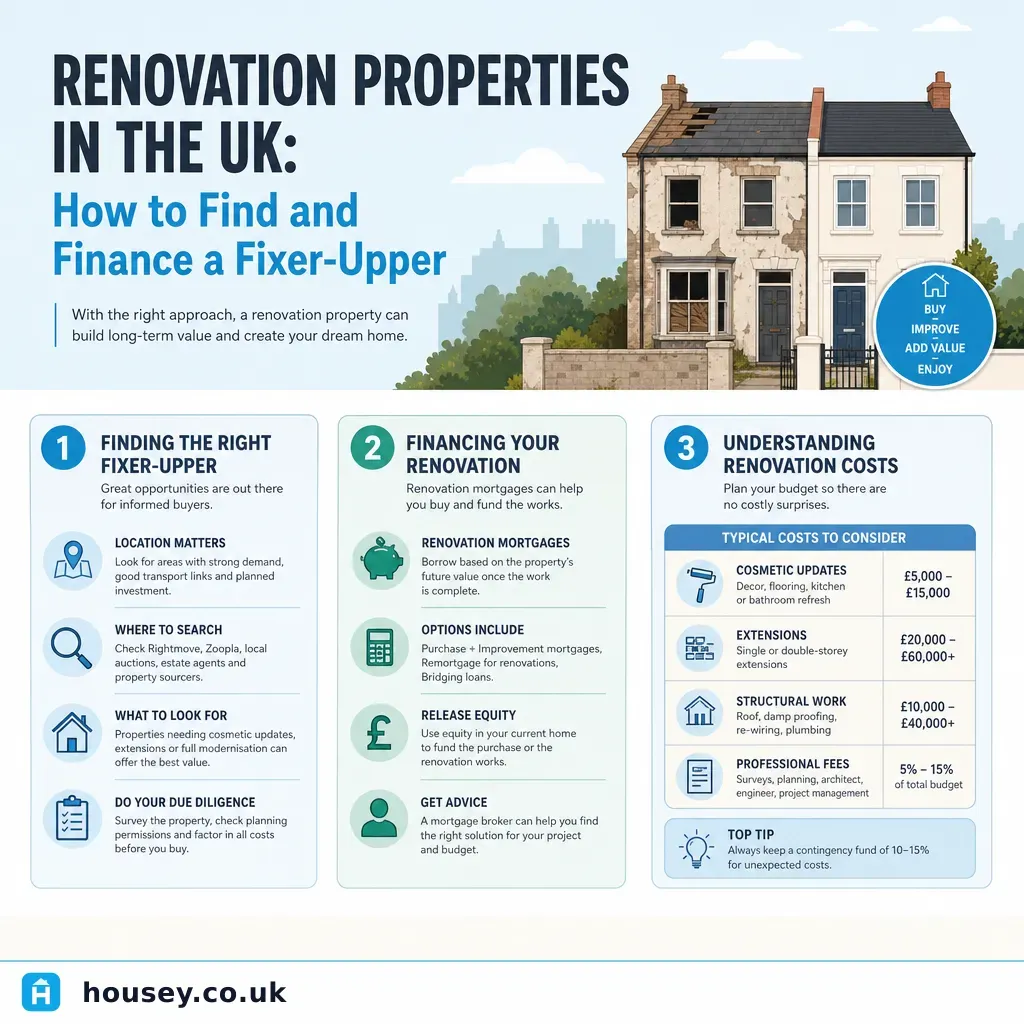
Renovation Properties in the UK: How to Find and Finance a Fixer-Upper
Renovation properties can offer genuine value, but success depends on thorough due diligence before exchange.
 Improvement & Build
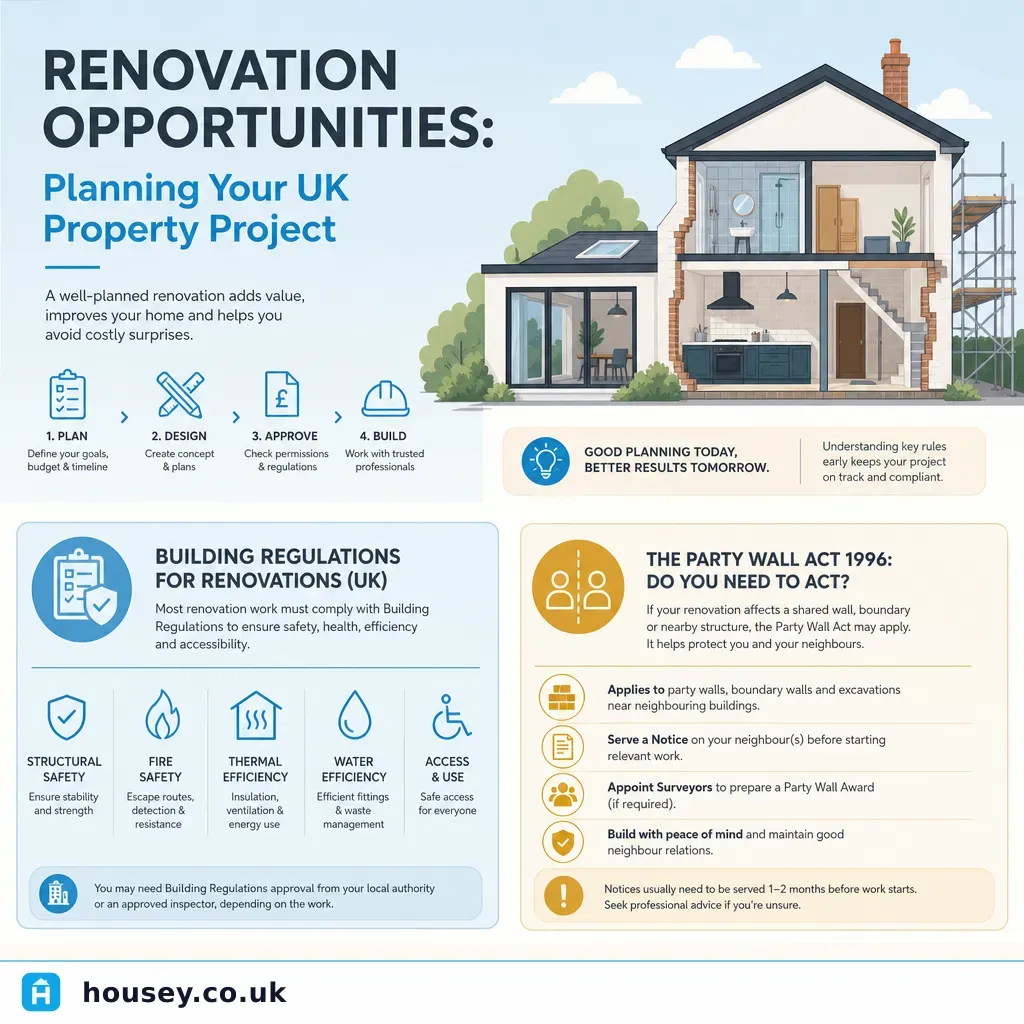
Renovation Opportunities: Planning Your UK Property Project
Planning a successful renovation in the UK means sequencing work correctly, securing building regulations approval where required, and budgeting for contingencies of at least 15–20%.
 Improvement & Build
How to Find and Evaluate Renovation Properties in the UK
A renovation property is worth pursuing when the acquisition price plus realistic renovation costs leaves a clear margin against comparable finished properties nearby.