Virtual Staging and 3D Visualisation for Property Marketing
By Housey · Last reviewed 11th of May 2026
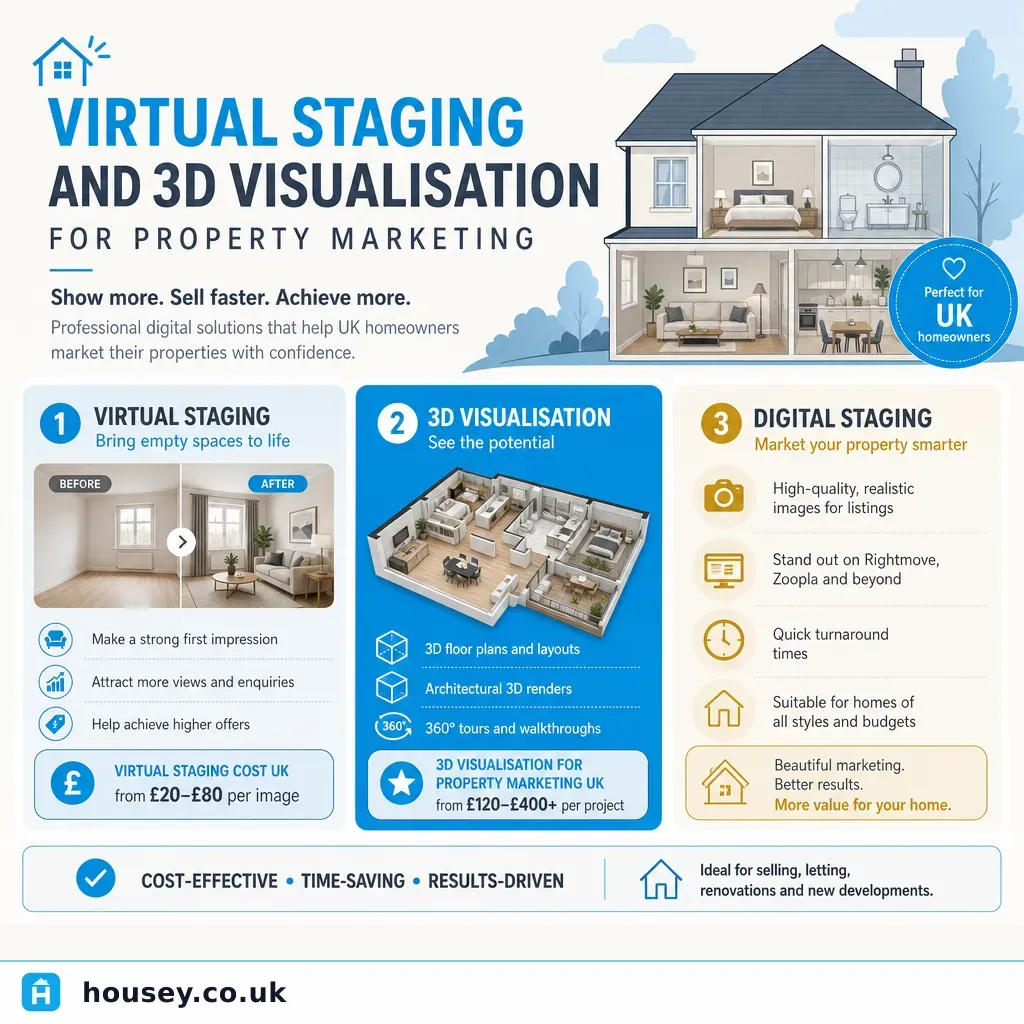
Virtual Staging and 3D Visualisation for Property Marketing
Marketing a vacant property is a practical challenge: empty rooms are notoriously difficult to photograph compellingly, and buyers in a competitive market often scroll past listings that fail to communicate a sense of scale or liveability. Virtual staging and 3D visualisation have become established tools in UK estate agency practice, particularly as Rightmove and Zoopla listings are now dominated by high-quality imagery and interactive content that set buyer expectations before any viewing takes place.
Key points
- Virtual staging adds CGI furniture and décor to photographs of empty or lightly furnished rooms; indicative costs are £30–£150 per image, compared with £500–£3,000 or more for physical home staging. Indicative UK costs, last reviewed 2026-05-11.
- The Consumer Protection from Unfair Trading Regulations 2008 requires that virtually staged images be clearly disclosed as digitally edited; failure to disclose may constitute a misleading commercial practice.
- 3D CGI visualisation is used primarily to market off-plan developments before construction, enabling buyers to see proposed layouts, finishes, and streetscape context before a property exists.
- Rightmove and Zoopla permit virtually staged images provided they are clearly labelled; Propertymark recommends a caption or watermark on each digitally altered image.
- Interactive 3D floor plans and 360° virtual tours show the property as it actually exists — they differ fundamentally from virtual staging and carry different disclosure considerations.
Virtual staging vs physical staging: which suits your property?
Virtual staging replaces real furniture with digitally rendered versions in post-production. Physical home staging involves placing actual hired or owned furniture in the property before photography. The right approach depends on budget, timeline, and the property's condition.
Approach | Best for | Not ideal for | Indicative cost | Main risk |
|---|---|---|---|---|
Virtual staging | Vacant properties; limited budget; speed to market | Occupied properties with clutter; buyers who want to see exact condition | £30–£150 per image | Buyer disappointment on viewing if not clearly disclosed |
Physical home staging | Higher-value properties where presentation ROI justifies cost; show homes | Tight budgets; properties with visible maintenance issues | £500–£3,000+ for partial staging | Higher upfront cost; requires access and removal on sale |
3D CGI visualisation | Off-plan sales; new-build marketing; planning applications | Existing furnished properties sold as-is | £300–£2,000+ per scene | Can create unrealistic expectations if not drawn to scale |
360° virtual tour | Any property where remote pre-viewing matters; long-distance buyers | Poorly presented or cluttered spaces | £100–£400 per property | Shows actual condition — poor presentation is fully visible |
Indicative UK costs, last reviewed 2026-05-11. Prices vary significantly by provider, room complexity, and turnaround time. Obtain at least three quotes.
Disclosure obligations under UK consumer protection law
UK estate agents and sellers must not mislead buyers about what they are purchasing. The Consumer Protection from Unfair Trading Regulations 2008 prohibit misleading actions and omissions — and showing a digitally staged room without clear disclosure could constitute a misleading commercial practice.
Propertymark guidance for member agents recommends that virtually staged images be clearly labelled, for example with a caption reading "Virtually staged for illustrative purposes" or a watermark applied to each image. Floor plans and virtual tours should reflect actual room dimensions and layout rather than aspirational interpretations.
Buyers who view in person and find the property materially different from the listing images may raise complaints through the Property Ombudsman or whichever property redress scheme the agent belongs to. Sellers using virtual staging independently of an agent carry the same obligations under the CPRs.
3D floor plans and off-plan CGI visualisation
3D floor plans — isometric or perspective CGI renderings of a property's layout — have become standard on higher-value Rightmove listings. When based on measured survey data, they represent the actual layout to scale rather than a stylised version, so the disclosure complexity differs from virtual staging.
Off-plan CGI serves a different purpose: enabling buyers to commit to a purchase before construction completes. Housebuilders and developers use it to show external elevations, interior finishes, and development context. When reviewing off-plan CGI materials, buyers should:
- Request the approved planning drawings and the specification schedule to verify what is included in the purchase price.
- Note that CGI renders frequently show premium upgrades not included as standard.
- Verify that room dimensions in the CGI match the measured floor plan attached to the property particulars.
What to ask before commissioning virtual staging or 3D visualisation
- What resolution will images be delivered in, and does it meet Rightmove and Zoopla upload specifications?
- Are the CGI furniture and décor proportioned to the actual room dimensions, or do they make rooms appear larger than they are?
- Will images be captioned or watermarked to indicate they are virtually staged?
- How many revision rounds are included, and what triggers additional charges?
- What is the turnaround time, and what happens if you need updated images after a price reduction or redecoration?
- For 3D floor plans: are dimensions based on a measured survey or from existing drawings?
- For off-plan CGI: does the render reflect the approved planning permission and agreed specification?
When virtual staging is worth considering
Virtual staging offers the clearest value when:
- The property is empty and would otherwise photograph as cold, hard to scale, or difficult to furnish mentally.
- Budget does not justify physical staging costs.
- The property needs to go to market quickly.
- The target buyer demographic is comfortable with digital marketing content.
It is less suitable as a standalone tool for premium property marketing, where buyers expect a well-presented home on viewing, or where visible maintenance issues cannot be concealed by digital enhancement.
When to get professional help
Virtual staging is a marketing tool, not a substitute for professional presentation advice or photography. Consider specialist input if:
- You are selling a high-value or unusual property and are unsure whether physical staging, virtual staging, or a combination is right.
- You need CGI for a planning application — planning CGI requires a specified level of accuracy and should be produced by a qualified architectural visualiser familiar with local planning requirements.
- You want interactive 3D floor plans alongside stills — these require a measured survey by a professional rather than estimated or scaled dimensions from existing drawings.
How Housey can help
Housey connects sellers and landlords with specialists in property photography and floor plans who can advise on the full range of digital marketing options — from standard photography and measured floor plans to virtually staged images and 3D visualisations — and help you choose the right presentation package for your property and budget.
Frequently asked questions
Is virtual staging legal in the UK?
Virtual staging is legal provided each image is clearly disclosed as digitally altered. Under the Consumer Protection from Unfair Trading Regulations 2008, misleading buyers about a property's appearance is prohibited. Best practice — and Propertymark guidance — is to label every virtually staged image with a caption or watermark indicating it has been digitally altered.
How much does virtual staging cost in the UK?
Indicative UK costs range from £30 to £150 per image for virtual staging, depending on the provider and room complexity. Physical home staging typically costs £500 to £3,000 or more for a partial staging of the main rooms. Prices vary significantly by provider; obtain at least three quotes. Indicative costs, last reviewed 2026-05-11.
Can virtual staging be used for rental properties?
Yes, though the same disclosure obligations apply. Landlords and letting agents must not mislead prospective tenants. Virtually staged images should be clearly labelled, and a significant discrepancy between listing images and actual property condition could be raised as a complaint with the relevant property redress scheme.
What is the difference between a virtual tour and virtual staging?
A virtual tour (360° walkthrough) photographs the property as it actually exists and stitches images into an interactive experience. Virtual staging digitally adds furniture and décor to still photographs of empty spaces. The two can be combined: virtually staged stills for the primary listing alongside a virtual tour that shows actual conditions.
Sources and further reading
- Consumer Protection from Unfair Trading Regulations 2008 — legislation.gov.uk
- Propertymark: guidance for estate agents — Propertymark
- The Property Ombudsman: property marketing complaints — The Property Ombudsman
- Rightmove: property listing information for agents — Rightmove
Useful next reads
 Buying & Moving
Property Enhancement Strategies for a Successful Sale
Enhancing a UK property before listing typically involves improving kerb appeal, decluttering and neutralising décor, addressing minor maintenance issues, and investing in professional photography.
 Buying & Moving
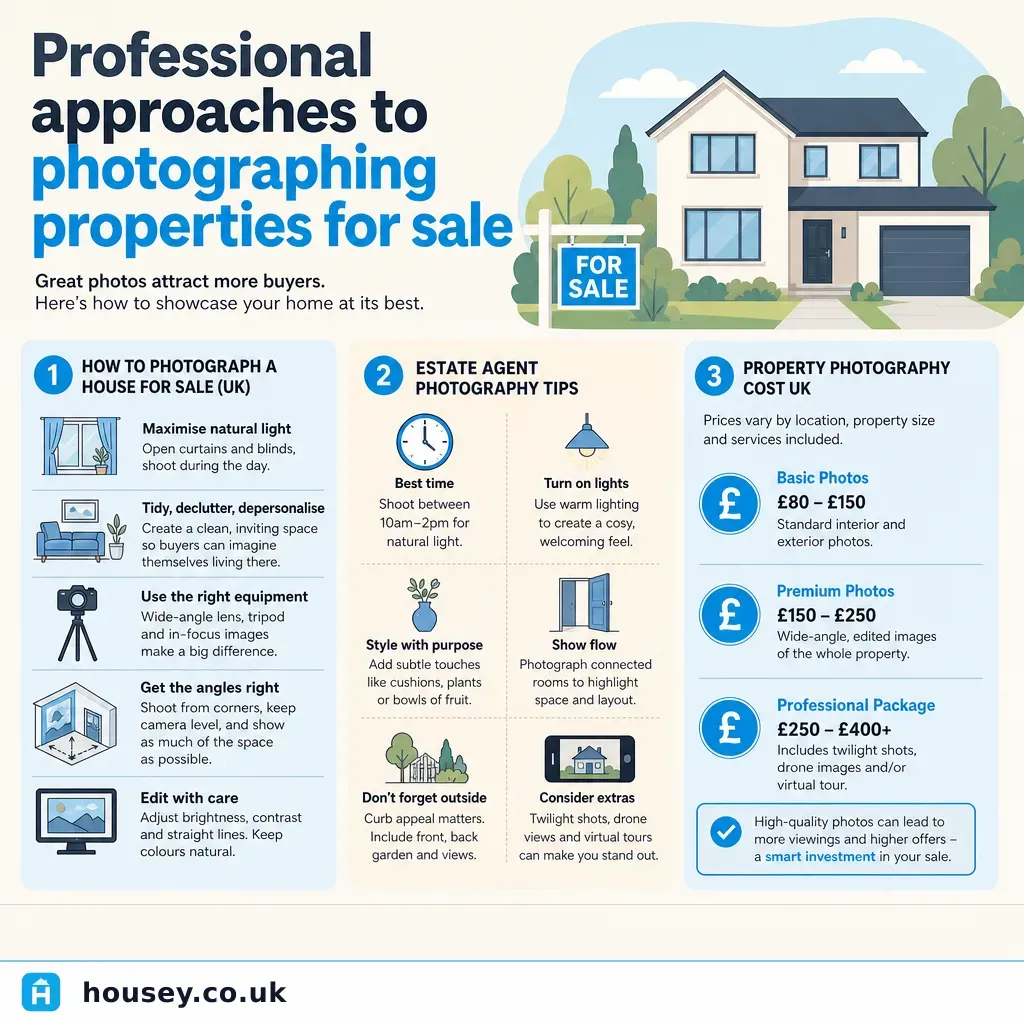
Professional approaches to photographing properties for sale
Professional property photography uses wide-angle lenses, HDR exposure blending, and careful staging to present rooms accurately and attractively.
 Buying & Moving
Using Art and Decor to Enhance Property Appeal When Selling
Thoughtfully chosen art and décor can make rooms feel larger, lighter, and more aspirational to buyers.
 Buying & Moving
Effective Property Marketing Strategies for Sellers
UK home sellers achieve more viewings and stronger offers by combining professional photography, an accurate floor plan, and a compelling portal listing.
 Buying & Moving
Proven Strategies for Selling Your Property Quickly and Effectively
To sell your UK home quickly, price it accurately from the outset, invest in professional photography and a measured floorplan, prepare your conveyancing documents before accepting an offer, and ensure the property presents well for viewings.