Proven Strategies for Selling Your Property Quickly and Effectively
By Housey · Last reviewed 30th of May 2026

Proven Strategies for Selling Your Property Quickly and Effectively
The average time from listing to legal completion in England and Wales stretched to around five to six months in 2025, yet homes that stall on the market consistently do so for a short list of avoidable reasons: an over-ambitious asking price, presentation that fails to translate well online, missing legal documents, or a conveyancing process that starts too late. For sellers who want to move on their own timeline rather than waiting out a slow-burning market, most of the controllable factors come down to decisions made in the weeks before a listing goes live.
Key points
- Properties that are overpriced at launch receive their highest online traffic in the first two weeks; once a listing stagnates and a price reduction follows, buyer confidence is harder to rebuild — the initial asking price is the most consequential decision a seller makes.
- A valid Energy Performance Certificate (EPC) is a legal requirement before a property is marketed for sale in England and Wales under the Energy Performance of Buildings (England and Wales) Regulations 2012; failure to hold one can delay or prevent listing.
- Under the Leasehold Reform (Ground Rent) Act 2022, sellers of leasehold properties must disclose ground rent terms; incomplete leasehold management information is a leading cause of transaction delays and collapses.
- Instructing a conveyancing solicitor before accepting an offer — sometimes called pre-instruction — allows the contract pack to be prepared in advance, potentially cutting weeks from the legal process.
- Official copies of the title register and title plan are available from HM Land Registry for approximately £3 per document and are required early in the conveyancing process; gathering them in advance avoids delays.
Getting the asking price right
Pricing is the single most consequential decision a seller makes. Too high and the listing stagnates; too low and value is surrendered unnecessarily. Three approaches are commonly available:
Valuation approach comparison
Approach | Best for | Not ideal for | Typical output | Main risk |
|---|---|---|---|---|
Estate agent appraisal (free) | Getting a quick market view; comparing agent knowledge | Agents may over-value to win the instruction | Indicative asking price range | Over-pricing at launch; no formal record |
RICS Red Book valuation | Probate, divorce, mortgage, disputed values, or unusual properties | Straightforward sales where an indicative range suffices | Formal written valuation, RICS-accredited | Cost (typically £300–£600); not always necessary for routine sales |
Automated valuation (online AVM) | Fast sense-checking against a known address | Non-standard properties, rural homes, recent significant alterations | Instant algorithmic estimate | Can be substantially wrong on atypical homes |
Indicative UK costs, last reviewed 2026-05-30.
For most sellers, obtaining two or three estate agent appraisals from agents with demonstrable recent comparable sales in your specific area provides the most useful pricing steer. A formal RICS valuation survey is worth commissioning if your property is unusual, recently extended, or if the valuation will be used for legal or mortgage purposes.
Preparing your home for sale
Pre-sale checklist
Professional photography and presentation
Amateur photography is one of the most avoidable mistakes sellers make. Most buyers begin their search on Rightmove or Zoopla, and the thumbnail image determines whether they click through. Professional photographers understand natural light, lens selection, and composition to show rooms at their best without misrepresentation.
A measured floorplan is equally important. Many buyers will not view a property without one, and solicitors increasingly request accurate square footage as part of the legal process. Inaccurate floorplans produced without measurement can create problems during the transaction. Professional property photography and accurate measured floorplans represent a modest cost relative to the value of the transaction — typically £150–£400 for a standard house — and are among the highest-return pre-sale investments available.
For vacant properties or homes with sparse or dated furnishings, virtual staging — digitally adding furniture to photographs — is a cost-effective alternative to physical staging.
Choosing the right method of sale
Sale method | Best for | Typical timescale to completion | Main caveat |
|---|---|---|---|
Traditional estate agent (no sale, no fee) | Most residential sales | 3–6 months | Agent quality and local knowledge vary widely |
Online or hybrid agent (fixed fee) | Sellers confident managing their own viewings | 3–6 months | Less local expertise; seller typically handles viewings and negotiations |
Auction (unconditional) | Unusual properties; probate; buyers wanting speed above price certainty | 4–8 weeks to exchange | Reserve price risk; narrower buyer pool for some property types |
Cash buyer or property buying company | Speed as the overriding priority | 2–4 weeks | Prices typically 10–25% below open market value |
Conveyancing and legal preparation
One of the most controllable factors in sale speed is how quickly the legal process progresses after an offer is accepted. Sellers who instruct a conveyancing solicitor before or immediately at the point of listing — rather than waiting until an offer arrives — can have the contract pack, Seller's Property Information Form (SPIF/TA6), Fittings and Contents Form (TA10), and management information ready to serve immediately.
Key documents to locate before listing:
- Official copies of the title register and title plan (available from HM Land Registry for approximately £3 per document)
- Planning permissions and building regulations completion certificates for any extensions, conversions, or structural works
- FENSA or CERTASS certificates for replacement windows or doors installed after 2002
- Gas Safe certificates for boiler installations or gas works; NICEIC or NAPIT certificates for electrical works
- For leasehold properties: service charge accounts for the last three years, ground rent history, building insurance schedule, and management company contact details
Red flags that could slow your sale
Buyer solicitors and mortgage lenders are trained to identify title and compliance issues. The following are common causes of delay or transaction collapse:
- Unregistered title — if the property has never been registered with HM Land Registry, first registration takes longer and requires the original paper title deeds to be located.
- Missing building regulations approval for extensions, loft conversions, or structural alterations — lenders will often refuse to lend without either the original certificate or an indemnity insurance policy.
- Disputed boundaries — even informal, long-standing boundary disagreements can trigger requisitions from a buyer's solicitor.
- Absent freeholder or management company (leasehold) — inability to obtain building insurance details or leasehold management packs causes a significant proportion of leasehold transaction delays.
- Short lease (under 80 years remaining) — triggers statutory lease extension rights and additional legal complexity; buyers using a mortgage may find their lender requires a minimum lease length.
- Chancel repair liability — older properties near historic parish churches may have potential chancel repair liability; indemnity insurance is usually straightforward and inexpensive to obtain.
What to ask an estate agent before instructing
- What is the evidence base for your suggested asking price? Ask to see actual sold prices from the last three to six months within half a mile.
- How and where will the property be marketed? Which portals, and how quickly will it go live?
- Who conducts viewings — a member of staff who knows the property, or a general negotiator?
- What is your current average time from listing to sale agreed for comparable properties?
- What is your fee structure, and at what point does it become payable?
- Is VAT included in the quoted fee?
- What happens if I am not satisfied with the service — is there a tie-in period?
Important limitations
This article provides general information for UK residential sellers. Property law, leasehold regulations, estate agency obligations, and conveyancing processes vary by transaction type and cannot be fully addressed in a general guide. Valuation guidance from any non-RICS source — including this article — is not a substitute for a formal RICS Red Book valuation where one is required for legal, probate, or mortgage purposes. Always instruct a qualified solicitor or licensed conveyancer for the legal elements of your sale.
What to ask a qualified professional
Conveyancing solicitor or licensed conveyancer:
- How quickly can you prepare the draft contract pack once instructed?
- Do you have experience with leasehold, unregistered title, shared ownership, or Help to Buy redemption (as applicable)?
- What are your full fees, disbursements, search costs, and VAT?
- How do you manage buyer enquiries, and what is your typical response time to solicitor-to-solicitor correspondence?
RICS-accredited valuer (if instructing one):
- Is this a RICS Red Book compliant valuation, and will it be acceptable for my specific purpose (mortgage, probate, matrimonial proceedings)?
- How familiar are you with recent comparable sales in this specific postcode?
- What comparable evidence are you relying on, and does it include any adjustments for condition or improvements?
When to get professional help
Sales involving probate, divorce settlements, shared ownership, Help to Buy equity loan redemption, leasehold with a short or problematic lease, or unregistered title benefit from specialist legal and valuation input from the outset. If your buyer's survey returns significant concerns — structural movement, damp, or roof defects — do not rely on a verbal interpretation of the findings from your buyer. Instruct your own professional to assess the issues before deciding whether to reduce the price, carry out remedial work, or provide written clarification.
How Housey can help
Housey connects UK sellers with vetted professionals across the entire sales process. Find professional property photographers and floorplan specialists to maximise your online presentation, instruct a RICS-accredited valuation surveyor for an independent market assessment, and appoint a conveyancing solicitor or licensed conveyancer to prepare your legal pack and manage the transaction from instruction through to completion.
Frequently asked questions
How long does it realistically take to sell a house in England and Wales?
From listing to exchange typically takes 8–14 weeks in England and Wales, depending on chain complexity, buyer finances, and the pace of the legal process. Exchange to completion usually adds a further 1–4 weeks. Homes priced accurately, well presented, and with legal documentation prepared in advance tend to move faster. Auction routes offer faster exchange — typically within 28 days — but at the cost of certainty on the final price achieved.
Does a poor EPC rating affect my ability to sell?
A poor EPC rating (F or G) does not legally prevent a sale of an owner-occupied home, but it may affect buyer confidence, limit the mortgage products available to some buyers, and influence offers. Making low-cost improvements before listing — such as topping up loft insulation or upgrading to a more efficient boiler — may improve the rating and widen your buyer pool. Check GOV.UK guidance on EPCs for sellers for the current rules.
Should I accept the first offer I receive on my property?
Not automatically. Early offers can reflect genuine buyer motivation, but they may also come in below market value. Discuss any offer with your estate agent in the context of recent comparable sold prices, the buyer's chain position and confirmed mortgage status, and how long your property has been available. A slightly lower offer from a chain-free, mortgage-approved buyer may represent better value overall than a higher offer from a buyer in a long chain.
What is gazumping and how can I reduce the risk of it happening?
Gazumping occurs when a seller accepts a higher offer from a new buyer after already agreeing a sale informally, but before contracts are exchanged. It is legal in England and Wales. The most effective way to reduce the window in which it could occur is to move quickly to exchange: prepare your legal pack in advance, instruct a solicitor immediately, and request that your buyer does the same.
Sources and further reading
- Get information about property and land — GOV.UK / HM Land Registry
- Energy Performance Certificates: guidance for home sellers — GOV.UK
- RICS guidance on residential valuations — RICS
- Leasehold Reform (Ground Rent) Act 2022 overview — GOV.UK
- Stamp Duty Land Tax calculator — GOV.UK
Useful next reads
 Buying & Moving
Property Enhancement Strategies for a Successful Sale
Enhancing a UK property before listing typically involves improving kerb appeal, decluttering and neutralising décor, addressing minor maintenance issues, and investing in professional photography.
 Buying & Moving
Using Art and Decor to Enhance Property Appeal When Selling
Thoughtfully chosen art and décor can make rooms feel larger, lighter, and more aspirational to buyers.
 Buying & Moving
How to Sell Your House Fast in the UK
To sell your home quickly in the UK, price it accurately from day one using a professional valuation, maximise kerb appeal, instruct a conveyancer before you list, and choose an estate agent with a strong local track record.
 Buying & Moving
Preparing Your Home for Sale: Practical Seller Strategies
Preparing a home for sale involves gathering key documents such as an EPC, planning permissions, and building regulations certificates, addressing condition issues that affect survey outcomes and buyer confidence, and presenting the property well for photography and viewings.
 Buying & Moving
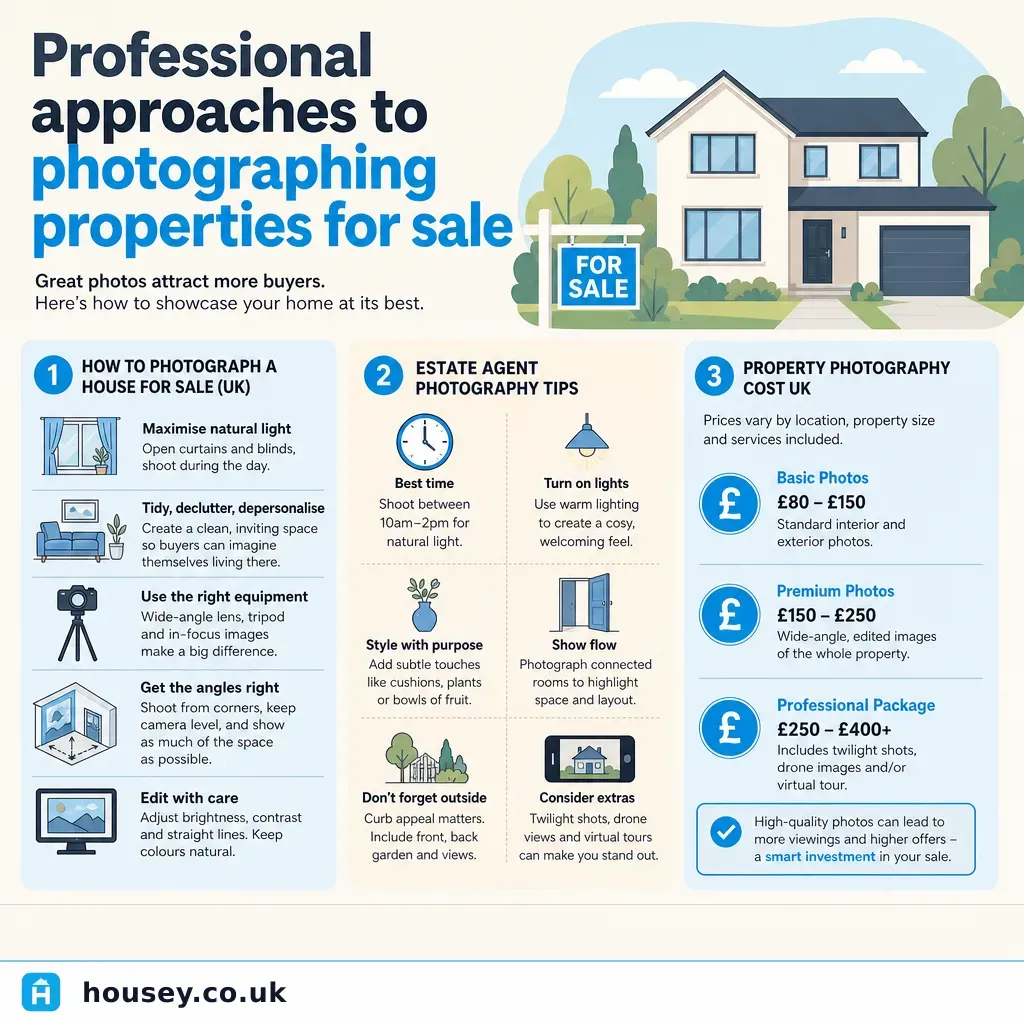
Professional approaches to photographing properties for sale
Professional property photography uses wide-angle lenses, HDR exposure blending, and careful staging to present rooms accurately and attractively.