Accelerating Your House Move: Strategies for Faster Property Transactions
By Housey · Last reviewed 18th of May 2026

Accelerating Your House Move: Strategies for Faster Property Transactions
For most buyers and sellers in England and Wales, the period between an accepted offer and completion is the most pressured phase of a property transaction. Delays during this stage are common, frequently avoidable, and can cascade through an entire chain, affecting people with no control over the original problem. Understanding where delays typically originate — and acting early on the steps within your control — can meaningfully reduce the time between offer and moving day.
Key points
- Stamp Duty Land Tax (SDLT) in England must be filed and paid within 14 days of the completion date; this 14-day deadline replaced a previous 30-day window in 2019, under amendments to the Finance Act 2003.
- Local authority property searches — a mandatory stage in residential conveyancing — can take between 1 and 10 weeks depending on the council, with significant variation between local authorities across England and Wales.
- Mortgage offers are typically valid for 3–6 months from the date of issue; a slow chain can force buyers to re-apply, potentially on different terms or at a different rate.
- Anti-money laundering (AML) identity checks are a legal requirement under the Money Laundering Regulations 2017; solicitors cannot begin substantive work until satisfactory ID is provided by all parties.
- Electronic signatures are now accepted for most conveyancing documents in England and Wales, removing the need for postal turnarounds on standard forms.
Where delays most commonly arise
In England and Wales, the period from offer accepted to exchange of contracts typically takes 8–12 weeks. Exchange to completion usually adds a further 1–4 weeks. Understanding which stages slow matters most helps you focus effort where it counts.
Stage | Common cause of delay | How to reduce it |
|---|---|---|
Instruction | Solicitor not yet instructed at point of offer | Instruct before or immediately after offer |
AML checks | Buyer or seller slow to provide ID documents | Prepare ID and address proof in advance |
Mortgage | Lender queries on income or valuation | Respond to lender requests within 24 hours |
Searches | Slow local authority processing | Ask about personal search alternatives |
Enquiries | Vendor cannot locate documents for alterations | Ask vendor to gather paperwork before listing |
Chain | A party elsewhere in the chain has their own delays | Keep communication open across all solicitors |
Exchange | Parties not ready to commit simultaneously | Set a target exchange date early and work to it |
Instruct a solicitor before the offer is accepted
Many buyers wait until an offer is accepted before contacting a conveyancer, which immediately introduces a delay of several days to a week before the process can begin. Instructing a solicitor before you offer means:
- AML identity checks can start the moment an offer is accepted.
- Your solicitor already holds your details and can request draft contracts as soon as the seller's solicitor is instructed.
- You avoid a queue for initial appointments at busy practices during peak moving periods.
Most solicitors are comfortable being instructed speculatively on a property you are actively pursuing, with the understanding that the matter only proceeds formally once the offer is accepted.
Provide identity documents promptly
AML checks are a legal prerequisite that solicitors cannot bypass. The standard requirements are:
- One document proving identity, such as a UK passport or photo driving licence.
- One document proving current address, such as a utility bill, bank statement, or council tax bill dated within 3 months.
Having these ready — or uploaded to your solicitor's digital ID verification platform — removes this step as a bottleneck from the very start of your transaction.
Respond quickly to lender and solicitor requests
Delays compound when responses are slow. Mortgage lenders and solicitors frequently need follow-up documents during processing — additional income evidence, confirmation of a gifted deposit, details of a previous address. Responding to any request within 24 hours keeps your matter in the active queue and prevents it being deprioritised during busy periods.
Set up email notifications from both your solicitor and your mortgage broker so that requests do not sit unread.
Which approach suits your transaction?
- Choose a personal search if your lender accepts it and local authority turnaround times in the relevant area are known to be slow — ask your solicitor at the very start of the transaction.
- Instruct a dedicated conveyancing specialist rather than a general high-street solicitor if speed is a priority; conveyancing-only firms often have streamlined processes and faster average turnaround times.
- Ask about electronic signing at the point of instruction; if your solicitor uses an e-signature platform, postal delays on standard documents can be eliminated throughout.
- Speak to a mortgage broker early if you have not yet secured a mortgage in principle — lender processing times vary significantly, and some work faster than others.
- Ask your seller to prepare documentation for any alterations before marketing begins — missing building regulations completion certificates and planning permissions are among the most common causes of late enquiry delays.
Document preparation checklist
For buyers
For sellers
When to get professional help
If your transaction has stalled and you cannot identify the cause, ask your solicitor for a written update listing every outstanding item and who is responsible for resolving it. If the delay lies with the other side's conveyancer, your solicitor can escalate through formal written correspondence.
For complex title issues — such as a defect in the title register, an undisclosed restrictive covenant, or a missing completion certificate for structural work — specialist legal advice or a specific defect report from a RICS-qualified surveyor may be needed before the matter can progress.
How Housey can help
Having reliable house removals and experienced conveyancing support in place keeps your transaction moving once the legal process is underway. Housey connects buyers and sellers with conveyancers and removal firms who understand the pace and pressure of modern property chains.
Frequently asked questions
How long does conveyancing typically take in England and Wales?
From offer accepted to exchange of contracts, most transactions take 8–12 weeks, depending on property complexity, chain length, and search turnaround times. Exchange to completion usually adds a further 1–4 weeks, making the typical total from offer to moving in around 12–16 weeks — though chains and title complications can extend this significantly.
What is the fastest a house purchase can complete?
In straightforward cases — a cash purchase with no chain and a property free from title complications — a transaction can sometimes complete in as few as four to six weeks. This requires immediate responses from all parties, quick search turnaround, and no unexpected enquiries arising from the title or any survey commissioned by the buyer.
Can I speed up local authority searches?
Ask your solicitor early whether a personal search is acceptable to your mortgage lender. Personal searches are carried out by regulated agents who retrieve the same data from local authority registers, often more quickly than an official search. Not all lenders accept personal searches, so check this at the start of your transaction rather than after a delay has already occurred.
What happens if my mortgage offer expires before completion?
Contact your mortgage broker or lender as soon as you anticipate a possible delay — do not wait until the offer has already expired. Many lenders will extend an offer if the delay results from normal conveyancing timelines, though they may require updated income evidence or a fresh property valuation. Acting promptly gives you the most options and the best chance of retaining your agreed rate.
Sources and further reading
- Finance Act 2003 (Stamp Duty Land Tax) — legislation.gov.uk
- Money Laundering Regulations 2017 — legislation.gov.uk
- Property transactions guidance — The Law Society
- Buying a home — Citizens Advice
- Search for land and property information — GOV.UK
Useful next reads
 Buying & Moving
Choosing the Right Removal Company for Your House Move
To choose the right removal company, get three quotes from British Association of Removers (BAR) members or similarly accredited firms.
 Buying & Moving
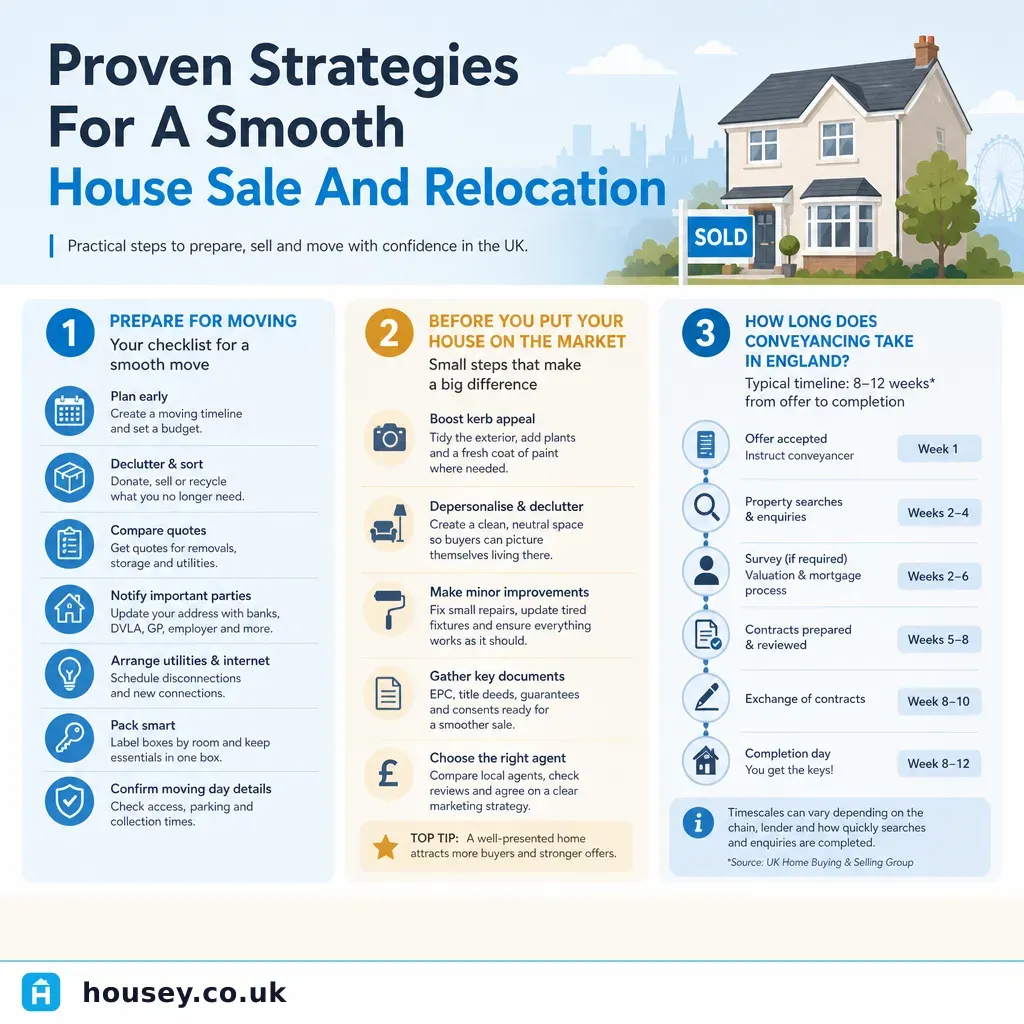
Proven Strategies For A Smooth House Sale And Relocation
Selling a house and relocating smoothly in the UK depends on preparation at every stage: instructing a solicitor early, presenting the property well for marketing, and booking removals before your completion date is confirmed.
 Buying & Moving
Planning A House Move In The New Year: A Complete Relocation Checklist
Planning a house move in the new year means coordinating removals, utilities, address changes, and legal completions across multiple parties.
 Buying & Moving
Booking a House Removal Company: Advance Notice and Scheduling Guidance
Most UK removal companies recommend booking 4–8 weeks in advance for a standard house move.
 Buying & Moving
House Removal Costs and Moving Logistics: A UK Guide
House removals in the UK typically cost £300–£1,500 for a local move and £800–£4,000+ for a long-distance or large property removal, depending on volume, distance, and services chosen.