Planning A House Move In The New Year: A Complete Relocation Checklist
By Housey · Last reviewed 31st of May 2026

Planning A House Move In The New Year: A Complete Relocation Checklist
January and February are among the busiest periods for UK removal companies, with many families choosing the new year as a moment for a fresh start in a new home. Yet post-Christmas moves often arrive with tighter timelines, limited availability, and the logistical challenge of coordinating exchange, completion, and removal bookings around a period when many businesses are still recovering from holiday closures. A structured plan begun well before moving day can make the difference between a smooth handover and an expensive last-minute scramble.
Key points
- UK removal companies typically book up 4–8 weeks in advance in January; begin gathering quotes at least 8–12 weeks before your target move date.
- Royal Mail Redirection must be set up at least 5 working days before your move date and can cover post for up to 12 months.
- Your solicitor must submit the change of ownership to HM Land Registry within 30 days of completion — chase confirmation this has been done.
- Ofgem requires energy suppliers to allow account transfers or closures with reasonable notice; notify your current supplier as soon as completion is confirmed.
- Contents insurance at your new property should be in force from exchange of contracts, not just from completion day — confirm the start date with your insurer.
Why January and February moves need earlier planning
Holiday closures affect solicitors, surveyors, mortgage lenders, and local authority search teams in late December and early January. If your target completion falls in January:
- Searches and mortgage offer processing may be delayed if requests were submitted during the Christmas shutdown.
- Many removal firms close for one to two weeks over Christmas and return with a full diary.
- School terms in England begin in early January, so families moving for catchment areas face a hard deadline.
Aim to have exchange of contracts confirmed before mid-December where possible. If that is not achievable, factor in an additional two to three weeks of buffer for any transaction that spans the holiday period.
8–12 weeks before moving day: the planning phase
This is when you lock in key professional services and begin the de-cluttering process.
- Confirm your target completion date with your solicitor and agree it with all parties in the chain.
- Get at least three quotes from house removal companies and check their British Association of Removers (BAR) or Approved Mover scheme membership.
- Book packing services if required — particularly useful for households with large quantities of fragile items or limited time before the move.
- Start de-cluttering room by room; arrange a house clearance for furniture and belongings you will not be taking.
- Book storage providers if there is a gap between leaving your current home and being able to move in — common when moving into a property that requires renovation works before occupation.
- Notify your mortgage lender, buildings insurer, and contents insurer of your upcoming move date.
- Set up a Royal Mail Redirection at royalmail.com — allow at least 5 working days, and ideally set it up well in advance.
4–6 weeks before: logistics and paperwork
- Confirm your removal booking and arrange a pre-move survey with the company — most reputable firms survey in person or by video call for larger moves.
- Source packing materials (boxes, bubble wrap, packing tape), or confirm whether the removal company is supplying them.
- Begin packing non-essential items: books, off-season clothing, and decorative objects.
- Notify government bodies and financial institutions of your upcoming address change (see the address change checklist below).
- Arrange transfer or cancellation of utilities: gas, electricity, water, and broadband.
- Contact your local council to cancel Council Tax at your current address and register at the new one.
- Notify TV Licensing of the new address.
- Update your GP, dentist, and any specialist healthcare providers.
1–2 weeks before: final preparations
- Confirm the completion date and moving day arrangements with your solicitor.
- Prepare an essentials box for moving day: kettle, mugs, tea, coffee, toilet paper, phone chargers, a change of clothes, and key documents.
- Take meter readings at your current property and photograph them for your records.
- Defrost the fridge and freezer the night before if the removal team will be moving these appliances.
- Confirm parking arrangements at both addresses — apply for a temporary parking suspension from your local council if needed (typically 5–10 working days' notice required).
- Confirm what time you can access the new property and who is providing the keys.
Moving day checklist
- Walk through your current property before leaving: check the loft, cellar, garage, shed, under beds, and under stairs.
- Take meter readings at the new property immediately on arrival and photograph them.
- Test heating, hot water, and electrics before the removal team departs.
- Check all windows and external doors lock correctly.
- Change the locks — the seller may have given copies of keys to tradespeople, neighbours, or cleaners.
- Locate the stopcock, fuse board, and boiler isolation valve in the new property.
Address change checklist
Notify the following organisations as soon as exchange occurs, or within the first week after moving:
Category | Who to notify |
|---|---|
Government and legal | DVLA (driving licence), Passport Office, HMRC, DWP, Electoral Roll (via GOV.UK or local council) |
Financial | Banks, building societies, credit cards, pension providers, investments, mortgage lender |
Insurance | Buildings, contents, car, life, health, and pet insurance |
Utilities | Gas, electricity, water, broadband, TV Licensing |
Healthcare | GP, dentist, optician, specialist providers |
Subscriptions | Online shopping accounts, streaming services, magazine subscriptions |
Work and education | Employer, children's schools, universities, HMRC payroll records |
Document preparation list for moving day
Gather these in a single folder or document wallet before moving day:
- Completion statement from your solicitor
- Title deeds or office copy entries (sent by your solicitor after completion)
- Building regulations completion certificates for any notifiable works at the new property
- Gas Safe certificate and boiler service record
- FENSA or CERTASS certificates for replacement windows and doors
- Electrical Installation Condition Report (EICR), if provided by the seller
- New home insurance policy documents
- Warranties for any built-in appliances left by the seller
When to get professional help
Most moves are logistically complex but manageable with good preparation. Seek professional advice if:
- Your removal company is not a member of BAR or a recognised trade body — recourse is limited if goods are damaged or lost.
- You need specialist packing for antiques, fine art, pianos, or wine collections.
- You are moving into a property requiring significant clearance before unloading — a house clearance service can prepare the space in advance of your removal team arriving.
- You discover at completion that agreed items have been removed by the seller, or that previously undisclosed defects are present — contact your solicitor immediately.
How Housey can help
Housey connects you with trusted house removal companies, storage providers, and house clearance services — all reviewed by UK homeowners. Compare quotes from local firms to find the right team for your new year move.
Frequently asked questions
When should I book a removal company for a January move?
Ideally 8–12 weeks in advance — meaning by mid-October for a January move. Removal companies fill quickly for January, and firms with strong reviews typically book out first. If you're already closer to your move date, contact several firms immediately rather than gathering quotes one by one.
What happens if completion is delayed after I've booked removals?
If completion is delayed after your removals are confirmed, you may face charges for storage and waiting time. Check the removal company's delay policy before booking. Your buildings insurance at the current address should also remain in force until legal completion occurs.
Do I need to update the Electoral Roll when I move?
Yes. Register to vote at your new address via GOV.UK or your local council's electoral services team. Your registration at the previous address does not automatically transfer. Contact the old council separately to remove your name from their register if you wish.
Should I take out separate removals insurance?
Check whether your removal company's standard liability cover is sufficient for your possessions. BAR members provide a baseline level of cover, but for high-value items you may want additional goods-in-transit insurance. Your contents insurer may also extend cover during a move — confirm this before moving day.
Sources and further reading
- Royal Mail Redirection service — Royal Mail
- Register to vote — GOV.UK
- Change your address on your driving licence — GOV.UK
- Choosing a removal company — British Association of Removers
- Moving home and council tax — GOV.UK
Useful next reads
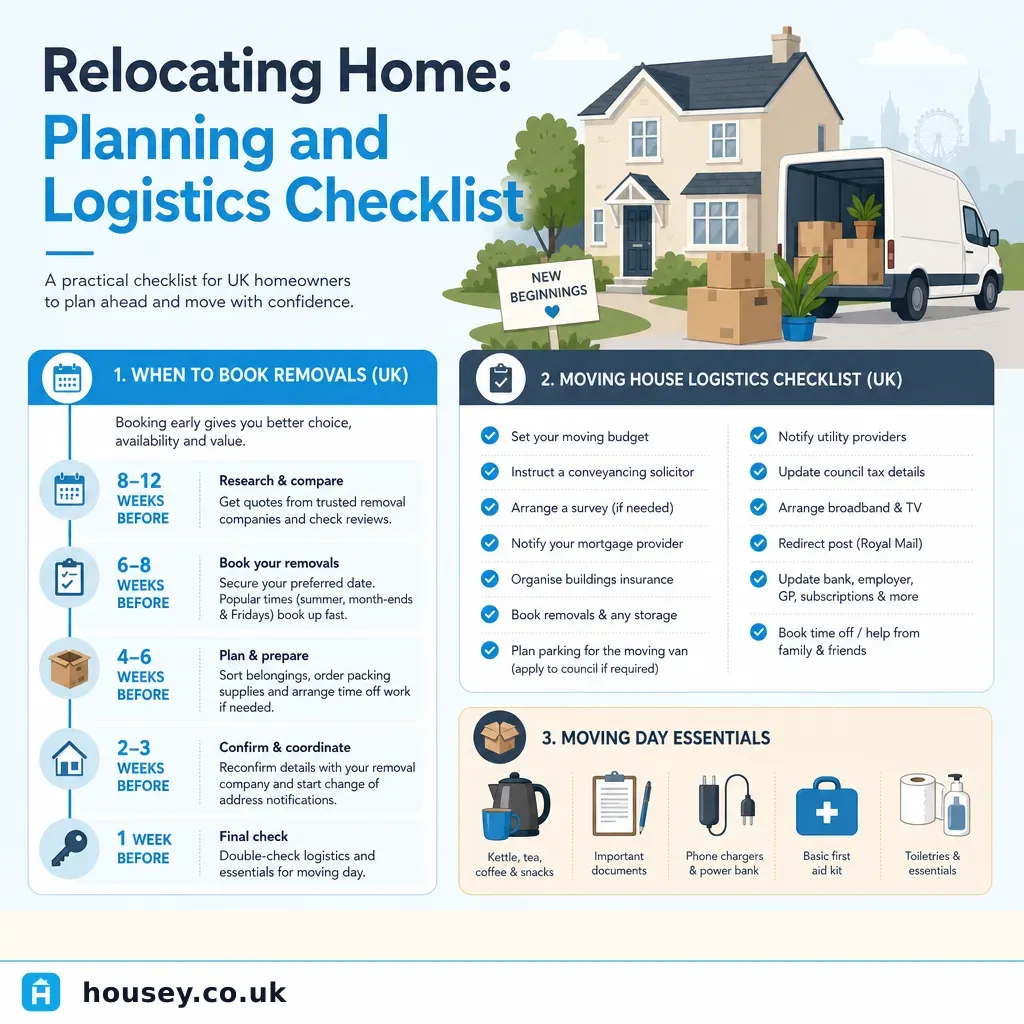 Buying & Moving
Relocating Home: Planning and Logistics Checklist
Successful home relocation in the UK typically requires 8–12 weeks of advance planning.
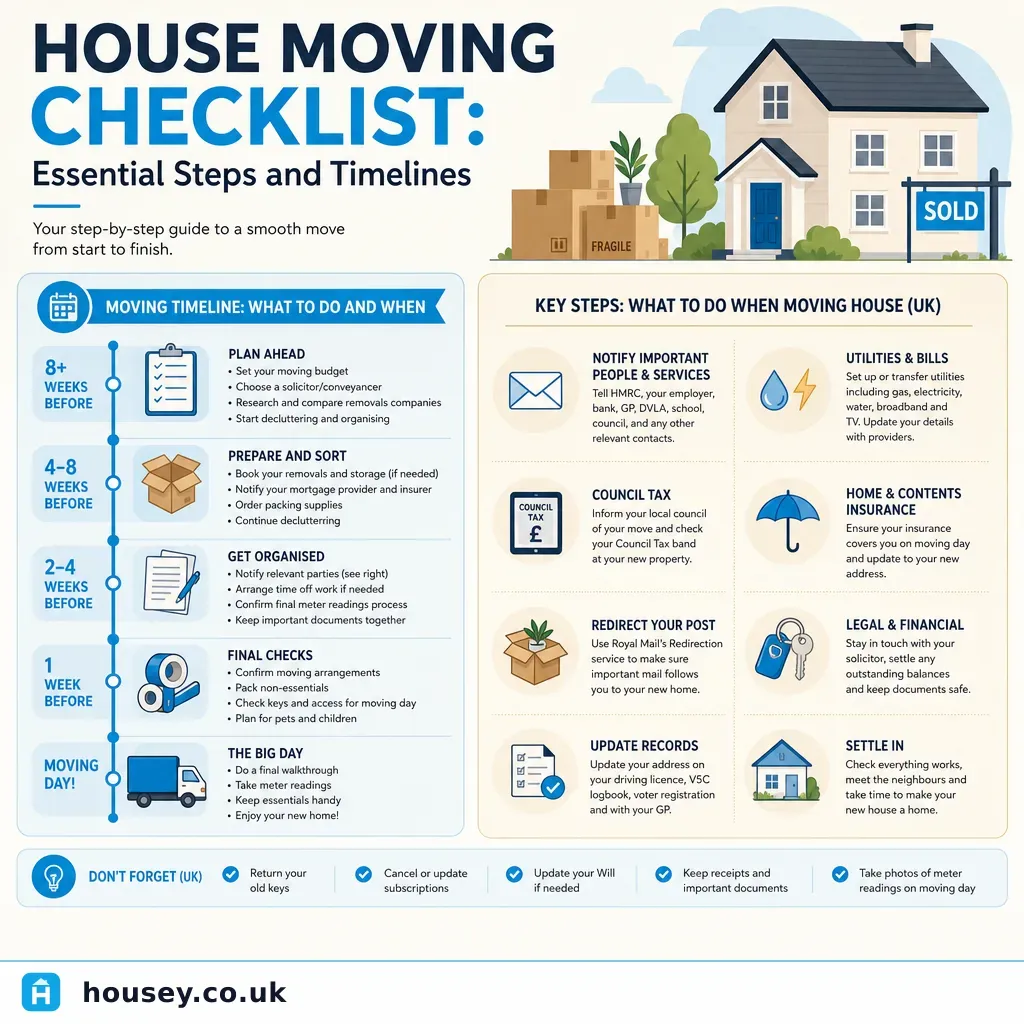 Buying & Moving
House Moving Checklist: Essential Steps and Timelines
A UK house move typically spans 8–12 weeks of preparation: book removals 4–6 weeks out, notify the DVLA, HMRC, and utilities as exchange approaches, take meter readings on moving day, and update Council Tax and the electoral register on arrival.
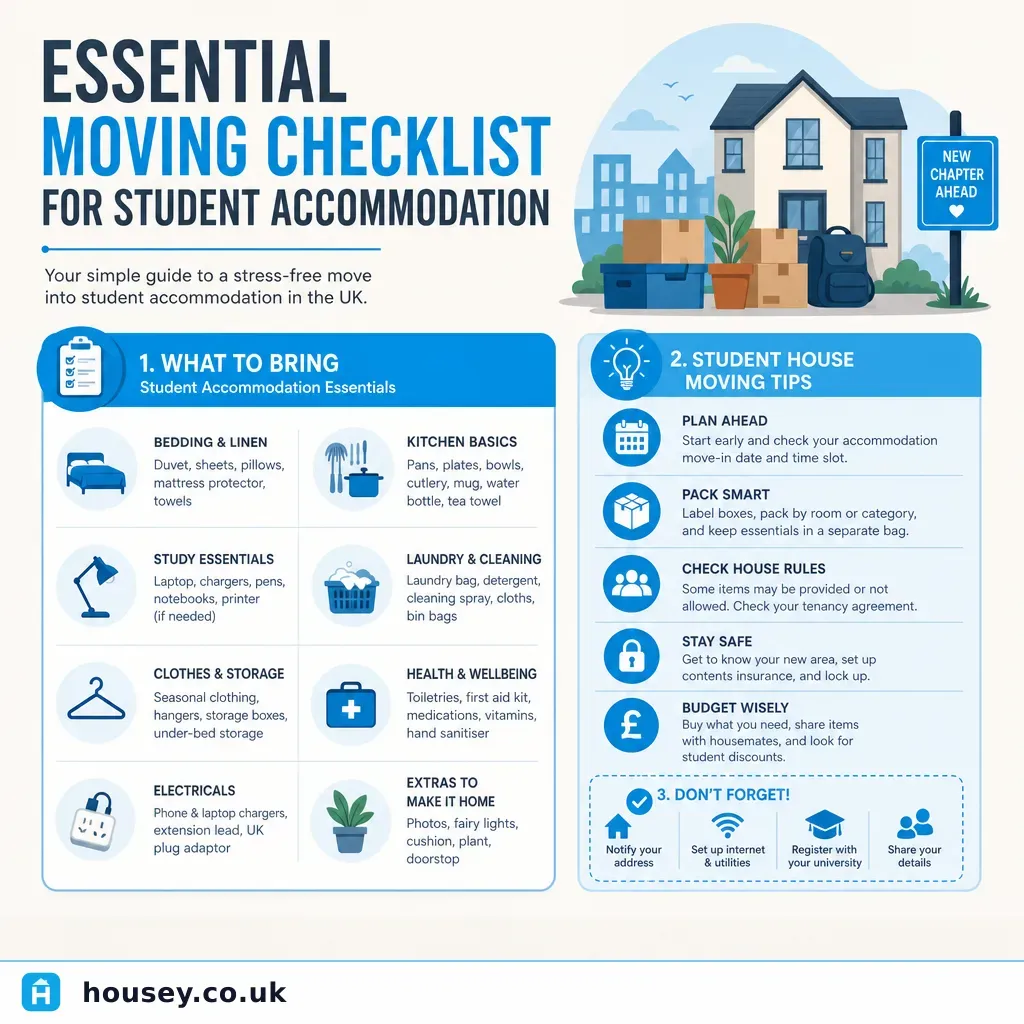 Buying & Moving
Essential Moving Checklist for Student Accommodation
Moving into student accommodation requires notifying your university and council, checking deposit protection, arranging contents insurance, and booking transport early.
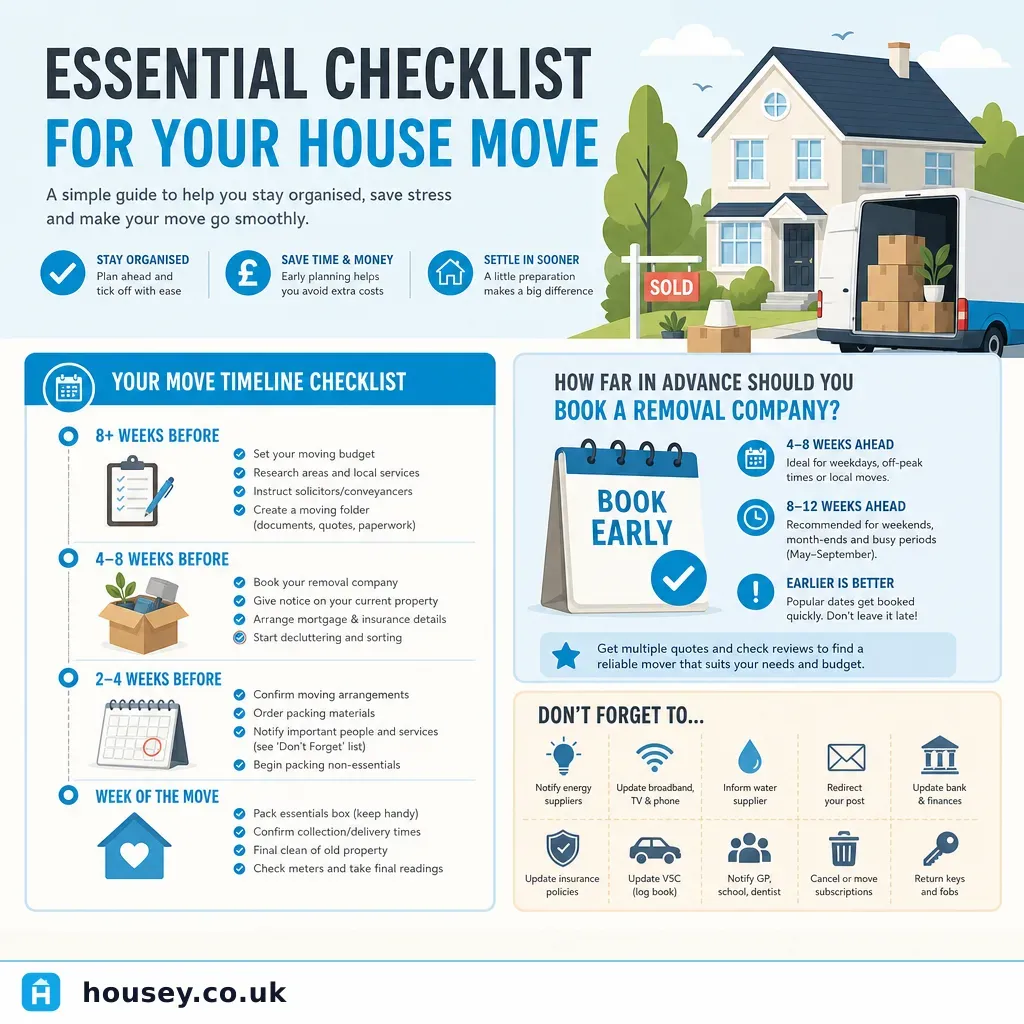 Buying & Moving
Essential Checklist for Your House Move
A successful UK house move relies on a staged checklist covering eight to twelve weeks before moving day through to two weeks after arrival.
 Buying & Moving
Choosing a House Removal Company: What to Look For
Choose a UK removal company that belongs to the British Association of Removers (BAR) or the Removals Industry Ombudsman Scheme (RIOS), carries goods-in-transit and public liability insurance, and provides a written quote after properly surveying your home.