Booking a House Removal Company: Advance Notice and Scheduling Guidance
By Housey · Last reviewed 4th of May 2026

Booking a House Removal Company: Advance Notice and Scheduling Guidance
Choosing a move date is one of the first practical steps once your purchase is progressing, and leaving removal bookings too late is one of the most common mistakes UK movers make. Demand for reputable removal firms spikes sharply at certain times of year and on particular days of the week, so timing your enquiry well can save both money and stress. Whether you are buying a first home, relocating for work, or downsizing, understanding how removal companies manage their availability helps you plan around exchange and completion with confidence.
Key points
- Most reputable UK removal companies recommend booking 4–8 weeks in advance for a standard house move, and up to 12 weeks during peak periods.
- Fridays and end-of-month completion days are consistently the busiest times for removal companies across the UK.
- June, July, and August are peak season for residential moves; availability shrinks and some firms apply surcharges for high-demand dates.
- A confirmed removal booking typically requires a deposit; some firms hold provisional dates for 48–72 hours without payment.
- British Association of Removers (BAR) membership means a firm operates under a Code of Practice and offers advance payment protection to consumers.
How far in advance should you book?
For most standard UK house moves, contacting removal companies 4–8 weeks before your expected completion date is a sensible starting point. This gives you time to gather at least three quotes, verify accreditation, and confirm the booking before the date is locked in.
During peak periods — particularly June to August and the last working day of each month — demand for removal crews across the UK intensifies. If your completion is likely to fall in one of these windows, extending your lead time to 10–12 weeks reduces the risk of your preferred firm being unavailable.
If you are buying as part of a chain, completion dates can shift right up to exchange. It is worth discussing flexible booking terms with your removal company at the outset, including what happens if your solicitor cannot confirm the date until close to exchange. Many firms will hold a provisional date for 48–72 hours before requiring a deposit; confirm this policy before assuming it applies.
When are removal companies busiest?
Understanding demand patterns helps you book at the right time and, in some cases, negotiate a better rate.
Busiest days:
- Fridays are by far the most popular completion day in England and Wales. Conveyancing chains typically complete on Fridays to avoid weekend complications, concentrating demand into a single day each week.
- Mondays are the second most common moving day.
- Mid-week slots (Tuesday–Thursday) are often easier to book and can attract lower rates from some firms.
Busiest months and periods:
- Summer school holidays (late June to early September) are peak season for family relocations.
- The last Friday or last working day of any month generates a notable surge in completions.
- Late March and late September (end of quarter) also see increased housing market activity.
Quieter periods:
- January and February tend to be quieter across the UK property market.
- A mid-week slot in autumn or winter often provides wider availability and more competitive quotes.
Decision tree: when should you book?
Use this as a starting point based on your circumstances:
- Book 10–12 weeks ahead if your completion falls in June, July, or August, or if you are moving on a Friday or end-of-month date.
- Book 6–8 weeks ahead if you have a confirmed completion date and are moving mid-week outside the summer peak.
- Book 4–6 weeks ahead if your date is flexible, you can consider mid-week slots, and you are moving in autumn or winter.
- Contact firms immediately if you have a confirmed completion date within the next three weeks — availability will be limited but some firms accommodate short-notice moves.
- Ask about provisional holds if you are in a chain without a confirmed date — some firms will provisionally reserve a slot before requiring a deposit.
- Check cancellation terms first if exchange has not yet happened and your date could still move by several weeks.
What to confirm before booking: a checklist
Before accepting a quote and paying a deposit, work through the following:
- Is the company a member of the British Association of Removers (BAR) or the Road Haulage Association (RHA)?
- What goods-in-transit and public liability insurance is included, and what is the claims process if items are damaged?
- Does the quoted crew and vehicle capacity match your property size and volume of belongings?
- Are packing materials and a professional packing service included, optional, or excluded from the quote?
- What are the reschedule and cancellation terms if your completion date changes?
- Has the company noted any parking restrictions, floor level, lift availability, or narrow access at either address?
- When is the deposit due, and what is the refund policy if completion falls through entirely?
- Is VAT included in the quoted price?
What to do if your completion date is not yet confirmed
One of the most common dilemmas UK buyers face is wanting to secure a removal company before exchange without having a confirmed date. A few practical approaches:
- Enquire early without committing. Contact two or three companies to ask about availability and obtain indicative quotes. Most firms understand that completion dates shift in a chain.
- Ask about provisional holds. Some removal companies will provisionally hold a date for 48–72 hours once you are close to exchange. Confirm this policy before assuming it applies.
- Check reschedule terms carefully. Before paying a deposit, understand what it costs to move the date by one or two weeks.
- Keep your solicitor informed. Coordinating between your solicitor and removal company on the likely completion day avoids last-minute conflicts.
When to get professional help
Removal companies handle the physical logistics of your move; they are not responsible for coordinating legal completion, storage arrangements, or specialist transport. Seek explicit confirmation from any firm you approach if your move involves:
- Storage between properties, for example if you are selling before completing your purchase.
- Unusually large, fragile, or high-value items such as pianos, antiques, or specialist equipment.
- International relocation, which requires separate customs documentation and carriers.
- Commercial premises alongside a residential move.
If you are unsure whether a removal company is reputable, the British Association of Removers maintains a public member search at bar.co.uk.
How Housey can help
If you are ready to compare quotes from vetted UK removal companies, Housey can connect you with local providers. Submit your move details through our house removals service to request and compare quotes, check availability, and review terms before your completion date.
Frequently asked questions
How far in advance should I book a removal company in the UK?
For most standard house moves, 4–8 weeks' notice is a sensible minimum. If you are moving during the summer peak (June–August), on a Friday, or at month end, aim for 10–12 weeks. Last-minute bookings within a week or two of your move are sometimes possible but availability is limited and prices may be higher.
Why are Fridays so expensive for removal companies?
Fridays are the most popular completion day in England and Wales because conveyancing chains tend to complete on Fridays to avoid weekend complications. This concentrates demand into a single day each week, which can allow removal firms to charge a premium. If you can negotiate a mid-week completion, you may find more availability and more competitive pricing.
What if my completion date changes after I have booked?
Check the reschedule terms before paying your deposit. BAR-registered companies must clearly state their cancellation and postponement conditions. Many firms allow one date change with reasonable notice; subsequent changes or very short-notice reschedules may incur a fee. Keep your removal company updated as soon as your solicitor advises of a likely change.
Can I book a removal company before exchange of contracts?
Yes, and it is advisable to start enquiring before exchange. Most companies understand that completion dates are not guaranteed until exchange. Ask about provisional booking options and confirm what notice they need to finalise the date. Some firms will hold a slot for 48–72 hours while you await exchange confirmation.
What accreditation should I look for in a removal company?
The British Association of Removers (BAR) is the principal UK trade body for the removals industry. BAR membership requires adherence to a Code of Practice, staff training standards, and advance payment protection for consumers. The Road Haulage Association (RHA) also accredits professional removals and haulage businesses.
Sources and further reading
- BAR Consumer Services and Member Search — British Association of Removers
- Moving Home — Citizens Advice
Useful next reads
 Buying & Moving
Choosing the Right Removal Company for Your House Move
To choose the right removal company, get three quotes from British Association of Removers (BAR) members or similarly accredited firms.
 Buying & Moving
Accelerating Your House Move: Strategies for Faster Property Transactions
The average time from offer to completion in England and Wales is around 12–16 weeks.
 Buying & Moving
Planning A House Move In The New Year: A Complete Relocation Checklist
Planning a house move in the new year means coordinating removals, utilities, address changes, and legal completions across multiple parties.
 Buying & Moving
House Removal Costs and Moving Logistics: A UK Guide
House removals in the UK typically cost £300–£1,500 for a local move and £800–£4,000+ for a long-distance or large property removal, depending on volume, distance, and services chosen.
 Buying & Moving
House Moving Timeline: How Long Does A UK Property Transfer Really Take?
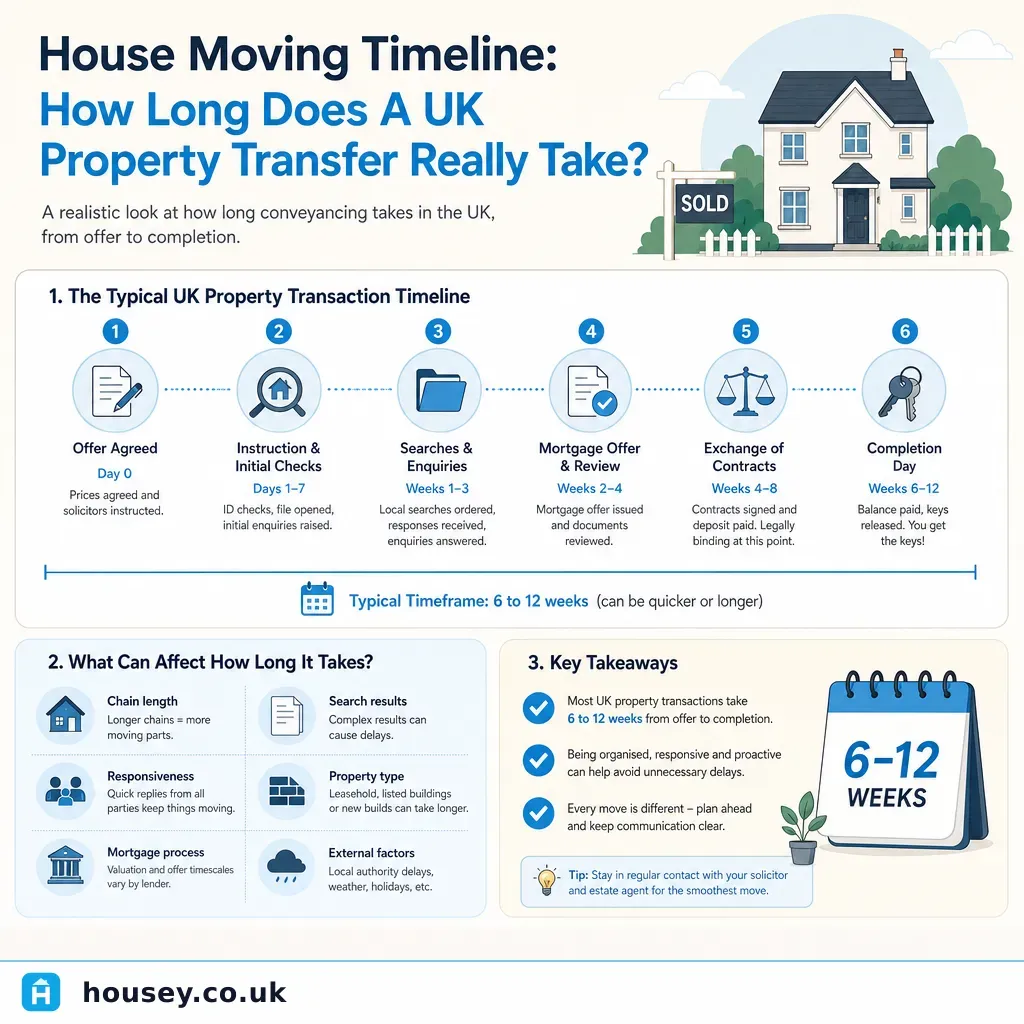
A UK property transfer typically takes 12–16 weeks from offer acceptance to completion, though chains, mortgage requirements, and survey findings can extend this considerably.