House Removal Costs and Moving Logistics: A UK Guide
By Housey · Last reviewed 6th of May 2026

House Removal Costs and Moving Logistics: A UK Guide
Moving home in the UK involves far more than hiring a van and packing some boxes. Completion day has a fixed time, you may be part of a chain still resolving itself that morning, and even a short local move can unravel without proper planning. Understanding what removal services actually cost — and what is and is not included — lets you budget accurately, compare quotes meaningfully, and avoid the kinds of last-minute surprises that make an already demanding day genuinely difficult.
Key points
- House removals for a standard 3-bedroom property typically cost £900–£2,500 for a local move and £1,500–£4,000+ for long-distance, depending on volume and services (indicative UK costs, last reviewed 2026-05-06)
- Standard removal company liability is usually capped at a fixed sum per item — full-value transit insurance must be confirmed as included or purchased separately before moving day
- Mid-week, mid-month moves are consistently cheaper; Fridays and end-of-month dates carry a premium of up to 25% with many firms
- British Association of Removers (BAR) accreditation gives access to a binding arbitration scheme and consumer protection if the firm fails to deliver
- Most removal firms recommend booking 4–6 weeks ahead, and 8–12 weeks for peak summer months (June–August) or large properties
What do house removals cost in the UK?
Removal costs vary based on property size, volume, distance, floor access, and the level of service chosen. The table below gives indicative ranges (indicative UK costs, last reviewed 2026-05-06; source: British Association of Removers industry data and Housey research):
Property size | Local move (under 50 miles) | Long-distance (50+ miles) | Full packing service added |
|---|---|---|---|
1-bed flat or studio | £300–£700 | £600–£1,200 | Add £150–£400 |
2-bedroom house | £600–£1,200 | £900–£2,000 | Add £250–£600 |
3-bedroom house | £900–£2,500 | £1,500–£3,500 | Add £400–£900 |
4–5 bedroom house | £1,500–£4,000 | £2,500–£6,000+ | Add £600–£1,500 |
These figures typically include one day of labour, a van of appropriate size, basic packing materials for fragile items, and furniture blankets. They do not usually include dismantling flat-pack furniture, specialist item handling (pianos, safes, large artwork), short-term storage, or transit insurance upgrades. Always obtain at least three quotes.
What affects the price of a house removal?
Volume and access Most firms quote by cubic footage or van load. A full loft, a basement, or a property with no nearby parking all increase time and cost. Narrow staircases or lifts in flats may mean items must be hand-carried further.
Level of service
- Basic (self-pack): you pack everything; the firm loads, transports, and unloads
- Part packing: the firm packs fragile or specialist items; you handle the rest
- Full packing: the firm packs everything, usually on the day before your move
- Full packing and unpacking: everything packed, moved, unpacked, and packaging removed
Day and date Mid-week, mid-month moves are the cheapest. End-of-month Fridays — when many solicitors target completion — are the most in-demand. Some firms charge 15–25% more for these peak dates. A Tuesday or Wednesday mid-month could save a meaningful sum if your completion date has flexibility.
Storage If a chain delay creates a gap between completion and move-in, short or long-term storage typically costs £25–£80 per week for a small unit (indicative UK costs, last reviewed 2026-05-06).
How to plan your move: a UK timeline checklist
This checklist assumes a completion date has been agreed and works backwards from that point.
8–12 weeks before completion
- Request quotes from at least three BAR-accredited or Which?-approved firms
- Confirm dates are flexible — completion dates can change
- Begin decluttering — items not moving are items not paid for
4–6 weeks before
- Book your preferred firm (most hold a date provisionally before exchange)
- Notify HMRC, DVLA, banks, utilities, GP, and arrange Royal Mail redirection
- Confirm what packing materials the firm supplies or order your own
2–3 weeks before
- Pack non-essential rooms: loft, spare room, garage
- Label all boxes with destination room and contents summary
- Confirm parking, lift bookings in flats, and key handover arrangements
1 week before
- Pack daily-use items last
- Confirm times and direct contact numbers with the removal team
- Prepare a moving-day bag: kettle, mugs, phone charger, medications, key documents
Moving day
- Check every room and outside storage before the van leaves
- Photograph utility meters at both properties at departure and arrival
- Receive keys and property documents at legal completion before the van is unloaded
Insurance: protecting your belongings in transit
Standard liability under the BAR code typically covers damage caused by the firm's negligence, not general accidental breakage. Compensation ceilings are often set per item and can be as low as £40 per kilogram.
Full-value transit cover pays replacement or repair cost up to an agreed declared value. Confirm whether this is included, an optional upgrade, or a separate policy entirely.
Your home contents insurance may already include some transit cover. Check your policy before paying for duplicate cover. Some insurers require advance notification of a move.
Self-packed items are frequently excluded from the removal company's liability, even if their crew physically handled those boxes throughout.
Red flags when choosing a removal company
- No physical address, landline number, or company registration number
- Quote given without a home or video survey for a large move
- No fixed-price option — only padded hourly rates
- No evidence of BAR membership or equivalent accreditation
- Insisting on full payment upfront via bank transfer only
- No written confirmation of quote terms, cancellation policy, or insurance position
When to get professional help
Most standard moves are handled competently by a reputable firm. Seek specialist input for:
- Pianos, safes, or large antiques: require specialist equipment and usually a separate insurance policy
- Cross-border or international moves: require customs paperwork and specialist logistics
- Properties with difficult access: request a site visit before the firm quotes
- Estate or probate moves: a dedicated house clearance service is often more appropriate if a significant volume of items needs disposing of rather than moving
How Housey can help
Housey connects you with vetted house removals companies across the UK so you can compare quotes, check credentials, and book with confidence. If your completion and move-in dates do not align, you can also find providers of short or long-term storage through the same marketplace, or arrange a house clearance service if a property needs clearing before or during your move.
Frequently asked questions
How far in advance should I book a removal company?
For most moves, contact firms at least 4–6 weeks before your intended completion date and 8–12 weeks during the summer peak (June–August). You do not need to wait for exchange of contracts — most firms will hold a provisional date. Leaving it until the final week severely limits choice and usually means paying a premium for whatever dates remain available.
Do I need to be present on moving day?
You or a trusted representative should be available throughout the day to supervise loading, confirm all items are accounted for, and accept delivery at the new property. For complex or large moves, your physical presence is strongly recommended. If you cannot attend, provide the crew with a detailed written inventory and a contact number reachable at short notice.
What happens if my completion is delayed on moving day?
Chain-related delays on moving day are more common than most people expect. Confirm the removal company's delay policy before booking. Reputable firms hold belongings in the van or a secure facility while awaiting key release, often at an agreed hourly rate. Get this policy confirmed in writing as part of your contract before your move date.
Is VAT included in removal quotes?
Many removal companies charge VAT at 20%, and quotes may be presented either inclusive or exclusive of tax. Always ask specifically. Sole traders below the VAT registration threshold (currently £90,000 annual turnover as of 2026) may not charge it. When comparing quotes, ensure you are comparing VAT-inclusive totals to avoid a misleading price difference between firms.
Can I move some items myself and use a removal firm for the rest?
Yes — many homeowners move lightweight boxes themselves in the days before completion, leaving the removal firm to handle furniture and fragile items. Tell the firm at quoting stage so they assess the correct remaining volume. Be aware that self-packed boxes are frequently excluded from the removal company's transit insurance if their contents are damaged in transit.
Sources and further reading
- British Association of Removers (BAR) — industry standards, member search, and consumer protection schemes
- Tell DVLA you have changed address — GOV.UK official address-change guidance
- Royal Mail address redirection service — Royal Mail, mail forwarding for house moves
- Moving home — Citizens Advice, practical guidance on tenant rights and logistics
- How to find a good removal company — Which?, independent consumer guidance on choosing and vetting a firm
Useful next reads
 Buying & Moving
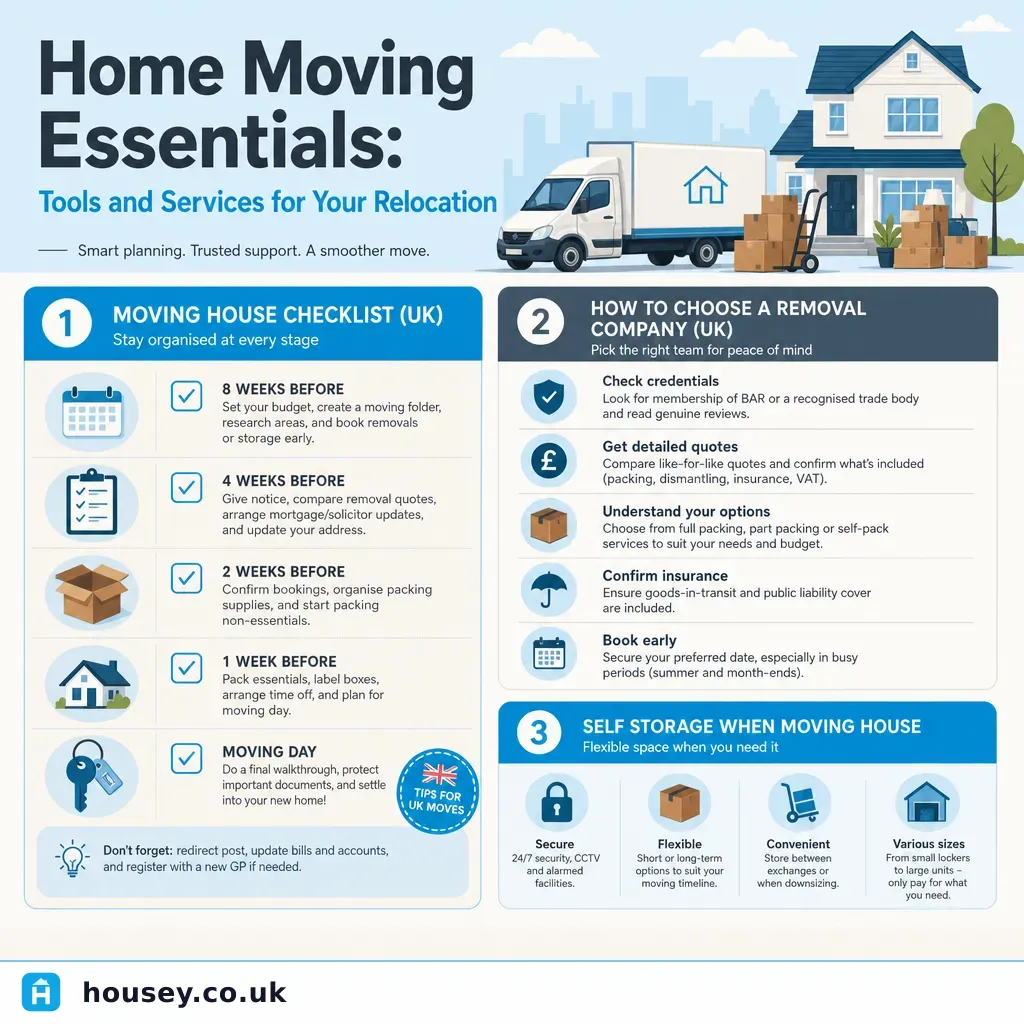
Home Moving Essentials: Tools and Services for Your Relocation
Moving house in the UK involves far more than hiring a removal van.
 Buying & Moving
How Removal Services Integrate Storage Solutions
Many UK removal companies offer integrated storage as part of their moving service, letting you store belongings in a secure facility — often a sealed container or warehouse unit — when completion dates do not align.
 Buying & Moving
Types of Removal Companies: Choosing the Right Mover for Your Relocation
UK removal companies range from man-and-van operators for small moves to full-service firms that pack, transport, store, and unpack.
 Buying & Moving
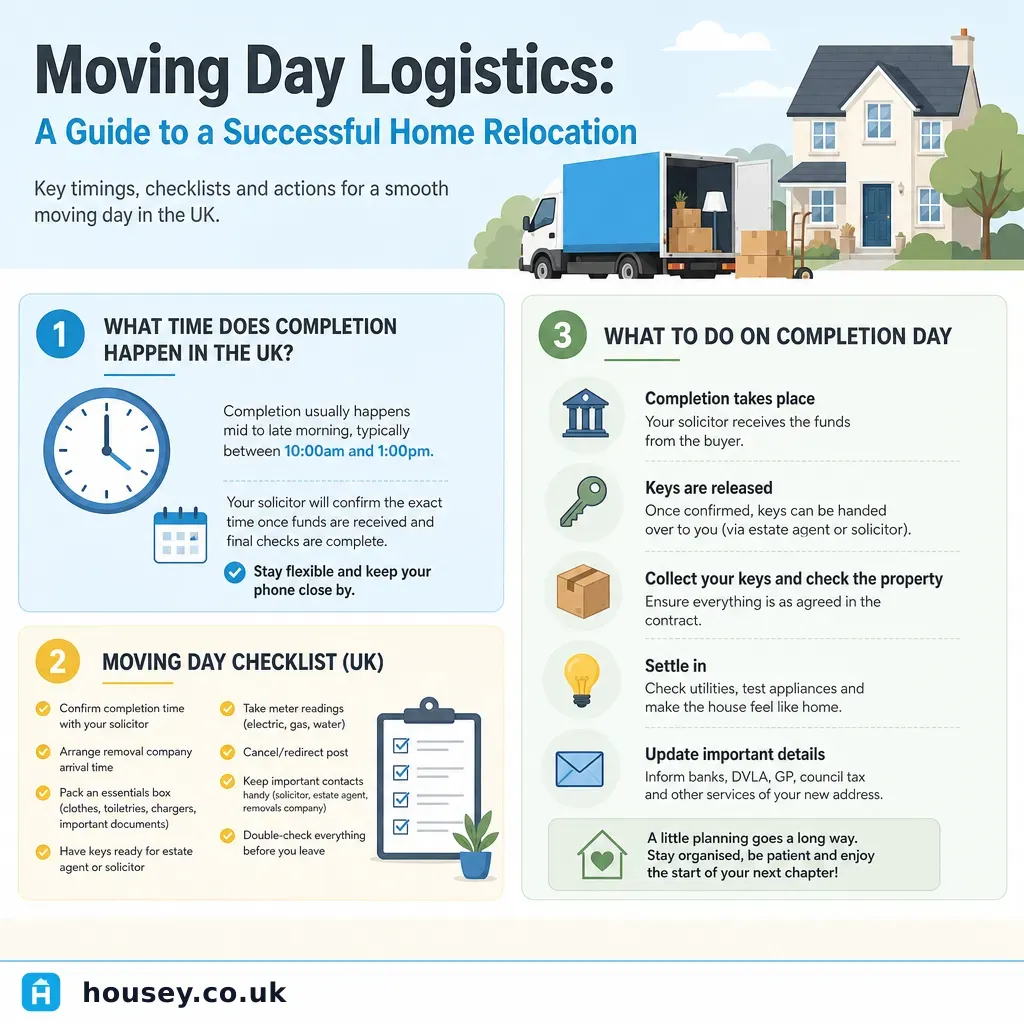
Moving Day Logistics: A Guide to a Successful Home Relocation
On moving day, wait for your solicitor to confirm completion before collecting keys — there is no fixed handover time and most UK completions happen between 11am and 2pm.
 Buying & Moving
Choosing a House Removal Company: What to Look For
Choose a UK removal company that belongs to the British Association of Removers (BAR) or the Removals Industry Ombudsman Scheme (RIOS), carries goods-in-transit and public liability insurance, and provides a written quote after properly surveying your home.