Assessing Renovation Potential When Purchasing a Property Requiring Updates
By Housey · Last reviewed 18th of May 2026
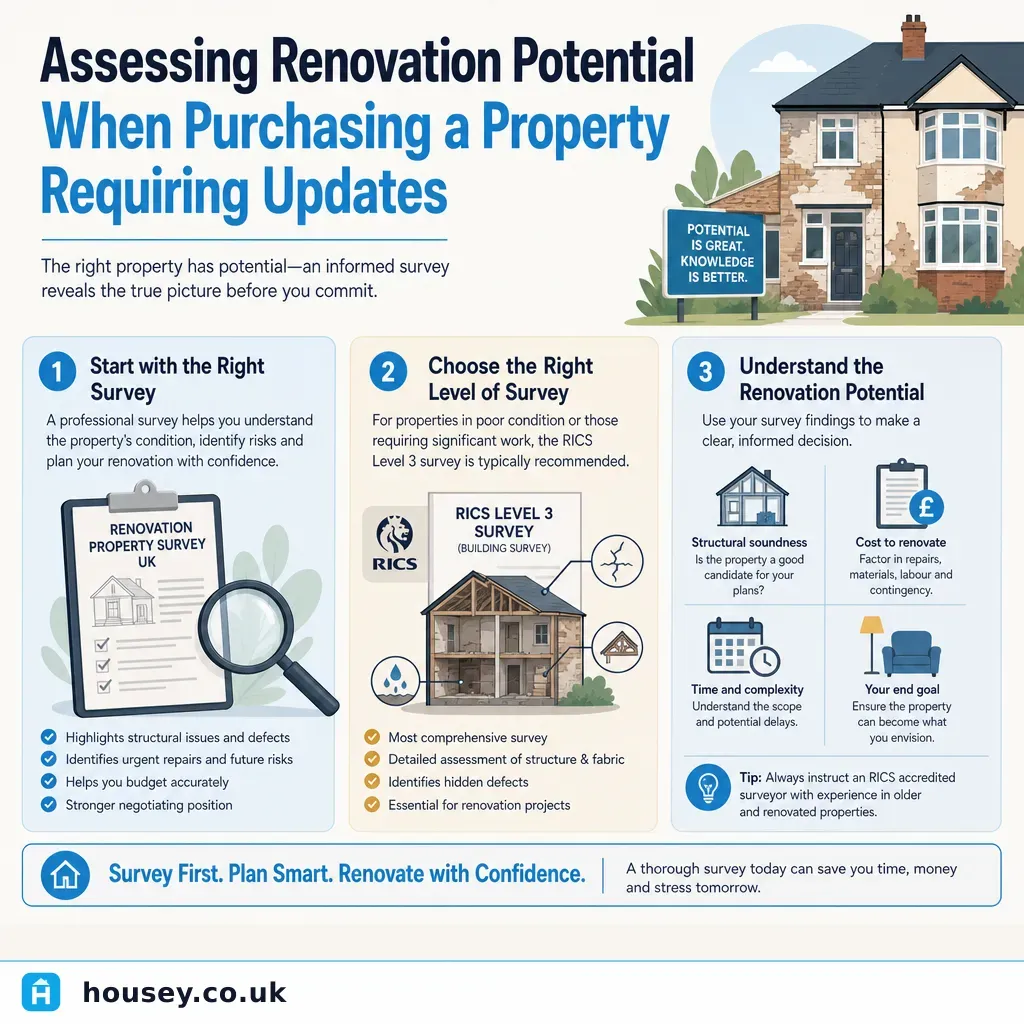
Assessing Renovation Potential When Purchasing a Property Requiring Updates
Properties advertised as "in need of updating" or "requiring modernisation" attract buyers who see genuine opportunity — but the gap between a cosmetic refresh and a full structural overhaul can run to tens of thousands of pounds. Understanding that gap before exchange is one of the most important financial checks in any renovation purchase.
Key points
- A RICS Level 3 Building Survey is the most appropriate pre-purchase inspection for older, altered, or visibly defective properties — it provides a full structural assessment and identifies maintenance priorities.
- Building control completion certificates confirm whether previous works — including extensions, loft conversions, and rewires — were inspected and signed off; missing certificates may require a regularisation application or specialist indemnity insurance.
- Structural defects such as subsidence, failed lintels, or roof spread can add £20,000–£100,000+ to a renovation budget depending on severity (indicative UK costs, last reviewed 2026-05-18).
- Planning history is publicly searchable via the local planning authority's portal — unauthorised works on a dwelling may carry enforcement risk for up to four years, and change of use up to ten years.
- Damp has multiple possible causes — rising damp, penetrating damp, condensation, or failed tanking — each requiring a different remedy; misdiagnosis by non-specialist sources is common.
Important limitations
This article provides general guidance only. The condition, age, tenure, and location of any specific property will significantly affect which surveys are appropriate and what risks apply. A qualified chartered surveyor, structural engineer, or building control consultant should assess your specific situation before you commit to purchase or begin works.
What does renovation potential actually mean?
Renovation potential is the difference between what a property costs to buy and what it could be worth after completed works, minus the cost of those works and associated professional fees. To assess this reliably, you need three things: a clear picture of the structural condition, a check of the planning and building control history, and a realistic scope and indicative cost for the works you intend to carry out.
A property with sound bones — intact roof structure, solid walls, no active structural movement — may require relatively modest investment to bring up to standard. A property with significant structural problems, asbestos-containing materials, or a backlog of unauthorised works will carry much higher and less predictable costs.
Which surveys should you commission before purchase?
Survey type | Best for | What it covers | Typical professional |
|---|---|---|---|
RICS Level 3 Building Survey | Older, altered, unusual, or visibly defective properties | Full structural assessment, defects, maintenance risks, legal issues to raise | RICS-chartered surveyor |
Specific defect survey | Where a particular problem needs investigation (e.g. a crack or damp patch) | Targeted diagnosis of a single identified defect | RICS surveyor or structural engineer |
Damp and timber survey | Where damp, rot, or woodworm is suspected | Moisture source identification, timber condition, cause assessment | Specialist damp surveyor (independent preferred) |
Structural engineer's report | Suspected movement, cracking, roof spread, or beam failure | Engineering diagnosis and recommended remediation | Chartered structural engineer (MIStructE or CEng) |
Choose based on the property's profile — not just its price. A 1990s estate house in good visible condition may suit a Level 2 survey. A Victorian terrace with a cracked bay window, a rear extension, and no paperwork warrants a Level 3 survey and, potentially, a structural engineer's report.
How to check planning and building control history
Before exchange, your conveyancer will check the local authority search — but you can carry out preliminary checks yourself.
Planning history is searchable through most local planning authority portals by property address. Look for:
- Approved planning applications for any extensions, outbuildings, or loft conversions — and whether planning conditions were formally discharged.
- Outstanding enforcement notices — these transfer with the property on sale.
- Listed building or conservation area designations — these significantly restrict what you can alter.
Building control records confirm whether physical works were completed to the satisfaction of the local authority building inspector. Request evidence of completion certificates for any extension, loft conversion, basement conversion, underpinning, or electrical rewire. Missing certificates may require a regularisation application and can affect your ability to sell in the future.
Worked example: a 1930s semi with a rear extension
A 1930s semi-detached property is listed at £235,000 in the East Midlands. The vendor added a single-storey rear extension approximately 15 years ago; there are hairline cracks above two ground-floor window openings.
A RICS Level 3 survey identifies:
- The extension has no building control completion certificate.
- The cracks above the windows are consistent with lintel deterioration, not subsidence.
- The flat-roof extension shows evidence of water pooling and requires replacement within two to three years.
Indicative additional costs identified (last reviewed 2026-05-18):
- Regularisation application for the extension: £600–£1,500
- Lintel replacement at two openings: £1,500–£3,000
- Flat-roof replacement: £3,500–£6,000
Total identified risk budget before cosmetic renovation: approximately £5,600–£10,500. This kind of finding typically forms the basis of a renegotiation request before exchange, and in many cases the vendor will reduce the asking price or undertake the most urgent remediation as a condition of sale.
How to estimate renovation costs before committing
Obtain indicative quotes — not final prices — from at least two contractors before exchange. Be explicit that these are for budgeting purposes. Key cost categories to assess:
- Structural works: underpinning, beam replacement, roof structure repairs
- External envelope: roof covering, gutters, pointing, window replacement
- Services: rewiring and EICR remediation, gas installation, drainage
- Insulation and energy performance: loft insulation, solid wall insulation, heating system
- Internal works: kitchen, bathrooms, plastering, decorating, flooring
For whole-house renovation projects, a project manager or quantity surveyor can prepare an early-stage cost plan — particularly useful where the scope is complex or the budget is constrained.
Red flags that increase renovation risk
Seek specialist advice before proceeding if you observe any of the following:
- Active cracks that are widening, stepped diagonally through brickwork, or accompanied by sticking doors or windows — possible subsidence or structural movement.
- A pervasive smell of damp or visible mould on ground-floor walls — possible rising damp, high water table, or drainage failure.
- Corrugated roofing sheets on outbuildings or older extensions where the material is unknown — potential asbestos-containing material; do not disturb.
- No evidence of any gas safety or electrical inspection in an occupied property.
- A loft conversion or basement room where the vendor cannot produce drawings, building control approval, or a completion certificate.
- Outstanding planning enforcement notices on the local authority search.
When this becomes urgent
Seek professional advice immediately if: a survey reveals active structural movement or a widening crack; you identify materials that may contain asbestos; or a structural engineer recommends monitoring or emergency stabilisation. Do not exchange contracts on a property with unresolved structural concerns without independent engineering advice.
What to ask a qualified professional
Before instructing a RICS surveyor or structural engineer:
- Is this property better assessed at Level 2 or Level 3, given its age, construction type, and visible condition?
- Will the survey include roof structure, drainage, and services — or are these additional?
- If defects are found, will the report include remediation recommendations and indicative costs?
- Are you independent, or do you also provide remediation services that could create a conflict of interest?
- Will you flag areas where specialist follow-up investigation is needed before exchange?
When to get professional help
For any pre-1980 property, or any property that has had extensions, loft conversions, or visible past repairs, commissioning a RICS Level 3 Building Survey before exchange is a cost-control measure, not an optional extra. If the survey flags structural movement, instruct a structural engineer before proceeding. If asbestos-containing materials may be present — common in properties built between 1950 and 1999 — arrange a professional asbestos survey before any intrusive works are planned.
How Housey can help
Housey connects you with qualified local professionals to help assess renovation potential before you commit to purchase. Find RICS-chartered surveyors for structural surveys and specific defect surveys, as well as specialists for damp and timber surveys. Once exchanged, Housey can also connect you with structural engineering consultants and experienced project managers to help plan and cost your works.
Frequently asked questions
Do I need a survey if I am buying a renovation property with a mortgage?
Your mortgage lender will require a valuation, but this does not protect you — it assesses the lender's security, not the property's condition. For a renovation property, a RICS Level 3 Building Survey is the appropriate pre-purchase inspection. Its cost is often recoverable through renegotiation if significant defects are identified.
Can I renegotiate the purchase price after a survey reveals defects?
Yes. Survey findings are routinely used to negotiate a price reduction or request that the vendor remedies specific defects before exchange. Support any renegotiation request with written contractor estimates where possible. Neither party is legally obliged to renegotiate, but it is standard practice in UK residential transactions.
How much does a RICS Level 3 Building Survey cost?
Indicative UK costs, last reviewed 2026-05-18: £600–£1,500+ depending on property size, location, and complexity. Older or larger properties attract higher fees. Obtain at least two quotes and confirm exactly what is included before instructing — some surveyors charge separately for outbuildings or drainage inspections.
Should I get contractor quotes before exchange on a renovation property?
Yes. For major works, obtaining indicative contractor quotes before exchange allows you to confirm the project is financially viable before committing. Be clear to contractors these are budgeting quotes rather than final prices. For complex whole-house projects, a quantity surveyor or project manager can prepare an early-stage cost plan to give you greater certainty.
Sources and further reading
- RICS Home Survey Standard — RICS
- GOV.UK: Planning permission guidance — GOV.UK
- GOV.UK: Building regulations approval — GOV.UK
- HSE: Asbestos — the hidden killer — Health and Safety Executive
- Historic England: Listed buildings and conservation areas — Historic England
Useful next reads
 Improvement & Build
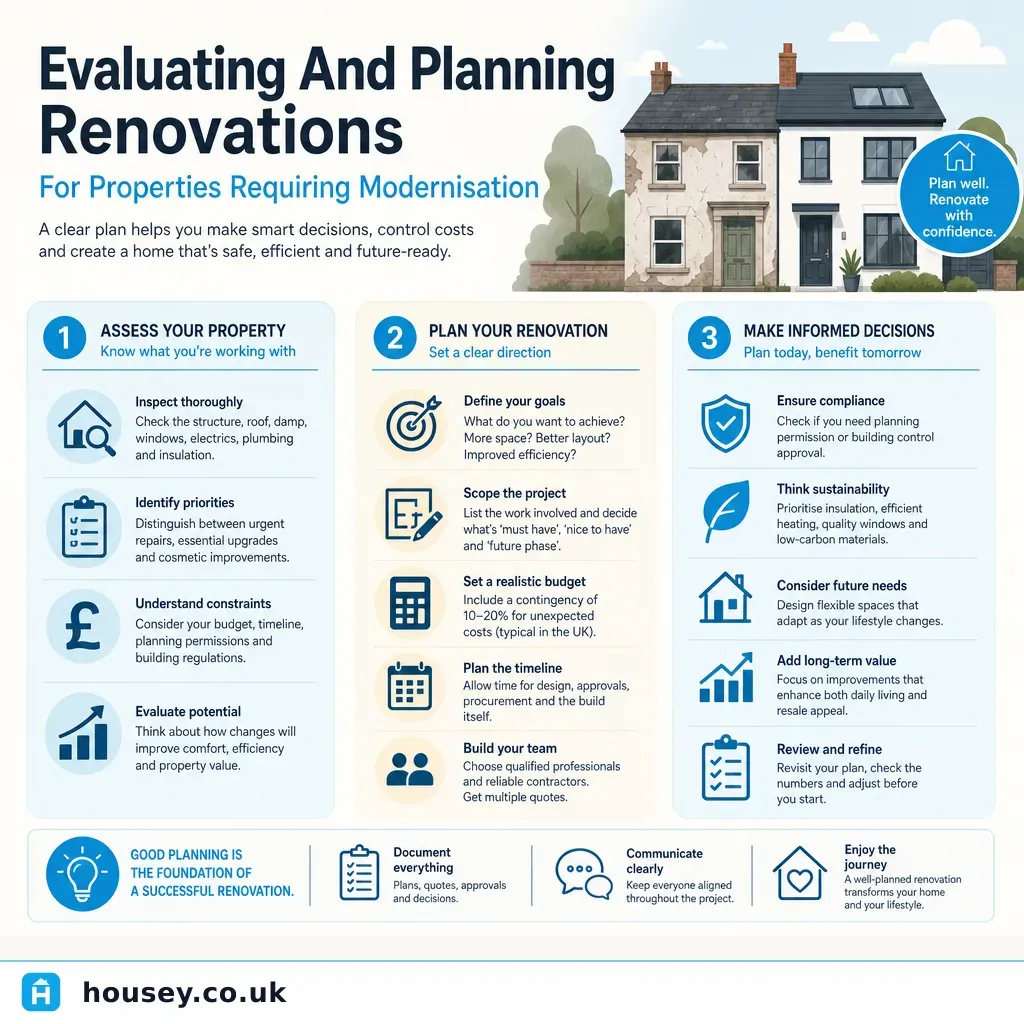
Evaluating And Planning Renovations For Properties Requiring Modernisation
Start by commissioning a condition survey — RICS Level 3 for pre-1919 properties — to identify structural defects, damp, and services issues before finalising a budget.
 Improvement & Build
Selecting and Hiring a Remodelling Contractor
Hiring a remodelling contractor starts with a written scope of works and a shortlist of at least three companies registered with TrustMark or the Federation of Master Builders.
 Improvement & Build
Selecting Renovation Contractors for Your Property Project
When selecting a renovation contractor, get at least three written, itemised quotes from contractors who have visited the site, verify membership of a recognised trade body such as the Federation of Master Builders, check references from comparable recent projects, and agree a detailed written contract before work starts.
 Improvement & Build
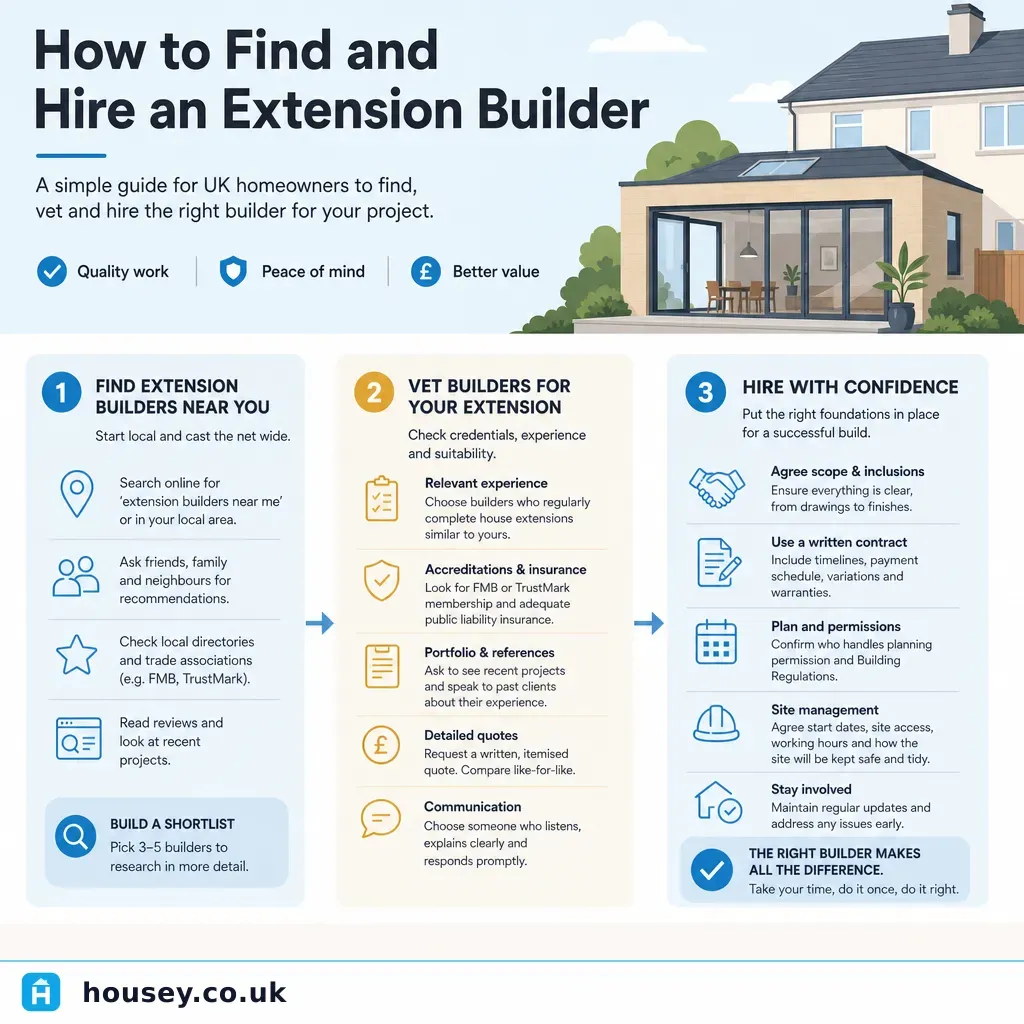
How to Find and Hire an Extension Builder
To hire a reliable extension builder, get at least three detailed written quotes from contractors with documented experience of similar projects.
 Improvement & Build
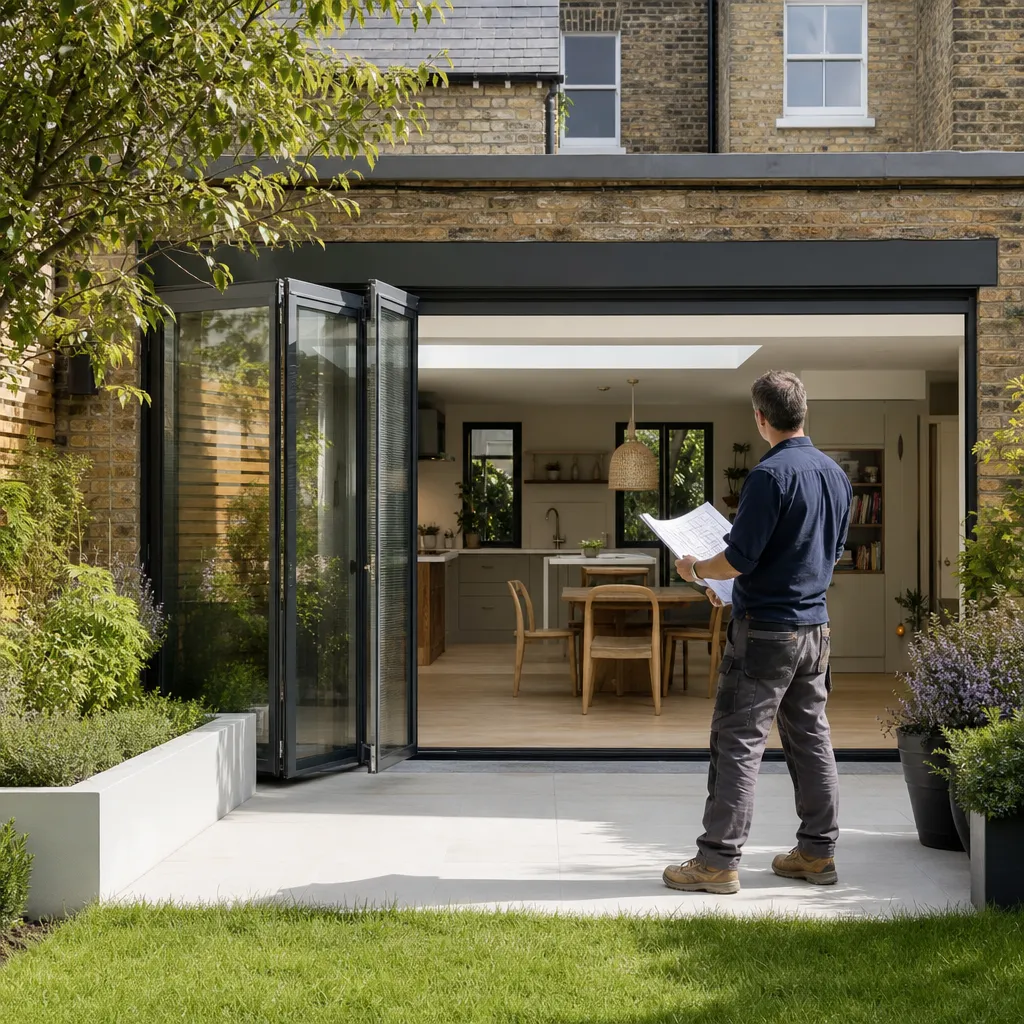
Home Improvement Projects That Add Value to Your Property
Loft conversions, rear extensions, and kitchen refurbishments typically offer the strongest return on investment for UK homeowners.