Selecting and Hiring a Remodelling Contractor
By Housey · Last reviewed 18th of May 2026

Selecting and Hiring a Remodelling Contractor
Whether you are reconfiguring a ground floor layout, adding a rear extension, or gut-renovating a Victorian terrace, the contractor you appoint will shape the outcome of the project more than any specification document. Choosing the wrong firm is among the costliest mistakes a UK homeowner can make: disputes over variation costs, delays, and defective work are among the most common complaint categories received by trading standards bodies and the Federation of Master Builders' dispute-resolution service. Finding the right contractor requires structured vetting, not speed.
Key points
- All structural work, extensions, and most significant internal alterations require building regulations approval under the Building Act 1984; your contractor must either submit an application or engage an approved inspector.
- Permitted development allows single-storey rear extensions up to 8 metres deep for detached houses and 6 metres for semi-detached and terraced properties; exceeding these limits, or adding a second storey beyond 3 metres depth from the original rear wall, almost always requires a full planning application under the Town and Country Planning (General Permitted Development) (England) Order 2015.
- The Construction (Design and Management) Regulations 2015 (CDM 2015) apply to most domestic renovation projects where more than one contractor works consecutively or simultaneously — as domestic client you carry specific duties under the regulations.
- A written contract — typically the JCT Minor Works Building Contract or equivalent — is essential; it sets out scope, programme, payment schedule, and the process for handling disputes and variations.
- Public liability insurance of at least £1–2 million is a standard expectation; employer's liability insurance is required by law wherever the contractor directly employs staff on site.
Understanding the types of remodelling contractor
The term remodelling contractor — or renovation contractor, as it is more commonly used in the UK — covers a wide spectrum of firms and individuals. Matching the right type to your project avoids costly gaps in responsibility.
Contractor type | Scope | Best for | Limitations |
|---|---|---|---|
General building contractor | Full build — you supply design drawings and planning permission | Extensions and major renovation where you already have an architect | You must manage design, planning, and building control separately |
Design-and-build firm | Architecture, planning, and construction under one contract | Homeowners who want a single point of responsibility | Often a higher fee; verify design quality independently before committing |
Specialist trade contractor | Single trade — plastering, tiling, or electrical work | Smaller jobs within a broader refurbishment programme | You must coordinate multiple trades yourself |
Main contractor with subcontractors | Manages and coordinates all trades on your behalf | Large or complex projects lasting more than 8–12 weeks | Quality depends on subcontractor selection; ask in advance who they use |
Which contractor do you need? — a decision guide
- Choose a general building contractor if you already have planning permission and approved building regulations drawings from an architect, and the project is primarily construction rather than design.
- Choose a design-and-build firm if you want a single point of contact from concept to completion and are comfortable with a slightly higher fee for that coordination.
- Appoint a structural engineer separately if you are uncertain about load-bearing walls, steel beam specifications, or foundation adequacy — this is not work to delegate to a contractor without qualified engineering oversight.
- Engage a contract administrator if the project value exceeds £50,000 — professionally administered contracts reduce variation-cost disputes significantly.
- Check your local planning authority before starting any extension work, as permitted development limits, Article 4 Directions, and conservation area rules vary considerably by location and property history.
How to find and shortlist contractors
Begin with scheme registrations rather than paid advertisements or social media recommendations:
- TrustMark (trustmark.org.uk): Government-endorsed quality scheme; registered contractors are subject to independent inspection for quality and financial probity.
- Federation of Master Builders (FMB) (fmb.org.uk): Vets members' trading history and quality; offers independent dispute resolution to consumers.
- Checkatrade / Which? Trusted Traders: Verification checks and consumer reviews — useful as a second signal, though always follow up with direct references.
- Local architect recommendations: Architects regularly work with local contractors and can recommend firms they have observed performing well on site.
Aim for a shortlist of three firms. Fewer reduces competitive tension on price; more becomes unwieldy to manage through the tender process.
Vetting contractors before you invite quotes
Before sharing your project details with any contractor, carry out these basic checks:
Homeowner pre-appointment checklist
What to include when requesting quotes
A vague brief produces vague quotes, which makes fair comparison impossible and creates disputes once work starts. Provide each contractor with:
- A written scope of works, including any drawings or sketches available.
- The building regulations approach you intend to follow — full plans application or building notice.
- Any known constraints: party wall requirements, listed building or conservation area status, suspected asbestos in the existing structure.
- Your preferred programme start date and any hard completion deadlines.
- A clear indication of quality specification — for example, standard builder's finish versus high-specification finishes throughout.
What to ask before accepting a quote
- What is explicitly excluded from the quote, and who is responsible for those excluded items?
- Is VAT included in the figure as stated?
- What payment schedule do you propose, and are stage payments linked to independently verified milestones or simply to calendar dates?
- What form of contract do you use, and will you sign a JCT Minor Works Building Contract or equivalent?
- Which subcontractors do you intend to use for electrical, plumbing, and plastering works?
- What structural warranty or latent defects insurance will be provided at practical completion?
- How will variation orders be handled — will all scope changes be confirmed in writing before additional costs are incurred?
- What is your process when unexpected problems — rotted joists, hidden asbestos, inadequate foundations — are found once work starts?
Red flags
Do not proceed if any of the following apply:
- The contractor requests more than 10–15% upfront before work starts.
- No written contract or specification is offered.
- The quote is a round number with no breakdown by trade or work package.
- The contractor cannot confirm who will manage the build on a day-to-day basis.
- Insurance cannot be evidenced in writing.
- References are provided but the contractor discourages you from contacting them directly.
When to get professional help
For projects involving structural alterations, new foundations, or uncertain scope, appoint a RIBA-chartered architect or RICS-accredited building surveyor before approaching contractors. These professionals can define the scope clearly, manage the tender process, and administer the contract — all of which reduce the risk of disputes and budget overruns that are disproportionately common when homeowners manage large projects without professional oversight.
How Housey can help
Housey works with vetted extension builders and design-and-build firms across the UK. Submit your project details once and receive up to four competitive quotes from local contractors assessed for quality, insurance, and accreditation — compare experience and pricing side by side before appointing anyone.
Frequently asked questions
Do I need a written contract for home renovation work?
Yes. A written contract is essential for any significant remodelling project. It should specify the scope of works, programme, payment schedule, variation-order process, and dispute-resolution mechanism. The JCT Minor Works Building Contract is widely used for residential projects in the UK. Without a written contract, enforcing agreed terms is significantly harder if a dispute arises.
How do I compare renovation quotes fairly?
Ask each contractor to quote against the same written specification. Comparing quotes submitted on different assumptions — some including VAT, some excluding groundworks — is common and leads to disputes. Once you have like-for-like quotes, investigate any that are significantly lower than the others: these often reflect scope omissions rather than greater efficiency or genuine value.
What is CDM 2015 and does it apply to my home renovation?
The Construction (Design and Management) Regulations 2015 apply to most domestic projects involving more than one contractor working at different times. Under CDM 2015 you become the domestic client with specific duties, including providing pre-construction information and notifying the Health and Safety Executive for notifiable projects. Your contractor should be familiar with these obligations; if they are not, that is a concern.
How much deposit should I pay a remodelling contractor?
A deposit of 10–15% before work begins is customary for materials procurement on larger projects. Stage payments tied to construction milestones are standard for projects lasting several weeks. Avoid paying more than 25% of the total contract value before substantial work has been completed and independently verified.
Sources and further reading
- Planning permission for extensions — GOV.UK
- CDM 2015: guidance for domestic clients — Health and Safety Executive
- JCT Minor Works Building Contract — Joint Contracts Tribunal
- Find a builder: Federation of Master Builders — Federation of Master Builders
- TrustMark: find a tradesperson — TrustMark
Useful next reads
 Improvement & Build
Selecting Renovation Contractors for Your Property Project
When selecting a renovation contractor, get at least three written, itemised quotes from contractors who have visited the site, verify membership of a recognised trade body such as the Federation of Master Builders, check references from comparable recent projects, and agree a detailed written contract before work starts.
 Improvement & Build
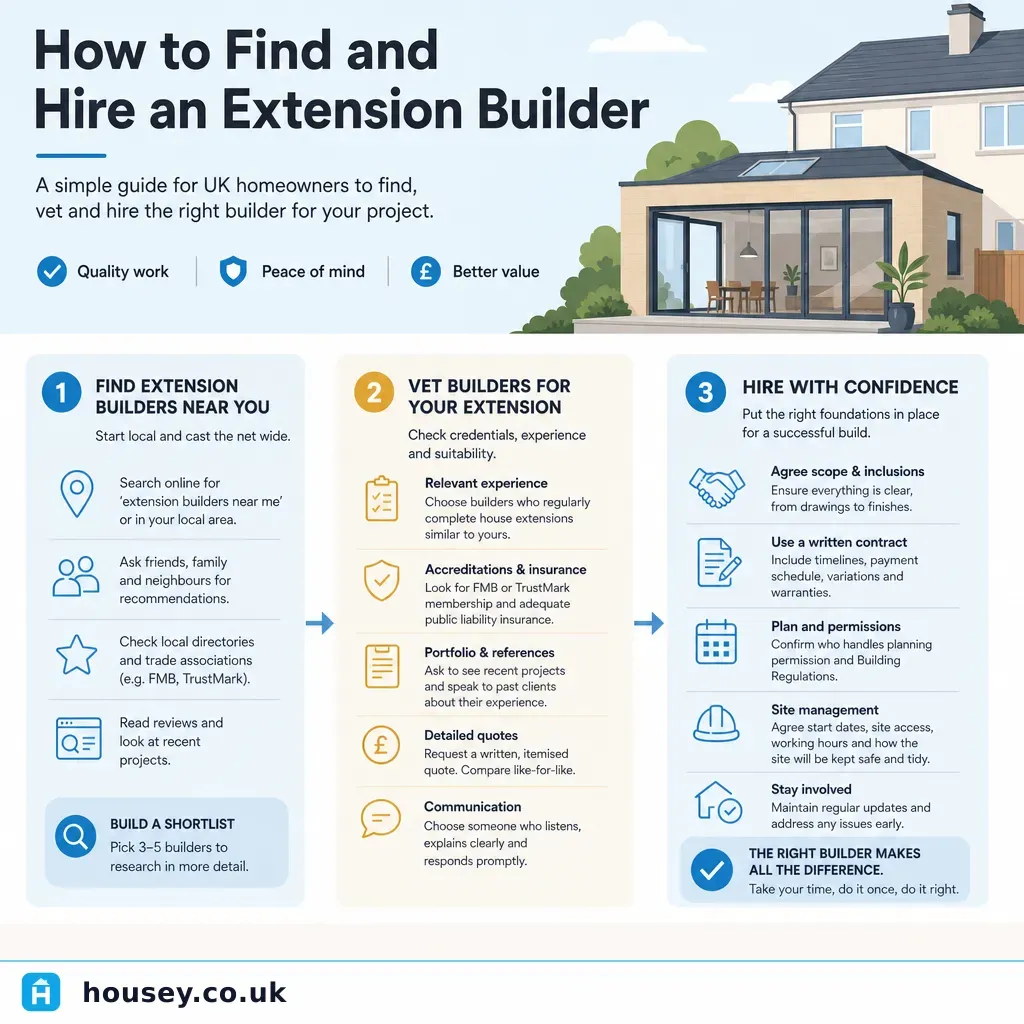
How to Find and Hire an Extension Builder
To hire a reliable extension builder, get at least three detailed written quotes from contractors with documented experience of similar projects.
 Improvement & Build
How to Hire a Professional Window Installer
Use a FENSA or CERTASS-registered installer so your window replacement complies with Building Regulations Part L and Part Q and you receive a certificate registered with your local authority.
 Improvement & Build
Evaluating And Planning Renovations For Properties Requiring Modernisation
Start by commissioning a condition survey — RICS Level 3 for pre-1919 properties — to identify structural defects, damp, and services issues before finalising a budget.
 Improvement & Build
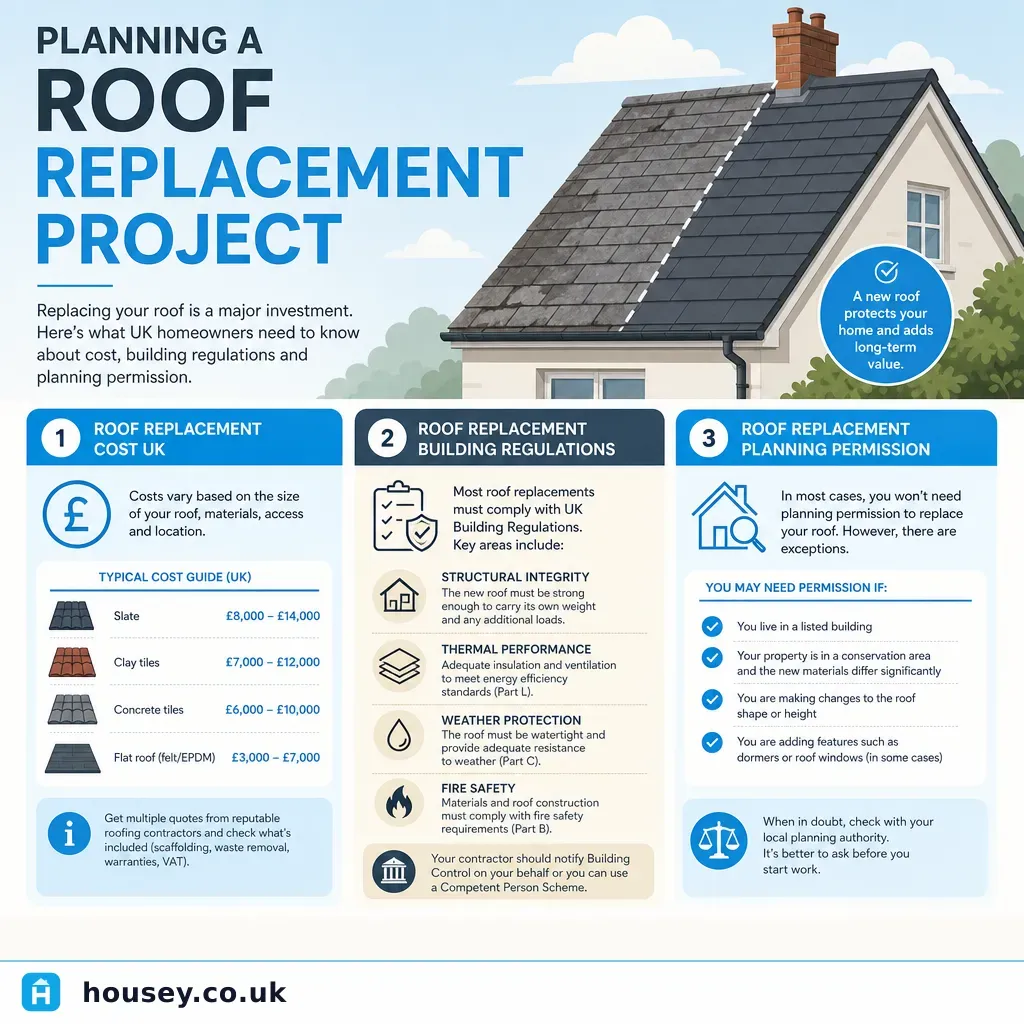
Planning a Roof Replacement Project
A roof replacement project involves stripping the existing covering, renewing the sarking felt and battens, and laying new tiles, slates, or a flat-roof membrane.