How to Find and Hire an Extension Builder
By Housey · Last reviewed 12th of May 2026
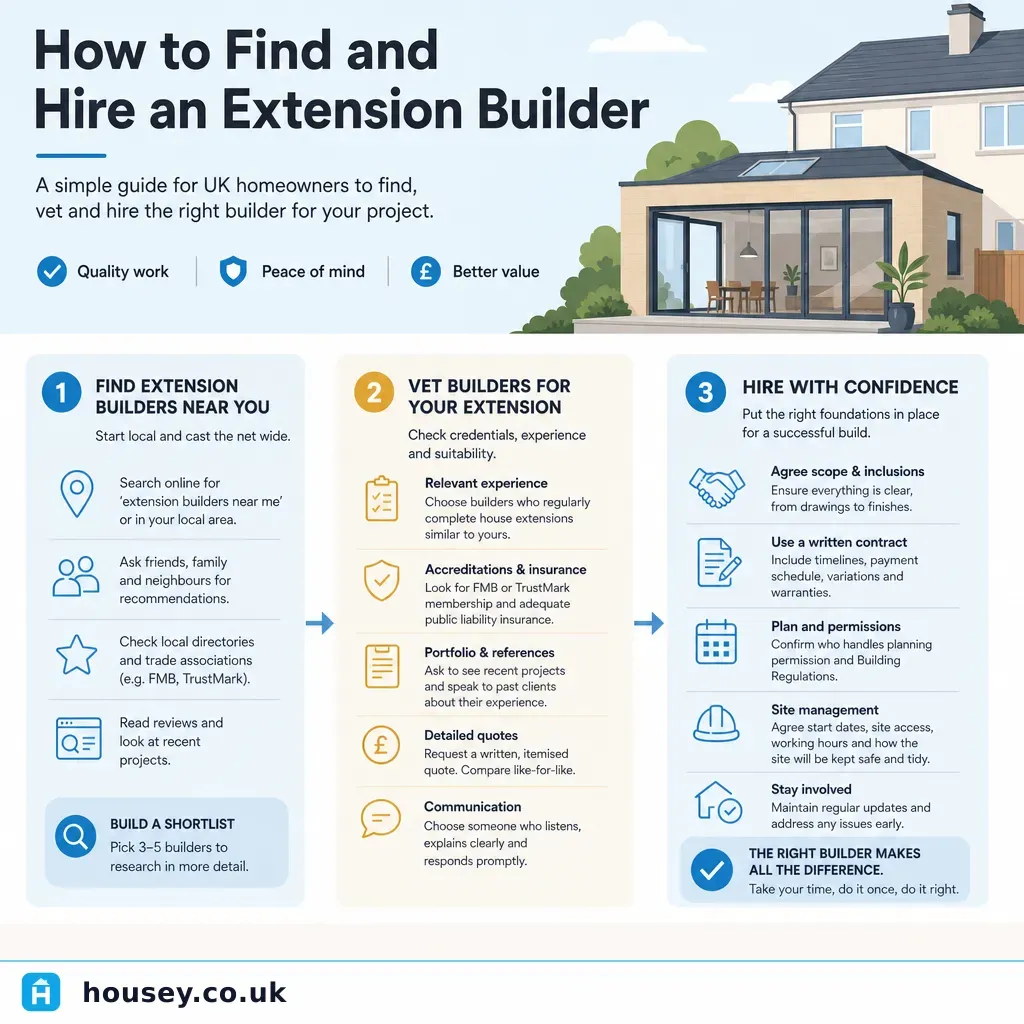
How to Find and Hire an Extension Builder
A house extension is one of the larger building projects most UK homeowners undertake, and who builds it shapes how the entire project unfolds. Structural work, building regulations approval, and often a planning application all run alongside the process of sourcing and managing a contractor. Getting the hiring process right before anyone breaks ground can prevent significant cost overruns, disputes, and delays that are hard to resolve once work is under way.
Key points
- Most single-storey rear extensions in England qualify for permitted development if they extend no more than 4m (detached) or 3m (semi-detached or terraced) from the original rear wall — but this must be confirmed with your local planning authority before work begins.
- Building regulations approval is required for virtually all extension work, regardless of whether planning permission is needed; a competent builder should be familiar with Approved Documents A (structure), B (fire), C (damp), F (ventilation), and L (energy efficiency) as a minimum.
- The Federation of Master Builders (FMB) independently vets members for quality, qualifications, and insurance — its Find a Builder tool is a reliable starting point.
- A stage payment schedule tied to completion milestones — not calendar dates — is standard practice on reputable extension projects and aligns the builder's incentives with progress.
- If works are close to a shared boundary or involve excavation near a neighbour's foundations, the Party Wall etc. Act 1996 may require you to serve notice on adjoining owners before work begins.
Where to find extension builders
There are several reliable routes to finding credible candidates:
- Recommendations from neighbours or friends: ask specifically about extensions of similar size, type, and complexity to yours.
- Federation of Master Builders (FMB) Find a Builder tool: FMB members are independently vetted for quality, qualifications, and insurance.
- TrustMark registered contractors: a government-endorsed quality scheme that assesses competence and trading practices.
- Housey: submit your project details once and receive quotes from vetted extension builders matched to your location and project type.
- Your architect or architectural technician: if you have already engaged a designer for drawings, they often know builders who have delivered similar projects to specification and on time.
Avoid relying solely on online directories without a vetting process, cold callers, or builders whose only reviews appear on their own website.
How to evaluate extension builders
Experience and portfolio
Ask to see photographs of completed extensions of similar type and scale. Even better, ask whether you can visit a finished project. Key questions to ask:
- Have you built this type of extension before — single-storey rear, two-storey, side-return, or wrap-around?
- How many comparable projects have you completed in the last two years?
- Can I speak to a previous client whose project was similar in scale and specification to mine?
- Have you worked with the building control team at my local authority before?
A builder who hesitates to provide references for comparable work is worth treating with caution.
Insurance and qualifications
Verify these before signing any contract:
- Employer's liability insurance: a legal requirement where the builder has employees, under the Employers' Liability (Compulsory Insurance) Act 1969.
- Public liability insurance: protects you if a third party is injured or property is damaged during the works. A minimum of £2 million coverage is typical; £5 million is preferable for extension projects.
- Professional indemnity insurance: relevant if the builder is also carrying out design or specification work alongside the build.
Ask to see current certificates rather than simply accepting a claim of coverage.
Comparing quotes: a checklist
Three or more detailed written quotes is standard guidance — but comparing them meaningfully requires all quotes to specify the same scope. Use this checklist to review them side by side:
Item to check | Quote A | Quote B | Quote C |
|---|---|---|---|
Structural engineer fees included? |
|
|
|
Planning application fee included? |
|
|
|
Building regulations application fee included? |
|
|
|
Groundworks and foundation specification stated? |
|
|
|
Wall construction material specified? |
|
|
|
Insulation standard — Part L 2021 compliant? |
|
|
|
Window and door U-values stated? |
|
|
|
Roof type and specification included? |
|
|
|
Internal finishes (plastering, flooring) included? |
|
|
|
First and second fix electrics and plumbing included? |
|
|
|
Site clearance and waste disposal included? |
|
|
|
VAT included? |
|
|
|
Stage payment milestones defined? |
|
|
|
Projected start and completion dates given? |
|
|
|
A quote that omits building regulations fees, structural engineer costs, or waste disposal will appear cheaper than one that includes them — until those invoices arrive separately mid-project.
Planning permission and building regulations: what to check
Your builder should understand both processes, but responsibility for compliance ultimately rests with the homeowner.
- Planning permission is the question of whether a development is allowed. Permitted development rights in England allow many extensions without a formal application, but conditions vary by size, materials, and location. Conservation Areas, listed buildings, and Article 4 directions remove or restrict these rights.
- Building regulations govern how the extension is built — structural integrity, fire safety, energy efficiency (Part L 2021), drainage, and ventilation. These are a separate legal requirement from planning permission and apply to almost all extension work.
- Party Wall etc. Act 1996: if works are within 3m or 6m of a neighbour's foundations (depending on foundation depth), or directly on or close to a shared boundary, you may need to serve notice. A party wall surveyor can advise on whether the Act applies.
A builder who is familiar with Approved Documents should be able to discuss what is required for your specific project. Vague answers about building regulations requirements are worth exploring further before you sign anything.
Red flags when hiring an extension builder
Watch for these warning signs during the quoting and contracting stages:
- Asking for more than 20–25% upfront before any work begins: deposits above this level are unusual from established contractors.
- Reluctance to provide a written quote or contract: a detailed written scope is essential for any project of this scale.
- Vague or missing specification: some items (particularly groundwork where soil conditions are unknown) can vary, but the main structure should be quoted to a clear specification.
- Cannot show proof of current insurance: do not proceed without seeing certificates.
- No prior references for comparable extension work: different extension types have genuinely different complexities and risks.
- Proposing to skip or delay building control sign-off: building regulations approval is a legal requirement and its absence affects your ability to sell or remortgage the property.
- Stage payments tied to calendar dates rather than defined milestones: milestone-based payments align the builder's progress with your payment obligations.
- Cash-only payment with no receipt or contract: makes disputes and VAT questions very difficult to resolve.
Contracts and stage payments
A written contract is essential. For extension projects, the Joint Contracts Tribunal (JCT) Minor Works Building Contract is widely used and recognised by both contractors and solicitors. Key provisions to confirm:
- Full scope and specification of works
- Stage payment schedule tied to defined milestones (for example, foundations passed inspection, wall plate level reached, roof completed, first fix complete)
- Variation procedure — how additional costs are proposed, agreed, and authorised in writing before work proceeds
- Retention sum — typically 2.5–5% of the total, held for a defects period of 6–12 months after practical completion
- Dispute resolution process
Do not make final payment until practical completion has been agreed and any snagging items are resolved to your satisfaction.
When to get professional help
For larger or more complex extensions, consider appointing additional professionals:
- Architect or architectural technician: for design, planning drawings, and contract administration on your behalf.
- Structural engineer: for beam calculations, foundation design, and sign-off — often required by building control for any load-bearing alterations.
- Party wall surveyor: if your project triggers the Party Wall etc. Act 1996.
Pause and seek independent professional advice if:
- The builder proposes to remove a wall without first confirming whether it is load-bearing.
- No structural calculations are provided for a new roof or significant beam span.
- Building regulations approval is described as optional or something to deal with at the end of the project.
- The extension is to a listed building or within a Conservation Area where specific consent conditions apply.
How Housey can help
Housey takes the effort out of finding qualified extension builders in your area. Submit your project once and receive structured quotes from vetted local contractors, making it straightforward to compare scope, experience, and price side by side.
Frequently asked questions
Do I need planning permission for a house extension?
Not always. In England, many extensions qualify as permitted development and do not need a planning application. The rules depend on size, position, materials, and property type. Conservation Areas, listed buildings, and some new-build estates have additional restrictions. Use the Planning Portal's interactive guide or confirm directly with your local planning authority before starting work.
How long does a single-storey extension typically take to build?
A single-storey rear extension typically takes 8–16 weeks from groundworks to practical completion, depending on size and design complexity. Two-storey extensions generally take longer. Your builder should provide a programme of works at the outset so you can plan around key phases and any temporary disruption.
Can I live in the house during an extension build?
Usually yes, though it depends on the scope of works. If internal walls are being removed or the roof is temporarily exposed, you may need to relocate for certain phases. Discuss the full programme with your builder before work begins so you can plan for dust, noise, and any access restrictions.
What is a snagging list and why does it matter?
A snagging list is a written record of minor defects or incomplete items identified at practical completion. A retention sum in the contract — typically 2.5–5% of the total cost, held for 6–12 months — gives you leverage to ensure these items are properly resolved before you release the final payment.
Sources and further reading
- Extensions: planning permission and building regulations — Planning Portal
- Building regulations approval — GOV.UK
- Find a Builder — Federation of Master Builders
- The Party Wall etc. Act 1996: explanatory booklet — GOV.UK
- TrustMark: Find a Tradesperson — TrustMark (Government Endorsed Quality Scheme)
Useful next reads
 Improvement & Build
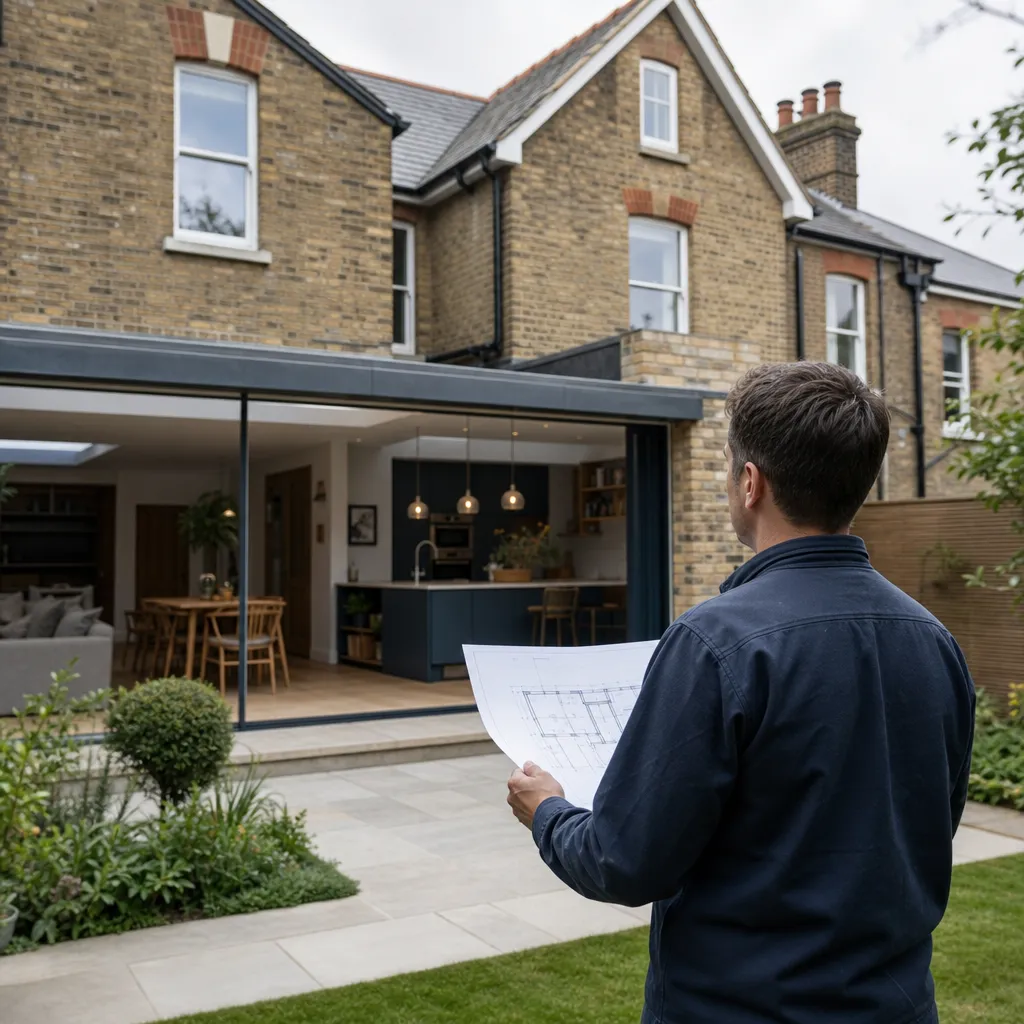
Selecting Renovation Contractors for Your Property Project
When selecting a renovation contractor, get at least three written, itemised quotes from contractors who have visited the site, verify membership of a recognised trade body such as the Federation of Master Builders, check references from comparable recent projects, and agree a detailed written contract before work starts.
 Improvement & Build
Selecting and Hiring a Remodelling Contractor
Hiring a remodelling contractor starts with a written scope of works and a shortlist of at least three companies registered with TrustMark or the Federation of Master Builders.
 Improvement & Build
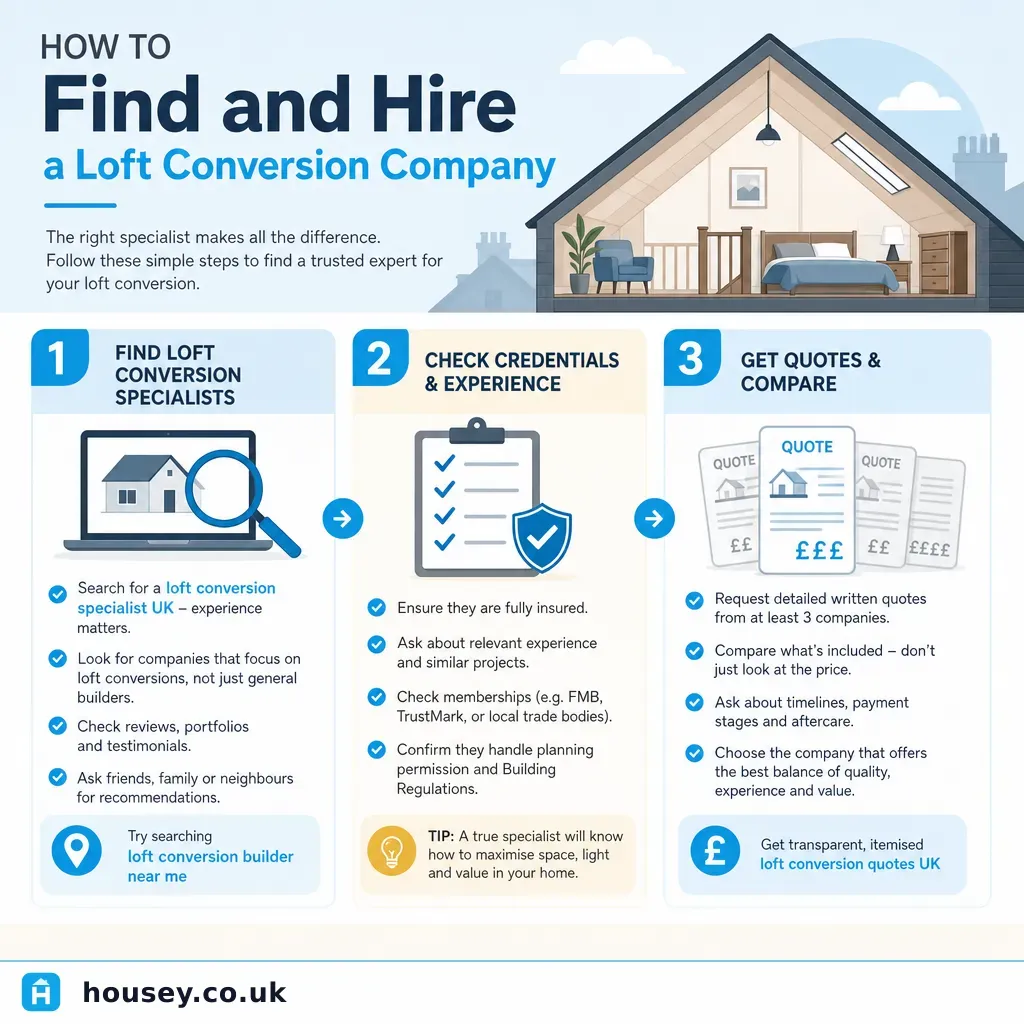
How to Find and Hire a Loft Conversion Company
To hire a loft conversion company, get at least three quotes from TrustMark-registered or FMB-member firms.
 Improvement & Build
How to Hire a Professional Window Installer
Use a FENSA or CERTASS-registered installer so your window replacement complies with Building Regulations Part L and Part Q and you receive a certificate registered with your local authority.
 Improvement & Build
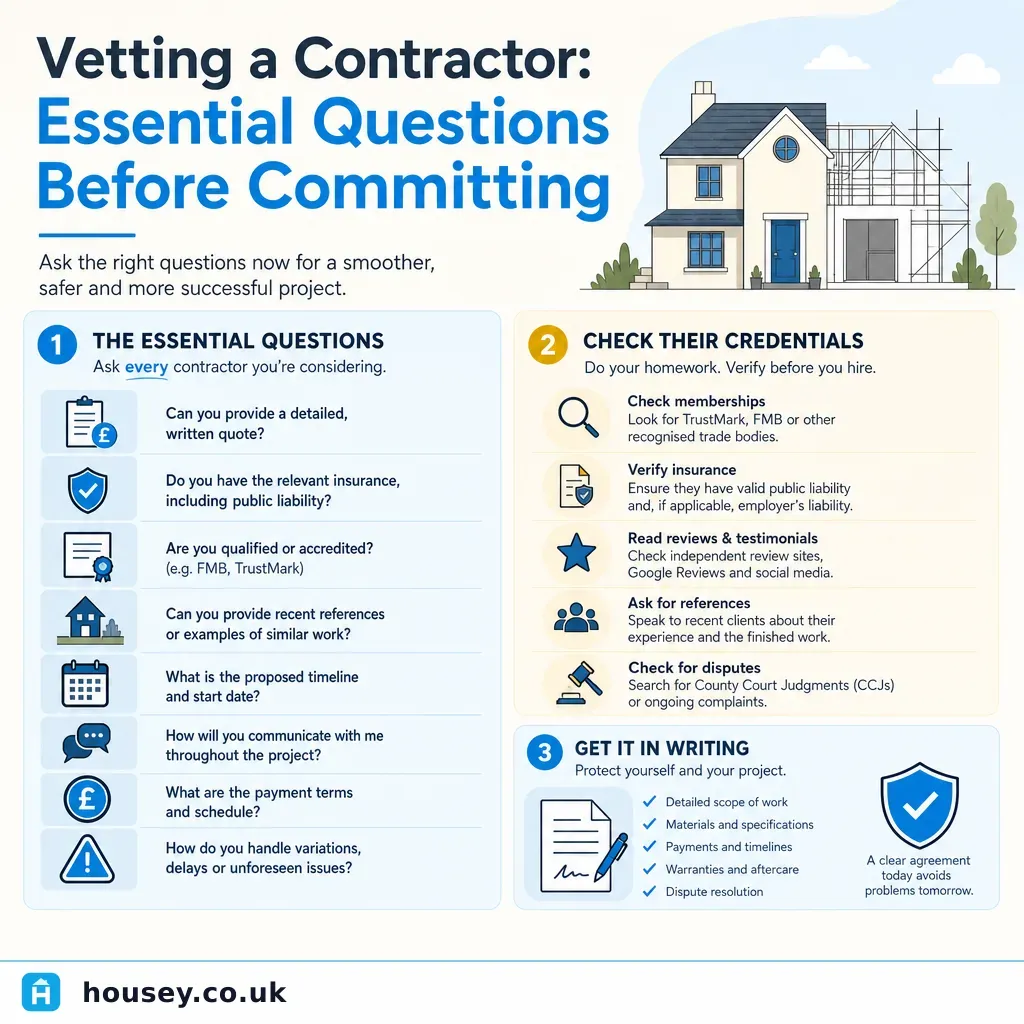
Vetting a Contractor: Essential Questions Before Committing
Vet a contractor by checking their full business name on Companies House, requesting current insurance certificates, verifying trade body membership directly with the association, and speaking to references from comparable recent jobs.