Home Improvement Projects That Add Value to Your Property
By Housey · Last reviewed 8th of May 2026
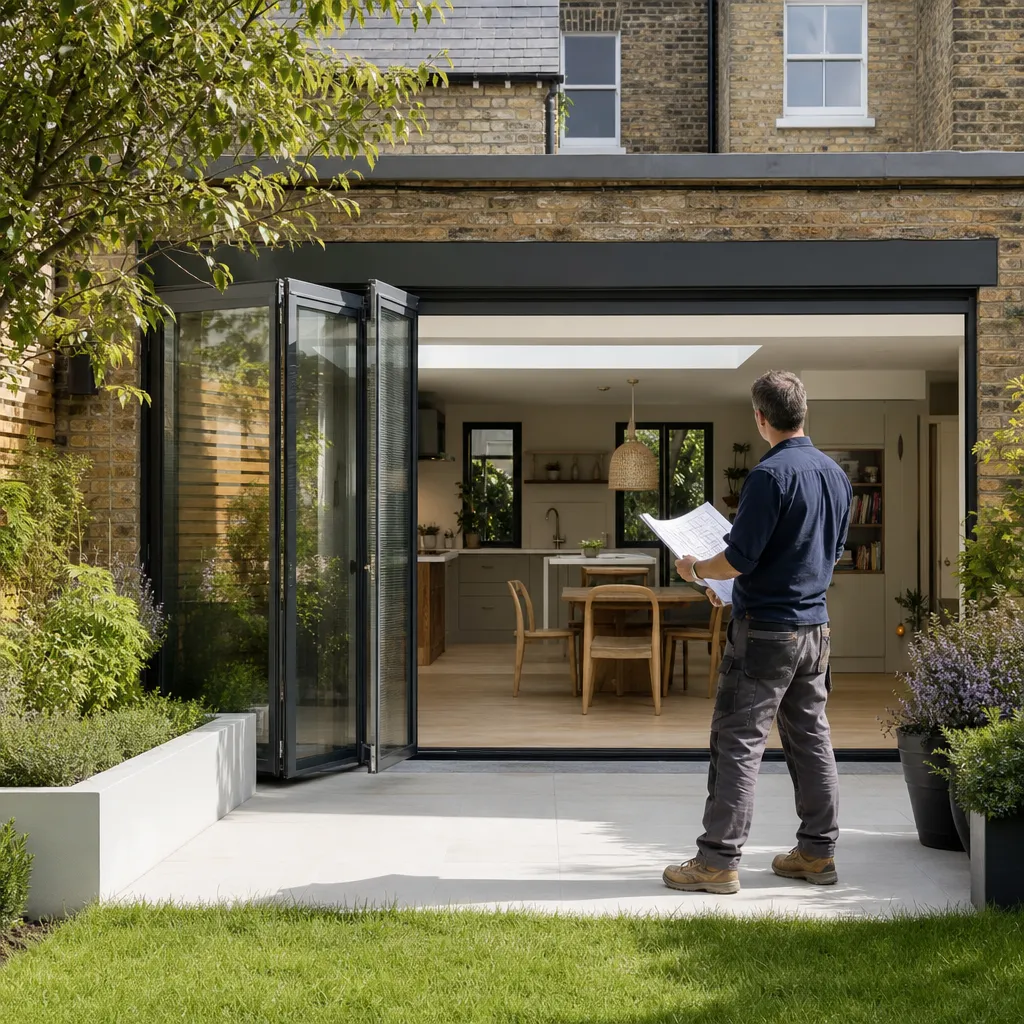
Home Improvement Projects That Add Value to Your Property
Choosing the right renovation project can make a significant difference to return on investment — but the gain depends on what your property currently lacks, your local market's price ceiling, and whether works comply with planning and building regulations. Not all improvements deliver the same returns, and what works well for a four-bedroom detached house in a commuter town may recover little cost in a two-bedroom leasehold flat.
Key points
- Loft conversions are consistently cited among the highest-return improvements; Nationwide Building Society research has estimated average value additions of around 20% for a usable loft conversion with Building Regulations approval.
- Single-storey rear extensions can add roughly 5–12% to value depending on size, quality, and location — returns tend to be higher in urban markets where floor space per square metre commands a premium.
- Under Permitted Development rights, most single-storey rear extensions up to 4m (detached house) or 3m (semi-detached or terraced) do not require a planning application — but Article 4 directions, conservation areas, and listed buildings change these rules.
- Kitchen and bathroom upgrades typically add 5–10% but must be proportionate to the property's current value and local comparables; spending 15% of a property's value on a kitchen rarely recovers that investment at resale.
- Over-improving relative to the price ceiling for your street reduces financial return; benchmark comparable sold prices on HM Land Registry before committing to large spend.
Which improvements add the most value?
The table below summarises common home improvements by estimated value uplift, typical cost range, and planning requirement. These are indicative national figures — outcomes depend heavily on location, quality of work, and market conditions at the time of sale.
Improvement | Estimated value uplift | Indicative cost (2026) | Planning permission usually needed? |
|---|---|---|---|
Loft conversion (dormer) | 15–20% | £35,000–£65,000 | Often permitted development for rear dormers; check volume limits |
Single-storey rear extension | 5–12% | £20,000–£50,000 | Usually PD within size limits; not in Article 4 areas or conservation areas |
Two-storey extension | 10–15% | £45,000–£90,000 | Yes — full planning application required |
Full kitchen refurbishment | 5–10% | £8,000–£25,000 | No |
Bathroom addition or upgrade | 3–7% | £5,000–£15,000 | No (unless structural work involved) |
EPC improvement (insulation, glazing, heat pump) | Variable; growing saleability impact | £2,000–£20,000+ depending on measures | Usually no; Building Regulations approval required for most measures |
New windows and doors (FENSA-registered) | 3–5% kerb appeal contribution | £5,000–£15,000 | Usually no for like-for-like replacement; listed buildings differ |
Garage conversion | 5–10% | £10,000–£25,000 | Usually permitted development; prior approval may be required |
Indicative UK costs and uplift estimates, last reviewed 2026-05-08. Value uplifts draw on national published research; local market conditions vary significantly.
Loft conversions and extensions: the largest value drivers
Loft conversions and extensions consistently outperform other improvement types because they add usable floor area — and in UK property, square footage directly drives value. The gain is typically more pronounced in areas with high cost per square metre, such as London, the South East, and other urban centres where buyers are stretching budgets for space.
Loft conversions are popular because many projects fall under Permitted Development rights, avoiding the cost and delay of a planning application. A rear dormer on a standard semi-detached property typically qualifies, subject to volume limits: no more than 40 cubic metres for terraced houses, 50 cubic metres for detached and semi-detached properties. Hip-to-gable conversions and mansard roofs common in London almost always require full planning permission.
Building Regulations approval is required regardless of whether planning permission is needed. This covers structural calculations, fire escape provision, thermal insulation, and stair access — without it, you may have difficulty selling.
Rear extensions offer similar benefits. Single-storey rear extensions within Permitted Development limits can add a kitchen-diner, playroom, or home office without a planning application in many cases. Always check whether your property is in a conservation area, subject to an Article 4 direction, or is a listed building — any of these can remove or restrict Permitted Development rights entirely.
A two-storey extension always requires full planning permission and must address neighbour impact, overlooking, and the 45-degree daylight rule applied by many local planning authorities.
Kitchen and bathroom improvements
A well-executed kitchen refurbishment can deliver a solid return per pound spent on a non-structural improvement. The key is proportion: fitting a £28,000 kitchen in a £200,000 terraced house is unlikely to recover that investment at resale. As a guide, spend no more than 5–8% of the property's current value on a kitchen upgrade if resale is the primary goal.
Mid-range kitchens from mainstream suppliers can look excellent with quality installation — layout and workmanship often matter more than the cost of the units themselves. An awkward galley kitchen reconfigured into an open-plan layout adds more value than an expensive kitchen in an unchanged footprint.
Adding an extra WC or a second bathroom adds genuine value by improving a family home's practical appeal. A property that jumps from one bathroom to two is often notably easier to sell in competitive family markets.
Energy efficiency and EPC improvements
EPC ratings are becoming a more significant factor in UK property transactions. Buyers are increasingly aware of running costs following energy price rises, and mortgage lenders are under growing pressure to account for energy performance in lending decisions.
Measures that improve an EPC rating — loft and cavity wall insulation, double or triple glazing, draught-proofing, and low-carbon heating — may not generate a simple headline percentage uplift in the way a loft conversion does, but they increasingly affect saleability. Properties with EPC ratings of D or below may face growing challenges attracting buyers as net zero policy tightens.
Improving from an E to a C rating on a solid-walled Victorian terrace can meaningfully broaden the buyer pool. Check GOV.UK's guidance on improving energy efficiency and the ECO4 scheme for grant eligibility — grants can substantially reduce the out-of-pocket cost of insulation and heat pump installations.
Decision tree: which improvement should you prioritise?
- Start here: Does your property have unused loft space with at least 2.1m of headroom at the ridge? If yes, get a loft conversion assessed first — it usually delivers the best £-per-square-metre return of any single improvement.
- No usable loft or already converted: Is there scope for a rear extension within Permitted Development limits? If yes, a single-storey extension is likely the next best option for adding value through usable floor area.
- Already extended at ground floor: Does your kitchen or bathroom put off prospective buyers? A mid-budget kitchen or bathroom refresh delivers cosmetic uplift and broadens buyer appeal with relatively modest outlay.
- Already extended and modernised: Is your EPC rating D or below? Insulation, glazing, or heating upgrades improve saleability and reduce running costs; check ECO4 and the Great British Insulation Scheme for grant support.
- Budget under £5,000: Focus on kerb appeal — a new front door, freshly painted render, tidy landscaping, and clean windows have a disproportionate impact on first impressions and listing photographs.
- At or near the local price ceiling: Pause before spending. A RICS-registered valuer can tell you how much headroom you have before over-improvement risk sets in.
Worked scenario: adding value to a 1960s semi in the Midlands
Consider a three-bedroom 1960s semi-detached house currently valued at £225,000 in a Midlands market where extended equivalents have recently sold for up to £285,000–£295,000.
- Single-storey rear extension (kitchen-diner): Estimated cost £28,000 — estimated post-improvement value £248,000–£260,000. Net gain roughly £23,000–£35,000 against £28,000 cost. Likely the better short-term return.
- Loft conversion (dormer, creating fourth bedroom): Estimated cost £48,000 — estimated post-improvement value £258,000–£270,000. Net gain roughly £33,000–£45,000. Adds a marketable bedroom; return depends on how much four-bedroom properties command locally versus three-bedroom.
- Both improvements combined: Cost £73,000–£78,000, potential value £275,000–£295,000 — approaching or matching the local ceiling. The combined spend may not fully recover at immediate sale but creates the most marketable and liveable version of the property, with the strongest long-term equity position.
This illustrates why benchmarking against the local price ceiling on HM Land Registry before committing to large spend is essential.
What not to assume
- "Any improvement adds value" — poor-quality workmanship, illegal builds, or works carried out without Building Regulations approval can reduce value or create legal complications at sale that delay or kill a transaction.
- "Planning permission wasn't needed for the previous owner's work, so I don't need to declare anything" — buyers' solicitors routinely request evidence of permitted development compliance or planning permission. Missing paperwork can block a sale even years later.
- "I'll recoup the full cost at sale" — few improvements recover 100% of cost in pure market value terms. The benefit is a combination of value uplift, improved saleability, and quality of life during ownership.
- "My personal taste will suit all buyers" — highly personalised finishes, unusual layouts, or niche features can narrow the buyer pool. Aim for quality and neutral appeal when improving primarily for resale.
When to get professional help
Before committing to any significant project, consider consulting:
- An architect or architectural technologist for design, planning, and Building Regulations drawings for extensions and loft conversions
- A structural engineer if you are removing load-bearing walls, creating large structural spans, or altering the roof structure
- A planning consultant if your property is listed, in a conservation area, or has a complex planning history that may affect Permitted Development eligibility
- A RICS-registered valuer for a formal assessment of projected uplift before investing substantial sums — particularly useful if you are approaching the local price ceiling
How Housey can help
Housey connects you with vetted professionals for the most value-adding projects. Request quotes from extension builders for rear or side extensions, explore loft conversion companies to add a usable bedroom or home office, or use design-and-build firms to manage your entire project from planning drawings through to completion.
Frequently asked questions
Does a loft conversion always add value?
In most cases, yes — a well-built loft conversion with proper headroom, natural light, and Building Regulations-compliant stair access adds both floor area and marketability. Returns are stronger where three- or four-bedroom properties command significantly more than two-bedroom equivalents locally. A poor-quality conversion lacking Building Regulations sign-off can hinder or block a sale.
Do I need planning permission for a rear extension?
Many single-storey rear extensions fall under Permitted Development rights and do not require a planning application, provided they meet size, height, and position limits in the Town and Country Planning (General Permitted Development) Order 2015. Listed buildings, conservation areas, and Article 4 directions can restrict these rights. Always check with your local planning authority before starting work.
How much does a loft conversion cost in the UK?
Indicative costs range from around £30,000 for a simple Velux-style conversion to £55,000–£70,000+ for a dormer or hip-to-gable conversion, depending on location, size, and specification. London and the South East typically cost 20–30% more than the national average. These are indicative UK costs, last reviewed 2026-05-08 — always obtain at least three comparable quotes.
Should I improve my home before selling or sell as-is?
This depends on your market, property condition, and available budget. Minor cosmetic improvements — fresh decoration, tidy garden, kerb appeal — almost always pay back at sale. Major structural works are harder to justify unless the property is materially undervalued relative to improved comparables nearby. A local estate agent's appraisal or a RICS-registered valuer can help you decide.
Does a new kitchen add value?
A kitchen refurbishment typically adds value when the existing kitchen is dated and the spend is proportionate to the property's value. Spending £12,000–£18,000 on a good mid-range kitchen in a £300,000 home is more likely to return value than spending £30,000 on a premium kitchen in a £185,000 flat. Installation quality and practical layout matter as much as the units themselves.
Sources and further reading
- Permitted development rights for householders: technical guidance — GOV.UK / DLUHC
- UK House Price Index — HM Land Registry
- UK House Price Index bulletins — ONS
- Improve your home's energy efficiency — GOV.UK / DESNZ
- Nationwide House Price Index — Nationwide Building Society
Useful next reads
 Improvement & Build
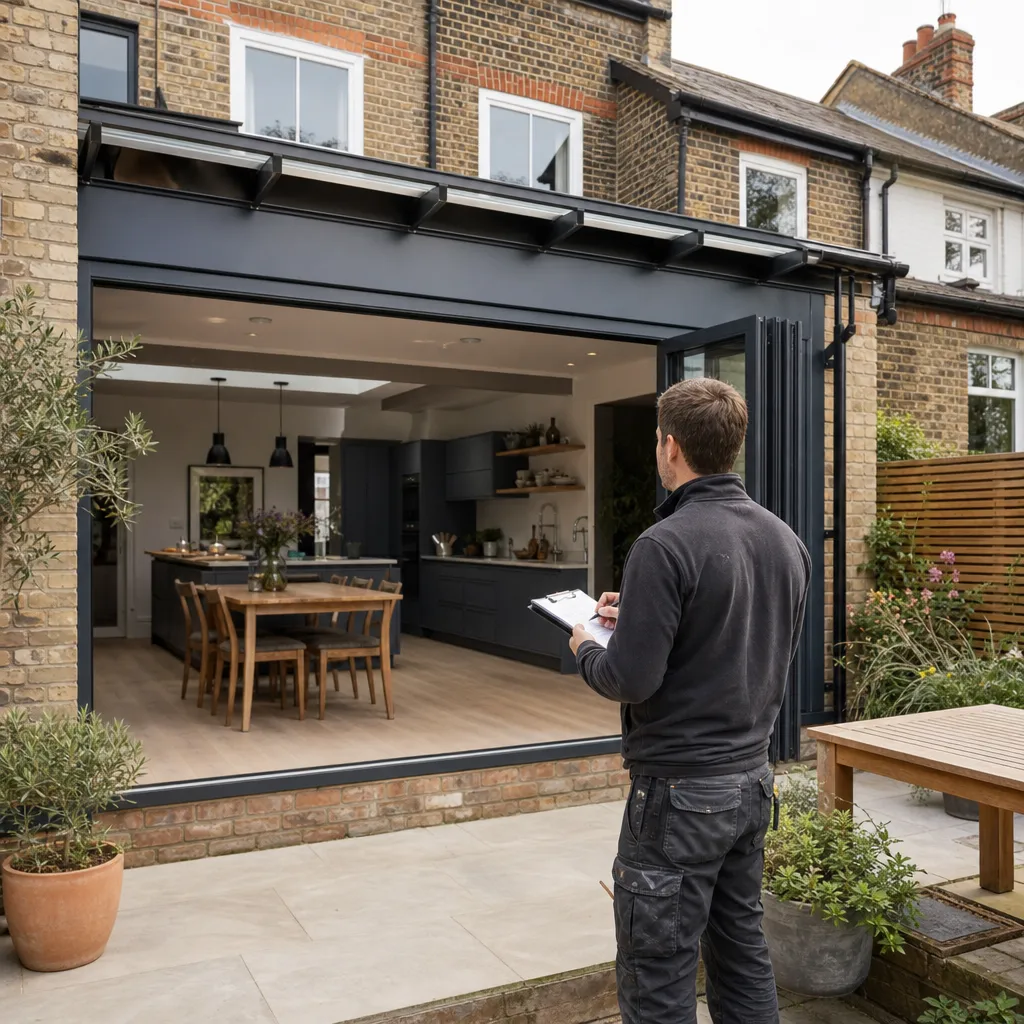
Maximising Value Through Strategic Home Improvement Projects
In the UK, loft conversions and kitchen extensions tend to deliver the strongest return on investment, with loft conversions potentially adding around 20% to property value according to Nationwide data.
 Improvement & Build
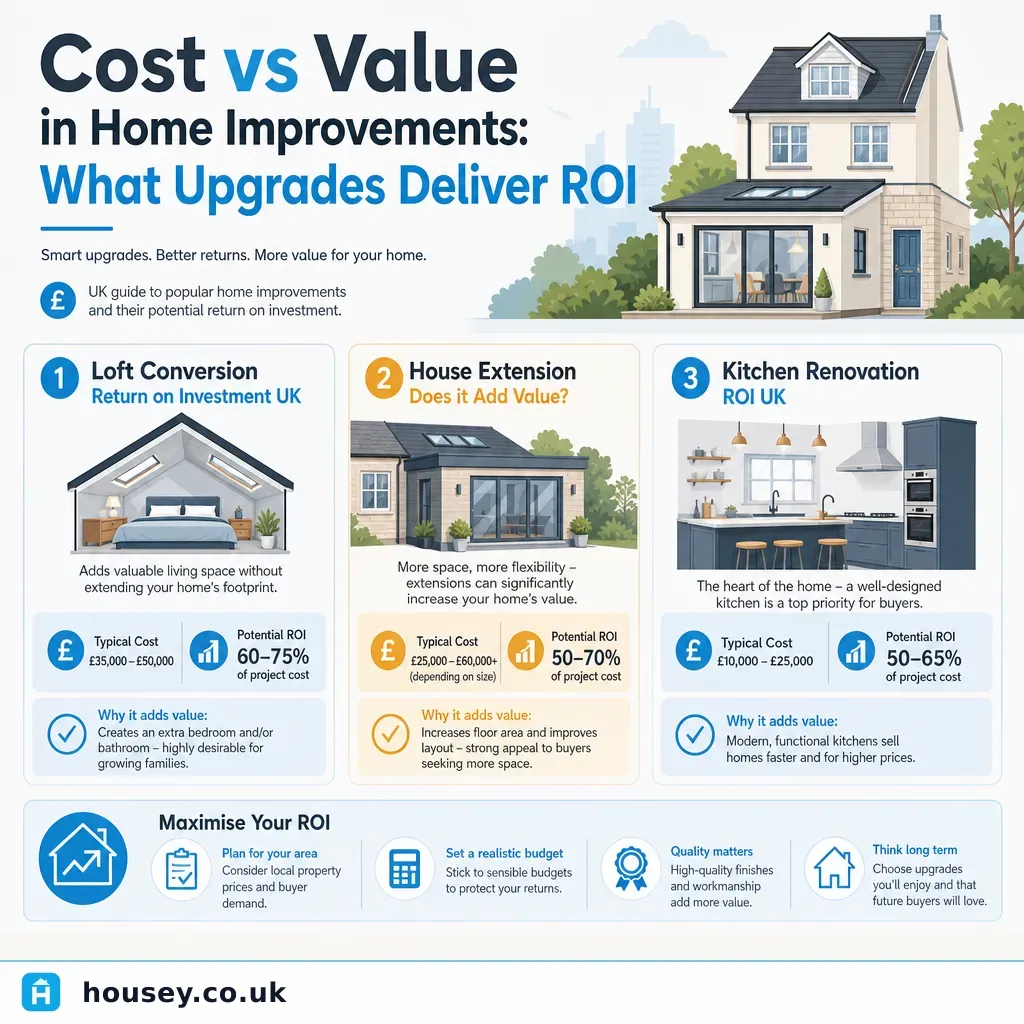
Cost vs Value in Home Improvements: What Upgrades Deliver ROI
Not all home improvements deliver the same return when you sell.
 Improvement & Build
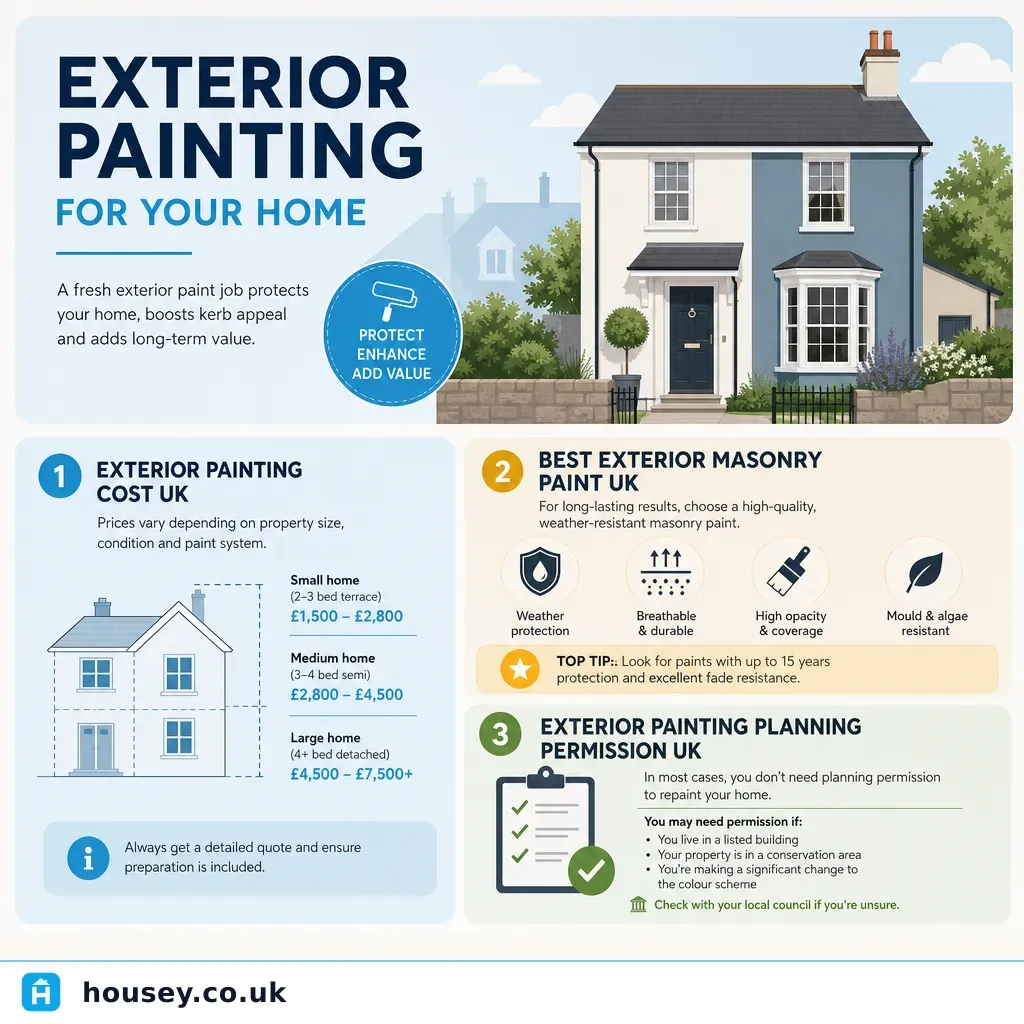
Exterior Painting for Your Home
Exterior painting protects your home from the UK's wet climate and can significantly boost kerb appeal.
 Improvement & Build
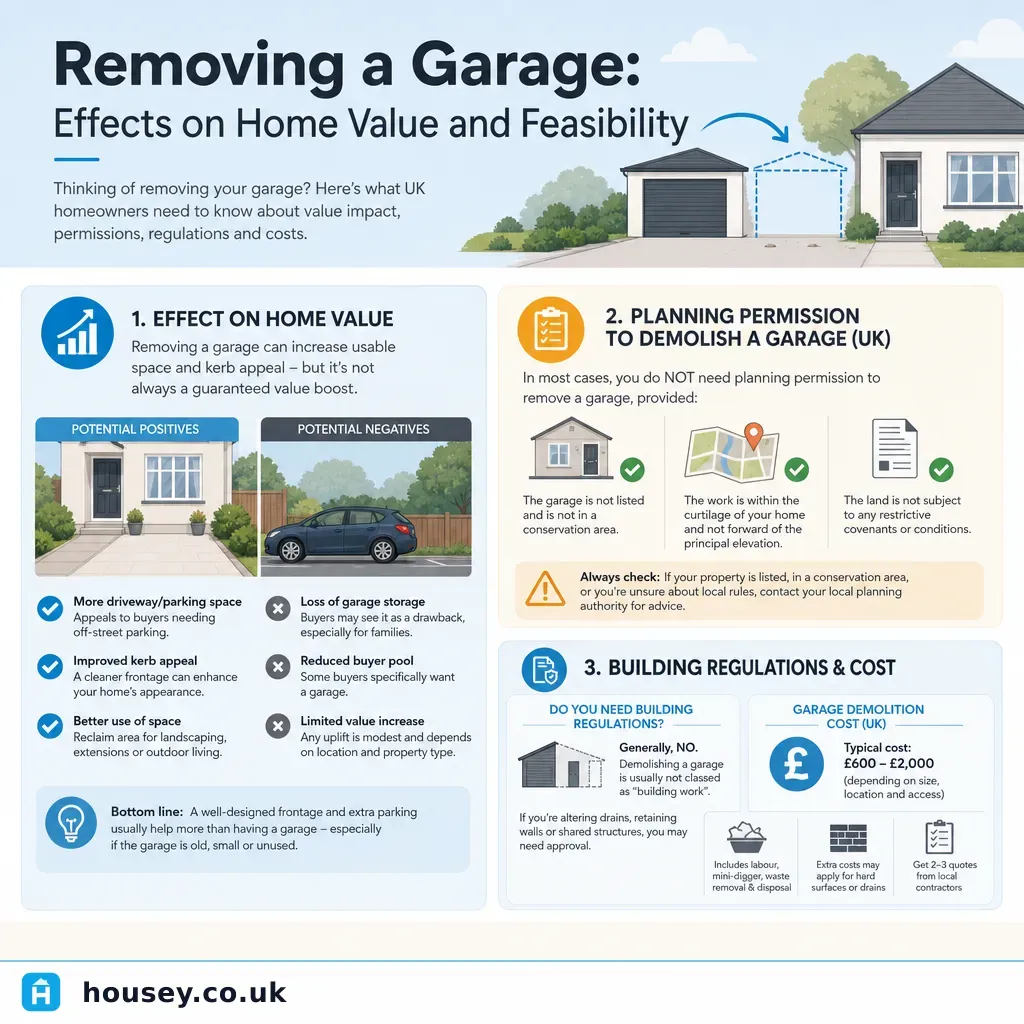
Removing a Garage: Effects on Home Value and Feasibility
Demolishing a garage in England may require prior notification to the local planning authority, and structural or building regulations assessments are often needed if the garage is attached to or integral with the house.
 Improvement & Build
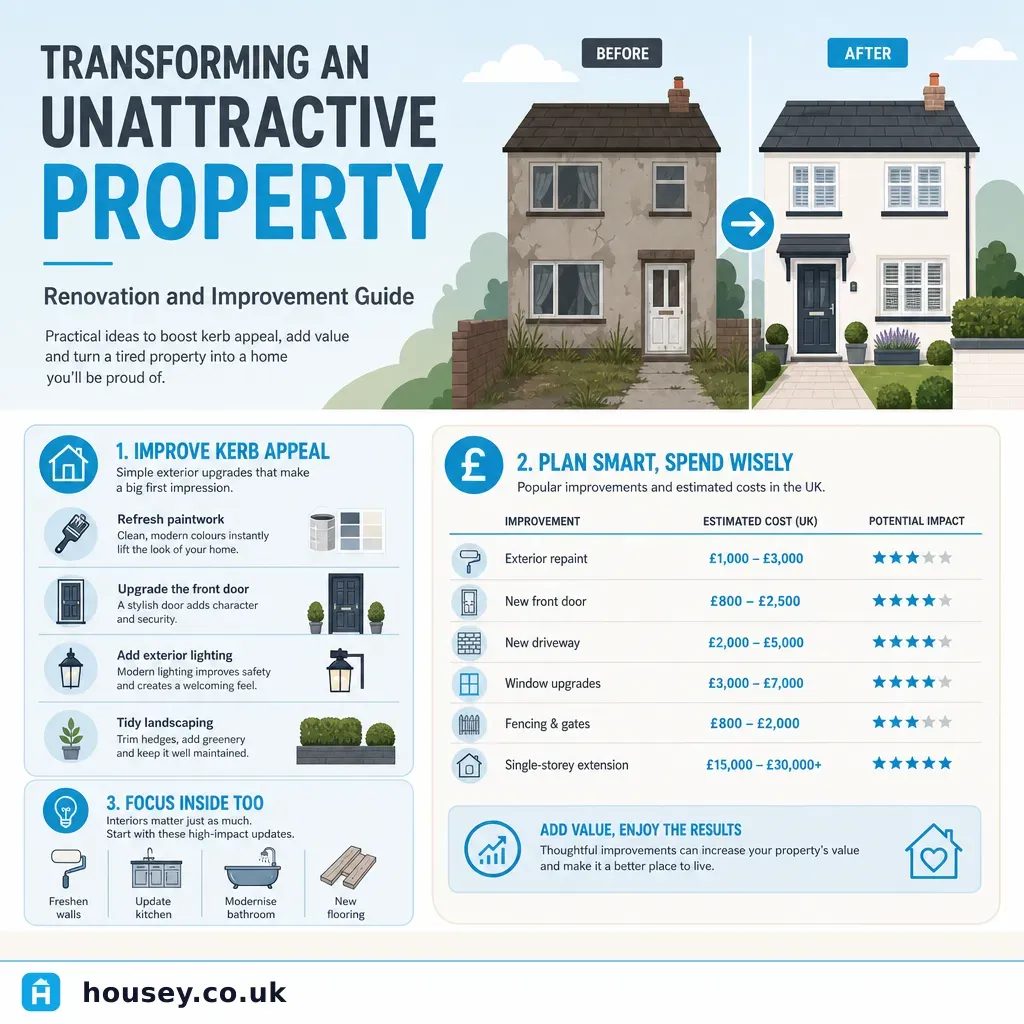
Transforming an Unattractive Property: Renovation and Improvement Guide
Transforming an unattractive UK property usually starts with surface-level improvements — render, windows, doors, and front landscaping — before tackling structural changes like extensions.