Evaluating And Planning Renovations For Properties Requiring Modernisation
By Housey · Last reviewed 18th of May 2026
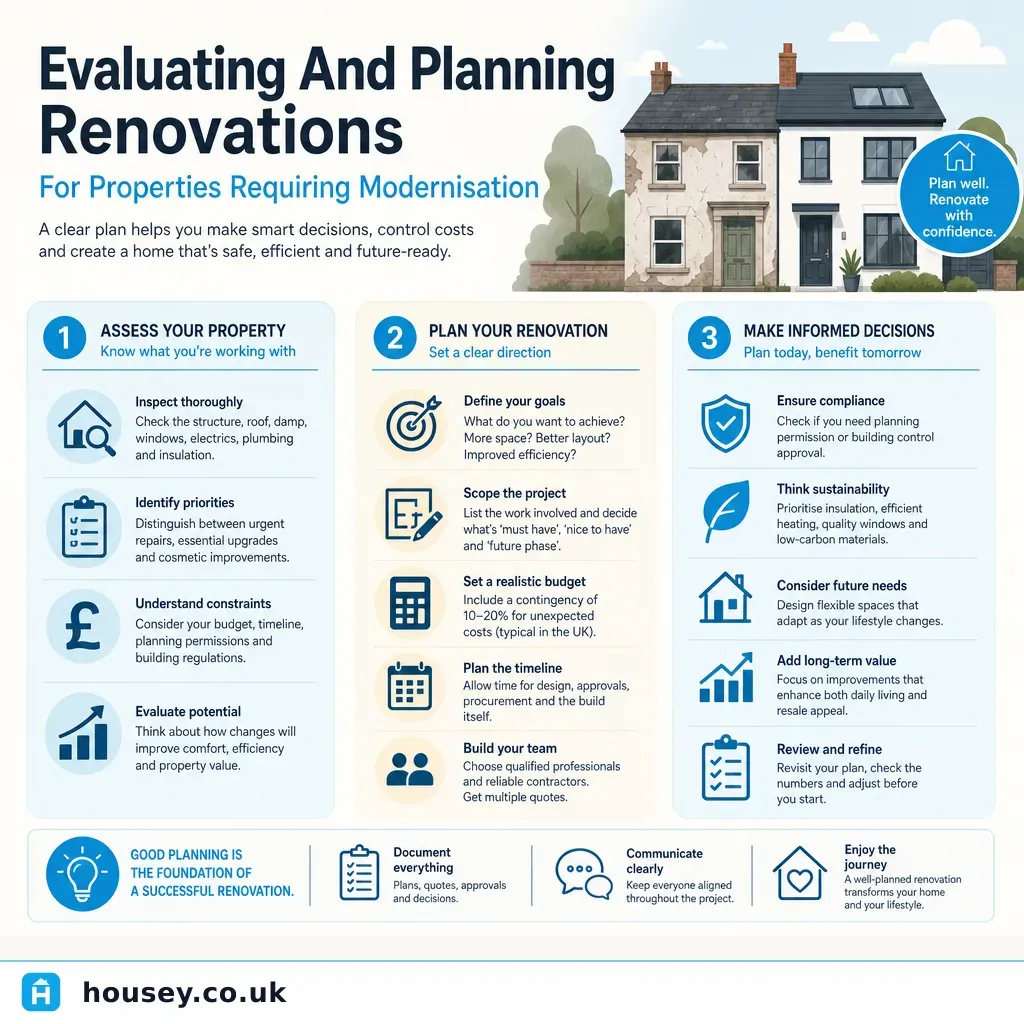
Evaluating And Planning Renovations For Properties Requiring Modernisation
Properties described as "in need of modernisation" can represent outstanding value — or a financial sink — depending on how thoroughly the condition is assessed and the scope defined before work begins. Whether you have just exchanged contracts on a 1960s semi or are preparing a Victorian terrace you have owned for years, the quality of your upfront evaluation determines whether the renovation stays on budget and on schedule. Regulatory requirements, hidden defects, and trade sequencing all affect outcomes significantly in UK renovation projects.
Key points
- A RICS Level 3 Building Survey is the appropriate starting point for any pre-1919 property, property showing visible defects, or unusual construction — Level 2 may be sufficient for post-1960 homes in reasonable condition.
- Building regulations approval (separate from planning permission) is required for structural alterations, new electrical circuits, boiler replacements, replacement windows not fitted by a FENSA-registered installer, and certain insulation works.
- A full modernisation of a three-bedroom Victorian terrace typically costs £50,000–£120,000 depending on condition, specification, and location — indicative UK costs, last reviewed 2026-05-18; quotes vary significantly by region and scope.
- A contingency of 15–20% is standard industry practice; properties with unknown service histories — particularly pre-1945 homes — may warrant 20–25%.
- Trades must follow a defined sequence: structural and weatherproofing before first fix, first fix (electrics and plumbing) before plastering, second fix after decoration. Disrupting this sequence generates abortive costs.
How to assess a property's condition before budgeting
A renovation budget built without a proper condition survey is likely to be wrong. The most common cause of budget overruns on UK renovation projects is unexpected defect discovery — damp, timber decay, inadequate foundations, outdated wiring — after physical work has already started.
Choosing the right survey
Survey type | Best for | What it covers | Main limitation |
|---|---|---|---|
RICS Level 2 Home Survey | Conventional post-1960 homes in reasonable condition | Visible defects, condition ratings, maintenance advice | Does not assess concealed areas or hidden defects |
RICS Level 3 Building Survey | Pre-1919 properties, unusual construction, visible defects | Detailed condition analysis, likely causes of defects, repair options | Higher cost; still limited by access |
Structural engineer inspection | Specific concerns — cracks, movement, roof spread | Engineering assessment of identified structural elements | Targeted assessment, not whole-property |
Damp and timber survey | Suspected damp, rot, or woodworm | Moisture readings, rising damp, penetrating damp, condensation identification | Some surveyors also sell treatment services |
For most properties requiring modernisation, a RICS Level 3 Building Survey is the appropriate starting point. It provides condition ratings and identifies defects that should directly influence your budget.
Beyond the general survey, arrange specialist inspections for:
- Electrical installation: a qualified electrician should carry out an Electrical Installation Condition Report (EICR)
- Gas and heating: a Gas Safe registered engineer should inspect the boiler and existing gas installation
- Drains: a CCTV drain survey is advisable for pre-1970 properties, particularly where external drainage covers or manholes are inaccessible
Defining the scope of renovation works
Once you have survey findings and specialist reports, categorise works into three priority bands:
Priority 1 — Safety and structural Works that must be completed before the property is safe to occupy or before other trades can proceed: roof structure repairs, chimney stacks, rising damp treatment, rewiring where the existing installation is a safety hazard, structural wall repairs.
Priority 2 — Regulatory compliance and weatherproofing Works that trigger building regulations or that protect the building fabric: replacement windows (Part L compliance if not using a FENSA-registered installer), boiler replacement (Part L, Approved Document J), roof covering replacement (Part A and Part C), loft insulation upgrades.
Priority 3 — Modernisation and cosmetic Works that improve habitability and value but do not affect safety or regulatory compliance: kitchen and bathroom replacement, redecoration, flooring, landscaping.
Renovation scope checklist
Use this checklist to build your initial scope before approaching contractors:
Estimating renovation costs
Cost estimation at the scope-definition stage is necessarily approximate. Its purpose is to check project feasibility — whether total likely cost is proportionate to the property's post-renovation value.
Indicative UK renovation cost ranges — last reviewed 2026-05-18; quotes vary; obtain multiple estimates
Work type | Indicative cost range |
|---|---|
Full rewire (3-bed house) | £3,500 – £6,000 |
New central heating system | £3,000 – £6,500 |
New kitchen (supply and fit, mid-range) | £5,000 – £20,000 |
New bathroom (supply and fit) | £3,500 – £10,000 |
Loft insulation (blown fibre, 3-bed) | £300 – £700 |
Full re-roof (3-bed semi) | £5,000 – £14,000 |
Damp-proof course injection | £500 – £2,500 |
Full internal replaster | £4,000 – £10,000 |
Solid wall external insulation | £8,000 – £22,000 |
These ranges reflect significant variation by region, property size, specification, and site conditions. London and South East costs are typically 20–30% above the national average. Always add a contingency on top of quoted costs: 15% for properties in known reasonable condition, 20–25% for pre-1945 homes or those with incomplete service history.
Navigating building regulations for renovation works
Building regulations approval is a legal requirement for many renovation activities and is entirely separate from planning permission.
Works commonly requiring building regulations approval include:
- Structural alterations such as removing walls or inserting steel beams
- Loft conversions and garage conversions to habitable space
- New electrical circuits or consumer unit replacement (Part P)
- Boiler replacement (Part L; Approved Document J for combustion appliances)
- Replacement windows and doors not installed by a FENSA-registered contractor (Part L energy-performance compliance)
- Roof replacement where structural elements are affected (Part A, Part C)
Decision tree: do you need building regulations approval?
- Are you altering the structure — removing or adding walls, inserting beams, or affecting roof structure? → Yes, building regulations apply.
- Are you replacing a significant proportion of the roof structure? → Yes — notify building control before starting.
- Are you adding a new electrical circuit or replacing a consumer unit? → Yes (Part P — use a registered electrician or notify your local authority building control).
- Are you replacing windows and not using a FENSA-registered installer? → Yes — Part L compliance check required.
- Are you only redecorating, replacing like-for-like sanitary fittings, or carrying out routine maintenance? → Check with your local building control body — many minor works are exempt, but confirm before starting.
Contact your local authority building control (LABC) or an Approved Inspector before starting work if you are uncertain. A building control consultant can manage submission and inspection on your behalf for more complex projects.
Selecting and managing contractors
Contractor quality is the single largest variable in renovation outcomes. A thorough selection process significantly reduces the risk of poor workmanship, disputes, and programme delays.
What to ask before accepting a quote
- What works are specifically included, and what is explicitly excluded?
- Who will carry out the work day-to-day — the person you met, or a subcontractor?
- What qualifications or accreditations are relevant — NICEIC (electrical), Gas Safe (gas), CHAS (health and safety)?
- Who will notify building control and manage stage inspections?
- What is the payment schedule, and is it tied to stages of inspected completed work?
- Is VAT included in the quoted figure?
- What happens if concealed defects are discovered once works have begun?
- Can you provide evidence of current public liability and employer's liability insurance?
- Can you provide references from comparable projects completed in the last 12 months?
Obtain a minimum of three written, itemised quotes for every major trade. Compare like for like — a lower headline price may exclude items that other quotes include.
Red flags when reviewing contractors
- Quote provided verbally only, or as a single lump-sum figure with no scope breakdown
- Request for more than 25–30% of the total contract value before work begins
- Resistance to signing a written contract or using a standard-form document such as JCT Minor Works
- No evidence of relevant qualifications or accreditations for regulated trades
- Unable or unwilling to provide recent references or project photographs
- Pressure to start work immediately before you have reviewed other quotes or checked references
- No verifiable business address or trading history
When to get professional help
Most renovation projects of any material scale benefit from professional coordination, particularly where works span multiple trades or involve regulatory compliance. Specific situations that warrant specialist input:
- Cracks, movement, or settlement: arrange a structural survey before committing to any other works — the cause of movement must be understood before remediation begins
- Damp affecting large areas or with unknown origin: specialist diagnosis should precede treatment; damp proofing specialists can identify whether the source is rising damp, penetrating damp, or condensation and recommend the appropriate remedy
- Building regulations submissions: a building control consultant can manage the application and inspection process, particularly for complex or multi-discipline projects
- Multiple trades across a significant programme: a project manager can coordinate sequencing, procurement, and site management, reducing the homeowner burden considerably
How Housey can help
Housey connects homeowners with qualified professionals across the full renovation process — from structural surveys and damp proofing specialists to project managers and building control consultants. Submit a job request to receive comparable quotes from vetted local professionals and start your renovation on a well-informed basis.
Frequently asked questions
Do I need planning permission to renovate a house in the UK?
Not necessarily. Internal works such as rewiring, replastering, or fitting a new kitchen generally do not require planning permission. External changes — adding a porch, altering a roof, or changing window styles in a conservation area — may require consent. Building regulations approval is a separate requirement that applies to many internal structural and services alterations regardless of planning permission status.
How long does a full renovation of a Victorian terrace take?
A full renovation covering structural, services, and cosmetic works typically takes 4–9 months for a two- or three-bedroom Victorian terrace, depending on scope, contractor availability, and material lead times. Projects requiring planning permission or listed building consent will need additional time for approval periods — typically 8 weeks minimum for a householder application.
Should I live in the property during a major renovation?
For major works — full rewires, replastering, or structural alterations — living on site is generally impractical and sometimes unsafe. Most homeowners arrange temporary accommodation for the principal works phase. Your mortgage lender may also have conditions about the property's habitability status, particularly if it becomes uninhabitable for an extended period.
What is the JCT Minor Works contract and do I need one?
The JCT (Joint Contracts Tribunal) Minor Works Building Contract is a widely used standard-form contract for small to medium renovation projects in the UK. It sets out responsibilities, payment mechanisms, and the process for handling changes and disputes. Using a written contract is strongly recommended for any project above a few thousand pounds and provides meaningful legal protection for the homeowner.
Sources and further reading
- Building Regulations: applying for approval — GOV.UK
- RICS Home Survey Standard — RICS
- FENSA — Competent Person Scheme for windows and doors — FENSA
- Gas Safe Register — check an engineer — Gas Safe Register
- NICEIC — electrical competent person scheme — NICEIC
- JCT Minor Works Building Contract — Joint Contracts Tribunal
Useful next reads
 Improvement & Build
Assessing Renovation Potential When Purchasing a Property Requiring Updates
Assess renovation potential before purchasing by commissioning a RICS Level 3 Building Survey to identify structural defects.
 Improvement & Build
Planning a Flat-Roof Extension: What Costs to Budget
A flat-roof single-storey extension typically costs £1,500–£3,000 per m² in the UK, depending on size, specification, location, and roof membrane choice.
 Improvement & Build
Selecting and Hiring a Remodelling Contractor
Hiring a remodelling contractor starts with a written scope of works and a shortlist of at least three companies registered with TrustMark or the Federation of Master Builders.
 Improvement & Build
Selecting Renovation Contractors for Your Property Project
When selecting a renovation contractor, get at least three written, itemised quotes from contractors who have visited the site, verify membership of a recognised trade body such as the Federation of Master Builders, check references from comparable recent projects, and agree a detailed written contract before work starts.
 Improvement & Build
Complete Guide to Budgeting and Planning a House Renovation
Budgeting a house renovation means defining the full scope before seeking quotes, adding a 15–20% contingency, and sequencing structural and building control stages first.