Barge Board Replacement and Roof Edge Maintenance
By Housey · Last reviewed 5th of May 2026
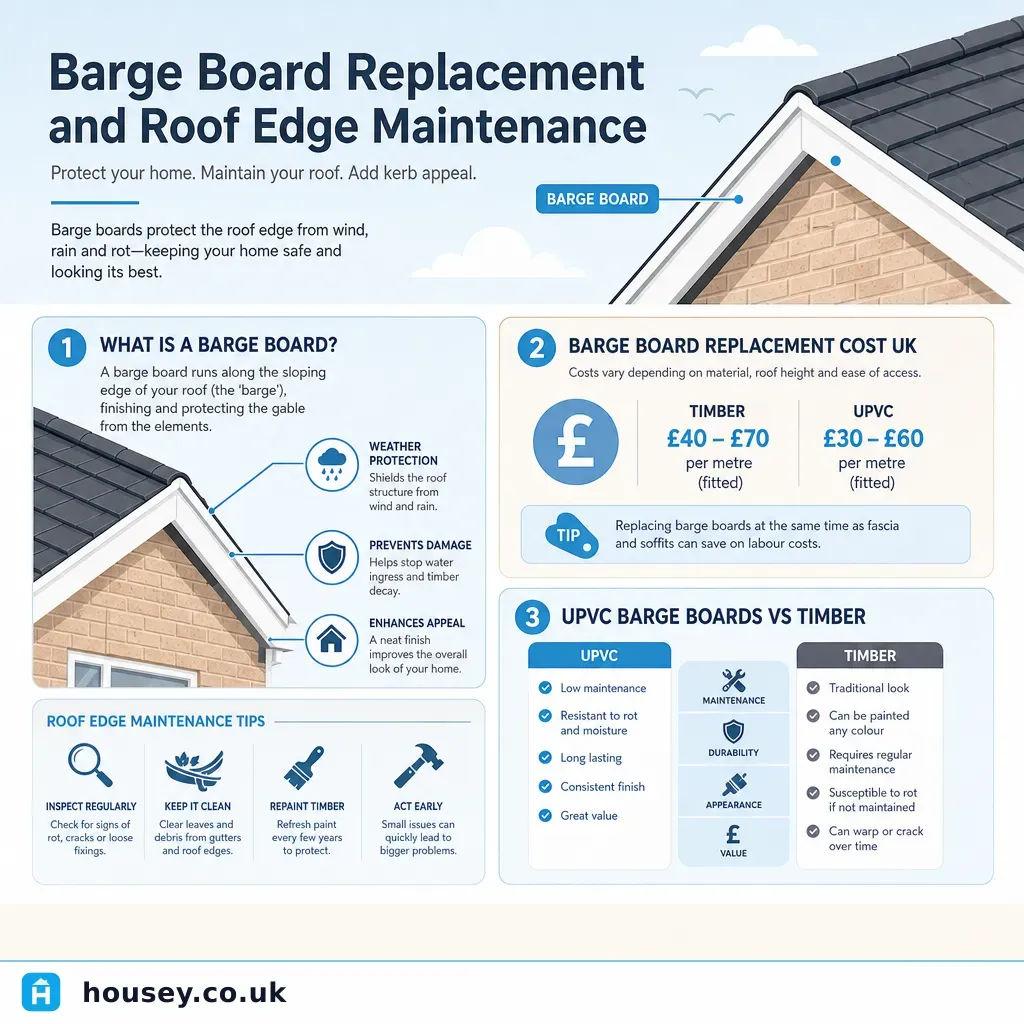
Barge Board Replacement and Roof Edge Maintenance
Barge boards and the broader roof edge assembly — including soffits and fascias — are often overlooked until water damage or visible decay forces the issue. For UK homeowners, the question usually arises when paint begins to peel, staining appears on the gable wall, or a roofer flags deterioration during an unrelated repair. Getting the condition right matters because a failing roof edge allows water to track behind cladding, into the roof structure, and down external walls — damage that can escalate quickly in the UK's wet climate.
Key points
- Barge boards run along the gable (sloping) edge of a pitched roof; fascia boards run horizontally beneath the roof at the eaves — they are distinct components with different replacement considerations.
- uPVC has largely replaced timber for new installations, offering a maintenance-free lifespan typically quoted at 20–30 years, compared with painted softwood that may need attention every 5–7 years.
- Like-for-like replacement of barge boards and fascias generally does not require planning permission as permitted development, but check with your local planning authority if your property is in a conservation area, subject to an Article 4 direction, or is listed.
- Working at height above 2 metres is a significant risk — the Health and Safety Executive (HSE) guidance on the Work at Height Regulations 2005 states that such work must be planned, supervised, and carried out by competent persons using appropriate equipment.
- Indicative UK costs for uPVC barge board and soffit/fascia replacement on a semi-detached house range from approximately £800 to £2,500 depending on size, access, and specification (Indicative UK costs, last reviewed 2026-05-05).
What are barge boards and why do they matter?
Barge boards (sometimes called verge boards or gable boards) are the boards fixed to the gable end of a pitched roof, running along the slope from ridge to eaves. They serve two functions: protecting the end of the roof structure — trusses, tiles, and felt — from wind-driven rain, and providing a finished appearance to the verge. Below them at the eaves, soffits close the gap between the wall and the rafter feet, and fascia boards carry the guttering.
When any of these components fail, the consequences can spread quickly. Water penetrating behind a rotted barge board can soak into roof timbers, cause staining on the gable wall, and — in exposed positions — allow wind to lift tiles at the verge. The verge is already one of the more vulnerable points on a UK roof because it lacks the shelter offered by a hip end or a parapet.
uPVC vs timber barge boards: which is right for your home?
Feature | uPVC barge boards | Painted softwood |
|---|---|---|
Typical lifespan | 20–30 years (maintenance-free) | 10–20 years (with regular painting) |
Ongoing maintenance | Wash down periodically | Repaint every 5–7 years; inspect annually |
Upfront cost | Usually higher | Usually lower |
Appearance | Clean, modern profile; limited styles | Traditional look; easier to match period properties |
Conservation area suitability | May require LPA approval | Usually acceptable |
Best for | Post-1960s and modern homes | Older, period, or listed properties |
For homes in conservation areas or with listed building obligations, painted timber is often the expected or required material. Confirm with your local planning authority before ordering materials if your property has any planning restrictions.
Signs your barge boards need attention
Red flags — act promptly
- Paint flaking, blistering, or peeling away in sections
- Visible cracks, splits, or soft spots in timber boards
- Black mould or algae that returns quickly after cleaning
- Staining or damp patches on the gable wall below the verge
- Sections of board pulling away from the wall or sagging visibly
- Tiles slipping or lifting at the verge
- Guttering running behind or away from the fascia
If you notice any of these signs, arrange a professional inspection. A roofer or specialist roofline contractor can assess whether repair or full replacement is more cost-effective.
What the replacement process typically involves
Replacing barge boards is not a small undertaking. A contractor will typically:
- Erect scaffolding or use a mobile elevated work platform (MEWP) — sustained roofline work should not be attempted from a ladder alone.
- Remove old boards, soffits, and fascias carefully, inspecting the underlying rafter feet and roof structure for rot or damage.
- Treat any affected timbers before fitting new components.
- Fit new uPVC or timber boards, ensuring correct overlap with tiles at the verge and adequate soffit ventilation to prevent condensation in the roof void.
- Refit or replace guttering, aligned correctly to the new fascia.
- Dispose of old materials responsibly.
Soffit ventilation is a detail worth confirming. NHBC guidance recommends adequate through-ventilation to prevent interstitial condensation in cold roof structures. If your existing soffits had ventilation gaps or insect-mesh strips, the replacement should replicate or improve them.
Homeowner checklist before getting quotes
Before contacting roofers or roofline contractors, work through this checklist:
When to get professional help
Barge board and roofline work should always be carried out by a professional because of the working-at-height risk. The Work at Height Regulations 2005 place a duty on those commissioning such work to ensure it is properly planned and managed. Do not attempt barge board replacement from a ladder.
Seek professional help promptly if:
- You have noticed internal damp on a gable wall — this needs diagnosis before the roof edge is touched
- Tiles are lifting or slipping at the verge — additional work to re-bed or dry-fix the verge may be needed
- Rafter feet are visibly soft or discoloured when old boards are removed
- You are in a conservation area or own a listed property — clarify material requirements before starting work
How Housey can help
If your barge boards, soffits, or fascias need attention, Housey can connect you with vetted local roofers and roofline contractors who can inspect the condition, recommend the right materials for your property type, and provide itemised, comparable quotes.
Frequently asked questions
Do I need planning permission to replace barge boards?
In most cases, replacing barge boards and fascias on a standard house is permitted development and does not require planning permission. Exceptions apply if your property is in a conservation area, subject to an Article 4 direction, or is a listed building. Check with your local planning authority before ordering materials or starting work if any of these apply.
How long do uPVC barge boards last?
uPVC barge boards are typically quoted by manufacturers as having a lifespan of 20–30 years under normal conditions. Painted softwood boards may need repainting every 5–7 years and could require replacement after 10–20 years, depending on exposure, maintenance history, and the quality of the original timber.
Can I replace just the barge boards without replacing the fascias and soffits?
Yes, it is possible to replace barge boards independently, but many roofline contractors recommend replacing all components at the same time if they are of similar age. Doing so reduces the total scaffolding cost and ensures a consistent finish. A contractor can advise on condition following inspection.
What is the difference between a barge board and a fascia?
A barge board runs along the sloping gable end of a pitched roof. A fascia board runs horizontally at the eaves, beneath the roof overhang, and typically carries the guttering. Both are often accompanied by a soffit — the board that closes the gap between the outer wall and the underside of the roof structure.
Sources and further reading
- Work at Height Regulations 2005: guidance for employers — Health and Safety Executive
- Permitted development for householders: exterior works — Planning Portal
- Approved Document C: Site preparation and resistance to moisture — GOV.UK
- NHBC Standards: roofing guidance — NHBC
Useful next reads
 Improvement & Build
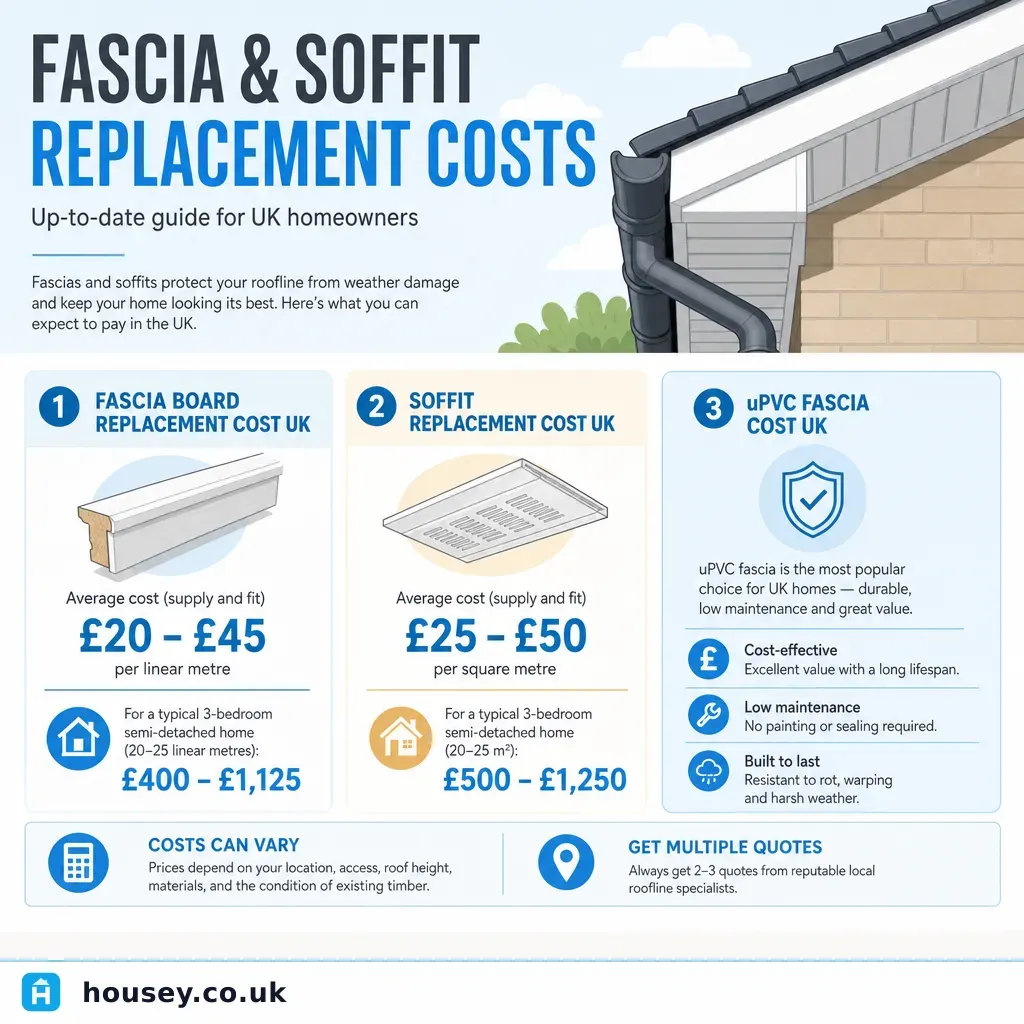
Fascia and Soffit Replacement Costs
Fascia and soffit replacement for a semi-detached house in the UK typically costs £1,800–£4,500 for uPVC boards and new guttering.
 Improvement & Build
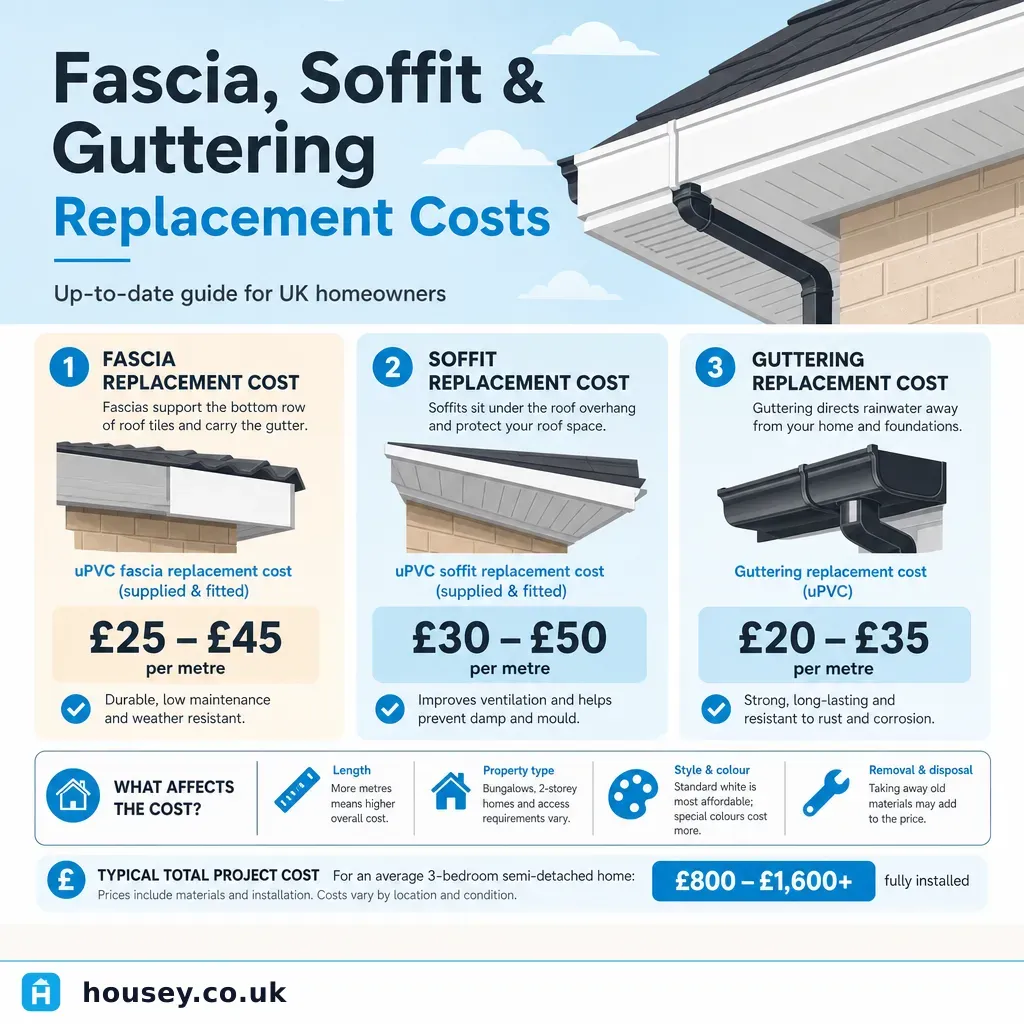
Fascia, Soffit and Guttering Replacement Costs
Replacing fascia, soffit, and guttering on a typical UK semi-detached house costs approximately £1,200–£2,500 using uPVC.
 Improvement & Build
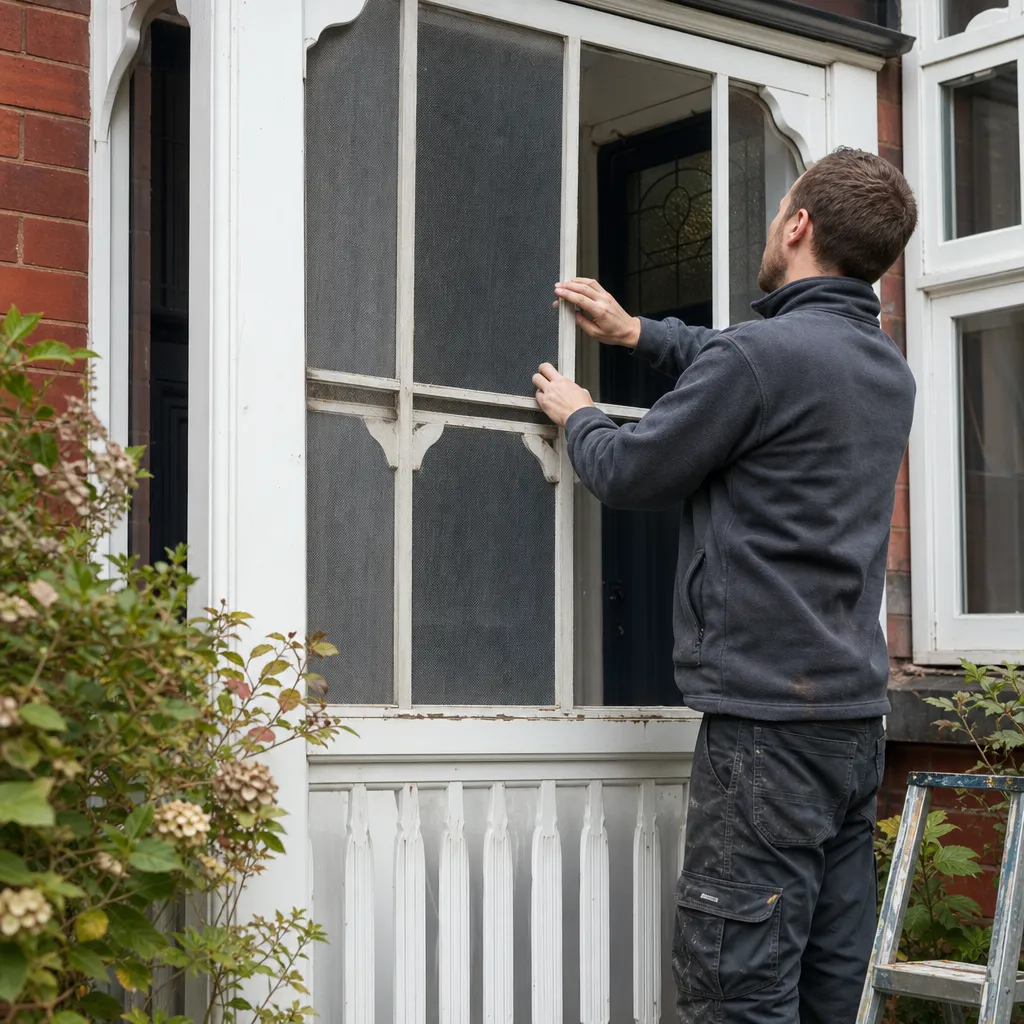
Repairing Damaged Porch Screens: When to Call a Specialist
Most porch screen repairs fall into two categories: surface work — cracked paint, minor mesh tears, loose beading — that a confident homeowner can handle, and structural or glass replacements that require a specialist.
 Improvement & Build
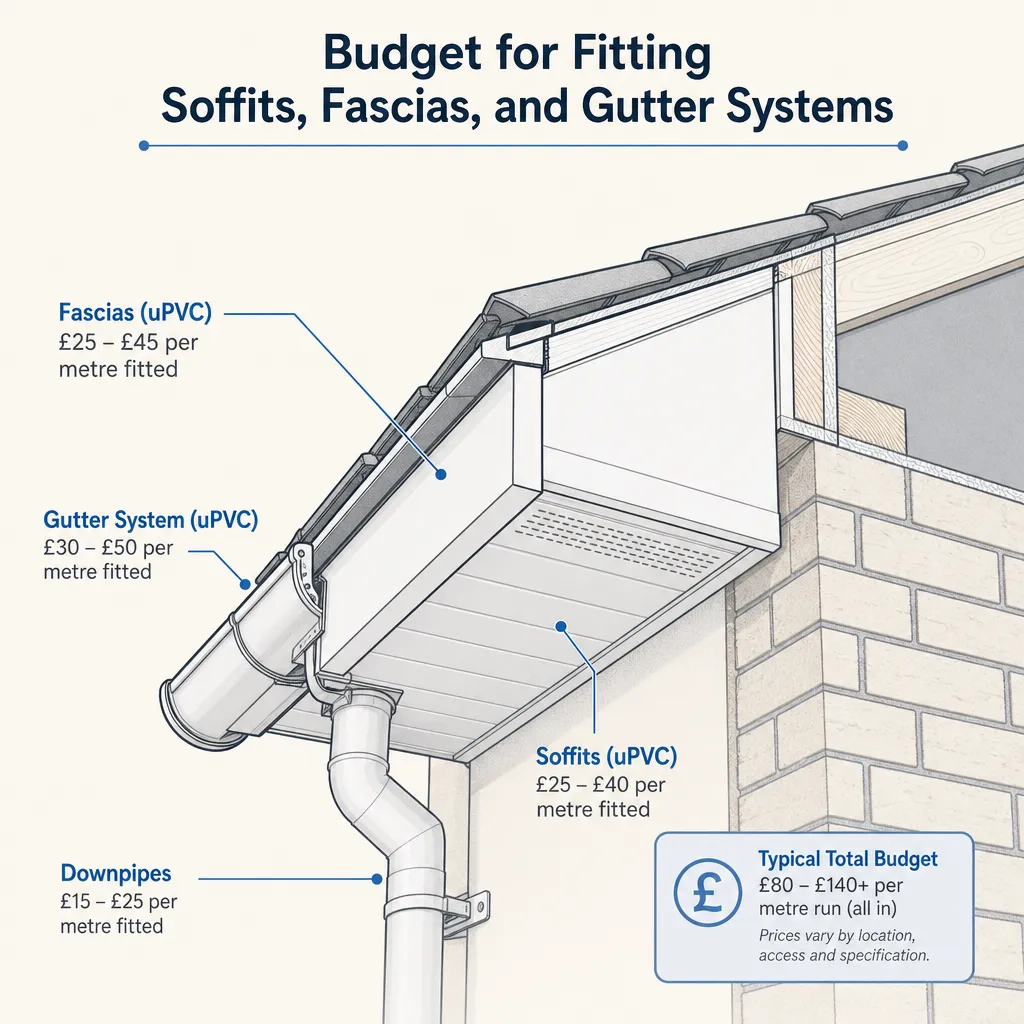
Budget for Fitting Soffits, Fascias, and Gutter Systems
Replacing soffits, fascias, and gutters on a typical UK semi-detached house costs roughly £1,500–£3,500 for uPVC, depending on property size, access, and material choice.
 Improvement & Build
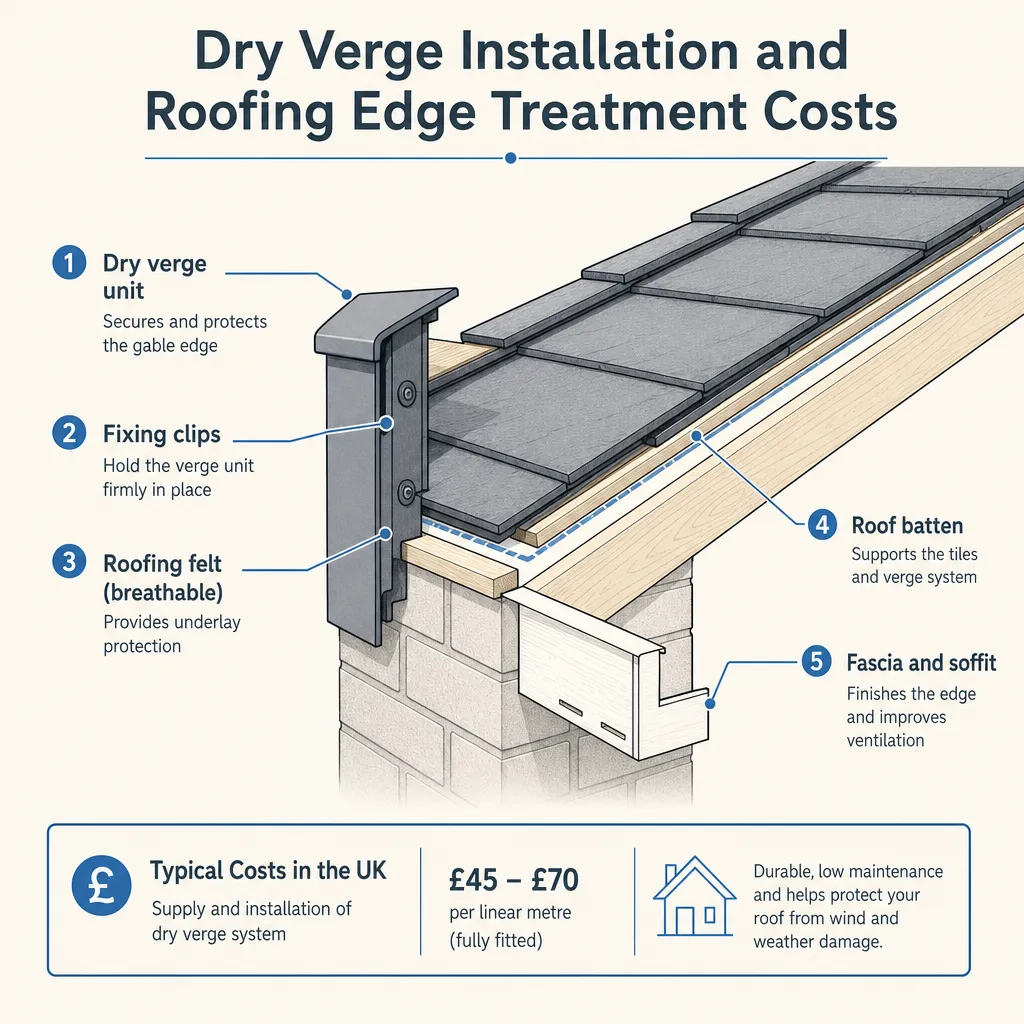
Dry Verge Installation and Roofing Edge Treatment Costs
A dry verge system replaces mortar bedding along the gable edge of a pitched roof with interlocking uPVC or aluminium units.