Fascia and Soffit Replacement Costs
By Housey · Last reviewed 11th of May 2026
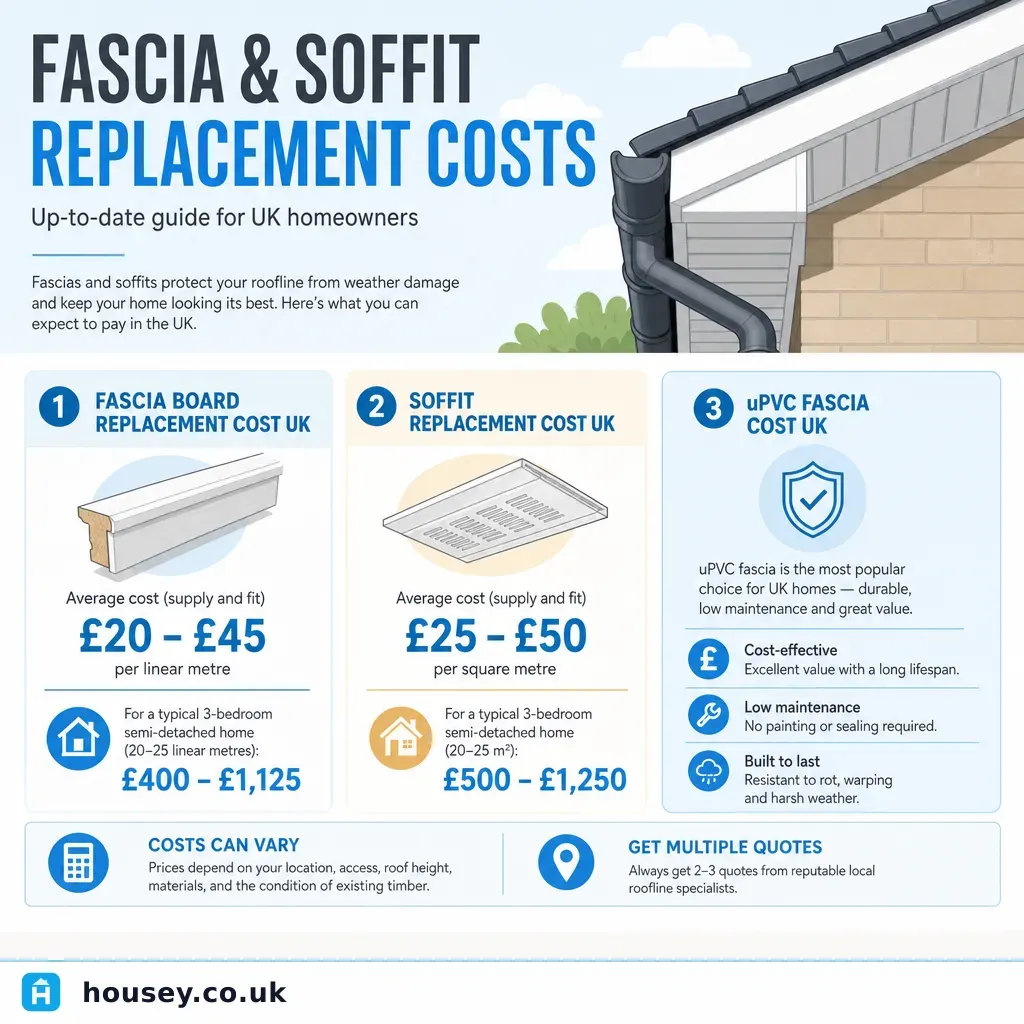
Fascia and Soffit Replacement Costs
Fascias and soffits are the finishing boards at the roofline of most UK homes — the fascia runs along the roof edge behind the guttering, while the soffit spans the underside of the roof overhang between the fascia and the wall. Most replacement projects arise when original painted timber boards rot, warp, or crack — common in properties built before the 1990s — or when a homeowner is upgrading guttering and chooses to renew the full roofline at the same time. Because the work requires scaffold access and is closely linked to guttering replacement, getting the scope and materials right before requesting quotes helps you compare prices fairly and avoid unexpected extras.
Key points
- Fascia and soffit replacement for a semi-detached house typically costs £1,800–£4,500 including uPVC boards and new guttering; for a larger detached house, expect £3,000–£7,000. Indicative UK costs, last reviewed 2026-05-11.
- Most pre-1990s UK homes have original painted softwood timber fascias that require repainting every three to five years; uPVC replacement eliminates ongoing maintenance but cannot be easily reversed once fitted.
- Scaffold or podium tower access is required for all two-storey roofline work — scaffold hire typically adds £600–£1,500 to the total project cost.
- Roofers should inspect rafter feet (the roof timbers directly behind the fascia) when boards are removed; rot here adds joinery repair costs before new boards can be fitted.
- New guttering must be installed at the correct fall (around 1:600 gradient) with sufficient bracket spacing — poorly fitted guttering is a frequent cause of damp ingress on UK homes.
Material options for fascia and soffit boards
The choice of material affects initial cost, lifespan, maintenance requirements, and visual appearance. Conservation areas and listed buildings may restrict the use of uPVC.
Material | Typical cost (semi-detached) | Lifespan | Maintenance | Best for | Limitations |
|---|---|---|---|---|---|
uPVC | £1,800–£4,500 | 20–40 years | Minimal (annual cleaning) | Most UK homes wanting low maintenance | Cannot be reversed; some prefer a different appearance |
Painted softwood timber | £2,000–£5,000 | 10–20 years with regular repainting | Repainting every 3–5 years | Conservation areas; listed buildings | High ongoing maintenance; rots if neglected |
Composite (woodgrain effect) | £2,500–£5,500 | 25–40 years | Low (occasional cleaning) | Timber look with low maintenance | Higher initial cost than uPVC |
Aluminium | £3,000–£6,500 | 40+ years | Very low | Premium or contemporary properties | Highest upfront cost |
Indicative UK costs for a semi-detached house, including labour and scaffold access but excluding guttering where retained. Last reviewed 2026-05-11. Costs vary by region, property size, and number of storeys.
Which material should you choose?
- Choose uPVC if your property is a standard residential house and you want low maintenance at a competitive price — this is the most common choice for UK roofline replacement.
- Choose painted softwood timber if your property is in a conservation area or is listed, where planning conditions may restrict or prohibit the use of uPVC.
- Choose composite or aluminium if you want the maintenance benefits of uPVC with a different aesthetic, or if the property warrants a premium material finish.
- Check with your local planning authority before replacing timber with uPVC in a conservation area — requirements vary significantly by council.
What affects the total cost?
Property size and roofline perimeter: Pricing is based on linear metres of roofline. A small terrace may have 15–20 m of roofline; a large detached house can exceed 60 m.
Number of storeys: Second-floor fascias on a two-storey property require more extensive scaffold or platform access. Expect to add £400–£900 to access costs compared with a bungalow equivalent.
Scaffold vs tower platform: Some contractors use mobile podium towers for straightforward properties, reducing access costs. Full scaffold is typically needed for multi-gable rooflines or where access is needed on multiple elevations simultaneously.
Guttering replacement: Most roofline quotes include uPVC guttering and downpipes. If your gutters are already modern uPVC and recently replaced, ask the contractor whether they are compatible with the new fascia profile before committing to retaining them.
Rafter foot condition: If rafter feet behind the fascia show rot or damage, these must be repaired before new boards are fitted. Timber repairs typically add £50–£150 per rafter foot, or more if damage is widespread.
Eaves ventilation: Building Regulations Approved Document C and good roofing practice require adequate eaves ventilation to prevent condensation in the roof space. Vented soffits or separate eaves ventilation inserts should be specified — missing this at installation is expensive to correct retrospectively.
Roof complexity: Properties with multiple gables, hips, dormers, or bay roofs take longer and use more materials.
Quote comparison checklist
Use the following questions when comparing quotes from roofline contractors:
- What is included and excluded — specifically guttering, downpipes, barge boards, and any roofline inspection?
- What access method will be used (scaffold, podium tower, or cherry picker), and is the hire cost included in the quote?
- What happens if rafter foot rot is found once boards are removed — how will you be notified and how is the additional work priced?
- What material, profile, and colour of board is specified?
- Will eaves ventilation be maintained or improved as part of the installation?
- Is VAT included in the quoted price?
- What warranty is provided on materials and on workmanship?
- Will a post-installation gutter flow test be carried out?
Homeowner checklist before the work starts
When to get professional help
Fascia and soffit work involves working at height and must always be carried out by a qualified roofer or roofline specialist using appropriate access equipment. Do not attempt to inspect, repair, or replace roofline boards from a domestic ladder — the Health and Safety Executive notes that falls from height are a leading cause of serious injury in non-professional settings.
Seek professional attention promptly if:
- Guttering is pulling away from the fascia board — this often indicates the board beneath has rotted and can no longer hold fixings
- Water is tracking into the eaves or appearing on internal ceilings after rain — this may indicate a fascia or flashing failure and potential internal damp damage
- The fascia board is visibly bowed or cracked along its length — the rafter feet or wall plate behind may need inspection before any new cladding is fitted
How Housey can help
Housey connects homeowners with vetted roofers and roofline specialists across the UK. Use the Housey quote tool to request itemised prices from local contractors for fascia, soffit, and guttering replacement — including access costs, materials, and any necessary timber repairs.
Frequently asked questions
How long does fascia and soffit replacement take?
A standard semi-detached house with combined fascia, soffit, and guttering replacement typically takes one to three days on site. Add a day each for scaffold erection and strike, so the total project from scaffold delivery to removal commonly runs four to six days. More complex rooflines with multiple gables or dormers will take longer.
Do I need planning permission to replace fascias and soffits?
In most cases, no — replacing fascias and soffits with similar materials is permitted development. However, if your property is in a conservation area or is listed, you may need conservation area consent or listed building consent before replacing original timber with uPVC or other materials. Always check with your local planning authority before proceeding.
How are rotten rafter feet repaired when found during fascia replacement?
Rafter foot rot is a common finding when UK timber fascias are removed. A joiner or roofer can cut back the decayed timber and splice in new treated softwood — a rafter foot repair or splice — typically costing £50–£150 per affected rafter foot. Widespread decay across multiple rafter feet may warrant a structural engineer's opinion before proceeding.
How do I know if my soffits are vented?
Vented soffits have small perforations or a ventilation strip that allows air to circulate into the roof void. If you are unsure, a roofline contractor can check during a survey visit. When replacing soffits, always ask for vented boards or separate eaves vent inserts to be included, to maintain adequate roof space ventilation in line with Building Regulations Approved Document C.
Sources and further reading
- Building Regulations Approved Document C: Site preparation and resistance to moisture — GOV.UK
- Working at height: a brief guide — Health and Safety Executive
- Planning permission: alterations to your home — GOV.UK
- Listed buildings and conservation areas: making changes to your home — Historic England
Useful next reads
 Improvement & Build
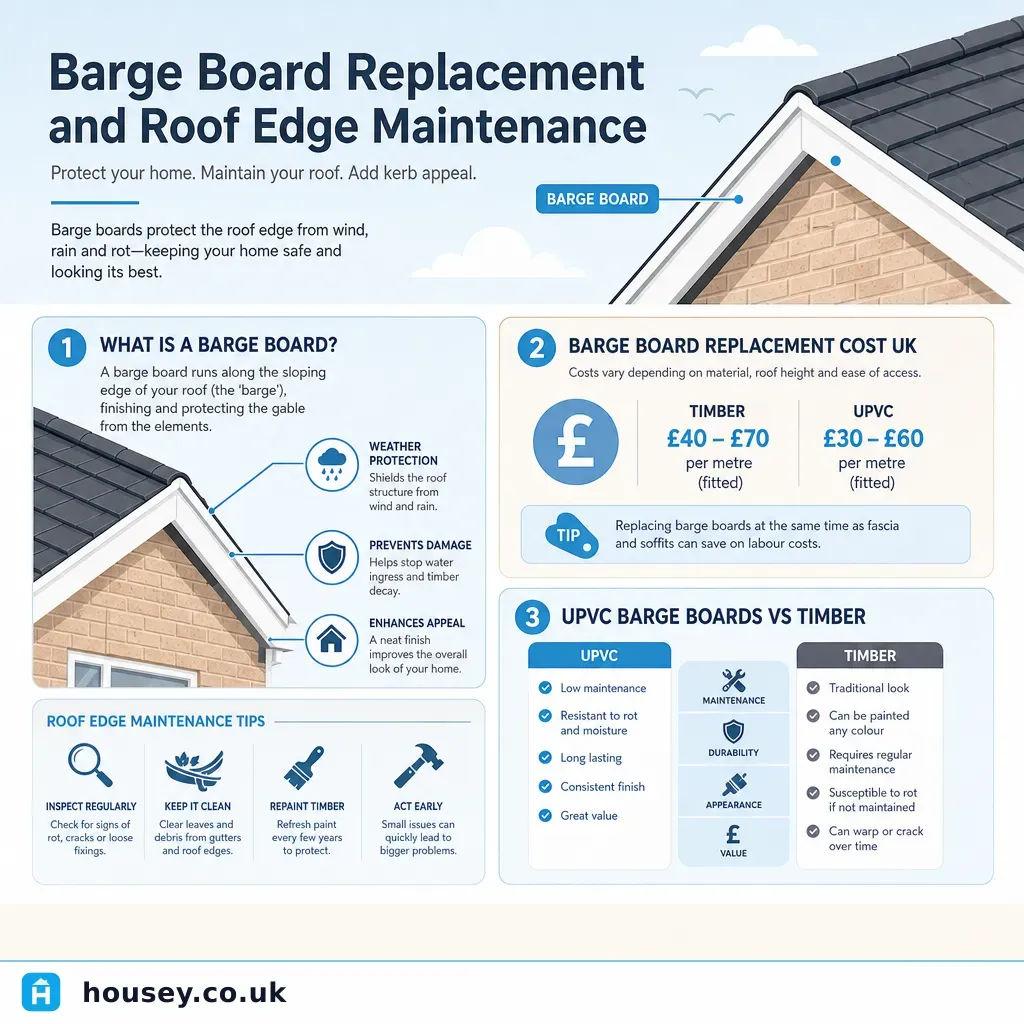
Barge Board Replacement and Roof Edge Maintenance
Barge boards sit at the gable end of a pitched roof and protect the verge from wind-driven rain.
 Improvement & Build
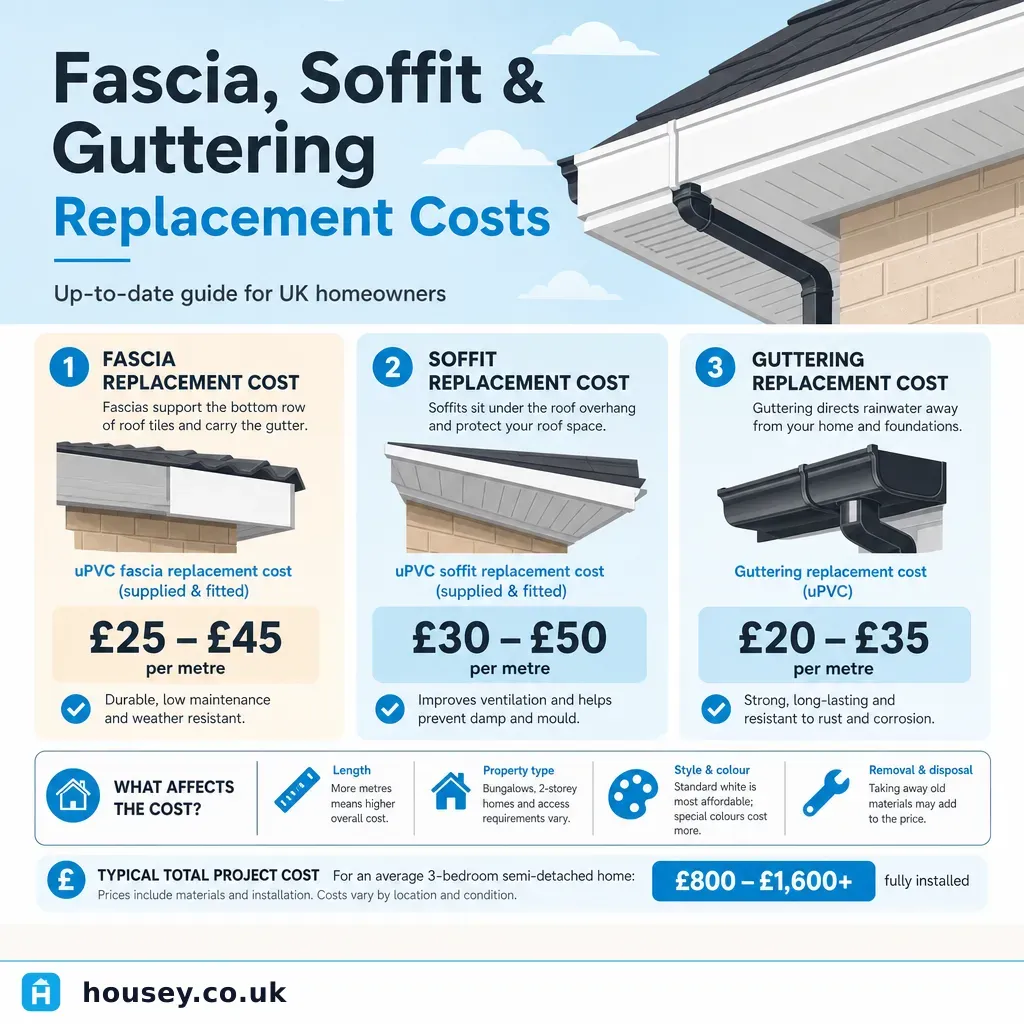
Fascia, Soffit and Guttering Replacement Costs
Replacing fascia, soffit, and guttering on a typical UK semi-detached house costs approximately £1,200–£2,500 using uPVC.
 Improvement & Build
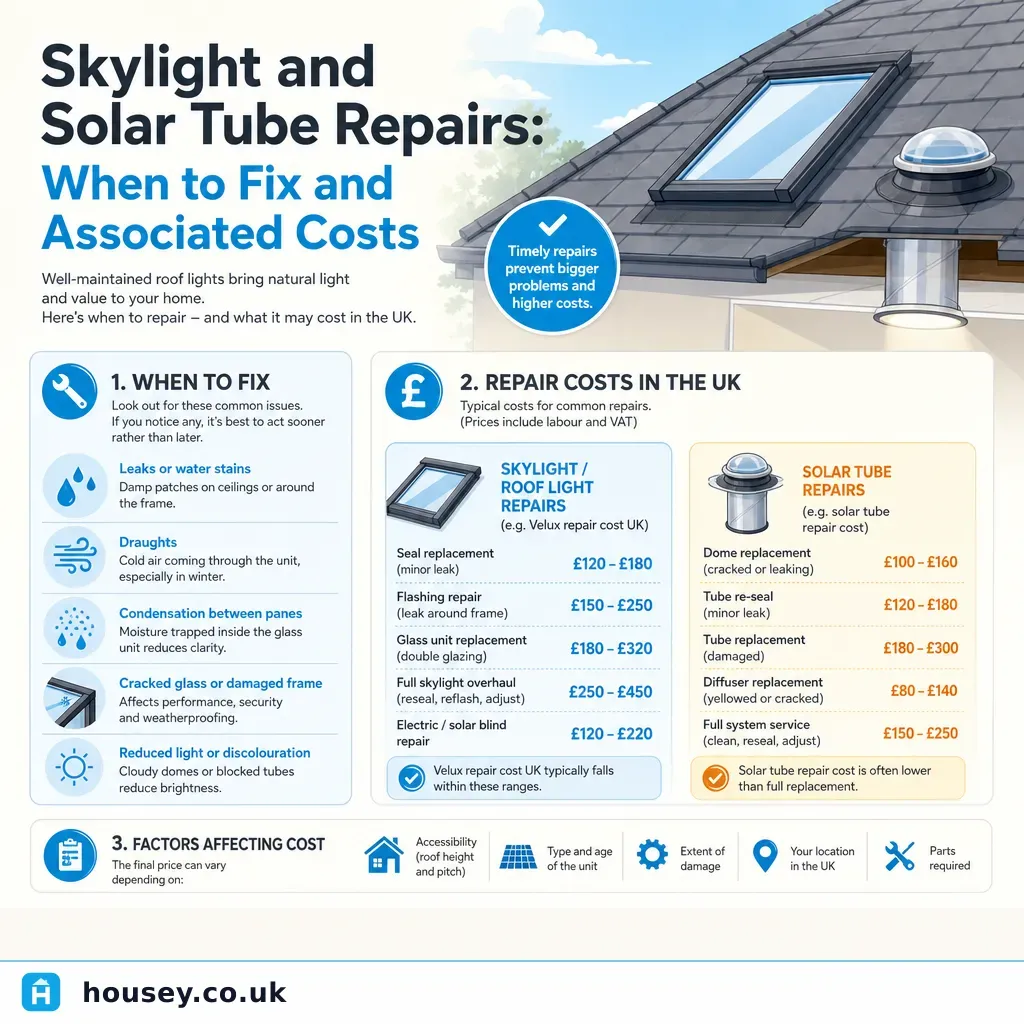
Skylight and solar tube repairs: when to fix and associated costs
Skylight repairs — resealing, reflashing, or replacing a misted glazing unit — typically cost £150–£400 for minor work and £800–£2,500+ for a full replacement in the UK.
 Improvement & Build
Door Sills: Purpose, Maintenance, and Replacement Guidance
A door sill — also called a threshold — is the horizontal component at the base of an external door frame.
 Improvement & Build
Garage Door Hardware: Spring Types and Selection Guide
UK garage doors use either torsion springs, mounted on a shaft above the door opening, or extension springs running along the side tracks.