Building Surveys: Professional Assessment and Structural Inspection of Properties
By Housey · Last reviewed 19th of May 2026
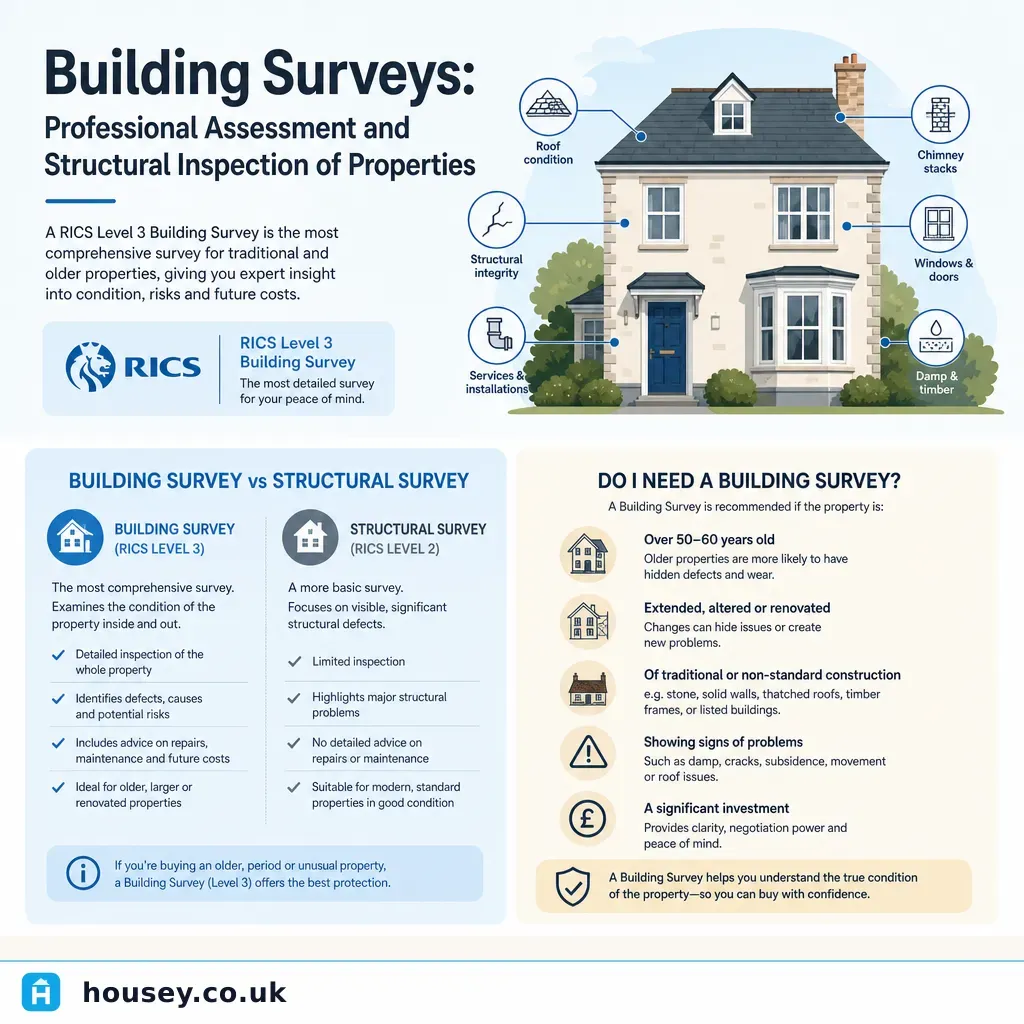
Building Surveys: Professional Assessment and Structural Inspection of Properties
When buying a property — particularly one that predates modern construction standards — a professional survey is one of the most important steps before exchanging contracts. In a housing stock where Victorian terraces, Edwardian semis, and 1930s houses make up a large proportion of available homes, defects can be expensive, hidden, and consequential. Understanding the different survey types, what each involves, and when a structural engineer's input is needed helps you make an informed decision before committing to a purchase.
Key points
- Under the RICS Home Survey Standard (effective March 2021), residential surveys are classified into three levels: Level 1 (Condition Report), Level 2 (HomeBuyer Report), and Level 3 (Building Survey) — the higher the level, the more thorough the inspection.
- A RICS Level 3 Building Survey is the most detailed standard residential survey and is generally recommended for properties built before 1920, substantially altered homes, properties with visible defects, and buildings of non-standard construction.
- A mortgage valuation is not a survey — it is commissioned by the lender to confirm the property is adequate security for the loan and does not assess condition in detail.
- Structural engineers provide specialist engineering assessment of foundation movement, cracking, and structural integrity and are typically instructed separately from a general building surveyor, often following concerns raised in a Level 3 report.
- A measured building survey produces accurate dimensional drawings — floor plans, elevations, and sections — rather than a condition report; it is required for planning applications, listed building consent, and refurbishment design.
What is a building survey?
In everyday property usage, the phrase 'building survey' is sometimes used loosely to mean any professional property inspection. Under the RICS Home Survey Standard, however, it refers specifically to the RICS Level 3 Home Survey — the most comprehensive of the three standard residential levels.
A RICS Level 3 Building Survey typically involves:
- Inspection of accessible structural elements: roof structure (where accessible via a hatch), walls (internal and external), floors, chimney stacks, and subfloor void where entry is possible
- Assessment of dampness, timber defects, and visible drainage arrangements
- Condition ratings (1 = no action; 2 = attention needed; 3 = urgent) applied to each element
- Commentary on alterations and whether they appear to comply with building regulations
- Advice on repair options, maintenance priorities, and elements requiring further specialist investigation
- A written report with photographic evidence throughout
The surveyor notes any limitations — fitted carpets cannot be lifted, furniture cannot be moved, and concealed elements cannot be opened up — but all limitations must be disclosed in the report.
RICS survey levels compared
Survey level | Best for | Not ideal for | Typical output | Main risk if wrong choice |
|---|---|---|---|---|
Level 1 — Condition Report | Modern conventional homes in good condition | Older, altered, or visibly defective properties | Traffic-light condition ratings only | Defects not investigated or quantified |
Level 2 — HomeBuyer Report | Post-1920 conventional homes in reasonable condition | Pre-1920 construction, significant alteration, visible movement | Traffic-light ratings plus repair advice; optional market valuation | Material defects missed where investigation was warranted |
Level 3 — Building Survey | Older, larger, substantially altered, non-standard construction, visible defects | Rarely unsuitable; may be cost-disproportionate on brand-new builds | Detailed condition report; repair options; maintenance notes | Very few — this is the most thorough residential survey option |
Specific defect report | One known area of concern when the property is otherwise understood | Properties needing a full overview | Report on the named element only | Broader defects remain uninvestigated |
Structural engineer's report | Movement, cracking, foundation concerns — often follows a Level 3 survey | General condition overview | Engineering report; may include calculations or monitoring recommendations | Structural risk unquantified |
Which survey should you choose?
Decision tree
- Choose RICS Level 1 if the property is a modern new-build or a lightly-used recent conversion in demonstrably good condition and you want documentary reassurance.
- Choose RICS Level 2 if the property is a post-1920 conventional house or flat in reasonable condition, with no visible signs of significant defects or unusual construction materials.
- Choose RICS Level 3 if the property is pre-1920, constructed of stone, solid brick, or timber frame; if it has been substantially extended or altered; if there is any cracking, damp, or evidence of movement; or if you want the most thorough picture before exchange.
- Commission a structural engineer if your Level 3 survey has flagged potential movement or structural concerns, or if you can see stepped or diagonal cracks in brickwork or masonry, or cracks greater than approximately 5 mm in any element.
- Order a measured building survey if you need accurate floor plans and elevations for a planning application, listed building consent, or a refurbishment design brief — this is a separate service from a condition survey.
What a structural inspection involves
A structural inspection by a chartered structural engineer — typically holding MIStructE or CEng status — provides engineering diagnosis rather than general condition assessment. A structural engineer may:
- Map and measure crack patterns, assessing width, orientation, and progression over time
- Identify the foundation type and likely bearing strata from records or visual evidence
- Assess floor joist condition, lateral restraint, and roof structural integrity
- Carry out or recommend monitoring such as crack gauges or precise level surveys
- Provide engineer's calculations for proposed alterations — beam sizing, padstones, propping requirements
- Recommend further investigation, such as trial pits, drainage CCTV, or intrusive opening up of fabric
Structural engineers do not provide property valuations. Look for membership of the Institution of Structural Engineers (IStructE) or equivalent Chartered Engineer (CEng) status when instructing.
What a measured building survey produces
A measured building survey records the physical geometry of an existing building — plan dimensions, ceiling heights, wall thicknesses, door and window openings, roof lines, and external elevations — using laser-scanning (Lidar), total station instruments, or traditional hand measurement. The output is typically a set of CAD drawings or a Building Information Model (BIM).
Measured building surveys are needed for:
- Planning applications for extensions or changes of use to existing buildings
- Listed building consent applications where accurate existing plans are required
- Refurbishment designs where as-built dimensions are essential to the design process
- Estimating material quantities before tendering construction works
They are not condition reports and will not identify structural defects, advise on repairs, or comment on compliance with building regulations.
Important limitations
This article describes survey types available in England and Wales. Survey practice and professional frameworks may differ in Scotland and Northern Ireland. RICS is the principal professional body regulating building surveyors in the UK, but not all property inspectors hold RICS accreditation — verify qualifications before instructing. Survey costs vary significantly by property size, location, age, and complexity; any cost figures in this article are illustrative and should not be relied upon without obtaining current quotes. A survey is a professional assessment at a point in time and cannot guarantee future performance or uncover all concealed defects.
When this becomes urgent
Seek a professional survey or structural assessment without delay if:
- A survey report has flagged movement, subsidence, or hidden defects requiring further specialist investigation
- You can see stepped or diagonal cracks in external brickwork, or cracks that appear to be widening
- Doors or windows have begun to stick suddenly without an obvious seasonal explanation
- Floor levels appear to have changed, or floor joists feel soft or springy underfoot
- You are buying a pre-1920 property, a property with visible defects, or one where no previous survey has been commissioned
What to ask a qualified professional
Before instructing a surveyor or structural engineer:
- What RICS survey level are you recommending for this specific property, and why?
- What will be inspected, and what will the report explicitly exclude?
- Will your report include repair recommendations and indicative repair costs?
- How will you communicate urgent defects — will you call before the written report is issued?
- Are you RICS-regulated (or, for structural work, a member of IStructE or a Chartered Engineer)?
- If further specialist investigation is required, what would you recommend and approximately what would it cost?
When to get professional help
A Level 3 Building Survey is not a luxury for older or unusual properties — it is the best tool available to a buyer for understanding what they are purchasing. Never rely on a mortgage valuation as a substitute; it is produced for the lender's benefit, not yours. For existing homeowners, commissioning a survey before major renovation works can identify defects that materially change the scope and cost of the project.
Seek professional advice if:
- You are buying any property built before 1970 or of non-standard construction
- Structural cracks or suspected movement have appeared in an existing home
- A survey report has recommended further investigation by a specialist
How Housey can help
Housey connects buyers and homeowners with RICS-regulated surveyors and structural engineers across the UK. Whether you need a RICS home survey to assess condition before exchange, a structural survey to investigate cracking or movement in an existing property, or a measured building survey to produce accurate plans for a planning application or refurbishment design, Housey can help you find and compare qualified local professionals.
Frequently asked questions
How much does a RICS Level 3 Building Survey cost?
Costs depend on the property's size, age, type, and location. Indicative UK costs (last reviewed 2026-05-19) range from approximately £500–£700 for a smaller conventional house to £1,200–£2,000 or more for a large, complex, or listed property. Obtain at least two or three quotes and confirm the surveyor is RICS-regulated. Source: RICS guidance on home surveys.
Can a building survey replace a mortgage valuation?
No. A mortgage valuation is commissioned by the lender to protect the lender's interest — it confirms the property is adequate security for the loan. It is not a condition survey and provides the buyer with no meaningful protection against undiscovered defects. A building survey is commissioned by and for the buyer and is a completely separate document.
How long does a building survey take?
The on-site inspection for a RICS Level 3 Building Survey typically takes two to four hours for a standard house, longer for larger or more complex properties. The written report usually follows within five to seven working days, though turnaround varies by surveyor and current workload.
Do I need a survey if the property is a new build?
A new-build property is covered by the developer's structural warranty — such as NHBC Buildmark, lasting ten years — but this does not prevent defects arising. An independent snagging inspection by a qualified surveyor before legal completion is strongly advisable, providing an independent record of defects for the developer to address before you move in.
Sources and further reading
- RICS Home Survey Standard — RICS
- RICS Find a Surveyor — RICS
- Institution of Structural Engineers — find an engineer — IStructE
- NHBC Buildmark warranty — NHBC
- Which? guide to house surveys — Which?
Useful next reads
 Surveys & Inspections
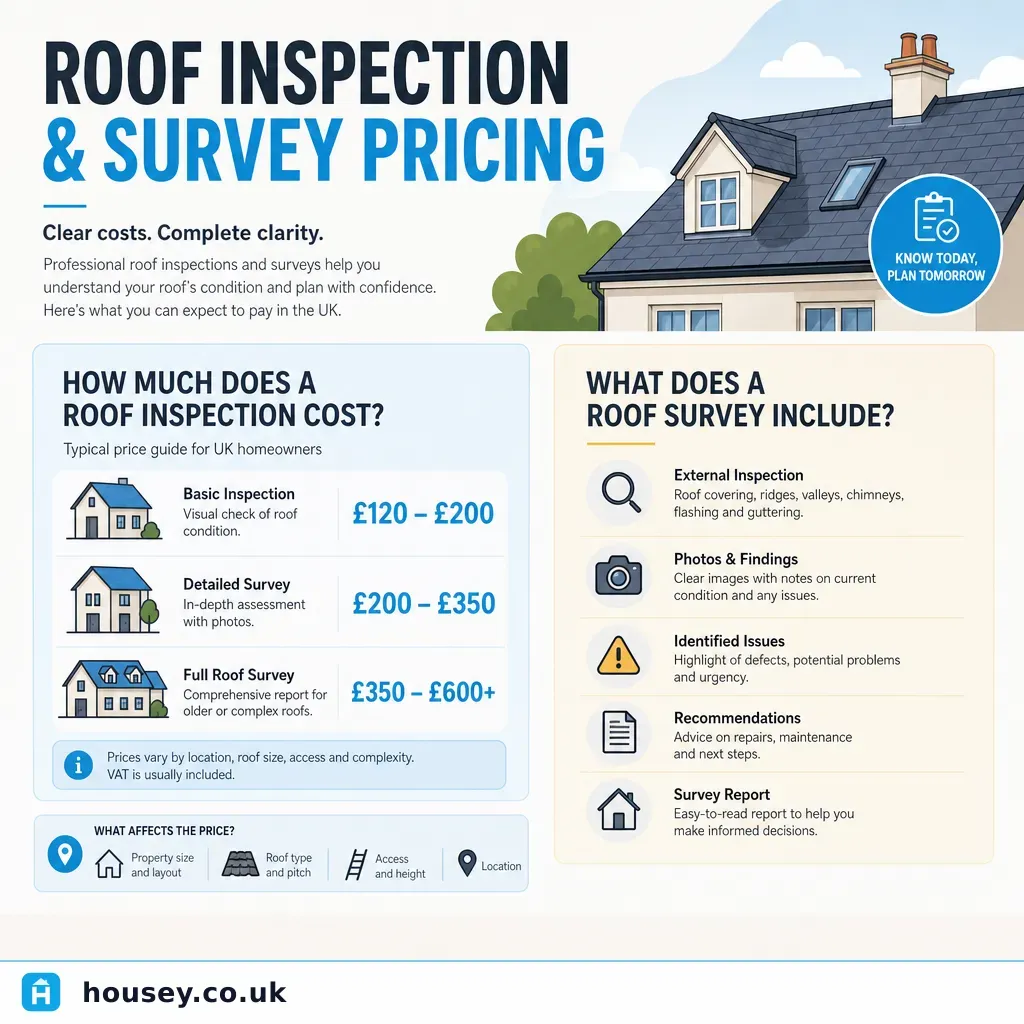
Roof Inspection and Survey Pricing
A professional roof inspection costs £150–£350 for a hands-on roofer survey, rising to £300–£800 for drone or thermal imaging surveys, and £600–£1,500 or more for a RICS Level 3 Building Survey.
 Surveys & Inspections
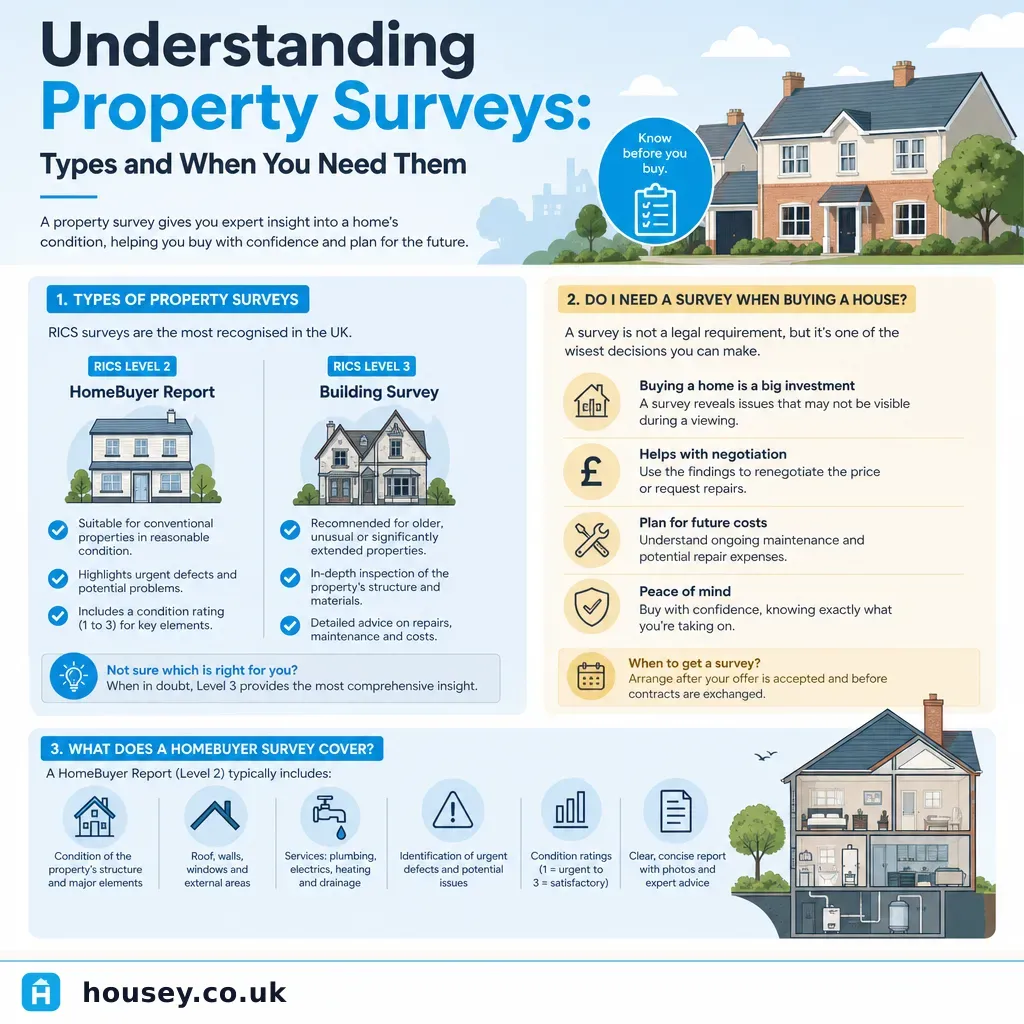
Understanding Property Surveys: Types and When You Need Them
The three main RICS survey types are the Level 1 Condition Report (for standard properties in good condition), the Level 2 Home Survey (conventional homes in reasonable condition), and the Level 3 Building Survey (older, unusual, or defective properties).
 Surveys & Inspections
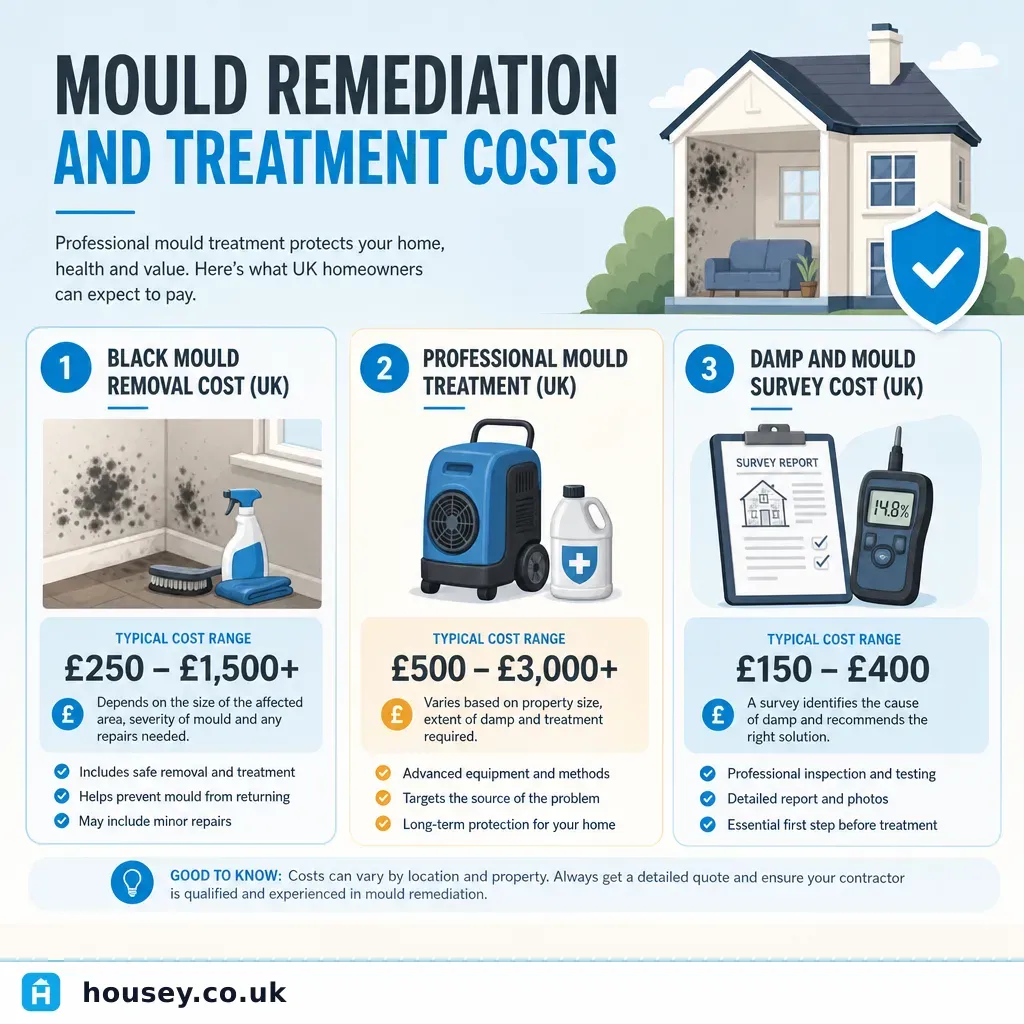
Mould Remediation and Treatment Costs
Professional mould remediation in the UK typically costs £150–£1,500+ depending on the extent of growth, underlying cause, and materials affected.
 Surveys & Inspections
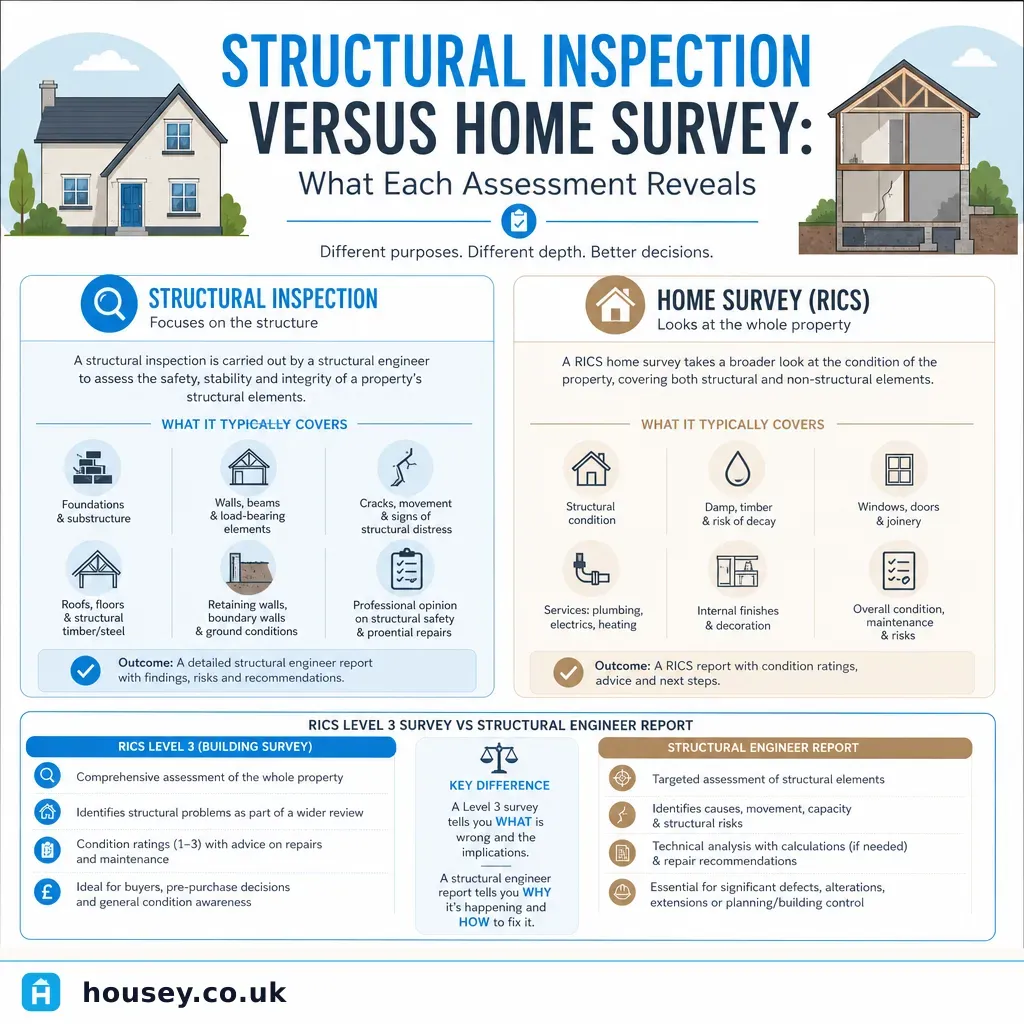
Structural Inspection versus Home Survey: What Each Assessment Reveals
A RICS Home Survey assesses overall property condition across all elements using condition ratings 1 to 3.
 Surveys & Inspections
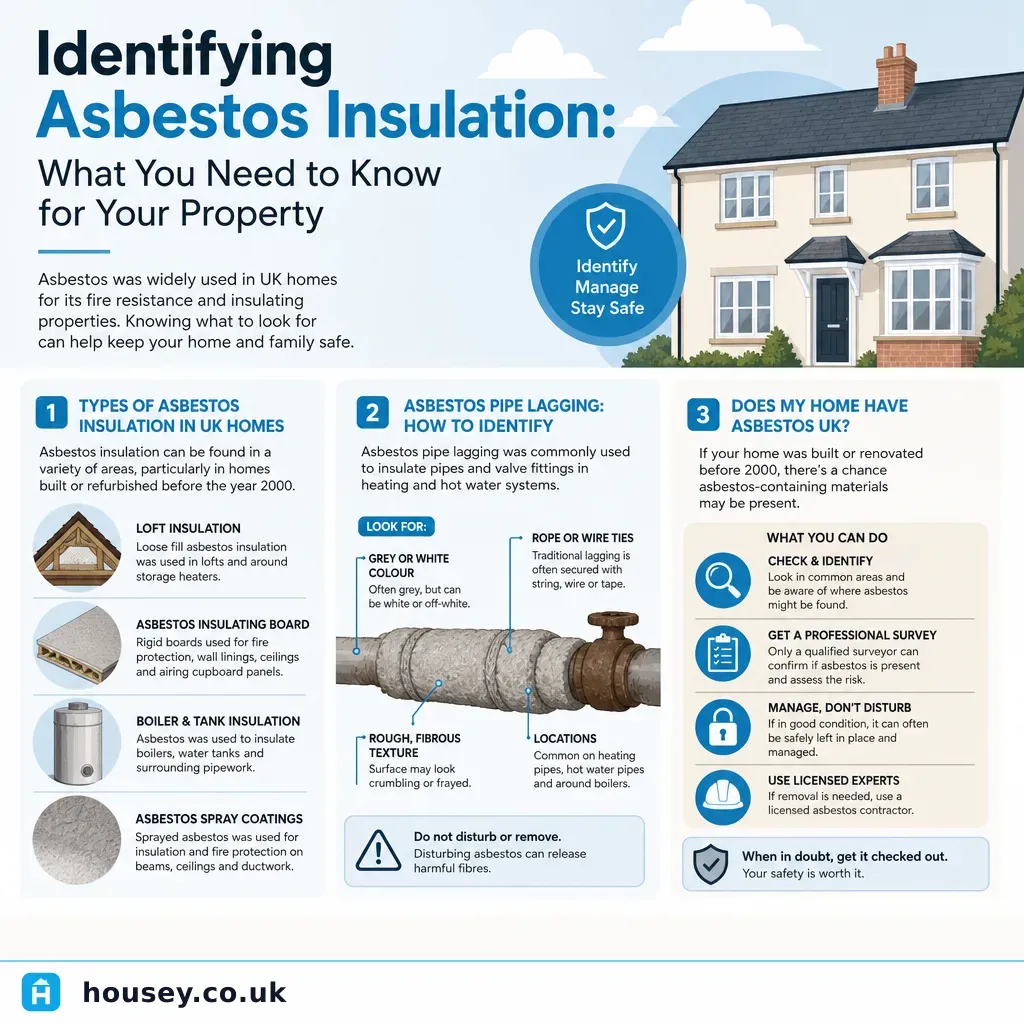
Identifying Asbestos Insulation: What You Need to Know for Your Property
Asbestos insulation was widely used in UK properties built before 2000, commonly found in pipe lagging, ceiling tiles, loose-fill loft insulation, and around boilers.