Structural Inspection versus Home Survey: What Each Assessment Reveals
By Housey · Last reviewed 25th of May 2026
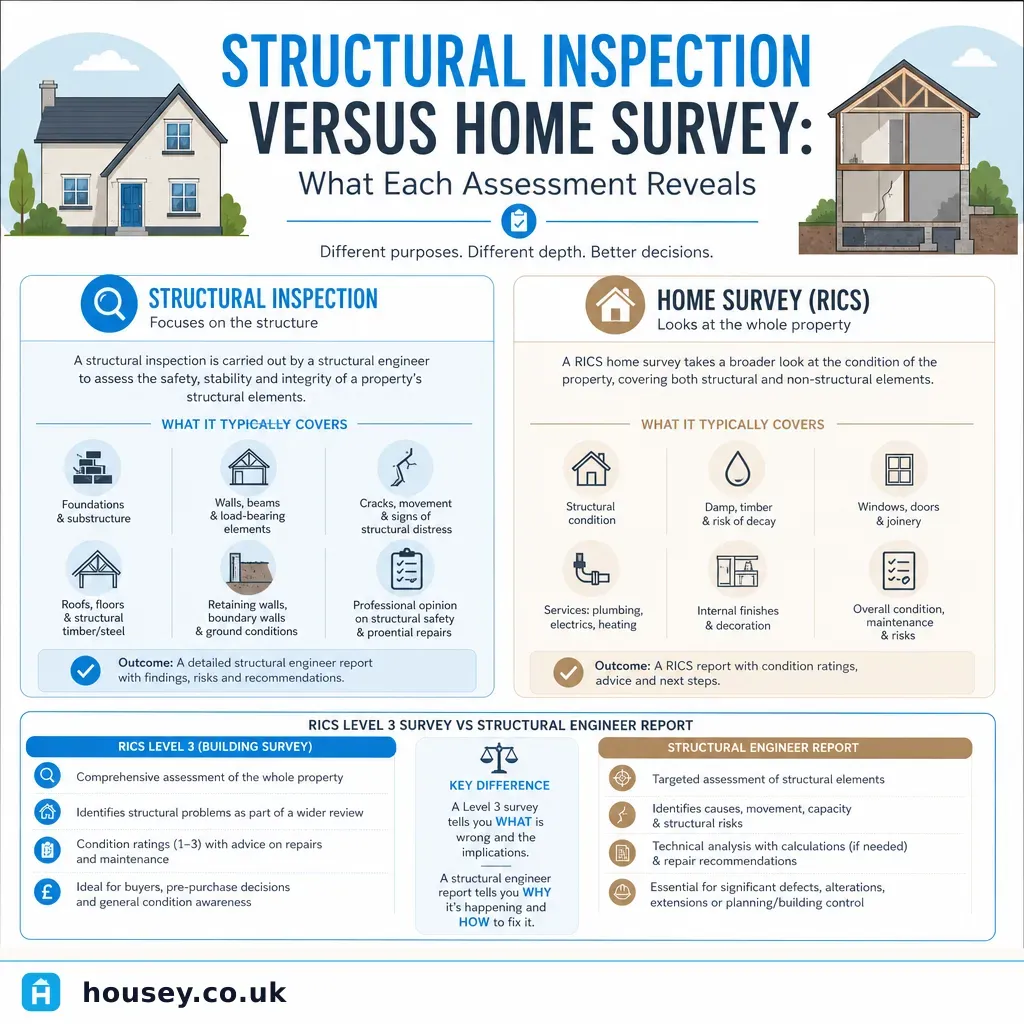
Structural Inspection versus Home Survey: What Each Assessment Reveals
When a property concern is flagged — during a purchase, after a period of adverse weather, or following visible deterioration — homeowners and buyers often face a choice between a general home survey and a specialist structural inspection. These are not the same assessment, and choosing the wrong one can leave significant gaps in what you know about a property before you proceed. Understanding what each assessment covers, who carries it out, and what the output means in practice is essential for making informed decisions about UK property.
Key points
- A RICS Home Survey (Level 2 or Level 3) is carried out by a chartered surveyor and assesses the overall condition of a property using a traffic-light condition rating system (1 = no repair needed, 2 = defects present but not urgent, 3 = urgent or significant defects).
- A structural inspection is carried out by a structural engineer and focuses specifically on load-bearing and structural elements; it produces an engineering opinion rather than a general condition assessment.
- RICS introduced its current Level 1, 2, and 3 Home Survey framework in 2021, replacing the older HomeBuyer Report and Building Survey branding; both the Level 2 (HomeBuyer Report) and Level 3 (Building Survey) remain available under the updated framework.
- Structural engineers must produce written calculations for building regulations purposes under Approved Document A (Structure); for a property purchase context, an engineer's report typically includes crack cause analysis, remediation advice, and an indicative cost estimate.
- A RICS Level 3 Building Survey explicitly recommends specialist structural investigation when warranted — this recommendation should always be followed up before exchange of contracts, not deferred until after completion.
What a RICS Home Survey covers
A RICS Home Survey is the standard assessment used across the UK for property purchases and general condition checks. Three levels are available under the RICS Home Survey Standard introduced in 2021:
Survey level | What it covers | Typical property | Output |
|---|---|---|---|
RICS Level 1 (Condition Report) | Overall condition ratings; no repair advice | New-build or modern properties in good condition | Condition ratings only |
RICS Level 2 (HomeBuyer Report) | Condition ratings plus brief description of defects; optional market valuation | Conventional post-1900 properties in reasonable condition | Condition report; optional valuation |
RICS Level 3 (Building Survey) | In-depth assessment of construction, defects, causes, and repair options | Older, extended, unusual, or visibly defective properties | Detailed narrative report with repair recommendations |
All three levels are carried out by a RICS-qualified surveyor — not a structural engineer. Surveyors inspect accessible and visible surfaces; they do not carry out invasive opening-up works unless specifically agreed in advance.
What a structural inspection covers
A structural inspection is an engineering-led assessment focused entirely on structural integrity. A structural engineer — typically a Chartered Member of IStructE or ICE — will inspect:
- Foundation type and evidence of settlement, heave, or differential movement
- Crack patterns in walls, floors, and ceilings: type, width, orientation, and probable cause
- Load-bearing elements: steel beams, lintels, timber posts, and columns
- Roof structure: rafters, purlins, ridge board, ceiling ties, and signs of spread or decay
- Floor structure: timber or concrete construction, deflection, rot, or inadequate support
- Evidence of structural alterations, removed walls, or modifications to load-bearing elements
The output is a written report with an engineering opinion, typically including an indicative remediation cost and a recommended course of action — repair, monitoring, or further investigation.
What not to assume
A number of common misunderstandings arise when homeowners and buyers compare these two assessments:
- Do not assume a RICS Level 3 survey is the same as a structural engineer's report. A Level 3 Building Survey is the most comprehensive general survey available, but it is not an engineering assessment. The surveyor will recommend a structural engineer if they identify concerning structural signs.
- Do not assume a "structural survey" is a defined product. In common usage, "structural survey" is sometimes used to mean a RICS Level 3 survey and sometimes to mean an engineer's structural inspection. These are different assessments carried out by different professionals. Always confirm who will inspect and what the report will cover before instructing.
- Do not assume a structural engineer's report replaces a home survey. An engineer's report focuses on structural matters only. It does not assess damp, drainage, roofing materials, windows, electrics, or heating — all of which a RICS Level 2 or Level 3 survey will address.
- Do not assume that no visible cracks means no structural issues. Foundation problems, wall tie failure, and roof spread can develop gradually and may not be visible on a single viewing.
- Do not assume a structural engineer's opinion is always definitive. For complex situations — suspected subsidence on shrinkable clay, for example — further investigation such as drain CCTV surveys, trial pits, or crack monitoring over time may be required before a conclusion can be reached.
Decision tree: which assessment do you need?
- Choose a RICS Level 2 Home Survey if the property is post-1945, conventional construction, in reasonable condition, and no obvious defects are visible at viewing. This is the standard starting point for most purchases.
- Choose a RICS Level 3 Building Survey if the property is pre-1919, solid-wall, listed, extended, converted, or shows any visible defects. The Level 3 is appropriate wherever the Level 2 may lack sufficient depth.
- Add a structural engineer's inspection if a RICS survey returns a condition rating 3 on any structural element, recommends specialist investigation, or if you observe significant cracks, leaning walls, uneven floors, or signs of subsidence.
- Commission a structural inspection first if your concern is specifically structural — you have seen cracks or movement and want an engineering opinion before deciding whether to proceed with a purchase at all.
- Commission both where a complex older property is involved and the lender or solicitor requires both a general condition assessment and a formal structural engineering opinion.
Comparing costs and timescales
Indicative UK costs, last reviewed 2026-05-25 — always obtain your own quotes as fees vary by region, property size, and scope.
Assessment | Indicative cost | Who carries it out | Typical turnaround |
|---|---|---|---|
RICS Level 2 (HomeBuyer Report) | £400–£700 | RICS-qualified surveyor | 5–10 working days |
RICS Level 3 (Building Survey) | £600–£1,500+ | RICS-qualified surveyor | 5–10 working days |
Structural engineer's inspection | £300–£600 (single issue) | Chartered structural engineer | 5–10 working days |
Combined Level 3 + structural inspection | £900–£2,000+ | Surveyor + structural engineer | Allow 2–3 weeks |
Fees vary significantly in London and the South East compared with other UK regions. Always confirm what is included, who will attend, and what the report will cover before instructing.
Important limitations
This article provides general information about the survey and inspection types available to UK homeowners and buyers. It does not constitute professional surveying or engineering advice. The right assessment depends on the specific property, its age, construction, location, and condition — factors that only a qualified professional who has inspected the property can properly evaluate. RICS surveying standards are set by the Royal Institution of Chartered Surveyors; structural engineering standards are set by the Institution of Structural Engineers (IStructE). Rules around what mortgage lenders require and what constitutes adequate investigation vary by case and lender.
When this becomes urgent
Seek a structural inspection promptly if:
- A RICS survey rates any structural element as condition 3 and recommends specialist investigation
- You are approaching exchange and have unresolved structural concerns
- You can see cracks that appear to be widening between visits to the property
- A crack is wider than approximately 5 mm, horizontal in a cavity-wall property, or stepped diagonally through brickwork
- Floors, ceilings, or walls appear visibly distorted in ways not apparent in earlier photographs
- A mortgage lender has flagged a structural concern in their valuation report
What to ask a qualified professional
When instructing either a RICS surveyor or a structural engineer, ask:
- What level of RICS Home Survey do you recommend for this property, and why? (for surveyors)
- Are you a Member of RICS? What is your membership number? (for surveyors)
- Are you a Chartered Member of IStructE or ICE? What is your membership number? (for structural engineers)
- What specific elements will you inspect, and what access will you need?
- Will the report include remediation advice and indicative costs, or only identify defects?
- What happens if you find issues that warrant further specialist investigation?
- Is VAT included in your fee, and what is excluded from scope?
- What professional indemnity insurance do you carry?
When to get professional help
A structural concern — however minor it appears — should always be assessed by a qualified professional before exchange. A RICS-qualified surveyor provides an overall condition assessment across all elements; a structural engineer provides a targeted engineering diagnosis. For most property purchases where structural concerns exist, commissioning both gives you the most complete picture before you commit.
How Housey can help
Housey connects UK homeowners and buyers with vetted professionals for both types of assessment. Request quotes for structural surveys from chartered engineers, or book a RICS Home Survey for a Level 2 or Level 3 assessment. Using both gives you the fullest picture before you exchange.
Frequently asked questions
Is a 'structural survey' the same as a RICS Level 3 Building Survey?
Structural survey is not a formally defined term in the UK. It is sometimes used colloquially to mean a RICS Level 3 Building Survey (carried out by a chartered surveyor) and sometimes to mean a specialist structural engineer's inspection. These two assessments serve different purposes and are carried out by different professionals. Always clarify which assessment is being offered and who will carry it out when requesting quotes.
Can a RICS surveyor give an engineering opinion on cracks?
A RICS surveyor can identify and rate cracks and recommend whether specialist investigation is needed. However, chartered surveyors are not structural engineers, and where significant cracking or suspected movement is present, the surveyor will typically recommend a structural engineer's report rather than providing a formal engineering opinion themselves.
Do I need both a home survey and a structural inspection?
For properties in good condition with conventional construction, a RICS Level 2 or Level 3 survey is usually sufficient. A structural engineer's inspection becomes necessary when the surveyor identifies structural concerns, the property has a history of movement or subsidence, or the buyer or lender requires an engineering opinion alongside the general condition assessment.
Can structural inspections be used for purposes other than property purchase?
Yes. Structural inspections are also commonly commissioned by existing homeowners investigating cracks or movement, by landlords conducting condition checks, by homeowners planning to extend or structurally alter a property, and for insurance or remortgage purposes where a lender requires a structural engineer's report.
Sources and further reading
- RICS Home Survey Standard — RICS: Home Survey Level 1, 2, and 3 framework
- Institution of Structural Engineers (IStructE) — IStructE: structural engineering professional standards
- Building Regulations Approved Document A (Structure) — GOV.UK: structural requirements under building regulations
- Property surveys and valuations — Citizens Advice: independent guidance on survey types
- Types of property survey — Which?: consumer guidance on survey options
Useful next reads
 Surveys & Inspections
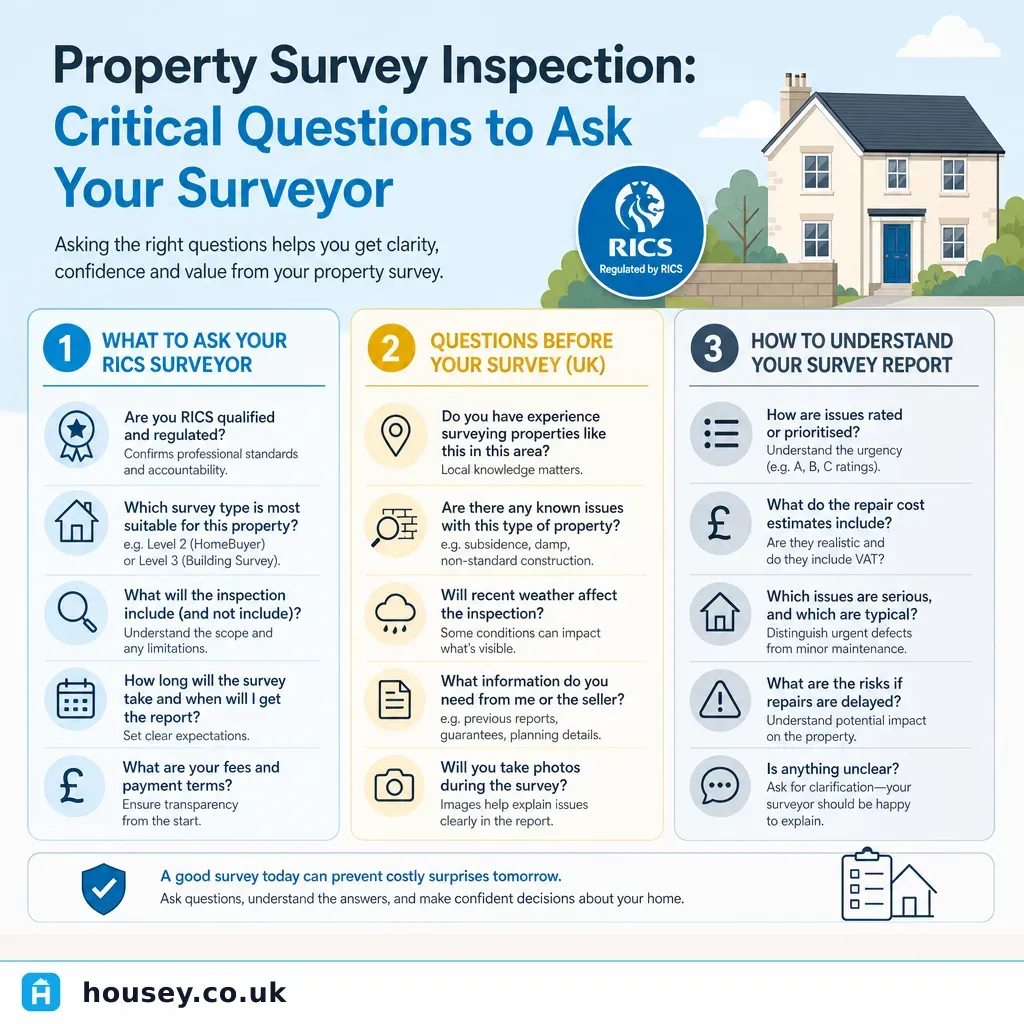
Property Survey Inspection: Critical Questions to Ask Your Surveyor
Before instructing a surveyor, ask which RICS level suits your property and what the report will and will not cover.
 Surveys & Inspections
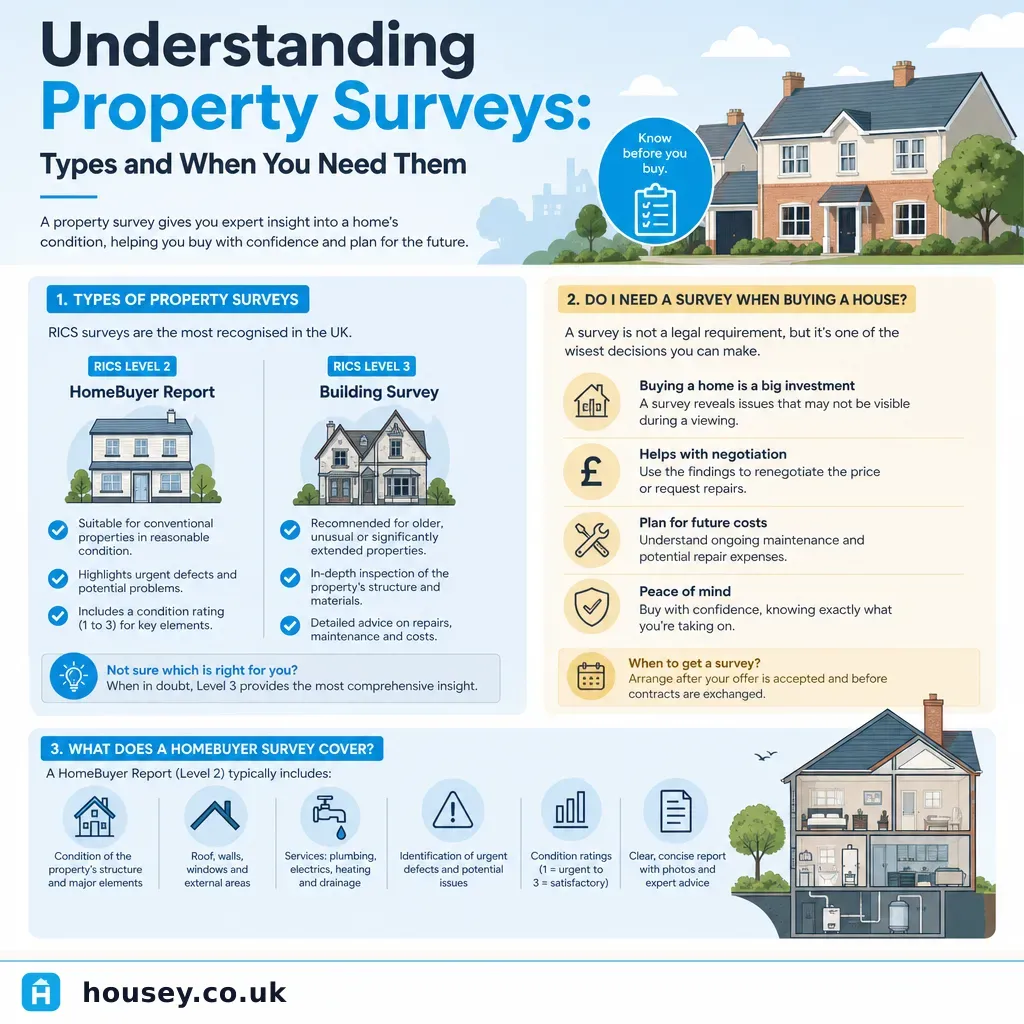
Understanding Property Surveys: Types and When You Need Them
The three main RICS survey types are the Level 1 Condition Report (for standard properties in good condition), the Level 2 Home Survey (conventional homes in reasonable condition), and the Level 3 Building Survey (older, unusual, or defective properties).
 Surveys & Inspections
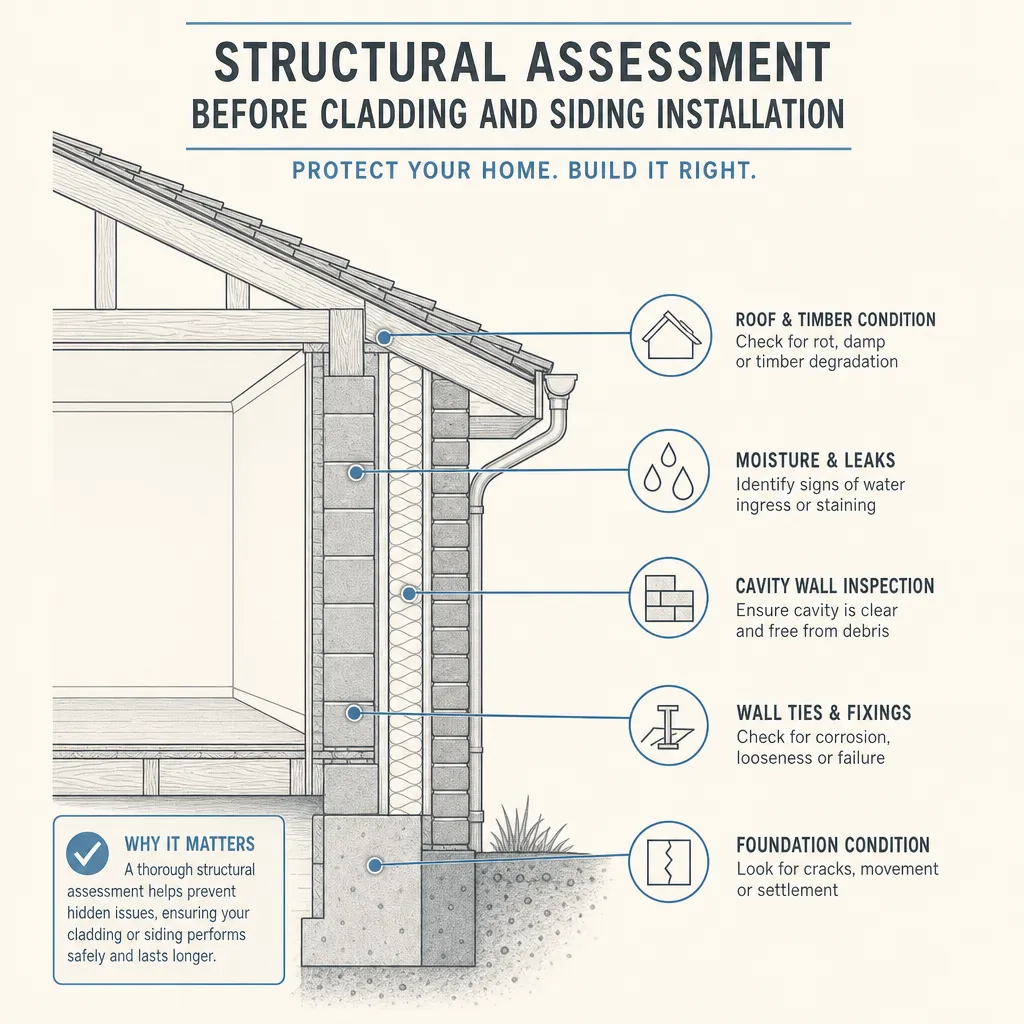
Structural Assessment Before Cladding and Siding Installation
Before installing external cladding or siding, a structural or specific defect assessment is needed to identify hidden timber decay, damp penetration, cavity wall defects, and any load-bearing implications.
 Surveys & Inspections
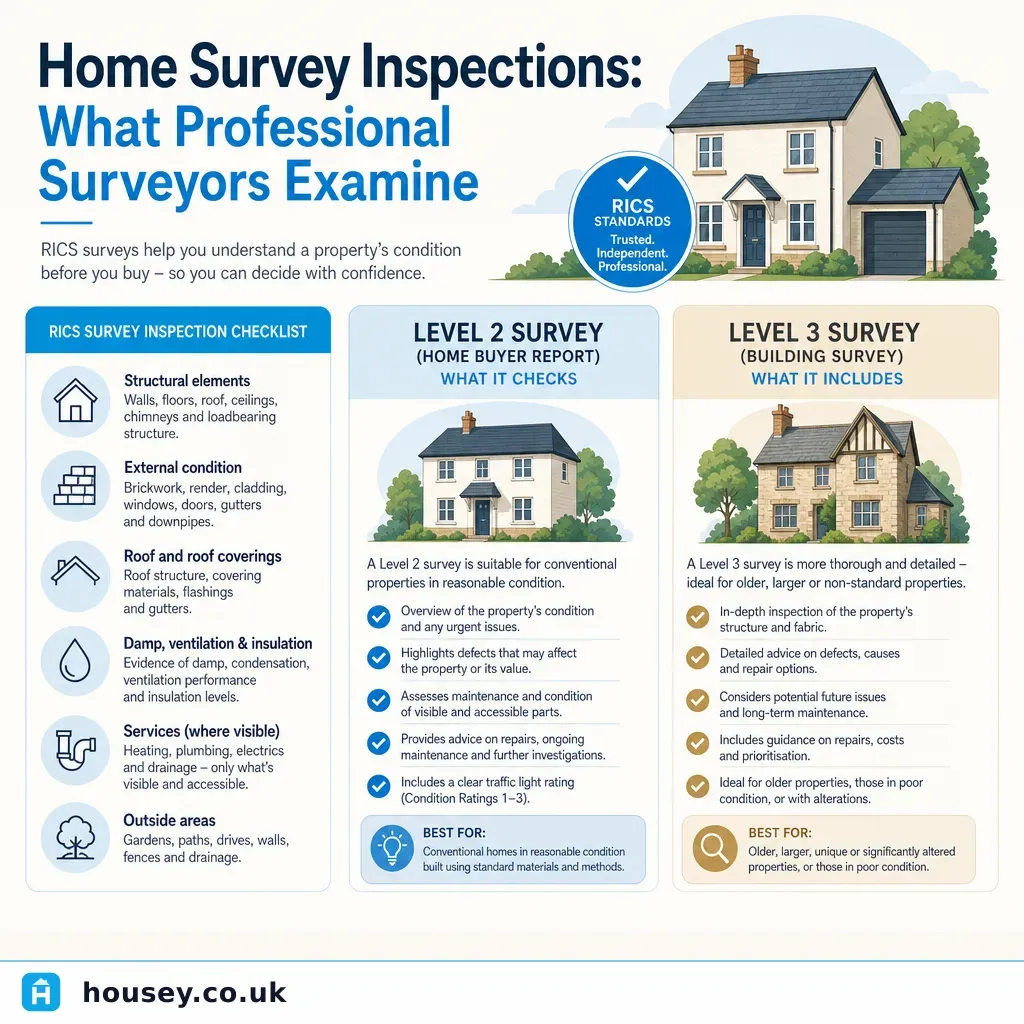
Home Survey Inspections: What Professional Surveyors Examine
A RICS home survey involves a visual inspection of a property's structure, roof, walls, floors, and services.
 Surveys & Inspections
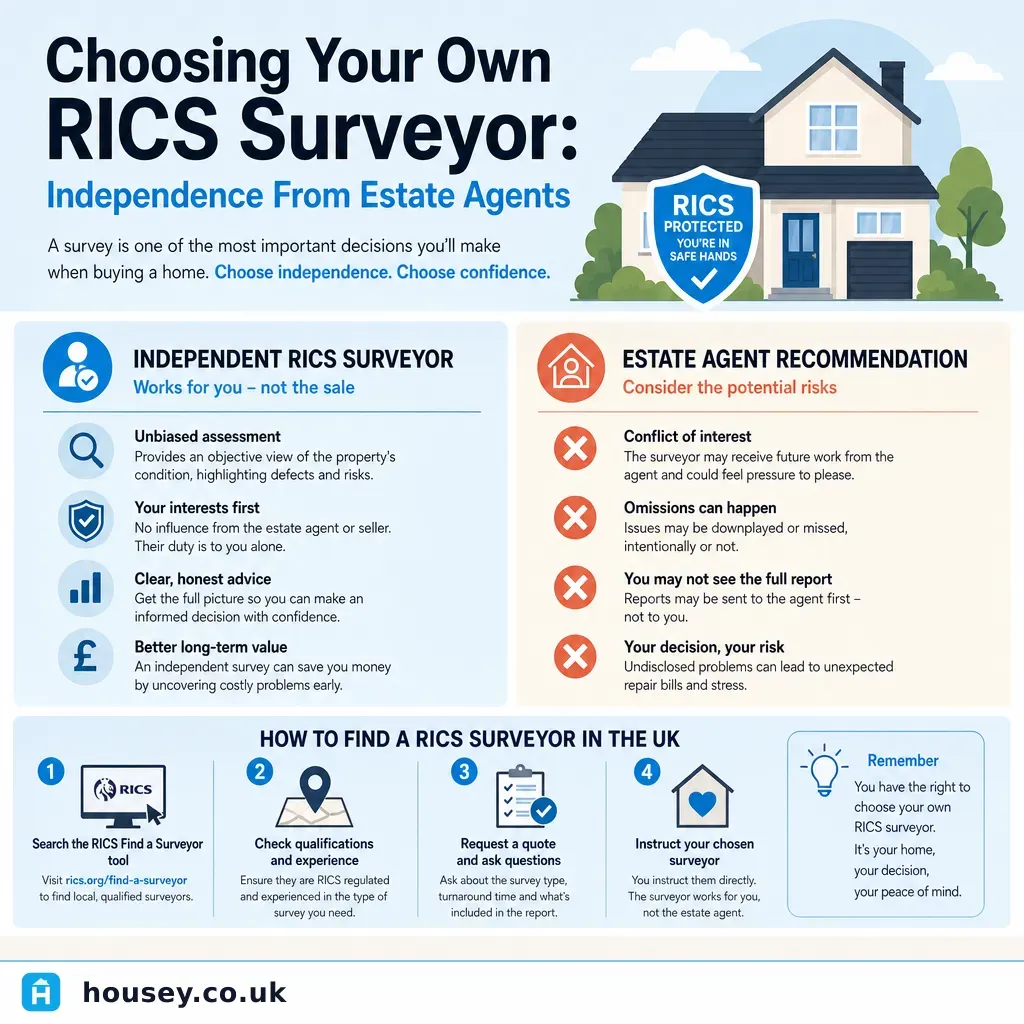
Choosing Your Own RICS Surveyor: Independence From Estate Agents
You have every right to choose your own RICS surveyor independently of your estate agent's recommendation.