Identifying Asbestos Insulation: What You Need to Know for Your Property
By Housey · Last reviewed 8th of May 2026
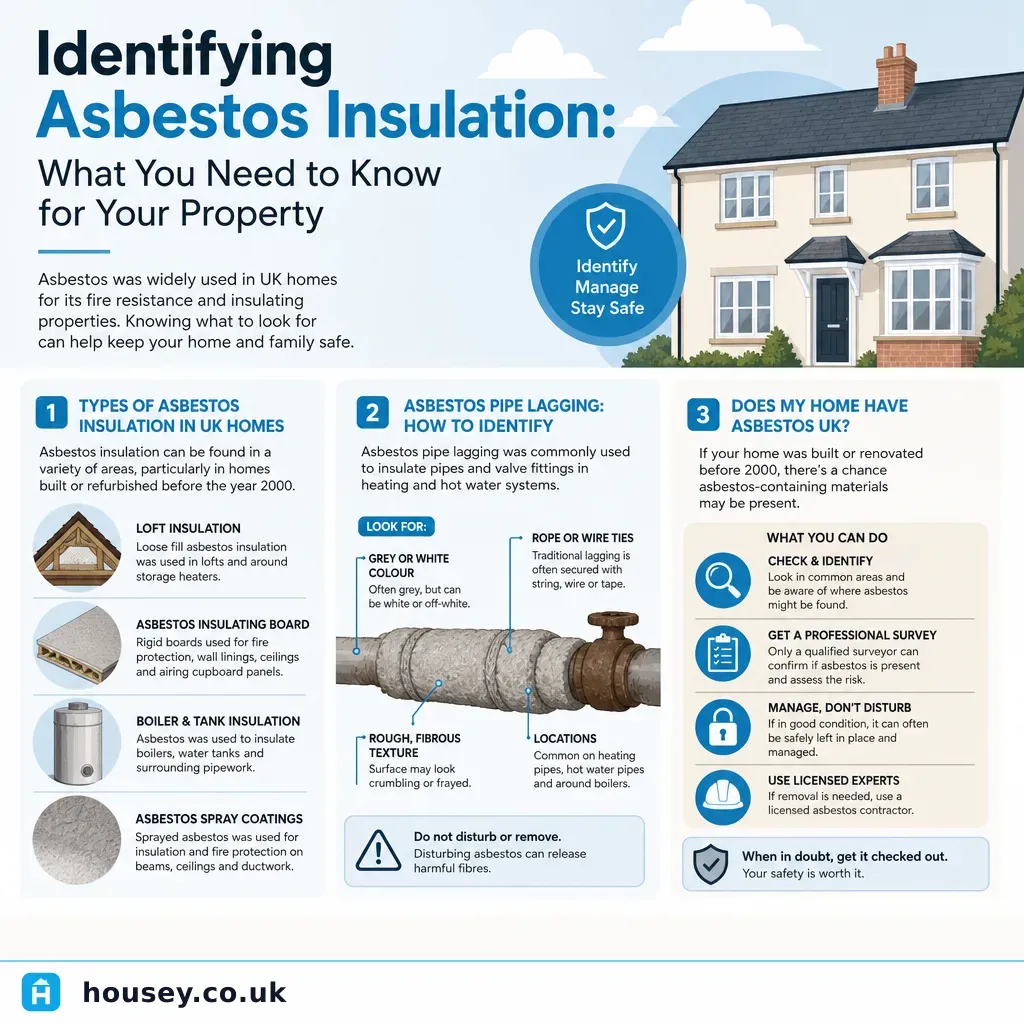
Identifying Asbestos Insulation: What You Need to Know for Your Property
Asbestos was used extensively in UK construction from the 1950s through to its complete ban in 1999, and many properties built or significantly renovated before that date contain asbestos-containing materials (ACMs) somewhere in the building fabric. Insulation was one of the most common applications — applied to pipes, around boilers, within ceiling voids, and in loose-fill form in some lofts. For anyone planning renovation work, purchasing an older property, or simply wanting to understand what may already be present, knowing where asbestos insulation is typically found — and what to do about it — is an important part of responsible property ownership.
Key points
- Asbestos was banned in the UK in November 1999 under the Asbestos (Prohibitions) (Amendment) Regulations 1999; any property built before this date may contain ACMs.
- The Control of Asbestos Regulations 2012 (CAR 2012) sets out legal duties for managing asbestos risk; for residential properties, these duties apply primarily to landlords and managing agents of non-domestic premises, but the health risks apply to everyone.
- Asbestos insulation cannot be reliably identified by appearance alone — the only definitive confirmation is laboratory analysis of a bulk sample taken by a trained professional.
- Three types of asbestos appear most commonly in UK insulation applications: chrysotile (white), amosite (brown), and crocidolite (blue); all produce hazardous fibres when disturbed.
- A Type 2 (sampling) or Type 3 (refurbishment and demolition) survey by a UKAS-accredited asbestos surveyor is required before any intrusive renovation work on a pre-2000 property.
Where asbestos insulation was commonly used in UK homes
The age of a property is the most useful first indicator of asbestos risk. Properties built before the 1980s are most likely to contain asbestos in insulation form; those built between 1980 and 1999 may contain lower-risk chrysotile products. Post-1999 construction should be asbestos-free, although renovation work carried out on older elements of a building may have reintroduced ACMs at any time.
Location | Typical asbestos type | Era most common | Risk level if disturbed |
|---|---|---|---|
Pipe lagging (central heating and hot water) | Amosite or chrysotile | 1950s–1980s | High — fibrous and friable |
Boiler and flue insulation | Amosite, crocidolite | 1950s–1970s | High — often mixed composition |
Suspended or glued ceiling tiles | Chrysotile | 1960s–1980s | Moderate to high if drilled or broken |
Loose-fill loft insulation | Amosite or chrysotile | 1965–1985 | High — loose fibres, easily disturbed |
Storage heater element lagging | Chrysotile | 1960s–1990s | Moderate — enclosed but friable if disturbed |
Spray-applied coating (Limpet asbestos) | Amosite or crocidolite | 1950s–1970s | Very high — highly friable |
Asbestos Insulation Board (AIB) in walls or ceilings | Chrysotile or amosite | 1950s–1980s | High if drilled, cut, or sanded |
This table is indicative only. The presence of asbestos can only be confirmed by laboratory testing of a bulk sample.
How to identify suspected asbestos insulation — and what not to do
Visual checks you can carry out safely
- Check the property's age. If the building was constructed before 2000 and has not been fully stripped and rebuilt, some ACMs may still be present somewhere in the structure.
- Look for grey or off-white pipe lagging on older central heating pipework, particularly in airing cupboards, under suspended floors, or in basements. Lagging that is crumbling, torn, or has been partially removed is especially concerning.
- Check the loft for loose granular material that looks like grey or off-white grit or fibres. Loose-fill asbestos insulation, installed in some UK homes under government energy-efficiency schemes in the 1960s and 1970s, can resemble vermiculite or old mineral wool but cannot be distinguished by sight.
- Examine suspended ceiling tiles for a grey, slightly fibrous texture; original tiles may carry installation date information on the reverse if any are accessible without disturbance.
- Review any existing paperwork. Documentation in a home's management file, a Scottish home report, or the conveyancing pack may reference previously identified ACMs or surveys already carried out.
What not to do
Do not drill, cut, sand, scrape, or attempt to remove any material you suspect may contain asbestos. Disturbing ACMs releases microscopic fibres that cannot be seen and cannot be removed from lung tissue once inhaled. The Health and Safety Executive (HSE) is explicit: the most dangerous asbestos is disturbed asbestos. The risk of mesothelioma, asbestosis, and asbestos-related lung cancer can arise from relatively limited exposure, often with a latency period of 20–50 years before symptoms appear.
What not to assume about asbestos insulation
- Do not assume that white or pale lagging is safe. All three main commercial asbestos types are pale or off-white in appearance. Colour alone cannot rule out asbestos.
- Do not assume that intact material poses no risk. ACMs in good condition and left undisturbed are lower risk, but condition can change with building movement, moisture ingress, or minor accidental contact during routine maintenance.
- Do not assume an older survey still covers the area you need. A survey carried out before a previous renovation, or covering only part of a building, may not be valid for a new scope of works.
- Do not assume removal is always the right course of action. The HSE recommends that ACMs in good condition and not at risk of disturbance are often better managed in place than removed, since removal itself creates fibre-release risk if not carried out correctly by licensed operatives.
- Do not assume a general home buyer's survey covers asbestos. A RICS Level 2 or Level 3 survey will flag the likelihood of ACMs in a pre-2000 property and recommend specialist investigation, but it does not include sampling or laboratory confirmation.
Red flags: when to act immediately
Seek professional advice without delay if:
- Pipe lagging is visibly crumbling, torn, or has been partially cut — fibres may already be airborne in the affected area; do not re-enter until it has been assessed.
- Loose-fill loft insulation has been recently disturbed by a tradesperson who may not have known what it was — this is a relatively common scenario during loft conversions and boiler servicing work.
- A contractor has already drilled, cut, or disturbed suspected ACMs without following licensed removal procedures — evacuate the area and contact a licensed asbestos contractor immediately.
- You find grey granular loose-fill insulation in the loft of a property built between 1965 and 1985 — this may be asbestos installed under government schemes; the HSE has specific guidance on this type.
- You are buying a pre-2000 property with planned renovation works and no asbestos survey has been carried out ahead of exchange.
What happens during an asbestos survey
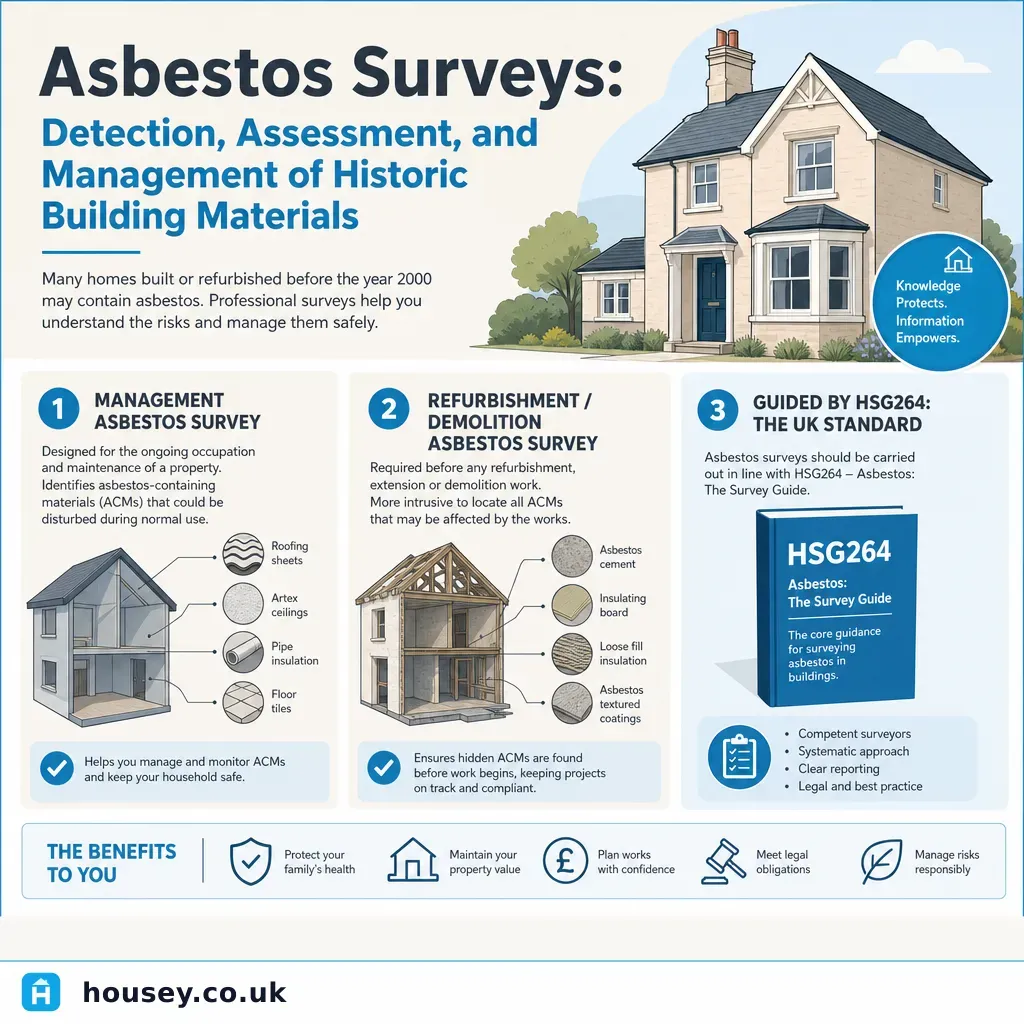
A UKAS-accredited asbestos surveyor will carry out either a management survey (visual inspection with limited sampling, suitable for the ongoing management of an occupied premises) or a refurbishment and demolition (R&D) survey (more intrusive sampling across all areas affected by planned works, required before any renovation or demolition). Both types result in a written survey report and asbestos register.
During an R&D survey, the surveyor will:
- Access all areas relevant to the planned works, including under floors, within ceiling voids, and inside service ducts.
- Take bulk samples of suspect materials for laboratory analysis under UKAS ISO 17025 accreditation.
- Document the location, extent, condition, and suspected fibre type of any ACMs found.
- Produce a written report and asbestos register for the property.
Samples are sent to a UKAS-accredited laboratory. Results typically take 3–7 working days, though urgent analysis is available from some providers.
Important limitations
This article provides general guidance to help property owners and buyers understand where asbestos insulation may be found and what steps are involved in identification. It is not a substitute for a property-specific asbestos survey. Only a UKAS-accredited asbestos surveyor carrying out bulk sampling and laboratory analysis can confirm whether a material contains asbestos. The legal framework — including licensed work categories, notifiable non-licensed work rules, and duty-to-manage obligations — is set out in the Control of Asbestos Regulations 2012 and associated HSE Approved Codes of Practice. Professional advice should always be sought before any work proceeds on pre-2000 properties.
What to ask a qualified professional
Before instructing an asbestos surveyor, consider asking:
- Are you UKAS-accredited for asbestos surveying, and is your laboratory accredited under ISO 17025?
- What type of survey do I need — management, or refurbishment and demolition?
- Which areas of the property will the survey cover, and are there any you will not be able to access?
- Will samples be sent to a UKAS-accredited laboratory, and how long will results take?
- Will I receive a written asbestos register and management plan following the survey?
- If ACMs are found, are you also licensed to carry out removal, or will I need a separate contractor?
- Do you hold an HSE asbestos licence for any removal work that may be required?
- What steps should I take to ensure no further work proceeds in the affected area until the survey is complete?
When to get professional help
If you suspect asbestos insulation in your property, the single most important rule is: do not disturb the material. Contact a UKAS-accredited asbestos surveyor before any renovation, maintenance, or demolition work begins on a pre-2000 property. Do not rely on a general builder's visual assessment alone. If a tradesperson has already disturbed material that may contain asbestos, evacuate the affected area and contact a licensed asbestos removal contractor immediately. In cases of significant or large-scale disturbance, the HSE may also need to be notified.
How Housey can help
If you need an asbestos survey before renovation work, following a property purchase, or as part of a landlord's management duty, Housey can connect you with UKAS-accredited asbestos surveyors working across the UK. Request quotes from qualified professionals before any work begins on a pre-2000 property.
Frequently asked questions
Can I remove asbestos insulation myself in the UK?
No. Under the Control of Asbestos Regulations 2012, certain types of asbestos removal — including pipe lagging, sprayed coatings, and Asbestos Insulation Board — are classified as licensed work and must only be carried out by a contractor holding an HSE asbestos licence. Other lower-risk work may fall under notifiable non-licensed work rules, but homeowner DIY removal of any asbestos-containing material is not recommended and in many cases is unlawful.
How do I know if my home has asbestos?
You cannot confirm asbestos by sight alone. If your home was built or significantly renovated before 2000, asbestos-containing materials may be present in insulation, ceiling tiles, floor tiles, or other locations. The only reliable confirmation is a survey by a UKAS-accredited surveyor, followed by laboratory analysis of bulk samples taken from suspect materials. Do not disturb any suspect material while awaiting results.
What happens if I leave asbestos insulation in place?
Asbestos-containing materials in good condition and not at risk of disturbance are often managed in place rather than removed. The HSE recommends this approach where removal would create unnecessary exposure risk. Following a survey, an asbestos management plan sets out monitoring and maintenance requirements. The plan must be reviewed and updated if any renovation or maintenance work is planned that could affect the material.
How much does an asbestos survey cost in the UK?
Indicative UK costs, last reviewed 2026-05-08: management surveys for a standard residential property typically range from £150 to £400. Refurbishment and demolition surveys, which involve more intrusive sampling, typically range from £300 to £700 or more depending on property size and complexity. Costs vary by surveyor, location, and scope. Always request itemised quotes from at least two UKAS-accredited surveyors.
Does a RICS Level 2 or Level 3 survey cover asbestos?
A RICS Level 2 (Home Survey) or Level 3 (Building Survey) will flag the likelihood of asbestos-containing materials in a pre-2000 property and recommend further specialist investigation, but it does not include bulk sampling, laboratory testing, or a formal asbestos register. A separate asbestos survey by a UKAS-accredited professional is required to confirm whether asbestos-containing materials are present before renovation work begins.
Sources and further reading
- Asbestos: manage it in buildings — Health and Safety Executive (HSE)
- Control of Asbestos Regulations 2012 — legislation.gov.uk
- Asbestos: homeowners' guide — Health and Safety Executive
- UKAS accreditation for asbestos testing and inspection — United Kingdom Accreditation Service
- Asbestos in homes — GOV.UK
Useful next reads
 Surveys & Inspections
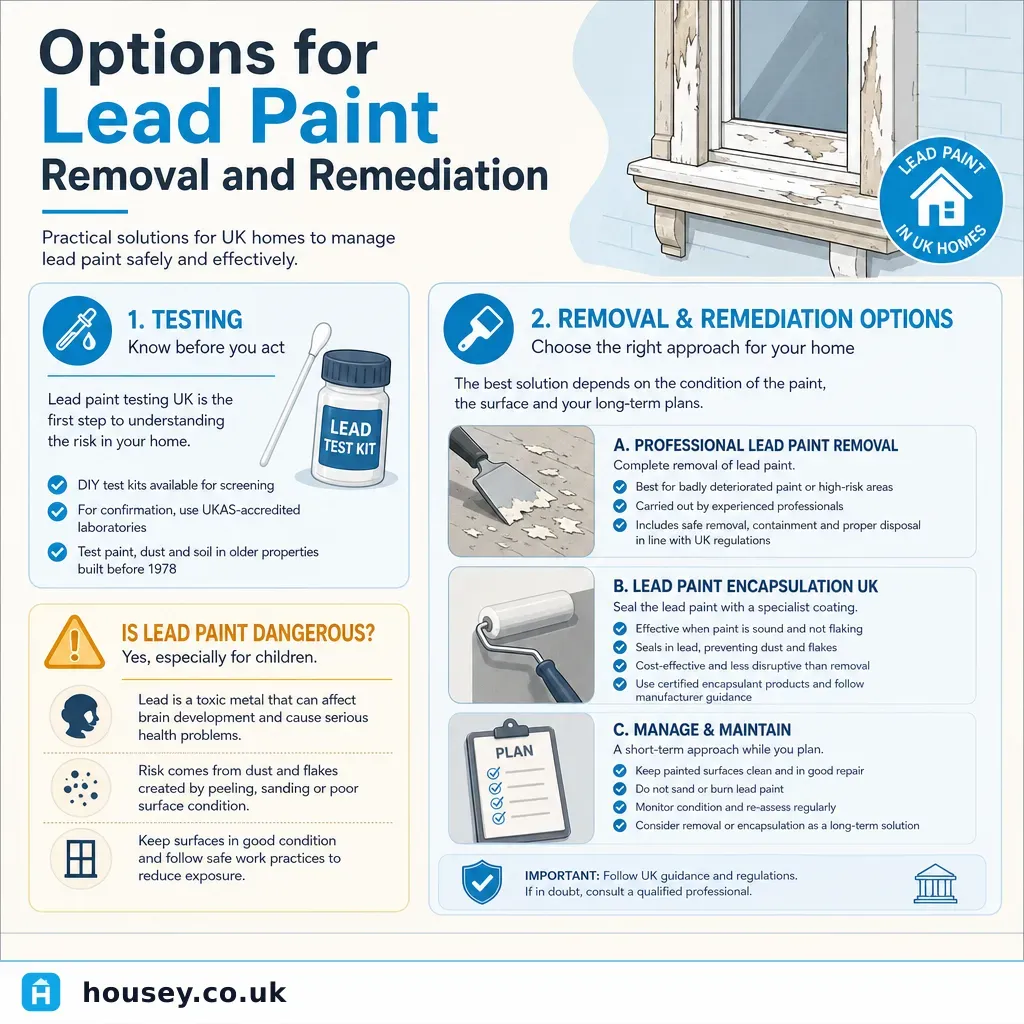
Options for Lead Paint Removal and Remediation
Lead paint in UK homes built before 1960 is common and not automatically hazardous if in good condition.
 Surveys & Inspections
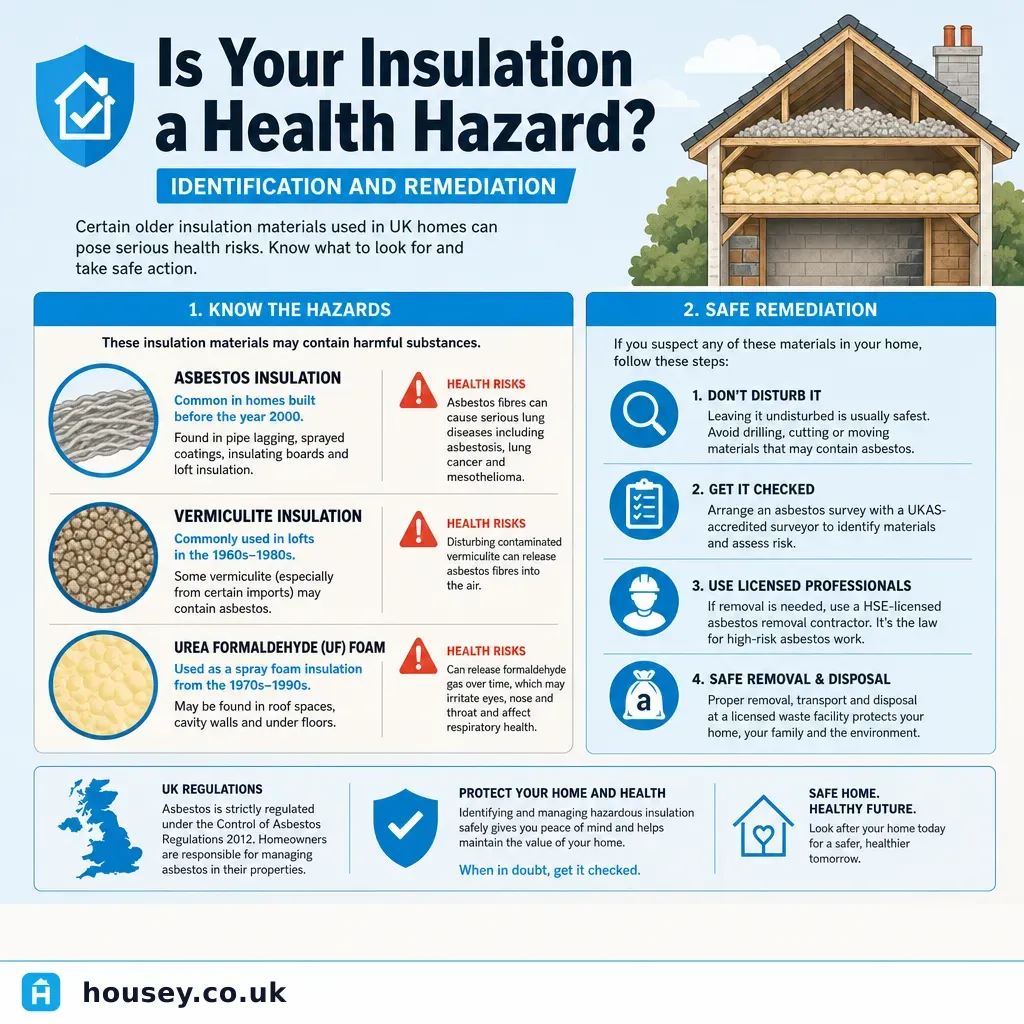
Is Your Insulation a Health Hazard? Identification and Remediation
Some insulation materials in pre-2000 UK homes may pose genuine health risks.
 Surveys & Inspections
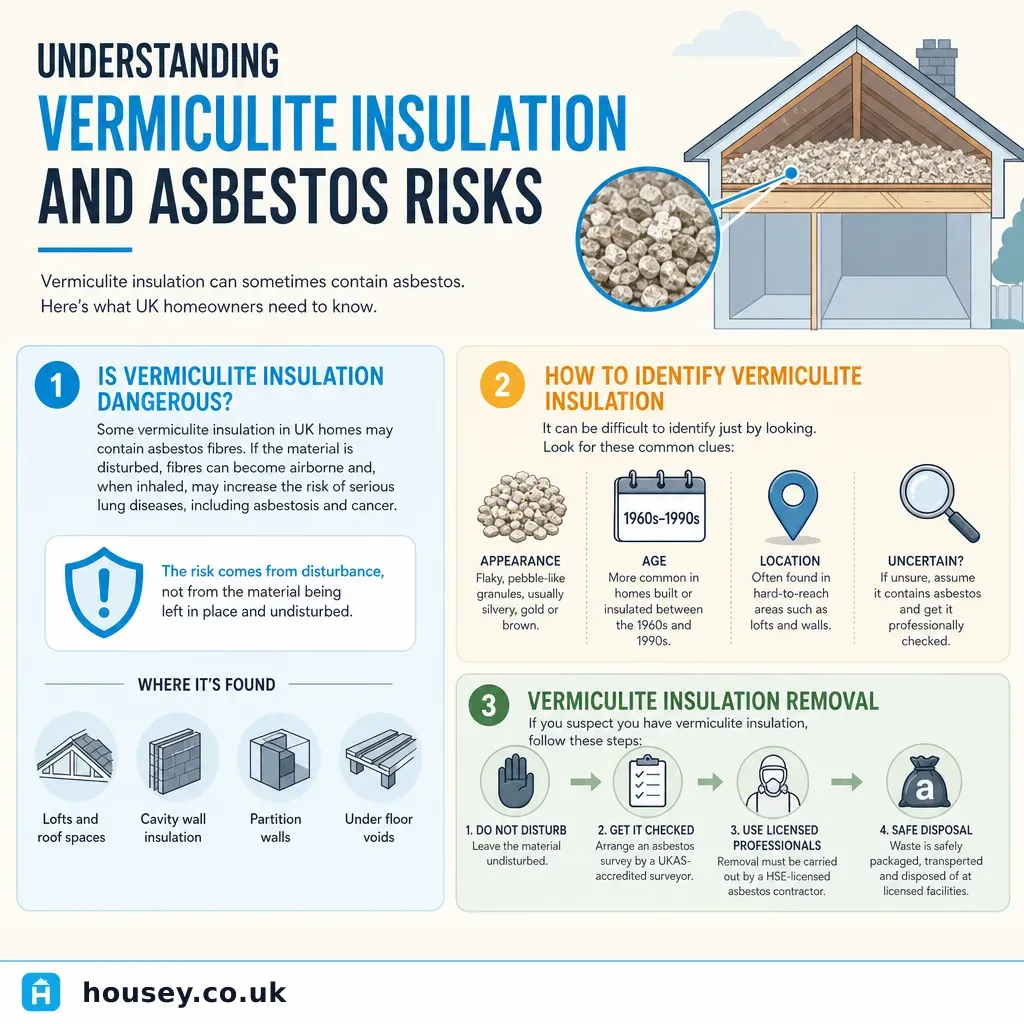
Understanding Vermiculite Insulation and Asbestos Risks
Vermiculite insulation is a lightweight granular mineral used in UK loft and cavity wall insulation from the 1960s to late 1980s.
 Surveys & Inspections
Asbestos Surveys: Detection, Assessment, and Management of Historic Building Materials
There are two main survey types in the UK: a Management Survey for buildings in normal occupation, and a Refurbishment and Demolition Survey required before any building work on a pre-2000 property.
 Surveys & Inspections
Identifying Asbestos in Drywall: Appearance and Safety Implications
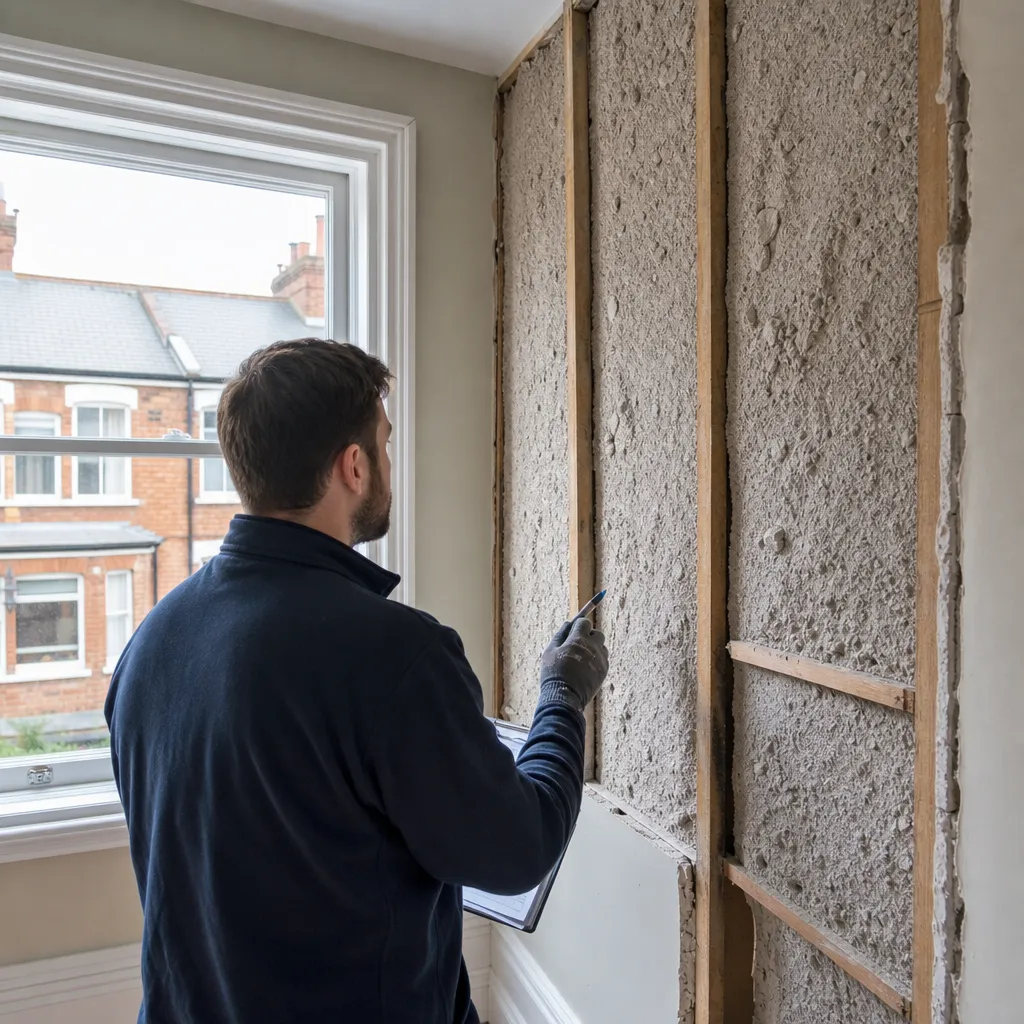
You cannot identify asbestos in plasterboard or drywall compound by sight.